INSTEAD OF WATCHING NETFLIX TONIGHT.
Spend 1 hour with this.
Claude AI FULL COURSE that teaches you how to BUILD and AUTOMATE anything.
The people who watch this tonight will wake up tomorrow with a new skill.
Watch it and bookmark it now.
Anthropic pays $750,000+ a year for engineers who can build LLM architectures from scratch. Stanford taught the entire thing in 1 hour lecture & released it for free.
Bookmark & watch this today before someone takes it down ...
Jev has been exploding in popularity recently.
If you already have access to the Jev API but aren’t sure how to start experimenting with it, just copy this checklist:
1. agent-desktop
Desktop automation. Read the system's accessibility tree, judge which button, menu, or input field to click next. https://t.co/ZtSEjUSPBF
2. typesafe-mario
Have Jev play Super Mario. No screenshots—just read the structured state in the emulator's RAM, then decide to run, jump, or dodge. https://t.co/GHttIjWQ3p
3. jev-drone
Use Jev to control a drone. The underlying flight control still handles stability and safety; Jev just does higher-level judgments like climbing, braking, and navigating obstacles. https://t.co/z0lYh9ykJq
4. OneVOneJev
1v1 FPS in the browser. Every decision tick, judge movement, view angle, aiming, firing, and jumping. https://t.co/aJiU0aaNcI
5. jev-trader
High-frequency market making on Monad testnet. Jev judges the next buy or sell based on spreads and trade direction, with model latency around 81ms. https://t.co/DaDRIrkJpO
6. Prism
Doesn't directly have Jev place orders. It judges states like toxic flow, market pressure, mean reversion, etc., then hands off to the original strategy. https://t.co/aim9lGRAP8
7. neo4jev
Stuff Jev into a knowledge graph. At each node, judge the most worthwhile edge to take next, then follow it all the way. https://t.co/9h0KXKdWj9
8. jev-curate
Use Jev to screen training data. For JSONL / Parquet, first judge quality, relevance, and risk, then decide which ones go into the next training round. https://t.co/yYV6aEdUtG
9. Canny
Prevents Coding Agents from stubbornly claiming they're done. Look at tool outputs, code diffs, and test results, then judge if the completion claim is reliable. https://t.co/H4jFT8hV0E
10. killmyidea
Input a startup idea, and Jev scores it from multiple angles, finally giving you KILL, FIX, or SHIP. https://t.co/XWo7JPOb6y
Copy these complete Jev blueprints - then read full Jev setup below ↓ ↓
Jev Founder, Diogo Amogo, just released a PDF on building a Jev Harness for coding agents
this is a blueprint on how to make your coding agents 200× faster and 400× cheaper
Send this PDF and the article below to your Claude
Code or Codex instance and start shipping 200× faster 👇
I looked at Karpathy's diagram for the third time before I understood why it embarrassed me more than it should have
three folders. one file. one loop. that's the entire architecture, and somehow almost nobody who saw it actually built it
most people who try a second brain build a filing cabinet without ever realizing that's what they built. drop notes in, search when needed, watch the pile get bigger every year while understanding exactly nothing more than it did on day one. that's not memory. that's hoarding with better folder names, and you've been calling it a system
a compiled wiki refuses to work that way, structurally, on purpose. raw holds the source, untouched, forever, ground truth that never gets edited by anyone. the model reads it once and converts it into structured, linked, evergreen knowledge, connected to everything already compiled before it. the human reads it. the model writes it. output only ever gets built from compiled understanding, never from memory alone, because memory alone is exactly the thing that was always going to fail you
one file sits at the center and does something no folder in that diagram gets any credit for. CLAUDE.md. identity, preferences, goals, the entire shape of what you're working on. the model reads it before every single session, automatically, so you stop performing an introduction to a machine that was already supposed to know you
the loop closes through update, and this is the exact part almost everyone skips without ever noticing they skipped it. every new source gets ingested, compiled, linked, integrated, permanently, no exceptions. skip that one step and you built a filing cabinet with better branding and a worse excuse. do it and the compiler gets smarter every single cycle without you lifting a single finger, while the library just gets bigger
retrieval answers questions. compilation builds understanding. Karpathy put those seven words underneath a diagram that pulled in 5,000 stars and 16 million views, and almost none of that attention ever turned into anyone actually building it
Google engineer:
“Just delete your IDE—you don’t need it anymore. Ask Claude Code to run Claude Code for you.
85% of PRs at Google are already shipped by AI agents. If you aren’t building the harness around your agents, it’s crazy how far behind you are.”
In this 90-minute talk, a Google engineer with 30 years of experience explains what the future of AI engineering will look like.
Worth more than 10 paid agentic engineering courses.
Watch it today, then read the article below to learn how to build a harness for reliable, self-improving AI agents.
Don't waste 2 years learning to become an AI agentic engineer in 2026.
Andrew Ng, the godfather of AI, gave the complete playbook to become one from scratch.
1 hour course. Free:
• 00:00 - AI agent basics
• 12:12 - AI Agentic workflows & design patterns
• 53:27 - Practical tips for building AI agents
• 1:20:30 - self-improving AI agent loops
• 1:30:19 - multi-agent AI systems
I watched it last night.
Halfway through, I realized I could get into Anthropic in weeks, not years.
Bookmark now. Watch it. Then build your own AI agent
Creator of C++, Bjarne Stroustrup:
AI-generated code isn't ready — it generates more bugs, more bloat, more security holes, and is nearly impossible to validate
"senior developers are already retiring rather than deal with it"
The problem is that even a small prompt change can shift the entire codebase in unpredictable ways
Most AI engineers know how to use MCP.
Very few understand the server patterns that make production AI systems actually scalable. ⚡
This breakdown of the top 5 MCP server architectures is pure gold for anyone building serious AI agents in 2026. 👇
1️⃣ Tool Server
Lets AI agents perform actions using APIs & external tools.
Think:
• sending emails
• database queries
• triggering workflows
• automation tasks
2️⃣ Resource Server
Feeds structured context into the LLM.
Perfect for:
📂 files
🗄️ databases
📑 documents
📚 knowledge systems
3️⃣ Prompt Server
Reusable prompts as infrastructure.
Versioned. Parameterized. Shareable.
This is where prompt engineering starts turning into software engineering.
4️⃣ Gateway Server
One endpoint controlling multiple MCP servers.
Handles:
✅ routing
✅ auth
✅ rate limiting
✅ orchestration
5️⃣ Proxy / Bridge Server
Connects legacy systems to modern AI agents without rewriting everything.
Huge for enterprise AI adoption. 🚀
The biggest shift happening right now:
AI systems are moving from:
“single chatbot apps”
to
“modular AI infrastructure.”
The engineers who understand MCP architecture early will have a massive edge building:
• AI copilots
• autonomous agents
• enterprise AI systems
• multi-agent workflows
Bookmark this.
One of the cleanest MCP architecture references I’ve seen so far.
THIS IS PEAK WHATABOUTERY 🔥
REPORTER: Why should Norway trust India when fundamental rights are being violated?
MEA: We have Gandhi, ancient civilisation, and a Constitution that guarantees fundamental rights.
REPORTER 🎯: Exactly. I know India has fundamental rights. That is why I asked about violations.
MEA: If rights are violated, people can go to court. 😐
REPORTER: That’s the point. Why are people forced to go to court for basic rights?
MEA: It’s my press conference. I will decide.
REPORTER: When will PM take free questions from the press?
MEA: Next question.
the engineer who built Claude Code just dropped a 28-minute video on how to write prompts that actually work
I've seen $300 courses that don't cover what he shows in the first 10 minutes
CLAUDE.md files, memory shortcuts, parallel sessions, prompting patterns
all in one video and completely free
works whether you're a developer, a beginner, or someone who's been using Claude for months
based on this, I put together 18 things you can copy and use in Claude today
full guide in the article below
I don't understand why so many people want US, UK, Canadian, or German citizenship.
Here are 12 websites to find remote jobs that pay in USD worldwide:
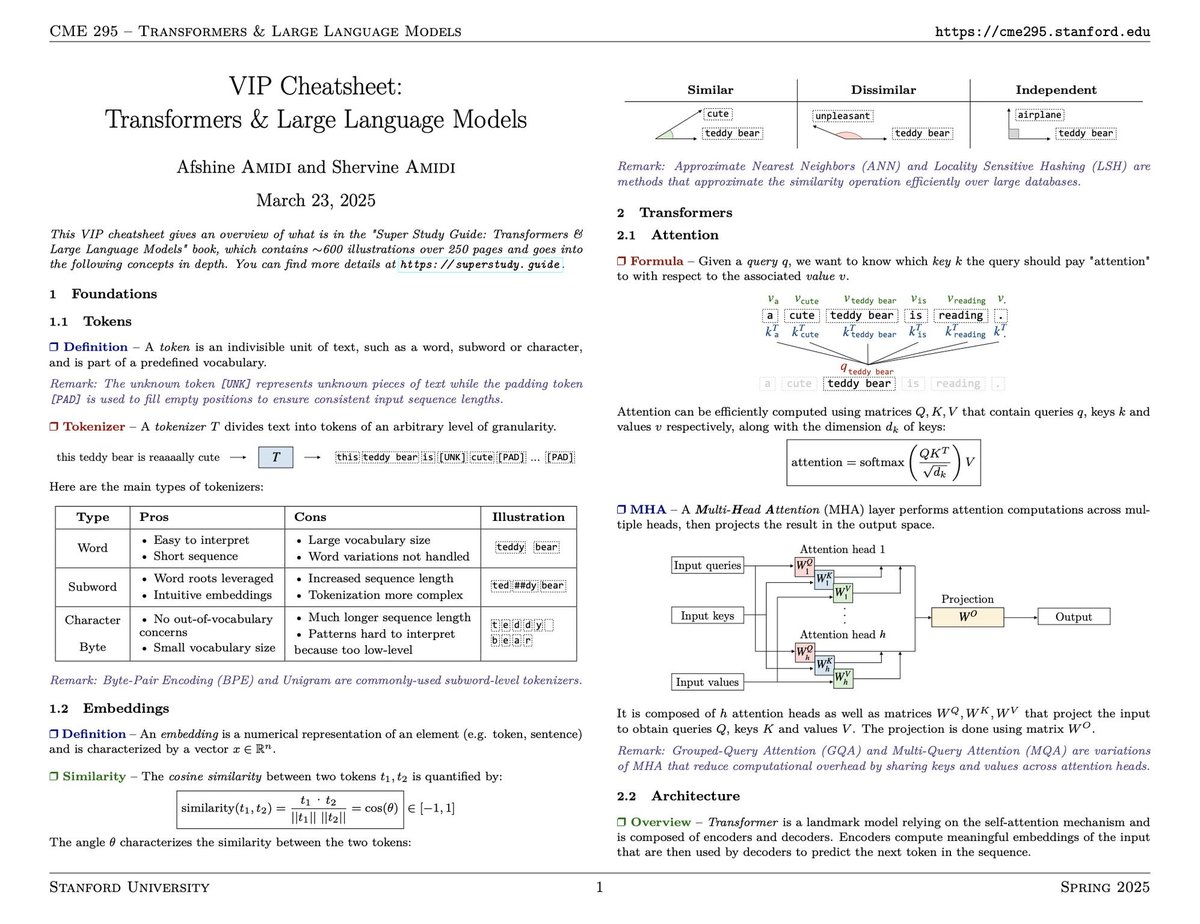
STANFORD UNIVERSITY compressed the entire field of LLMs and transformers into free cheatsheets anyone can use today.
It covers everything from self-attention to Flash Attention, LoRA, SFT, MoE, distillation, quantization, RAG, agents, and LLM-as-a-judge.
100% Free and Open Source
🚨 In 1993, Steve Jobs literally predicted the future of technology decades before it happened.
Most people still haven’t seen this.
Long before the iPhone, modern Internet, or AI boom…
He was already describing it.
Watching it today feels unreal.
He talked about computers becoming personal companions not just tools, but extensions of how we think and live. Devices you carry, systems that understand you, and technology that feels almost human.
He imagined a world where everything is connected, information flows instantly, and software adapts to people not the other way around.
And his biggest insight? The future isn’t about machines.
It’s about people.
That’s why this still hits hard.
Because while most people wait for the future…
A few can see it coming years before it arrives.
This is probably my favorite Feynman lecture -- Seeking New Laws, 1964. Basically him discussing how to develop the next great theory of physics.
Really relevant today with everyone trying to create an automated Feynman for AI research
Oh wow, you can now build a complete AI data analyst in under a couple of hours!
100% Open-source.
It's a CLI that maps your database schema to context files, so you can use an agent or model to query your data.
All of your data stays on your computer. This is not a SaaS, and you don't need API keys to access it.
No SaaS. No API keys.
@e_opore Researchers studying artificial intelligence often focus on unresolved challenges that limit real-world adoption from a systems engineering perspective.