The badge is smarter than it appears. Usually You have two things with you: Your smartphone in your pocket and a badge around your neck (in corporate settings).
The badge is just a mic, a camera, a mini display, and a very cheap processor. Connectivity could be provided by smartphone connected via Bluetooth.
But this is not about the form factor, it’s about the (vertical) use cases. As shown, doctors, nurses, workers. This could also be glasses or a headset, but a badge is much easier and more flexible to wear. Lighter, more robust, etc. Also: A camera you can use horizontally is much better usable as the one with your smartphone.
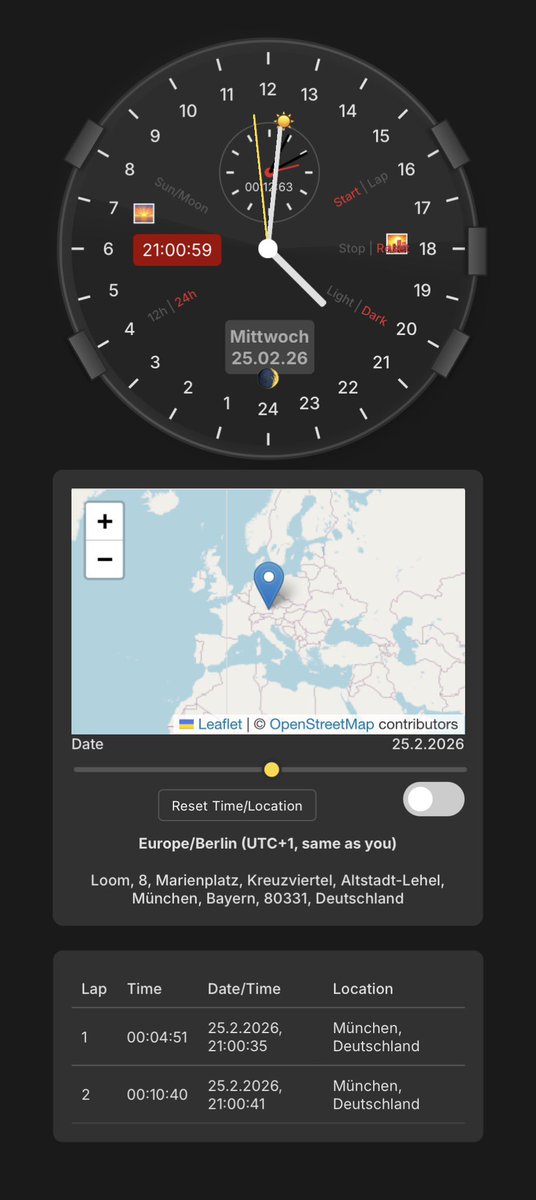
@_atilla1 There are so many ways to „play“ with time. It can be aesthetic, minimal or functional. This simulation was done 95% using AI and it is fully functional:
https://t.co/0U58A11z7u
@steipete@aadarshhx8 Don’t get me wrong, but using OpenClaw made us all working harder. Several hours after each update. 😬
It’s like a drug, you are the dealer, we are the addicts. 😅
Actually that’s good, but also … kind of bad. 😔
@gregisenberg It won’t help. Install the next update, switch to another LMM or just have a minor issue on your machine and you are cooked. OpenClaw, while definitely a revolution will keep you busy. Too busy.
I remember installing it on my raspberry PI super fast, worked immediately, cleaned up my testing environment, installed and hardened another Linux server and finally it made a picture of me with my monitors camera connected to the Mac. Using Gemini flash 2.5!
But then, after a few updates, config- and LLM- changes it went dumb. So yes, constant but required maintenance made it almost unusable. There are a lot Docs, but they were almost never helpful. The complete experience is actually bad: UI, stability, bugs, docs.
Still a nice „toolset“ to play around with and indeed an AI revolution. But as of now unproductive even if you know what you do.
@schiebde Diese ORF-Interviews fand ich ziemlich daneben. Bedenkenträgerei bis zum Abwinken. Kein Wunder, daß er in SFO bleiben will. Wer seine Posts verfolgt, hat das schön längst (auch ohne ORF) hier gelesen.
@jianxliao While I am not a fan of bragging with „just 400 loc“.
But, totally amazing: Your readme and docs in git are masterclass! Never read such a clear and concise introduction/documentation.
I will try it primarily because of that.
@KochID19@KI_Agent Und dieses ständige: „in X Monaten ist alles anders“. Das kann keiner so genau wissen, ist auch egal, denn natürlich wird es extrem schnell gehen.
@KochID19@KI_Agent Huang hat endlos viel und in aller Breite zu diesem Thema gesagt. Kann man gar nicht alles aufzählen. Zuletzt (Musik im Video ist etwas nervig), trotzdem gut. https://t.co/cBoBRbX9i4
Software engineering used to be the pinnacle of intelligence. Now it’s the first job AI is replacing.
Jensen Huang: “Technical intelligence is becoming a commodity.”
The hard technical problems everyone worried about? Those turned out to be the easy ones. Machines solve them faster, cheaper, and without error.
So what’s left for humans?
Huang: “People who can see around corners are truly, truly smart.”
The new intelligence isn’t solving the problem in front of you. It’s sensing the problem before it exists. Connecting patterns that don’t look related. Anticipating what no one has thought to ask for yet.
That’s not logic. That’s intuition. A synthesis of experience, context, empathy, and instinct you can’t train into a model.
Huang: “My personal definition of smart is someone who sits at the intersection of technical astuteness and human empathy.”
Technical skill is table stakes now. The real edge belongs to people who read between the lines, navigate ambiguity, and synthesize across domains AI can’t bridge.
Calculation is commodity work. Synthesis is where the power lives.
The valuable people aren’t writing the code anymore. They’re seeing what needs to exist before anyone knows to ask for it.