NEW EPISODE: "If AI is an enabler that can put storytellers front and center and in a more meritocratic way, and allow people who wouldn't traditionally have access to make and release stuff, that's huge." -Gossip Goblin @Gossip_Goblin
0:00 Gossip Goblin
9:36 CGI Marvel Movies vs. AI
15:50 Fred Vogg & the First AI Stories
33:50 Midjourney, Prompting & Visual Language
40:30 Chasing the Surreal Over the Real
59:11 Lack of Imagination & the Algorithm
1:12:53 Gods Don't Give Gifts
1:23:47 Why AI Needs a Human in the Loop
1:29:05 Sculpture School & the Bald Prophets
1:37:19 Travel, Nepal & Life Without Language
2:01:03 Self-Distribution & Why Asia Matters
Ogni grande storia nasce da qualcuno che ha il coraggio di immaginarla.
L’intelligenza artificiale non sostituisce né le relazioni umane, né la creatività.
#napoliaifilmfestival
Ogni grande storia nasce da qualcuno che ha il coraggio di immaginarla.
L’intelligenza artificiale non sostituisce né le relazioni umane, né la creatività.
#napoliaifilmfestival
261 submissions. 47 countries. Just 30 days.
One month since submissions opened, Napoli AI Film Festival has already received stories and visions from around the world. Thank you to everyone joining.
Submissions are still open until January 10, 2027.
#NapoliAIFilmFestival
Celebrating cinema, fresh perspectives, and meaningful connections at Al di là della Visione Film Festival in Naples.
Where stories bring people together and new visions come to life.
Two weeks ago we asked you to open source Higgsfield.
Then they tried to shut us down. 300+ of you shipped anyway.
Submissions from 45+ countries and 3 build nights later…
The winners of #OpenSourceHiggsfield
🥇 Best Overall: ComfyUI Panorama Stickers by @noma_door
💡 Most Innovative: Blocksfield by @SquaredCubeRBX
🔥 Most Viral: Imagination Studio by @SamJWasserman & @u1tra_instinct
🎨 Open Weights Only: Paint a Plate by @AInVFX
Huge thanks to @runpod_io, our partner and cash prize sponsor.
Plus 10 honorable mentions, with bonus prizes from @ltx_io, @bfl_ai, @runpod, and @MiniMax_AI:
Reshoot 4D by @itsmetamike, OneShot MV by @VisualFrisson, Freefield by @neuregex, H3 Motion by PxTicks (YT), Splat Edit Engine by @TheBurgstall, Sonder App by @SonderSaid, Max Editor by jonathan_7gramirez (IG), Genobi by Radek Rudnicki (LinkedIn), Henge by @Alissonerdx, and H3-AudioRetake-Studio by @nebsh83.
To everyone who built: thank you. You didn’t just enter a challenge. You showed that the best creative tools don’t have to sit behind a closed platform. Every project here was built in the open and shared so others can build on it.
Built by the community, for the community.
Creativity stays open source.
A special thank you to our partners as well.
Stay Comfy. 🤝
We sincerely thank the City of Naples @ComuneNapoli and Mayor Gaetano Manfredi @GaeManfredi for granting their official patronage to the Napoli AI Film Festival. An important recognition of our vision to bring cinema, creativity, and innovation together.
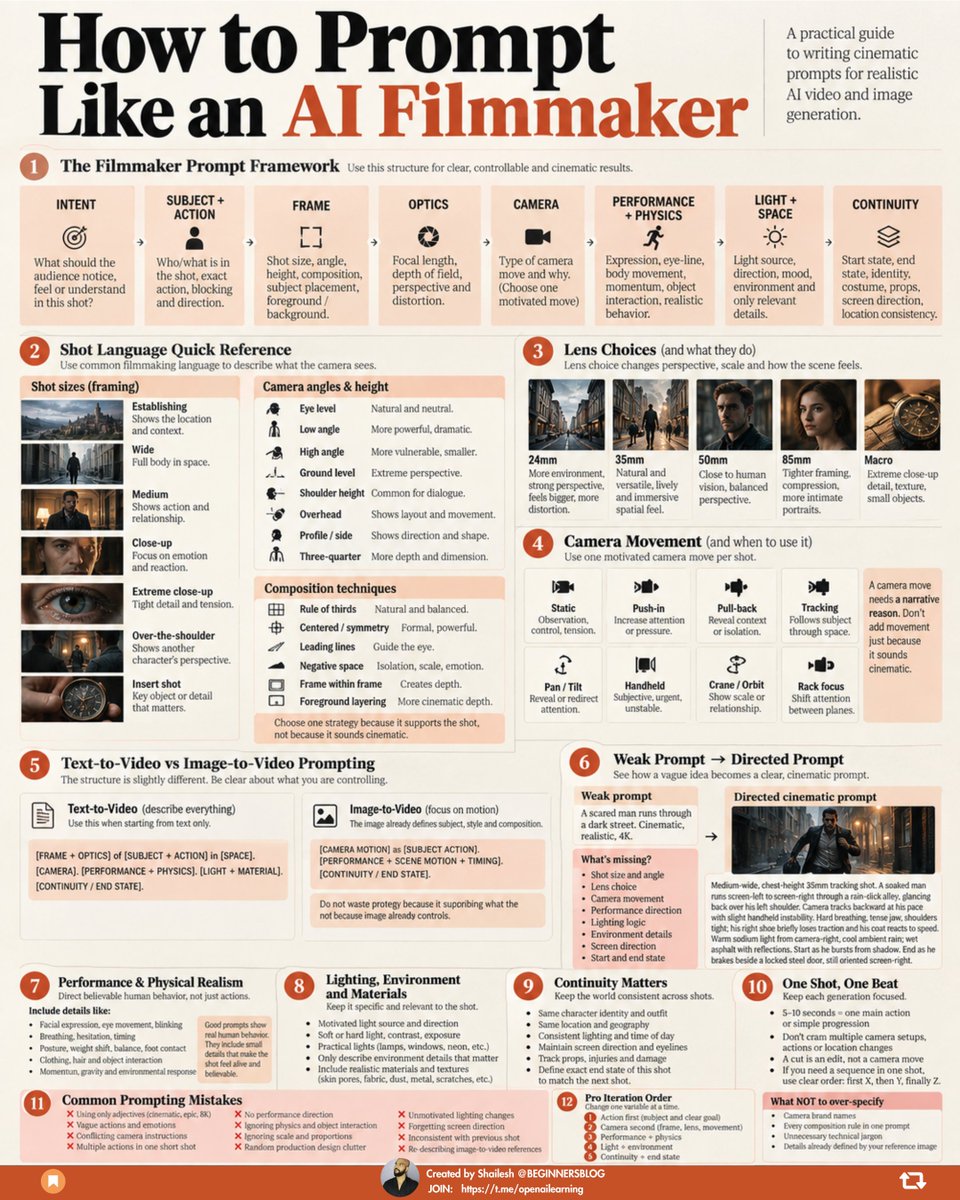
Most AI video prompts fail before generation even starts.
Not because the model is bad.
Because the prompt says:
“Cinematic man running through a city. Realistic. 4K.”
That describes a vibe.
It does not direct a shot.
A professional AI filmmaking prompt should answer:
→ What should the audience notice?
→ Who is in the frame?
→ What exactly are they doing?
→ Where is the camera?
→ What lens are we using?
→ How does the actor perform?
→ Where does the light come from?
→ What physically reacts to the action?
→ Where does this shot begin and end?
The framework I use is:
INTENT → SUBJECT + ACTION → FRAME → OPTICS → CAMERA → PERFORMANCE + PHYSICS → LIGHT + SPACE → CONTINUITY
Here is what that actually means.
1. INTENT
Before writing anything, decide what this shot is doing.
Reveal information?
Create tension?
Show scale?
Capture a reaction?
If the shot has no purpose, camera language will not save it.
2. SUBJECT + ACTION
Do not write:
“Man is scared.”
Write the behavior:
“He freezes at the doorway, eyes tracking toward the sound, shoulders tightening before he slowly steps backward.”
Prompt visible behavior.
3. FRAME
Define what the camera sees.
→ Wide = geography and scale
→ Medium = action and relationships
→ Close-up = emotion and reaction
→ Insert = important detail
Then add angle, height and composition only when they matter.
4. OPTICS
Lens choice changes the image.
→ 24mm = environment, perspective, speed
→ 35mm = natural spatial energy
→ 50mm = balanced human perspective
→ 85mm = compression and intimacy
→ Macro = tactile detail
Do not add “35mm” because it sounds cinematic.
Know why it is there.
5. CAMERA
Use one motivated camera behavior.
Static.
Push-in.
Pull-back.
Tracking.
Handheld.
Pan.
Tilt.
Crane.
Orbit.
The camera should move because the story gains something.
6. PERFORMANCE + PHYSICS
This is where many AI shots collapse.
Direct:
→ eyelines
→ breathing
→ hesitation
→ posture
→ weight shifts
→ foot contact
→ momentum
→ clothing response
→ object interaction
→ balance and recovery
“Runs fast” is weak direction.
“Accelerates, loses traction for half a step, catches his balance and keeps moving” gives the model physical information.
7. LIGHT + SPACE
Describe motivated lighting.
Not:
“Beautiful cinematic lighting.”
Instead:
“Warm sodium light from camera-right, cool ambient rain fill, hard reflections across wet asphalt.”
Then describe only the environmental details that affect the shot.
8. CONTINUITY
Every shot exists between two states.
Define:
→ start position
→ screen direction
→ costume
→ props
→ injuries
→ scale
→ geography
→ end position
This matters even more when generating multiple clips.
And one major distinction:
Text-to-video and image-to-video should not be prompted the same way.
Text-to-video needs more visual information.
Image-to-video already has the character, composition, lighting and environment.
So stop describing the reference image again.
Prompt the motion:
→ camera motion
→ subject motion
→ performance
→ environmental motion
→ timing
→ continuity
The biggest rule:
One shot. One camera setup. One clear beat.
Do not cram five actions, three camera moves and two emotional changes into an 8-second generation.
PS:) Follow for more!
.
.