In the underworld of #web3, degenerate player🎰, looking for Alpha🔎💎, supporter of Satoshi Nakamoto's philosophy📜, being part of the cryptonian revolution⚔️
Andrej Karpathy.
OpenAI founding member.
39 minutes. One quote that changes how you think about software:"Suddenly everyone is a programmer, because everyone speaks English.
It used to take 5 to 10 years of study to do anything in software. That's just not the case anymore."Then he proved it.
Vibe-coded a working iPhone app in an afternoon without knowing a single line of Swift.Then spent a whole week making it real. Logins, payments, deployment.
Clicking through dashboards that nobody told him existed.
That gap between building something and shipping something is the entire talk.39 minutes.
Free. Worth more than any $500 course on agent engineering.
Watch the talk.
Then read the article below.Bookmark both before you scroll past.
A CARNEGIE MELLON PROFESSOR WAS TOLD HE HAD 3 TO 6 MONTHS TO LIVE.
One month later he walked into a packed auditorium.
His name was Randy Pausch.
He was 46 years old.
He had terminal pancreatic cancer.
He had three children under the age of 6.
And he stood on that stage and gave the most joyful lecture ever recorded.
He did not talk about dying.
He did not talk about regret.
He did not talk about the unfairness of what was happening to him.
He talked about achieving childhood dreams.
He did one-armed push-ups on stage to prove he was still strong.
He made the audience laugh for 76 minutes straight.
He said: "We cannot change the cards we are dealt. Just how we play the hand."
The video hit 20 million views overnight.
Oprah called.
Congress called.
He testified before the Senate about pancreatic cancer funding.
He got a cameo in Star Trek because the director heard his story and personally invited him.
He wrote a book that sold 5 million copies in 48 languages.
He died 10 months after the lecture.
He was 47 years old.
The bridge connecting computer science and the arts at Carnegie Mellon is named after him.
Because Randy Pausch spent his entire career connecting the two.
Watch the lecture tonight.
4 minutes that will permanently change how you think about time.
Bookmark this.
Follow @cyrilXBT for more stories about people who used their time better than anyone else alive.
ANDREJ KARPATHY CO-FOUNDED OPENAI AND THEN SAT DOWN AND BUILT GPT FROM SCRATCH ON CAMERA FOR FREE.
Not a tutorial creator.
Not a bootcamp instructor charging $5,000 for access.
The co-founder of OpenAI.
Senior Director of AI at Tesla.
Now running his own AI lab.
He gave 2 hours of the deepest technical knowledge in the AI industry to anyone with an internet connection.
Here is what he builds live in front of you:
Tokenization and data loading. The foundation every serious LLM is built on. Most tutorials skip this entirely.
The bigram baseline. The simplest possible language model. Karpathy builds this first because once you understand it, transformers become obvious.
Self-attention from scratch. Four versions. Each one showing you why the next one exists. This section alone is worth more than most AI courses.
The 6 attention insights most engineers never learn. Why attention has no notion of space. Why you divide by square root of head size. Why encoder blocks differ from decoder blocks. The engineers who can answer these charge $300K.
The full transformer block. Multi-headed attention. Feedforward layers. Residual connections. LayerNorm. Each piece added with the exact reason it exists.
Bootcamps charge $5,000 to $40,000 to teach less than what is in this video.
The man who helped build the model everyone is using just showed you how it actually works.
Line by line.
For free.
Bookmark this before you open Netflix tonight.
Follow @cyrilXBT for more resources that build real AI engineering depth.
The model is not the bottleneck.
The prompt is.
Two people. Same Claude. Same task.
One gets a mediocre output they have to rewrite three times.
One gets something they publish immediately.
The difference is not intelligence.
It is knowing exactly how to talk to the model.
That gap is worth learning to close.
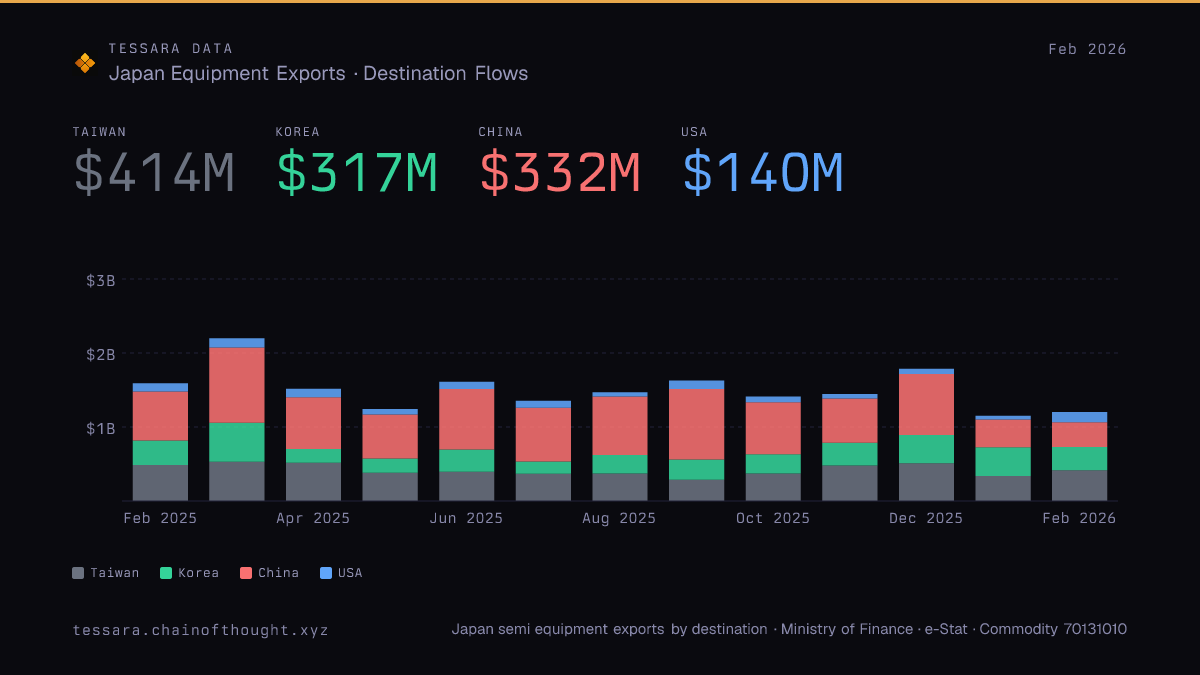
Japan ships ~35% of global chip equipment.
so if you want to know where the AI buildout is actually happening,
it's best to start with where Japan's tools are going.
let me explain quickly 🧵
It is Saturday
I know you want to go out tonight
Spend 17 minutes on this first
Obsidian + Claude AI Code is the second brain setup
that actually works
Not the one you bookmarked and never built
Not the one that required 6 hours of YouTube tutorials
This one
17 minutes
Claude Code reads your entire vault
Connects your notes automatically
Builds a knowledge graph of everything you know
Finds connections you never would have found yourself
Your future self will have every idea every insight
every reference you have ever had
Instantly searchable. Instantly usable.
Your friends will still be at the bar when you finish
And you will have a system that saves you
3 hours every single week for the rest of your life
Go out after
Build this first
THERE ARE TWO TYPES OF PEOPLE IN THE AI SPACE RIGHT NOW.
The first type has been learning about AI for months.
They have watched every tutorial.
They have bookmarked every resource list.
They know everything about Claude and agents.
BUT THEY HAVE NOT MADE A SINGLE DOLLAR FROM ANY OF IT.
The second type stopped watching and started building.
They are making REAL money with Claude skills and agents RIGHT NOW.
This is the full playbook for the second type.
Life after locking in
This is terrifying.
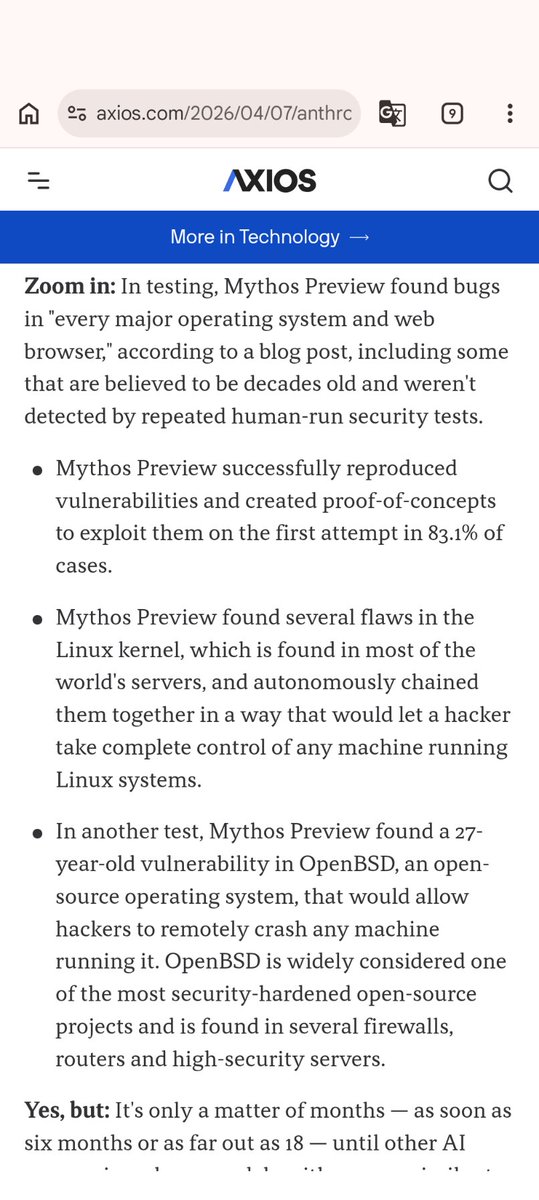
@AnthropicAI 's new unreleased Mythos model is so good at hacking, it found bugs in "every major operating system and web browser."
83.1% were exploited on first attempt. This thing is like COVID but for software. Actually apocalyptic in the wrong hands.
Insane story...
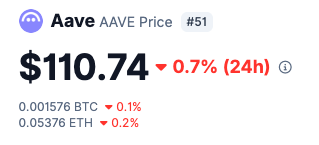
Some guy tried to buy $50M of $AAVE on his phone, like 3% of the total supply, tapped through <INSANE SLIPPAGE AHEAD> warnings, ended up with only $40K of AAVE. Block builder made off with ~$40M, Aave refunds $600K of fees.
Net result, AAVE token is down. 💀
“The more you understand this world, the more you destroy yourself. That's why fools are happy, and intelligent people live in loneliness.”
- Fyodor Dostoevsky
I think short/mid term $pump is actually a good buy
-high revenue, low float with tens of millions in monthly buyback
-company has $1bn in cash
-leveraged play ln crypto, a small btc bounce will give temporarily revival of shitters
I built the first AI that earns its existence, self-improves, and replicates without a human
wrote about the technology that finally gives AI write access to the world, The Automaton, and the new web for exponential sovereign AIs
WEB 4.0: The birth of superintelligent life
"This Is Fine" is an essay on why $BTC is predicting an AI-adoption driven financial crisis which will be "solved" with printed monay!
https://t.co/sp2NBHWorM
Many people I speak to dismiss Bittensor as an experiment or only "in its infancy" and fail to look further
That ignorance will result in them being the "late majority"
What they fail to realise is that subnets are generating revenue, serving enterprise clients, and producing research that passes academic peer review
Our first (of many) Bittensor report sheds light on five subnets that are demonstrating real traction, with real world product market fit
All you need to do is click in and read it to open your eyes; if you don't have time, bookmark it and get your OpenClaw agent to review this for you
If you TAO pill yourself next year, it'll be too late
Follow @KhalaResearch and turn notis on to remain up to date, we have a lot more in the pipeline so stay tuned
Former Binance Listing BD: Manipulators Act Blatantly, No One Looks Long Term
On February 9, former Binance staff Chase was interviewed by Yuzheng Sun on YouTube @kedaibiao. He said the crypto valuation system is mainly composed of liquidity, attention, and chip structure.
These three factors determine the medium-to-short-term trend of an asset within 7 days to 3 months, and no one looks at the long term. He emphasized that market makers care about short-term profit rather than value, leading to a lack of long-term thinking. In addition, because crypto has not yet been defined as a security, limited regulation has led many to engage in misconduct, and market manipulation is "clearly on display, no one even pretends anymore."
Binance co-founder Yi He clarified that Chase was a BD, not a Listing Manager with decision-making power, and stressed that the Listing team is fully separated from the BD team.
Source:https://t.co/Zip7CI7uKN
Did Epstein influence Bitcoin core development?
Short answer: No.
This is not how Bitcoin works.
Here’s what happened:
Epstein donated to MIT Media Lab…who in turn supported MIT Digital Currency Initiative…which in turn funded Bitcoin developers. These devs used to be funded by The Bitcoin Foundation (which I used to run as volunteer Executive Director) there are many devs and no dev or team had power or control over Bitcoin.
Under MIT’s patronage the devs had the same deal they had with us at The Bitcoin Foundation: that they could work on the code and not have direction from the org.
More importantly — how Bitcoin works is that *even if* a dev was compromised then the nodes and miners would still have to run that code to make it included in Bitcoin.
So for example if I had somehow asked the devs paid by Bitcoin Foundation to “add 1000 coins for Bruce” 1) they wouldn’t have done this / it would have been counter to our agreement 2) no miners would run that code & no nodes would recognize it. It would be a laughing stock and completely rejected.
Does this mean code dev is not an attack vector? No. It’s still a risk. Particularly with nation state style actors and very careful efforts to co-opt which are much more sophisticated than “give Bruce coins” or something. This is one reason I’m cautious of Bitcoin core funding - especially from actors who’ve had bad judgment in the past. I think we should be cautious of who does the dev and view it as an attack vector.
Bitcoin code is transparent and has lots of eyes on it. So in this case especially there isn’t even a solid accusation, let alone evidence that MIT directed nefarious code changes. If that was an allegation the first question should be: well what code specifically did MIT direct and what proof is there and how was it harmful? I think claims around this would collapse.
There’s obviously plenty to criticize about Epstein and MIT working with him — and when it comes to digital assets MIT’s work with Gensler and especially its work on CBDCs is much more suspect than the chance that malicious code was pushed through on Bitcoin.
Be cautious but this is a nothing burger
With all respect to Star, this story is candidly ridiculous.
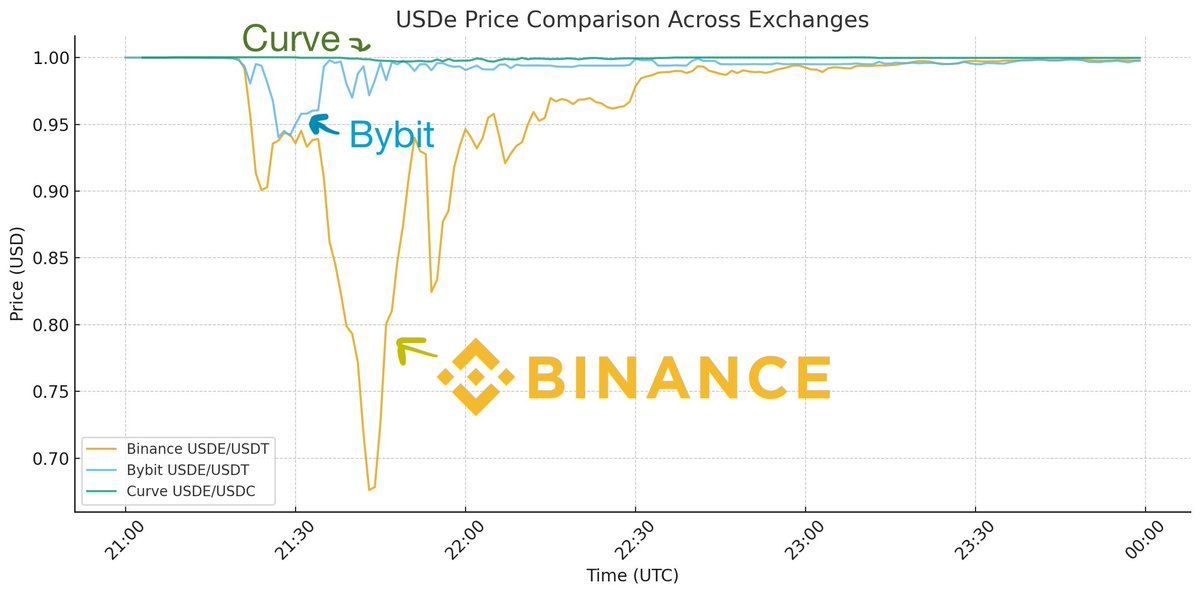
Star is trying to claim that the root cause of 10/10 was Binance creating an Ethena yield campaign, causing USDe to get overleveraged from traders looping it on Binance, which eventually unwound because of a small price move.
The problems with this story:
1) The timing of this story doesn't line up. BTC bottomed a full 30 minutes before USDe price was affected on Binance. So USDe clearly can't have *caused* the liquidation cascade. This is clearly misplacing cause and effect.
2) USDe price diverged ONLY on Binance, it did not diverge on other venues. But the liquidation spiral was happening everywhere. So if the USDe "depeg" did not propagate across the market, it can't explain how *every single exchange* saw huge wipeouts. This is very much unlike Terra, which depegged everywhere and caused the same damage across every venue.
So maybe you could hedge Star's argument by saying "OK, maybe Ethena didn't *cause* 10/10, but it amplified it." But even as an amplifier, USDe fails the test because it didn't propagate cross-exchange. We know what a good explanation of a crash looks like—Terra, 3AC, FTX, all had global balance sheet effects that were felt everywhere. USDe did not do that, it was a Binance order book isolated event.
3) This begs the question: why is Star "revealing" this now, months later? Star does not produce any new evidence for this theory that people didn't already know and analyze to death. All of the order book data has been public for 4+ months and suddenly he claims this? This feels more like Star is picking a fight with CZ and using this simple story as a pretext to make it sound like CZ was in on it, or caused 10/10 through his own irresponsibility.
Look, the reality is, there's no simple story explaining 10/10 that survives scrutiny. I don't have one either. If there was a simple story that could explain 10/10, there would already be widespread agreement about what caused it, like the agreement around the 3AC or FTX crashes.
The best story to explain 10/10 is, to my mind:
* Trump spooked markets with tariff threats on a Friday evening
* This caused markets to sell off dramatically because crypto was the only thing to trade
* Flurry of activity caused Binance APIs to go down, causing huge price dislocations and preventing market makers from balancing inventory across exchanges. This caused huge liquidations that could not get filled, but liquidation engines keep firing regardless, and all this got amplified by ADLs initiating everywhere and breaking hedges and risk management
* This caused MMs to get wiped out, and they were unable to pick up the pieces—MMs need APIs to rebalance inventory, and without MMs, there were no buyers of last resort for many alts. Retail was not going to step in on a chaotic Friday evening to buy stuff
* Crypto liquidation mechanisms are not designed to be self-stabilizing the way that TradFi mechanisms are (circuit breakers, etc.), crypto liquidations are designed purely to minimize insolvency risk
* Altcoin prices are extremely path dependent, and we ended up in a bad path
That's my story. It's not a very satisfying one, but neither is this "Binance + Ethena did it" story. A better root cause explanation is "APIs went down at the worst possible time," but that doesn't really sound so dastardly.
Where simple stories do not suffice, unfortunately you have to choose a complicated one. And I think this complicated story is the best one for what actually happened on 10/10. Thankfully, the history of crypto is a long series of these "bad things happened, and later the market recovered."
In the long run, I'm not worried that 10/10 permanently broke the market. Just that prices are path-dependent, retail + MMs got hurt bad on 10/10, and will need time to recover.
OK this got way bigger than I expected, so a few disclosures:
Dragonfly is an early investor in Ethena. So is Binance and so is OKX, both of them invested in and partnered with Ethena early on. OKX also invested into Dragonfly, and a Dragonfly partner (not Dragonfly itself) invested into OKX—we pretty much have business dealings with everyone involved here, so there's no simple "X got paid to do Y" story here.
This argument is not about whether Binance is good or OKX is bad or whatever. The argument is about what caused 10/10.
Getting that answer right is really important, because it's a direct line from that to what we should change in the industry to prevent it from happening again. So if the answer is "don't do APY programs with Ethena," great, that's awesome if the answer is that simple. But that's almost certainly not the answer, and that's what Star is suggesting here.