Tech Sales professional. Former finance guy.
I post about my experiences and observations in sales, tech, cold emailing, markets, finance,+ general biz.
The Winner Effect is the idea that winning increases the likelihood of future winning
In life we experience this in many ways
Most can relate from playing sports
When you win a game, it gives you confidence that you can do it again
You feel more motivated to work harder because you got a taste of victory
It is a self-reinforcing loop
But losses work against you in the same way
Experience loss > lose confidence > become more cautious > move slower > less motivated > greater likelihood of future loss
Outside of sports, most young men have experienced this as a single guy - if you built up the courage to talk to a girl, and it went well, it got easier to find the courage next time and with greater confidence it also improved your chances bc confidence is attractive
A lot of this has to do with how our brains are wired, and how testosterone is produced when dopamine spikes after winning (this is the case for both men and women)
Spikes in testosterone are associated with greater levels of assertiveness, motivation, confidence, focus and willingness to take risks
For men, it’s why working hard and success feels so good
In sales, I find this rings more true than anything else in adult life
I share this bc it’s important to know how your brain is wired so you can hack it to compound more wins
Sometimes it can be hard to pick up the phone and dial, but after you close a deal, or book a meeting, rather than take your foot off the gas, while you have the motivation see what else you can make happen
Some of my most productive weeks of outbounding have come from deciding to make another 20 dials because I booked a meeting that day, and rather than quit once I had booked 2 meetings that week, I pushed harder when I had the motivation and confidence to do it with ease (that motivation isn’t always there)
Not only did it make dialling easier because I’d already booked multiple meetings that day (worst case they hang up on me and I still booked 2 meetings that day), but cold calling when you’ve got the confidence improves your tonality 1000x
The next thing I know, I’ve booked 8 meetings that week
Not only is it easier to motivate yourself to do it, but your likelihood of success is also higher - simply put you are more effective after a win and it’s more fun to do the work
Conversely, it’s also important to know how your dopamine receptors negatively respond to losses
When you hear back from a prospect and they say they went with another vendor, it’s easy to clam up for the day and just take the L
But it’s so so so important to get back on the horse and finish on a positive note even if the win is small
If you lose a deal, try and make it a win by identifying what went wrong, how to avoid it for next time and at least make the learned experience a win
Try adding value to another deal and firm up next steps
If there’s time in the day, try making some dials - even if you can’t get a “yes” to a meeting, any amount of intel that helps you get to a yes down the road, that’s a W
I spent a few years of my life where I felt like a winner every day - it felt like everything was going my way and it only made me more hungry
This was the case from ages 16-23 for me
And then it all came crashing down
I took a few back to back L’s, I clammed up and my life stalled out
I became complacent and complicit to mediocrity - it felt like my agency in life had vanished
I went from having a great job, passing my first CFA exam, to failing the subsequent CFA exam 3 times, work performance cratered, family member got ill, quit my job (and banking entirely), felt like I’d been on the right track my whole life and suddenly everything went to shit
Knowing this now, I think a lot of my setbacks could have been avoided if I didn’t let my L’s compound but hindsight is 20 20
Alas, I’m 32 now and my life is amazing - no regrets
Anyhow - I hope this helps someone who feels like they could use a push, you’ve got the sauce now so go be a winner
My old manager always used to say “treat em mean to keep em keen”
In transactional deals you have to detach from the outcome and build a pipeline so strong that you don’t gaf if any odd deal closes
Step 1 is having a monster pipeline
Step 2 is framing the call in a way your prospect respects that you’re there to help them and don’t have unlimited time
A good opener to build trust can go something like this:
“My job here is to make sure we can even help you, and from there I’m here to help you make a decision as fast as possible - what’s one thing you’d like to take away from this call?”
Once a prospect knows you want to solve their problem more than make a sale they’ll open up so you can actually address their problems
Telling them you want to make it quick lets them know that you’re respectful of their time while also firmly letting them know that your time is also valuable and elevates your status
Asking what’s important to them let’s them know the call is about them not you
@fel1de I bet. I’m a remote AE and in person doesn’t happen to often as I’ve been SMB for the last 18 months.
IRL is a different game but starting MM in November so might get more chances for belly to belly selling in the near future.
My old manager always used to say “treat em mean to keep em keen”
In transactional deals you have to detach from the outcome and build a pipeline so strong that you don’t gaf if any odd deal closes
Step 1 is having a monster pipeline
Step 2 is framing the call in a way your prospect respects that you’re there to help them and don’t have unlimited time
A good opener to build trust can go something like this:
“My job here is to make sure we can even help you, and from there I’m here to help you make a decision as fast as possible - what’s one thing you’d like to take away from this call?”
Once a prospect knows you want to solve their problem more than make a sale they’ll open up so you can actually address their problems
Telling them you want to make it quick lets them know that you’re respectful of their time while also firmly letting them know that your time is also valuable and elevates your status
Asking what’s important to them let’s them know the call is about them not you
Have had a handful of recruiters/hiring managers reaching offering effectively the same job I currently have, similar OTE, same segment, objectively it’s the same gig but at “an AI native”.
I’m extremely content where I’m at. Progressing quickly, 2 promos in last 6 months, consistently exceeding attainment and at top of segment with a manager and ELT I really like.
Grass ain’t always greener but they do make it tough to cut through the noise.
Commented this on someone’s post but seems like most ya’ll don’t know this so let me put you onto some game:
Next time you get connected to the Android call screener just say “Hey (prospect name), it’s” and then go silent
Curiosity killed the cat
Connect rates go burr 📈
I never said there was a bubble - I simply made some observations about a chart and statement that were intended to imply that a bubble was not present, but the data provided does not support that claim. You seem to be defending that AI isn’t a bubble, which I never even said lol.
I made the claim that the data was misleading and provided justification for it.
It’s like putting up crime statistics about North America and stating that crime in America has gone down. I was not refuting that American crime hasn’t gone down, but that showing data that also includes Canada and Mexico dilutes the data set and proves little.
You not thinking AI could possibly be in a bubble is an opinion. You stating it like a fact does not mean it is one.
Bubbles can also still exist without leverage. They are amplified with leverage. When there’s an unlimited availability of capital that suddenly stops being unlimited (see ZIRP era software co’s) valuations come back to earth.
If growth stagnates, be it due to capital or compute constraints, things will get bumpy.
For point 3 - as I understand it, you were trying to say that circular revenues are offset by the fact that one company recognizes it as revenue and another AI company recognizes it as a depreciation expense which you said refutes my claim that earnings are inflated because net earnings would be unaffected across all AI companies. But depreciation is happening over the useful life, so about 20% per year. So my point is that 100% of the revenue is recognized, while only 20% of the costs. On a cashflow basis, if these companies cannot raise unlimited capital, or become compute constrained, this would worry me as an investor. But my point is that earnings MAY be lower or at least growth may not be as sustainable as we’ve been led to believe. Not to mention all the sketchy accounting and leaks of flatlining revenues (which remain to be seen) and massively increased competition to the frontier. Even if it’s only 2 companies that might be overvalued, it’s ~$4T in market cap - that will have ripple effects across the ecosystem if something bad happens.
AI could very well be properly or even massively undervalued. But the data in that chart didn’t prove that.
I think you’re interpreting my observations as a claim that AI isn’t viable or is going to fail. I never said that at all.
I was literally just stating that the chart and claim made no sense together.
1) if there’s a bubble, which is possible, it’s AI, not all tech. And the chart he showed wouldn’t include the 2 companies most people are accusing of being overvalued because they are both private.
2) software is down, AI is up, chart includes both which makes the PEs average out. If you had a chart of just AI companies, PEs would be much higher than the chart he presented.
3) I have no confusion about how earnings are calculated. I think perhaps we just disagree here.
1) my point is that it’s an AI bubble, not a public tech company bubble but the chart is data from public tech companies, which isn’t what people are saying is overvalued. Private AI companies are a major if not the biggest part of the overvalued AI companies (Anthropic & OpenAI) which are not included in a pub co chart.
2) it’s AI that’s overvalued, not broad-based public tech companies.
3) AI companies are selling things to eachother. These show up as revenue for one company, but are capex for the purchaser, thus don’t show up in calculating EBITDA/earnings. While prices are up, earnings are also up and so PE isn’t as high as you’d expect.
Anyone doing any type of B2B services/agencies, home services, consultants doing any kind of sales, hell even wedding planners can make that much if they’re busy. There are literally thousands of kinds of small businesses that could bring in +$200k to the business owner or sole proprietor.
Most of the people in the top tax bracket earning more than $1m per year likely have the ability to shelter their taxes via reinvestment into their business, or getting paid out in different ways that would lower their taxable income or be paid out in tax advantaged mechanisms like dividends through a professional corp. So the ones hit the hardest are those making $190k - which in cities like Vancouver just isn’t a lot of money, especially if you’re a single family income household with multiple kids.
For every business owner making this much, they can employ a dozen or more people - those jobs get relocated if a business owner can’t operate the business from a satellite office. If they employ 20 people, that’s about 4%, but all 20 of those jobs leave with them.
Where could they move? The new taxes make BC one of the most burdensome tax distinctions on earth. They could simply move next door to Alberta and pay 14% provincial taxes vs 22.5% if they stay in BC. Let alone cost of living and sales taxes being lower, BC will continue to see a brain drain.
Less doctors, less business owners, less goods and services available to consumers (less competition), higher prices and less tax revenue. At some point it will also mean less social services, or greater deficits.
I can understand why Eby’s policy can resonate when you’re not the one paying the tax but the reality is, it won’t help the province make more tax revenue - the Laffer Curve exists and has been studied.
The NDPs objective of the new tax brackets proposed are to make the Conservative Party in the province look bad by defending the 4% and to distract from their brutal track record. But the message resonates because who doesn’t agree that “rich people should pitch in a little more for seniors healthcare”.
The practical outcomes will be less tax revenue and slowing economic growth and greater deficits followed by more taxes.
AI in sales is going to create a huge amount of disparity for AEs
It used to just be the reps with hustle that actually spent time improving their craft had all the leverage
AI is giving people with agency even more leverage over the plebs
Most people are lazy and 95% will just assume things are look good on first prompt and hit send
Competent people will double check for em dashes and slop writing & redundancy
Critical thinkers will add in further context to their prompts, rewrite and polish everything that goes out
The top 1% will actually spend time learning what good copy looks like, building skills, understanding their customers problems, reaching out to their team members for input, text their champion for their comments and make final edits before it goes to the buyer - and automate 99% of it along the way
AI is going to turn most sellers into meat proxies
Those with agency and commitment to improvement, and a desire to test their will and skill will excel faster and further than even the best of the best reps from 5 years ago
It wouldn’t surprise me if we saw some sellers even in SMB earning mid to high 6 figs consistently
Top mid market sellers close to 7 figs (I’ve already seen it)
The sky is the limit in Enterprise
You’ll spend all your time selling
The quality of touch points will be 10x
You’ll also hit 10x as many people
Signals will be incredibly hot if your GTM team has things dialled and are supporting you
You’ll be hitting all the right people at the exact right time with 10x the value
The real governor for earnings will be the gatekeepers
As long as your CFO likes seeing revenue go up and to the right and doesn’t get their ego shattered seeing AEs make more $ than them, salespeople are going to get a lot more leverage and make a lot more $
Those without the agency to seize the moment will be sitting at the back of the plane and out of a job
I’ll be doing my best to be at the front of that plane
Just know that the plane is getting smaller
This post isn’t intended to dissuade anyone from joining a seed-stage startup.
I just find early stage can be romanticized in tech.
But if your number 1 priority is securing the bag, and becoming a certified SaaS slinger, it probably isn’t the best spot for you.
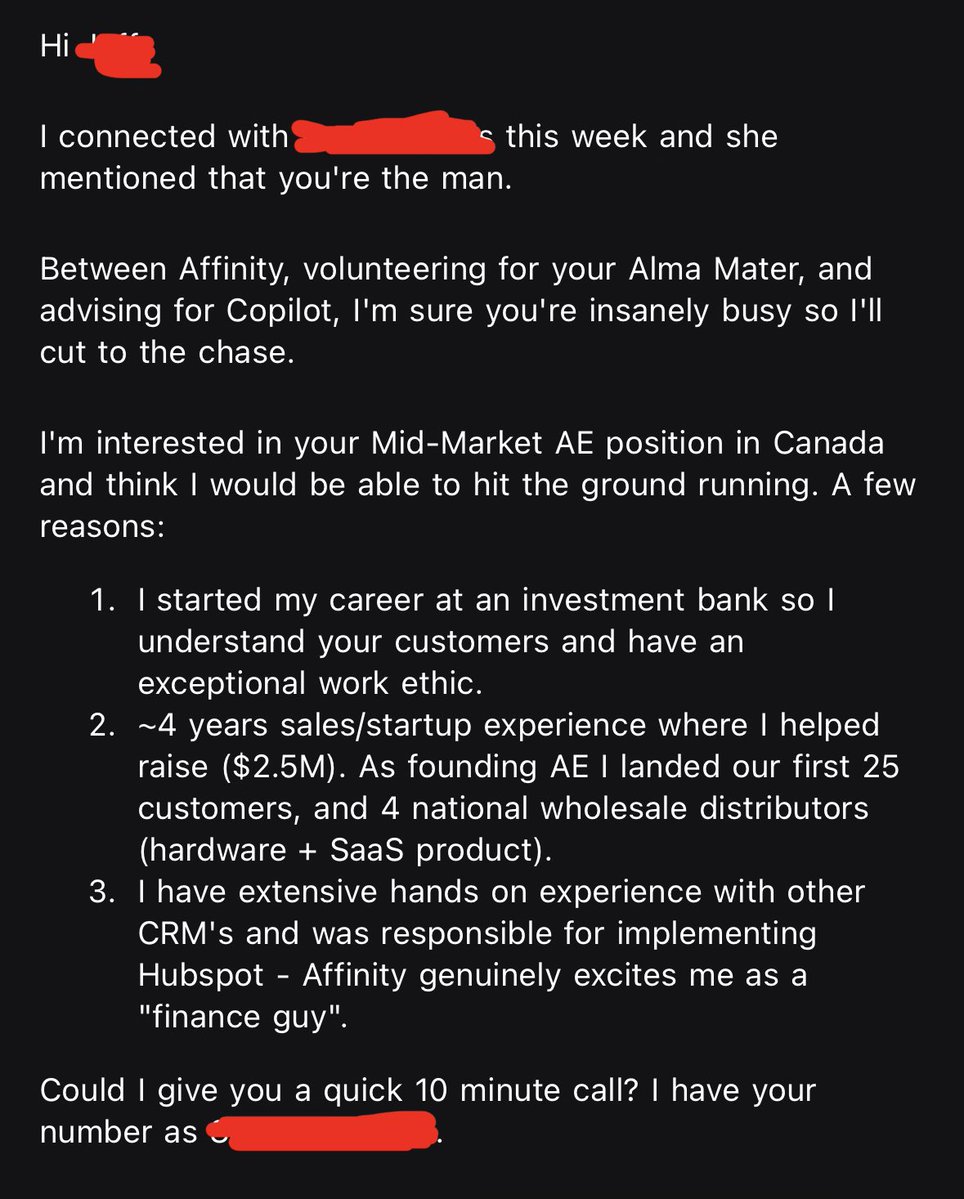
You’re 1 cold email away from your next big career jump.
Here’s a simple framework that will help you land your dream role (with proof).
Step 1: find literally anyone at the company willing to speak to you via LinkedIn
Step 2: ask who are key decision makers for role and learn as much as you can in a 10 minute call, and ask if you can name drop them to the hiring manager
Step 3: get their phone # and email
Step 4: write a killer cold-email with this framework
Hi X,
I spoke to person Y and they said you run a great org.
(Add something personal to build rapport).
I’m interested in (position) and believe I could hit the ground running, here’s a few reasons why:
Reason 1 - be specific and measurable
Reason 2 - be highly tailored and qualitative
Reason 3 - be unique/differentiated
I have your number as (X), can I give you a quick call?
Step 5: if they don’t respond (they will), call them EOD