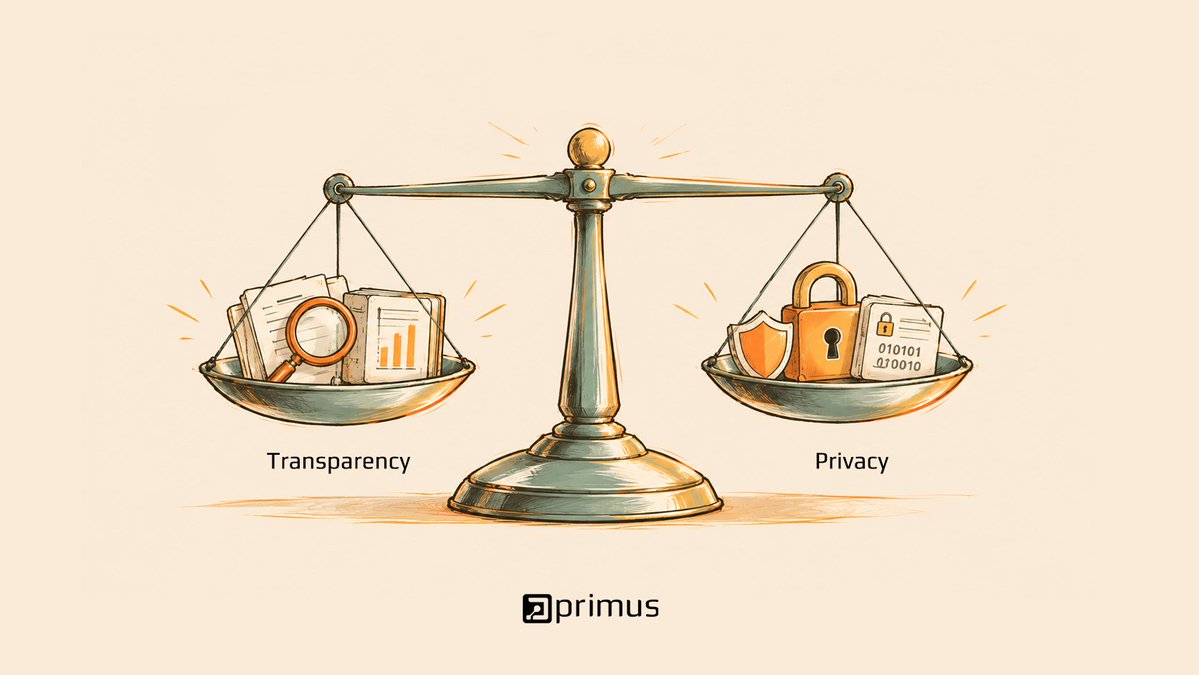
“Proof of reserves” blurs two questions. zkTLS targets the one people forget.
Was the math done correctly?
Were the inputs real?
Zero knowledge proofs are good at the first. zkTLS is aimed at the second. Here’s how Primus uses it, and where the limits are.
What zkTLS is. It builds on TLS, the protocol that secures nearly every website, and adds zero-knowledge proofs. Per Primus’s docs, the goal is to verify that data is authentic without revealing the data itself.
Example 1: Kaito Pulse. It’s a Chrome extension that lets users verify activity on platforms like Binance and Polymarket directly on their X timeline. zkTLS lets them prove positions and activity without handing over login credentials.
Example 2: real time Proof of Reserves for Unitas’s USDu (announced May 2026). Reported architecture:
Primus zkTLS authenticates exchange data
a TEE protects sensitive balances
Brevis’s Pico zkVM computes a provable reserve total from private inputs
Coverage: on-chain yield and liquidity positions, plus the centralized exchange hedge leg.
Why three layers? Each answers a different question:
zkTLS: did this data really come from the source?
TEE: who sees the raw balances while they’re processed?
zkVM: was the total computed correctly?
Remove one and a specific trust gap reopens. (Diagram in the second image.)
Earlier exchange style reserve proofs focused mainly on letting users verify their own holdings were included. The approach here tries to reach the off-chain side from authenticated source data.
Limits I’d keep in view:
- zkTLS shows that data came from a source, not that the source is honest
- In Primus’s model an attestor takes part in the session, so the attestor set matters.
- TEEs add hardware trust assumptions
- A proof covers the accounts it’s configured for. It can’t, by itself, prove there are no other accounts
My take: the real shift is moving reserve verification from periodic, document-based reports toward continuous checks on authenticated data, with the weak points stated openly.
Which claims are worth proving this way, and which still need a human auditor?
@primus_labs
Variational has just raised a $110M Series B at a $1.5B valuation.
The round was led by Bain Capital Crypto, with participation from Dragonfly, HSG, Peak XV, and 50T Funds.
The capital will be used to raise open interest caps and add hundreds of new stock, index, commodity, and FX markets.
Variational is an on-chain derivatives protocol built on Arbitrum.
Its main product is Omni, a perpetual futures platform using an RFQ model instead of an order book.
Trading has zero maker/taker fees; revenue comes from the spread.
It supports up to 50x leverage and multiple asset classes (crypto + TradFi).
It is running the Omni Points program (150,000 points per week) for a 32% airdrop of the $VAR token.
Following @variational_io
Fungo market is live.
List, buy, or sweep the floor, all in ETH.
Royalties always to creators.
Encrypted NFTs finally trading where they were minted.
#SILKRA@FungoLabs
👉 https://t.co/KbBSBzYTtq