Helping launch and grow your online platform so you can reach and impact more people. Featured in Forbes, Entrepreneur, HuffPo. Free Audience Building Guide👇
Thank you #TwitterSmarter for having me today to talk about Building An Audience!
I just dropped my tweet threads on this post to make it easy to skim through - https://t.co/EUOGCGCqXT
Underrated life advice: Always assume things will work out, then do the work to make it true. It’s a mindset of active optimism. Earned faith. It creates a quiet confidence that allows you to tolerate the uncertainty of life better than anything else.
– @SahilBloom
Search rankings are like waiting in line for the deli, your number might be getting close but you don't get anything until you're at the front of the line
how to turn your website into a revenue generating machine:
use this free conversion optimization skill
paste this into your coding agent and ask it to make a skill that will audit every landing page, sales page, or lead gen form you build against these 25 points automatically
the framework
1. headline 4-u formula - useful, unique, urgent, ultra-specific (80% won't read past this)
2. above-fold value proposition - customer problem focus, no company story, zero scroll required
3. cta first-person psychology - "get MY guide" vs "get YOUR guide" (90% more clicks)
4. 5-field form maximum - every field kills conversions, progressive profiling for the rest
5. message match precision - ad copy and landing page headline must match, broken promises = bounce
6. social proof near ctas - testimonials with faces and names, placed at decision points
7. cognitive bias stack - loss aversion (fear), social proof (fomo), anchoring (pricing)
8. pas copy framework - problem, agitate, solve. emotion before logic.
9. genuine urgency only - real deadlines, actual limits. fake timers destroy trust forever.
10. price anchoring display - show expensive option first, make real price feel like relief
11. trust signal clustering - security badges, guarantees, policies all visible together
12. visual hierarchy f-pattern - eyes scan f-shape, put your ctas in the path
13. lead magnet hierarchy - templates beat checklists beat guides (instant beats delayed gratification)
14. objection preemption - address top 3 concerns before they think them, faq near cta
15. mobile thumb zone - ctas where thumbs naturally rest, no stretching required
16. one-variable testing - change one thing, measure impact, compound wins over time
17. post-conversion momentum - thank you page sells the next step while excitement peaks
18. cart recovery sequence - email at 1 hour, retarget at 4 hours, incentive at 24 hours
19. reading level grade 6 - smart people prefer simple. 11-word sentences, short paragraphs.
20. tofu/mofu/bofu logic - awareness content is not decision content. match intent precisely.
21. white space = focus - empty space makes ctas impossible to miss. crowded = confused.
22. benefit-first language - features tell, benefits sell, transformations compel
23. micro-commitment ladder - small yes leads to big yes. start with email only.
24. performance tracking stack - heatmaps show problems, recordings show why, events show what
25. weekly optimization ritual - review metrics monday, test tuesday, iterate or scale
how to use this:
on any page audit: scores each item pass or fail, lists top 5 failures ranked by conversion impact, gives one specific fix per failure.
on any new build: checks every item before delivering. won't ship a page that fails items 1-5.
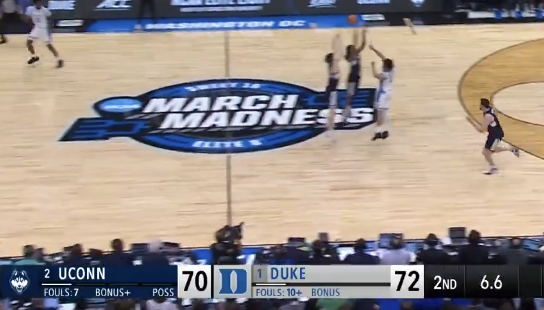
With 10 seconds left, Duke was up 2 with the ball.
All they had to do was hold the ball. They passed. And one was deflected. A clutch three and UCONN wins.
But...why throw the pass?
Under pressure, our brain betrays us. Part of it goes offline.
It's one of the cruel things in all of sport:
First, some context on how insane this was.
Duke led by 19. Number one seeds were 134-0 all time when leading by 15+ at halftime in the NCAA tournament. 134-0.
Braylon Mullins, the freshman who hit the 35-footer with 0.4 seconds left, was 0-for-4 from three before that shot.
Nothing about what happened should have happened.
We tell athletes to "rise to the occasion."
That's a lie. Under extreme pressure, you don't rise to anything. You fall to your defaults.
The latest neuroscience explains why:
When pressure spikes, your prefrontal cortex, the part of the brain responsible for planning, decision-making, and overriding impulse, starts to go offline.
Stress hormones like norepinephrine and dopamine flood the system. At moderate levels, they help you focus and lock-in. But past a threshold, the PFC starts to shut down.
Attention flips from thoughtful "top-down" control to "bottom-up" control, where whatever stimulus is in front of you captures your attention.
It's less thinking and planning and more impulsive reacting.
Hartogsveld and colleagues tested this in 2020. They stressed participants out and measured whether they could override trained habits when the situation changed.
Stressed participants committed significantly more "slips of action," performing the trained habit even when it was no longer the correct response.
Stress made them default to what they'd practiced most.
It's the cruel paradox of choking.
Your most practiced behaviors take over precisely when the situation demands something different.
Duke needed to do nothing. Literally hold the ball.
But everything a basketball player has ever practiced is telling them to make a play. In this situation, get past midcourt to avoid the backcourt violation.
When our PFC is off-line, we lose that impulse control to tell us, wait a minute, context demands something different!
Research shows that we often try to compensate for the pressure by trying harder.
We start forcing things or trying to micromanage the situation to deal with losing a bit of control.
Inevitably, this backfires. So you get this terrible contradiction.
The PFC goes offline and you lose top-down control.
But whatever executive resources remain get directed at the wrong thing, overmonitoring your own movements.
You start consciously controlling things that should be running on autopilot, and the whole system jams.
Don't believe me, try to do simple math when you are moderately stressed or fatigued, such as mile 15 of a marathon or the 6th 400m repeat of the workout?
Any runner will tell you, it's hard to do 26 minus 15...
Now, add the pressure of millions watching, and see how your brain works.
There's no perfect solution. You've got to feel for the Duke kids. This close and have it ripped away.
But that's why when preparing for a high pressure situation there are a few solutions.
1. Inoculate Yourself
Train in environments that simulate pressure as best you can. Up the ante, use exercise as a stressor to challenge decision making.
Visualize it. Michael Phelps visualized a "problem tape" of what to do if it went wrong.
Create simple If...Then scenarios. A mental playbook of sorts, like a QB that knows to dump it to the RB if pressure comes.
2. Copy Pilots.
They have checklists and slogans for emergencies (Aviate-Navigate-Communicate). It simplifies the priorities directing them what to focus on and what actions to take when their brain isn't working.
Tell your brain where to focus and what action to take.
Coaches need to make it simple and explicit. When the pressure is on, treat your athletes like a toddler. Because that's how their brain is kind of working...
“The key is to keep asking yourself the same question, again and again and again: this is your life—what do you want to pay attention to?”
— Catherine Price
via the 5-Bullet Friday newsletter (https://t.co/kpYcrS50Wg) from @tferriss
"If you think you're gonna win on a volume game...long-term you're just not gonna win." - Tim Ferriss
In a world of AI slop, here’s what matters with your social content:
• Only you can create it
• People get value from it
• It outcompetes other pieces of content on the same subject
If you nail those, you’ll keep winning.
Your "dead" email list isn't dead. It's just waiting for the right strategy.
Just saw a client turn a 3-year dormant list of 300 into 8 qualified leads in under 3 weeks. Here's how we did it: 👇
6/ This isn't magic. It's proof that:
1. Fundamentals matter more than flashy tactics.
2. Re-engagement is potent.
3. A small, targeted list beats a large, neglected one.
5/ The outcome? In just 2.5 weeks, from a seemingly "dead" list of 300, she received 8 direct responses from people ready to work with her.
That's 8 qualified leads from a dormant audience, generated with a clear strategy and minimal effort.
4/ With the foundations set, we crafted a simple, yet powerful, warm-up email sequence.
A few friendly, value-driven emails, culminating in what I call a "hand-raiser" email. No hard selling, just an invitation to connect for those interested.