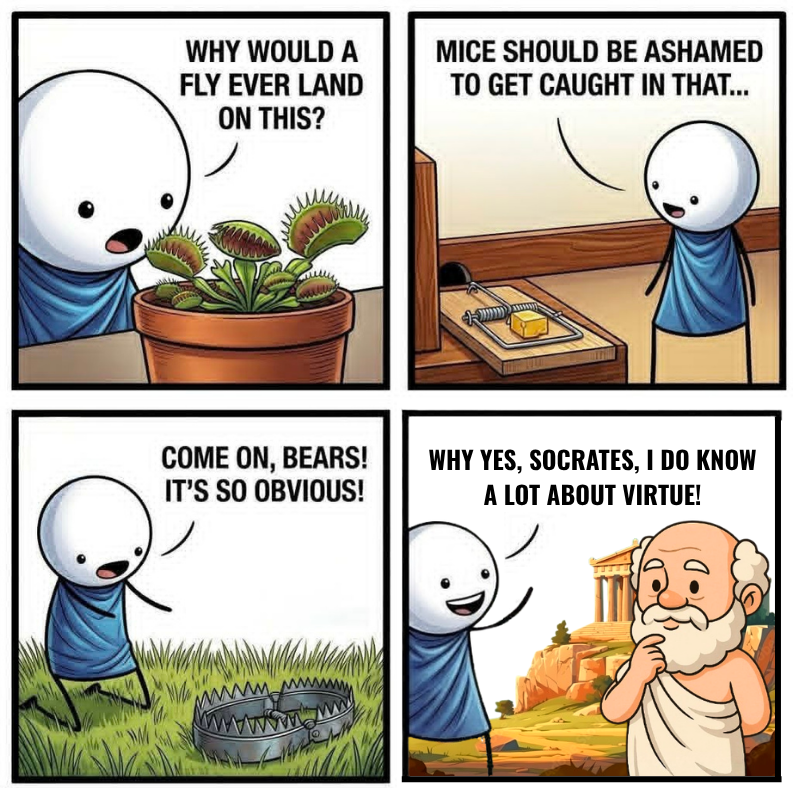
I'm sharing my first post on my new Substack blog:
https://t.co/7da2mRlngm...
Make sure to check it out! Please consider liking, sharing, and subscribing! There is a lot more to come!
#philosophy#blog
@prosochesati@PAHoyeck This is well put. I always knew what the answer was to these sorts of questions, but never fully understood it. The way you put it now helped clarify things for me. Thanks.
@analyticatheism@CounterApologis I agree with this take, but to me the biggest difference has always been how they approach ideas and theories that they don't agree with. Craig often seems dismissive and unwilling to engage with some ideas. Oppy is always accommodating and genuinely engages. Legend.
@Soar_126 Pretty much. I currently endorse something like Humean constructivism or Blackburn's quasi-realism. I do place a lot of normative emphasis of virtue theory, but like I said, my normative ethics is typically pluralist.
I'm sharing my first post on my new Substack blog:
https://t.co/7da2mRlngm...
Make sure to check it out! Please consider liking, sharing, and subscribing! There is a lot more to come!
#philosophy#blog
@Soar_126 Thanks for letting me know! I'm glad you enjoyed it.
When I one day get back to posting on the blog, I'll likely post a lot on virtue ethics/theory. I defend a pluralist and sentimentalist view of the virtues. So maybe keep an eye out for that.
“[Philosophy’s] goal is not to discover new truths about the world on the model of physics, let alone about possible worlds—the glories of metaphysics. […] Philosophy aims to disentangle conceptual confusions, to destroy metaphysical illusions.”
—Peter Hacker on Wittgenstein
@LatFilosof But if you then target a specific form of moral realism, such as intuitionism, the undercutting is even stronger. Because an evolutionary account of our intuitions arguably undermines their truth tracking nature when it comes to independent normative truths.
@LatFilosof I think I kinda agree. But it also depends, as I think the point of that sort of argument is to undermine our belief or access to stance-independent moral truths. So it is at the very least an undercutting defeater for believing moral realism is justified.
Some critical answers for this guy
1. Atheists don’t believe that
2. The entire field of abiogenesis
2. Cell membranes can form without DNA
3. Everywhere
4. How does God do it? No one has a very good answer.
@JoshuaLWatson I really liked this book and think the way semi-compatibilism is framed helps a lot and is the philosophically stronger position to defend. I ended up endorsing something similar to it. Really good book for anyone wanting to understand the current state of the debate.
“The word ‘sceptic’ is now often loosely used to mean someone who thinks that something, say X, doesn’t exist. This is not genuine scepticism, scepticism as it was originally understood. Genuine scepticism about X never says that X definitely doesn’t exist.”
~Galen Strawson 🔗⬇️
Apart from a few quibbles on a few points, I'd say @TherionWare's response below is right. As anyone who follows me knows, I have no time for those fellow atheists who distort or oversimplify history to ram home a blunt "religion bad!" polemic. But the opposite is just as stupid.