Magogo has not expressed awareness of wrongdoing or remorse for his actions , a circumstance that is suited to mitigate the culpability of an offender. On the contrary, magogo continues to mislead the public how he has done everything to reform FUFA as he loots from the game but his time has come.
@BryanAheebwa should be reminded that @FIFAcom investigatory chamber initiated a preliminary investigation in accordance with article 59 of the FIFA Code of Ethics on 15 March 2019,when insideworldfootball, an online news platform, published an article reporting on several accusations made against former @CAF_Online president @AAhmad_CAF including contract fraud, mismanagement of CAF funds and payments to the private bank accounts oversees.
FIFA can do the same against FUFA president magogo who has a binding plea bargain for the theft and resale of the world cup tickets✍️
.@BryanAheebwa believes some people are becoming increasingly desperate to see FUFA President Moses Magogo leave office, drawing parallels with what happened to former Speaker of Parliament Anita Annet Among. For them, this is a now-or-never moment.
#NBSportThisMorning #NBSSportUpdates
Where is your voice,Infantino?
As African players,referees,Journalists and fans are humiliated. World Cup is supposed to Unite according to FIFA slogan.
You preach "global football" and "unity" why are people suffering because US border politics?
Stand up or step down.
@kktim19
The proper course of action for @GovUganda, in my opinion, is to move through the @FIFAcom Council Bureau requesting the intervention of a Normalisation Committee to oversee the FUFA election process.
FIFA´s Intervention in Member Associations through Normalisation Committees has been done previously in cases related to Kuwait, Ivory Coast, Guinea, Guatemala, Greece, Argentina, Thailand, Mali, Benin, Uruguay, Madagascar, Dominican Republic, Egypt, Iraq, Pakistan, Venezuela, Namibia, Trinidad and Tobago, to name a few examples over the past years.
The Normalisation Committee oversees a revision of all pertinent FUFA Statutes that violate any of the FIFA Statutes. Afterwards, the Normalisation Committee should revise, conduct and monitor the new FUFA presidential elections, just as it happened in the Uruguayan Football Association in 2018 (see more info here:
https://t.co/IREUv2bqxB.
@NCSUganda1@OgwangOgwang@kasujja@BenMisagga@SsekatawaAli
This can only happen in a failed state that has no respect for human rights of its own citizens. Football in Uganda is led by a @FIFAcom convict, magogo and i have seen many top @UPL clubs celebrating their online following yet they pay robots worldwide to like their pages but if you ask them if they know these fans personally, the answer will be no. Such goons committing serious offences in broad daylight wearing club jerseys should be traced from the records at @KCCAFC secretariat but unfortunately this may not be possible.
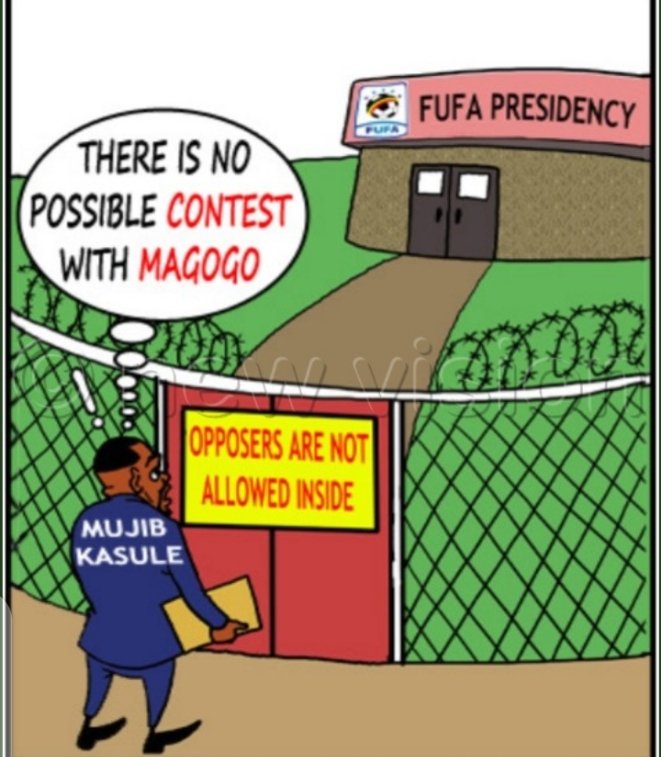
Many times we have seen such goons hide in FUFA house to stone cars of potential FUFA presidential candidates like @MujibKasule and also beat up ex players like Mike Mutyaba. The beautiful game needs to be protected. @RugyendoQuotes@CliveKyazze@aitajoel@MedVilla11@DavidLumansi@AKasingye@BenMisagga@FifiPhionaPinky@NCSUganda1@OgwangOgwang@skybossuftv
For the sake of good order, exiting the corrupt Ugandan football industry is the best option. Thanks for your service and investment in the beautiful game @atagenda 🙏
@WakisoGiantsFC
I gave everything. Time, money, energy& belief.
Sadly, football has a way of punishing those who genuinely invest in it.
Some decisions are painful, but necessary.
The biggest mistake is expecting fairness in a system that feeds on ur passion& gives nothing back. @OfficialFUFA
@kizzabesigye1 cannot be in prison when a person like @FrankGashumba is moving freely on the streets of Kampala. President @PaulKagame should be enjoying his popcorn now with this evidence on record. We shall thank @Thomas_Tayebwa later for exposing these criminals.
What Gashumba said may not have direct personal consequences for him, but the implications of such statements are far reaching and require serious attention. Remarks that link perceived political exclusion to the possibility of armed rebellion (M23) in Uganda are highly sensitive and risk creating unnecessary suspicion, weakening trust, and straining relations among banyarwanda in Uganda and Rwandans entering Uganda.
Such narratives can also have unintended consequences on key national interests, including security perceptions, the tourism industry may affected since such a statement creates global fears, and the free movement of people across Rwanda and Uganda boarders. In a time when regional integration is being actively promoted, including the vision of East African unity and federation championed by President Yoweri Kaguta Museveni @KagutaMuseveni, responsible communication becomes even more critical.
It is important that such matters are addressed through appropriate accountability mechanisms, ensuring that public discourse remains constructive and does not fuel tension or mistrust.
PLU leadership under @mkainerugaba should also consider a careful internal review and take appropriate disciplinary action, in line with the standards expected of responsible political communication.
@iankiryowa FUFA is a body that is established to run the game of football in Uganda and NOT businesses. In doing so, FUFA has structures through which it effects its mandate. @NCSUganda1
As organisations enter H2, decision rooms are filling up with forecasts, revised targets, budget reviews, and growth discussions.
What fascinates me is that most growth conversations focus on outcomes, yet very few focus on the things preventing those outcomes.
The organisations that consistently grow tend to understand where their constraints are. Whether the challenge sits in leadership, culture, systems, customer experience, technology, pricing, distribution, capability, or execution, they are honest enough to acknowledge what is standing in the way.
Most growth blockers are not hidden. They've usually been discussed in meetings, highlighted in reports, raised by customers, or flagged by employees. The real challenge isn't awareness; it's the willingness to act.
Many organisations fall into the trap of searching for external solutions to internal problems. A new marketing campaign will not fix a broken customer experience. More salespeople will not solve poor product-market fit. A new CRM will not repair a culture that resists accountability. An AI tool will not compensate for the absence of strategy. A stronger economy is unlikely to rescue a business that customers no longer trust.
The mistake many businesses make is treating growth as a sales or marketing challenge when it is often an organisational challenge.
Sometimes the blocker is internal; teams are misaligned, decisions take too long, and systems create more work than they remove.
Sometimes the challenge sits in the market; customers have changed, competitors have adapted, and partners are no longer creating the value they once did.
Sometimes the pressure comes from outside altogether; economic realities shift spending habits, technology changes expectations, and society continues to raise the bar on what responsible business should look like.
Customers are increasingly rewarding organisations that are not only efficient and innovative, but also trustworthy, responsible, and relevant.
Many businesses enter H2 assuming that more effort will produce better results, yet growth usually comes from removing friction rather than adding activity. Sometimes the next breakthrough is not another campaign, product, or meeting... sometimes it is finally dealing with the issue everyone already knows exists.
As you prepare for the second half of the year, perhaps the more useful question is not whether your growth target is achievable but whether your organisation is willing to identify and address the things preventing it.
Your H2 plan is only as strong as your willingness to be honest about H1.
What is the single biggest growth blocker facing your business today?
Ugandan football will forever blame @RebeccaKadagaUG for blocking @Parliament_Ug debate and protecting magogo when @FIFAcom opened an investigation against Magogo on 23 July 2018 related to the theft and resale of
FIFA 2014 World Cup Tickets. In accordance with Art. 67 para. 1 of the FIFA Code of Ethics.
After a plea negotiation and magogo confessing that he stole from poor Ugandans, FIFA and Magogo agreed on the following sanctions:
• A fine of CHF 10,000.00 (ten thousand Swiss francs).
• A two-month suspension from taking part in any kind of football-related activity
at national and international level.
The suspension became effective upon the validation of the agreement by the chairman
of the adjudicatory chamber on 10 October 2019.
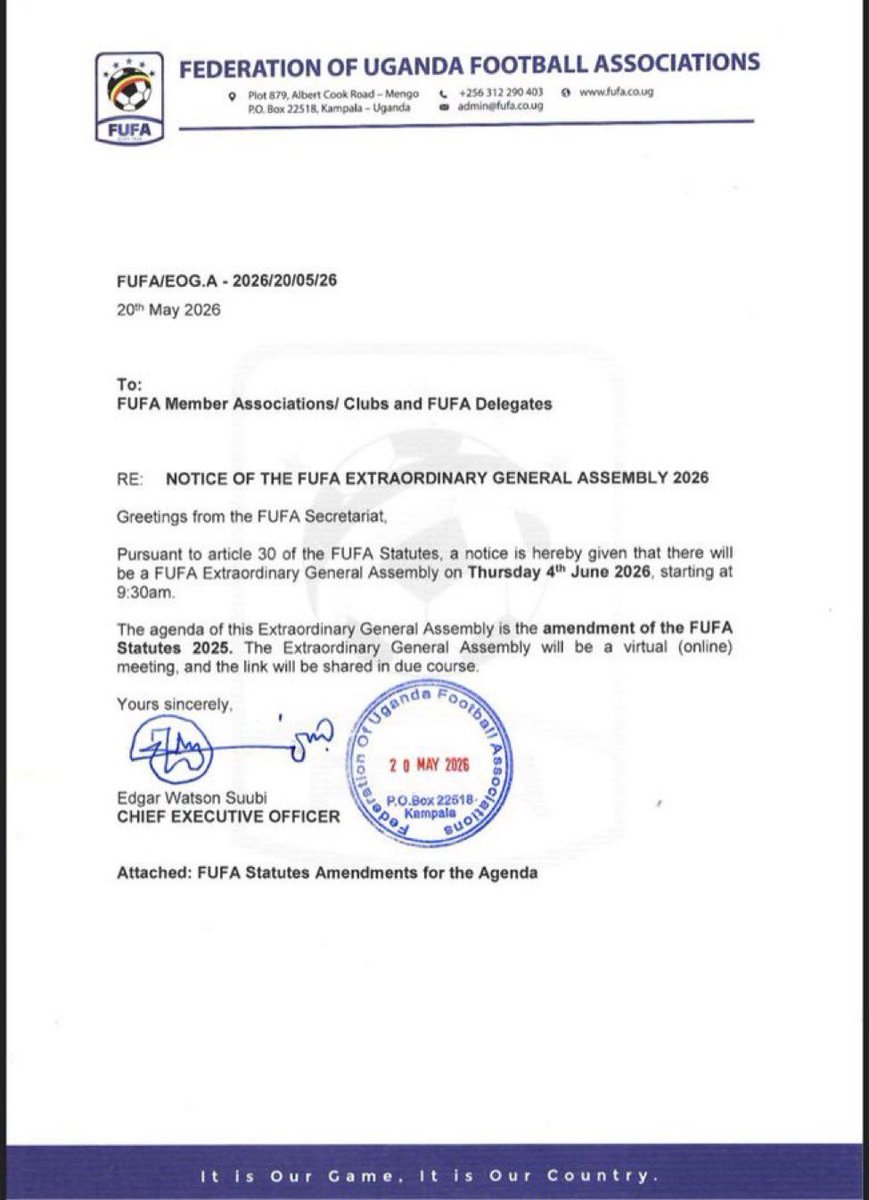
@iankiryowa will the proposed amendments include a requirement for an eligibility check to be conducted before a person would be nominated for FUFA Presidency. An integrity check should be conducted before someone becomes FUFA president. See: Article 44 (6) of the FUFA Statutes (as amended) as opposed to Article 48 (d) of the FIFA Governance Regulations.
Since the president of FUFA is also responsible for supervising the General and extra ordinary assemblies
(art. 39 (4) FUFA Statutes). The President of FUFA has an ordinary vote on the Executive Committee with a
casting vote whenever votes are equal which is a Potential conflict of interest. Is that fair to you @iankiryowa
??
@iankiryowa@EdgarSWatson@ASheba_Ronah@FIFAcom@CAF_Online@iankiryowa because you have an obligation as a person acting as the fiduciary to seek and critically analyze the information potentially affecting the interests of the person defined as the beneficiary of the said duty, in this case FUFA.