At midnight on February 6th, earlier this year, the doorbell to our apartment rang. The doorbell was followed by a pounding on the door. I answered the door and a security person in our building handed me his phone. It was my oldest daughter Eloise. She had found my 26-year-old daughter unconscious on the floor of her apartment and had called 911. The EMT team was already there, but they did not know what was wrong with Lucy or to which hospital they would take her.
I threw on some clothes and jumped in an Uber heading east toward Brooklyn. (Lucy lived alone in Williamsburg.) On the way, I learned that they were taking her to Elmhurst, a City trauma hospital in Queens. I arrived about five minutes after the ambulance to join Eloise, Lucy’s mom, and a friend, and waited to learn what was wrong.
After about 15 minutes, I asked a nurse where she was. I looked over his shoulder to his computer. Next to her name, it said “non-responsive.” I walked into the emergency room and wandered around looking for her until I found her unconscious on a gurney surrounded by several doctors and nurses.
By about 2:30am with the results from a CAT scan, Lucy’s doctors had determined that she had a massive brain hemorrhage and would need an emergency hemicraniectomy to release the pressure on her brain and remove the blood from the hemorrhage. I called our wonderful friend and family doctor Eddie Fisher and explained what was going on. He woke up Josh Bederson, Chairman of Neurosurgery at Mount Sinai, to find out more about Zach Hickman, the neurosurgeon on call that night. Dr. Bederson said Hickman was an excellent surgeon, which was comforting as we had no choice.
The surgery to save Lucy’s life began around 3:15am and finished around 5:30am. It was successful.
The following day, I joined Lucy in an ambulance while she was being transferred to Mount Sinai on Madison Avenue. Later that day, we determined from Lucy’s Oura ring that her hemorrhage had occurred around 9am, which meant that more than 19 hours had passed from the time of the hemorrhage to the completion of the surgery to release the pressure on her brain (I only wish @ouraring had an alert for this kind of a medical event. Imagine it could call a family member if the wearer doesn’t cancel the alert).
I later learned that the standard of care is not to do surgery to save a patient with a large brain bleed if more than five hours have passed since the hemorrhage. Even when the surgery is done, I was told that the likely outcome for the patient is a few months in a nursing home and death from pneumonia.
When I met Lucy’s doctors, I did my best to inspire them: “Let’s see what can be accomplished if we give her the best care possible and we invest unlimited resources to restore her to life.” And I promised that whatever we learned we would make available to everyone.
Dr. Chris Kellner, her neurosurgeon, and Dr. David Putrino, Director of Rehabilitation Innovation for the Mount Sinai Health System have led Lucy’s care team since that day. Words cannot describe the remarkable and compassionate care that she has received beginning with the EMT team and then from nurses, doctors, therapists, and the army of people who have worked to save her and return her to life. To this day, we have a daily Zoom where we discuss her progress and make adjustments to her care. While her care and oversight have been incredible, the learnings for the Mount Sinai team have also been elucidating and will assist in the care of many others.
Lucy began in a bad place. She was in a coma for several weeks and then awoke not being able to breathe on her own, unable to walk, see or speak.
Over the last six months, she has recovered her cognition – she understands everything including her circumstance – is able to walk a hundred or more steps at a time with assistance, is making progress with sounds, vowels and consonants and the beginnings of speech, but she remains unable to see.
Each day, she makes a little progress, and daily progress compounds. Every day I tell her that she just needs to make a little progress and it won’t be long before she is back.
We remain optimistic that Lucy will return to normal function. It will likely take years, but I believe it is only a matter of time, hard work, and technological progress, along with some, and perhaps a lot, of divine intervention.
Many people have been praying for Lucy and we are incredibly grateful for the prayers and remarkable support she has received. Lucy’s friends have been with her every day since the beginning, and their presence and friendship have saved her life and helped to rebuild and maintain her spirit. And on a very positive note, Lucy’s challenge has brought together our entire modern family who have all been incredibly devoted to her care and recovery.
Lucy's vision and other faculties may require some form of brain computer interface, work that is underway at Neuralink, Precision Neuroscience, Science, Synchron, Nudge, and other companies in the space.
If you are going to have a devastating brain injury, now is the best time in history for that to happen. We are living in a world when you can be confident that the blind will soon see again. We are going to do everything we can to help make that happen, including by assisting existing companies in the space.
With respect to our promise to make Lucy’s care available to others, we have made good progress. In May, a real estate colleague made me aware of a 93% vacant, brand new, 400,000 square foot Class A+ purpose-built biotech facility on West End Avenue between 65th and 66th Streets that missed the market and was available for sale. The Pershing Square Foundation acquired the building 60 days later.
We also put under contract an adjoining 130,000 square foot building at 320 West 66th Street that is currently being used by Saturday Night Live for studio space. The building has 35-foot ceilings with massive column-free spaces that can be converted into superb rehabilitation facilities. We will close on the SNL building in December.
We are also acquiring an adjoining vacant lot with additional air rights. With just the existing zoning rights, we can add a 150,000 square feet for a total of 680,000 square feet, a lab footprint larger than Rockefeller University, and that’s without including the potential for an upzoning that would allow for substantially more buildable area on the site’s 3.4 acres with spectacular views of the Hudson.
Our goal is to build the world’s greatest brain research, rehabilitation, recovery, human optimization, and longevity institute. We have named it The Ackman Oxman Institute or the AOI for lack of a better name, but also to reinforce the point that Neri and I and our family are all-in on the mission.
The AOI will be patient-centric. It will not be an academic research institute that produces lots of papers, a Nobel Prize winner or two, but little if any results for patients. We will be laser-focused on cures, treatments, devices, rehabilitation and exercise equipment, and targeted and basic research with a goal of massively accelerating the time from idea to innovation to production to helping a patient.
While the AOI will be a non-profit, it will have highly commercial instincts. The AOI will have its own venture funding and will work to develop innovations to create companies that we will seed, assist, and spinout to ensure technologies, treatments, techniques, and drugs get to patients as promptly as possible.
On one 3.4 acre campus in what is still the greatest city in the world, we will do neurosurgery, neuroscience, rehabilitation, nutrition, BCI and device development, human trials, hyperbaric oxygen treatments, and life extension programs, and we will mandate and incentivize collaboration among the teams with no silos, politics, bureaucracy, or any other constraint that is inconsistent with the mission.
Mount Sinai will be an important partner and deservedly so, but it won’t be our only hospital or medical school partner as we don’t believe any institution has a monopoly on the best ideas or the best talent. We don’t believe in exclusive relationships because that is not in the best interest of patients.
Five years ago, we considered launching a brain institute inspired by Neri’s mom who sadly died from Alzheimer’s. We couldn’t make the math work as the real estate was too expensive and we believed it would be too difficult to recruit the best talent from universities to our effort.
Since then, the real estate became available at a 70% discount, universities became a much less attractive place to work due to politics outweighing meritocracy, protests that disrupt learning, the curse of antisemitism, and a decline in funding. Fortunately, during the same time, I made sufficient personal economic progress to make the AOI possible.
The advance of AI in the last few years will also enable us to greatly accelerate our mission. AI still has a lot to learn about human intelligence and the brain, and the AOI should be at the forefront of the interplay between the brain and AI.
Today, I am making a public filing disclosing a gift from Neri and me of ~$400 million or 10,000,000 shares of Pershing Square Inc. (PS) to the AOI. It is very early days for Pershing Square so these shares are intended to anchor the long-term work of the AOI as the shares compound over time while generating what we expect will be a growing stream of quarterly dividends to fund the Institute.
We will also be announcing an additional gift of similar and potentially greater size which won’t be in the form of Pershing Square stock to provide the AOI with the short- and intermediate-term runway necessary to enable it to achieve its goal of becoming a self-sustaining institute, which reinvests all of its revenues, royalties, and the economic rewards of company formation to advance the fields of brain health and human longevity.
Neri and I have chosen to anchor the funding of the AOI to maintain vision alignment and limit the need for the organization to focus on fundraising. We expect the AOI to be the best-resourced brain, rehab, recovery, and longevity institute in the world.
We are grateful to have been able to form a board which includes Dean Kamen (our generation’s Thomas Edison), George Yancopoulus (CEO of Regeneron), James Rothman (Nobel Laureate), Bernardo Sabatini (neuroscientist), Chris Kellner (neurosurgeon), Olivia Flatto (CEO Pershing Square Foundation), Neri Oxman, and myself.
We have recently identified a CEO who we expect to announce by October along with other key hires, and are beginning searches for a Chief Scientific Officer, a Chief AI/Technology Officer, a Chief Operating Officer, a Chief Financial Officer, and other key leadership roles.
If you find what we are building compelling and want to be part of the leadership team that creates and builds the AOI from a standing start, please send an email to: [email protected] with a short note as to why you believe you can help. Please include your best three ideas for the AOI along with a summary of your background and your most important accomplishments.
We promise strict confidentiality to those expressing interest in working with us.
We have learned from Lucy that the brain can recover from even catastrophic injury. There is so much more work to be done as the mind is a terrible thing to waste.
For details from my Pershing Square SEC filing see:
https://t.co/gZKafCw6Ia
Recently, I frequently hear the argument that the S&P 500 is “expensive”. The index trades at around 22x forward earnings compared to its long-term average of closer to 16x earnings – an almost 40% premium. But is this a fair apples-to-apples comparison? My view is that it’s not, and that the index today deserves a higher multiple than its historical average.
1️⃣ The first reason is that the composition of the index has changed. The S&P 500 of today bears little resemblance to the index of the 1980s, or even the early 2000s. Historically, the index was dominated by financials, industrials, and energy companies. Today, nearly half the index is technology companies. This shift matters. The index has moved from lower quality, more cyclical and more commodity-linked businesses, with slower revenue and earnings growth, to more global, high-quality, more profitable, and less cyclical companies with better growth prospects. Earnings multiples are a function of durability and growth. As a result, today’s leaders fundamentally deserve a higher valuation than the companies that made up the index in past decades.
2️⃣ The second reason is that current accounting rules distort the true earnings power of most technology companies making them incomparable to the legacy industrial and energy businesses. Old-economy companies depreciate capital expenditure over several years. For modern technology companies, research and development and sales and marketing are effectively long-term investments (the digital equivalent of CapEx). Yet under current accounting rules, these investments are expensed in the year they occur, even if the benefits are long-lived. This depresses reported earnings and makes the P/E multiple look artificially higher. Despite the recent surge in data center investments, CapEx as percentage of operating cash flow has declined steadily for the index over the past decades.
It is difficult to pinpoint what the “fair” multiple for the index should be. However, the idea that the index is expensive because it sits above its long-term average and therefore a correction is imminent is simply misguided. The underlying constituents of the index have changed, their fundamentals have improved, and accounting standards mask their true earnings power.
What I ask myself is whether the multiple can expand even further. For the last 15 years, S&P 500 returns benefited from both solid earnings growth and a roughly 100% multiple expansion (from post-GFC lows). I think it’s unlikely that the multiple expands another 100% (to 44x earnings) over the next decade. A more realistic scenario is that the index has now rerated to reflect the new leadership of companies and future returns will be driven primarily by earnings growth rather than further multiple expansion.
At its Investor Day, $AMD projected a $1T data center silicon TAM in 2030 (from $200B in 2025, a 40% CAGR) and expects its own revenues to grow even faster (60%+ over the next 3-5 years). While this is encouraging for $AMD, it also implies significant upside for $NVDA, which is not yet reflected in consensus estimates.
Consensus already embeds $AMD’s targets: ~$16B in DC revenues in 2025 rising to $150B by 2030 (a 56% CAGR), with market share expanding from 8% to 15% of their estimated TAM.
$NVDA’s numbers, however, tell a different story. Street estimates call for $180B in DC revenues in 2025 rising to $320B in 2030 (just 12% CAGR) – a significant deceleration in growth rates and a projected 10% decline in CY 2028. This implies a market share collapse from ~90% today to ~30% in 2030 of AMD’s TAM estimate.
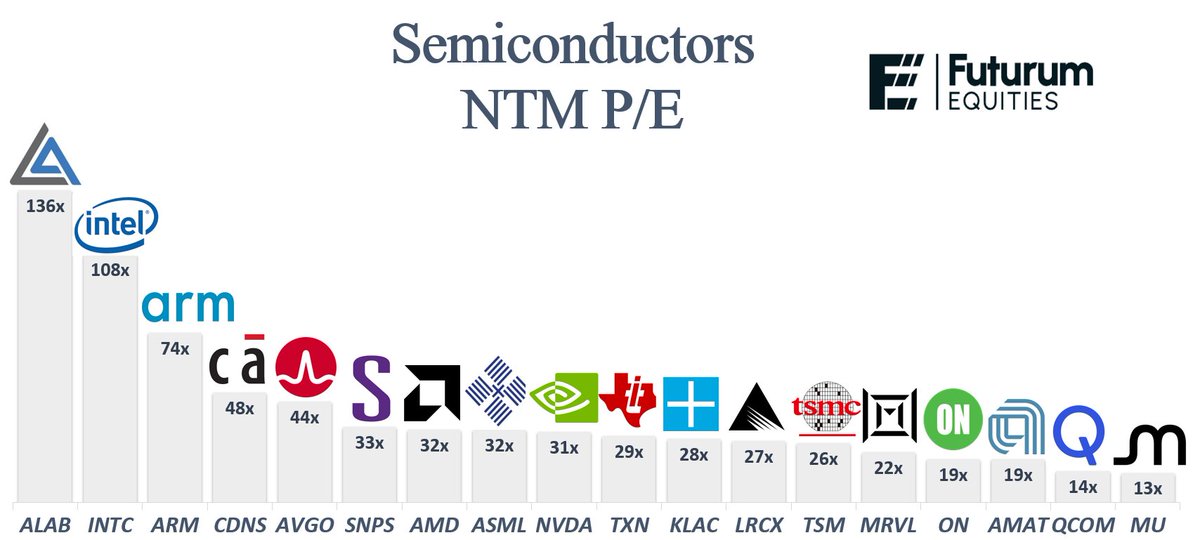
Meanwhile, $NVDA continues to trade at a discount to $AMD (28x vs. 38x forward earnings).
What is the market saying?
1. $AMD is a winner and will gain market share.
2. $NVDA’s best days are over.
3. If both sets of estimates are “correct”, ~$500B of the TAM is unclaimed.
My view: $NVDA’s consensus estimates are likely too low. It’s more probable that $NVDA grows roughly in line with the overall market rather than falling behind. If estimates move higher, today’s 28x forward P/E will look even cheaper.
A few quick thoughts on $META as the sell-off has continued following Q3 earnings.
$META had a very strong quarter:
· Revenue +26% Y/Y, as AI recommendation systems help deliver relevant quality content, resulting in higher engagement (video time spent on Instagram +30% Y/Y). The playbook: engage and then monetize the engagement. Meta’s executing on both fronts. 3.5B DAUs, ad impressions +14% Y/Y, and average price per ad +10% Y/Y.
· EPS +20% Y/Y (ex. one-time tax expense).
What spooked the market? Guidance. Management indicated CapEx of at least $107B in 2026 (up from $72B in 2025) and OpEx of at least $142B (up from $116B), likely resulting in mid-single-digit EPS growth in 2026. Reckless spending? I believe not. Additional compute can be used to further aid the core business. Growth wouldn’t be +26% Y/Y, without AI.
“We’re certainly seeing that we wish we had more capacity today than we do.” – Susan Li, CFO, implying that revenues could’ve grown faster.
Moreover, management has optionality: they can either pivot quickly, slow down spending and reduce OpEx if ROIC lags, or repurpose additional compute into Meta Cloud (something Mark hinted at during the call). This is a long-term game that is underappreciated by a short-term market.
$META remains cheap relative to the quality and long-term growth prospects of the business. The most accurate way to look at Meta’s multiple is ex. Reality Labs – not assigning it a large negative value. Family of Apps is expected to generate $112B in Operating Income in FY 2026, or roughly $90B net income ($35/share) at 20% tax rate. With the stock at $630/share, that’s just 18x 2026 P/E. We remain optimistic and long $META.
Views are personal. Not investment advice.
At Odrysia Capital, $AMZN has been one of our largest positions since inception of the fund. Last week’s results were outstanding. The clearest view of the quarter comes from excluding one-time items:
· Revenue: +13.4% Y/Y
· Operating Income: +24.8% Y/Y ex. $2.5B FTC settlement & $1.8B severance costs
· EPS: +24.6% Y/Y ex. $9.5B Anthropic gain (assuming similar tax rate as last year)
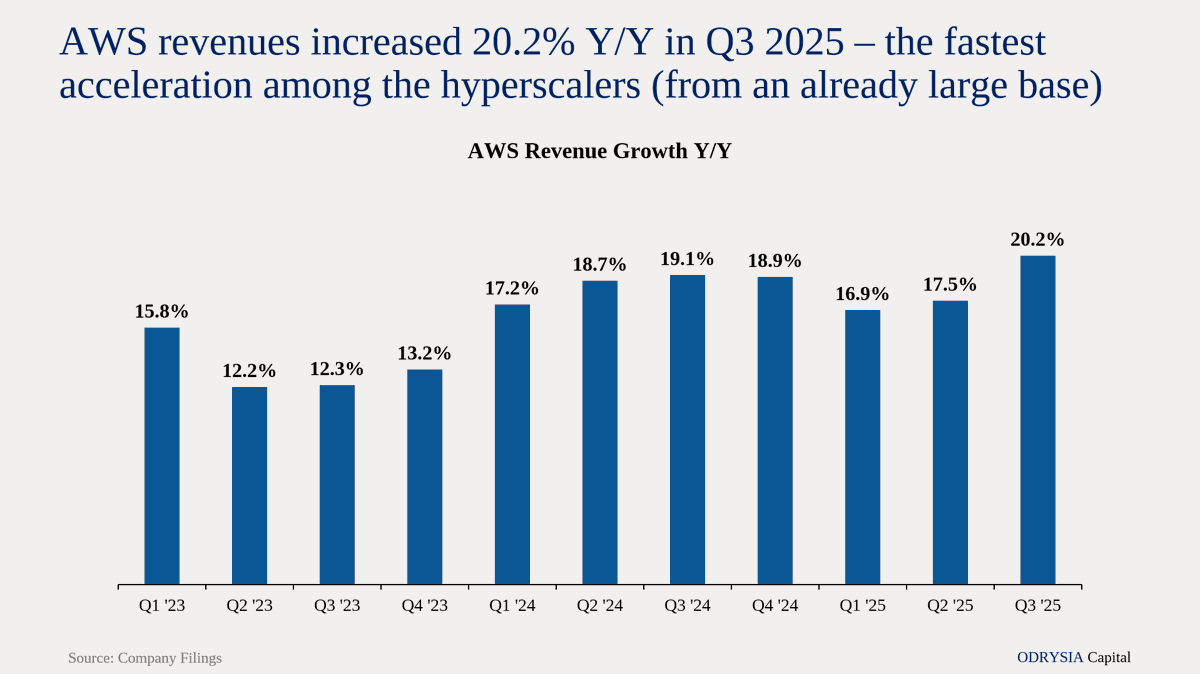
AWS grew 20.2% Y/Y – the fastest acceleration in growth among the hyperscalers from an already massive base – with 34.6% margin and $200 billion backlog. Management signed new deals in October, with total deal volume greater than all of Q3. AWS added 3.8 GW of capacity in the last 12 months – on track to double by 2027. 80% of global IT spent is still on premises vs. 20% on the cloud. Trainium is seeing strong adoption and is now a multibillion-dollar business, up 150% Q/Q. The cloud is a royalty on global compute consumption.
“As fast as we’re adding capacity right now, we’re monetizing it … I believe we can continue to grow at a clip like this for a while.” – Andy Jassy, CEO
Retail & Ads: Amazon stores continue to lead on selection, pricing, and convenience. 80% of global retail is still physical vs. 20% online. Management is further improving inventory placement, automation, and scaling groceries to 2,300 cities by year-end. Ads grew 22% Y/Y (a high-margin growth engine).
I expect broad-based growth to continue, with AWS & Ads both compounding 20%+ Y/Y, driving low-mid teens total revenue growth. Margin expansion should follow from scale, operational leverage, and favorable mix-shift toward higher-margin businesses, supporting durable 20%+ EPS growth for the medium term. Yet, the market values $AMZN at just 31x forward earnings.
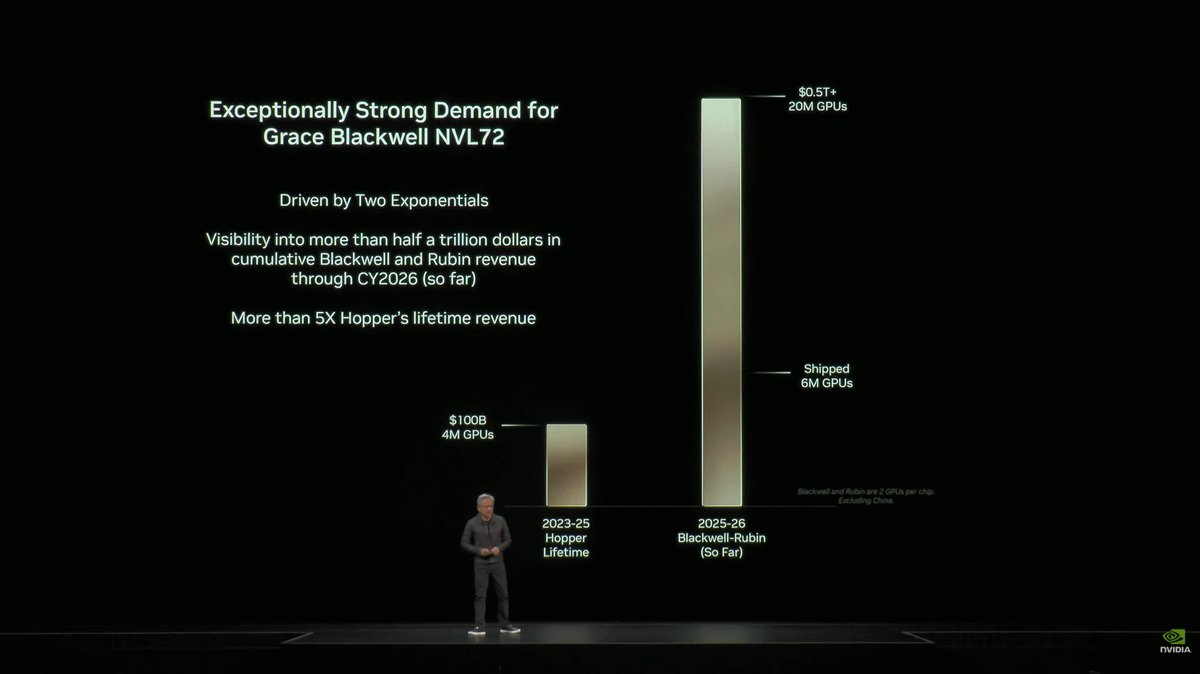
$NVDA has visibility into $500 billion of Blackwell & Rubin revenues by the end of CY 2026. Jensen likely said it correctly at first, then misspoke and caused some confusion.
~6M GPUs are already shipped since Blackwell’s intro. The remaining ~14M GPUs (roughly $350 billion in revenues) are expected over the next 5 quarters.
This is just the demand they see so far – still early days for Rubin and no China revenues included. Data Center revenue consensus for the next 5 quarters is $304 billion (Nvidia guided ~15% higher). Outstanding numbers.
OpenAI’s $1 trillion bet — demand for compute & for capital.
As the dust settles around the latest AI announcements, here’s my attempt to demystify what it all means for the ecosystem.
💡 Key takeaways:
- Computing demand remains strong: Expect a shortage of compute for several years, driven by reasoning models & rising consumer demand.
- OpenAI deals reinforce Nvidia’s dominance: Net positive for $NVDA and net negative for $AMD.
- Large incumbents hold the upper hand: AI is a game of kings - compute & talent are expensive.
- High risk-reward outcomes: OpenAI has commitments of over $1 trillion. It either works spectacularly, or the dominos start to fall.
🔍 Digging deeper:
The $AMD deal is additive to the compute OpenAI plans to purchase from $NVDA. Sam said it himself:
“This is all incremental to our work with Nvidia (and we plan to increase our Nvidia purchasing over time)”. — Sam Altman
OpenAI likely won't use Nvidia’s funds to fulfill other commitments — if they fail to deploy 1 GW of capacity, they forfeit the next $10B investment.
The math works in Nvidia’s favor: 1GW costs ~$50B, of which $30B will likely go to Nvidia. At 60% margin, that's $18B in operating income or $14B in NOPAT on $10B investment. AMD’s deal is at best neutral for current shareholders.
🔄 Circular Deals?
As long as there is legitimate business purpose and strong end-user demand, these transactions make economic sense. It’s not a closed loop — each GPU deployed supports real usage.
$NVDA & hyperscalers are propelling future customers. As an early investor in OpenAI, Microsoft helped propel a business that now has 800 million WAUs and approaching $20 billion revenue run-rate.
⚠️ Caution is warranted!
OpenAI has total commitments exceeding $1T. Where is the capital going to come from? Likely from their revenues (growing exponentially), Nvidia’s investment, and I expect capital raised by selling AMD stock — but mostly through debt.
If GPUs have a useful life closer to one year (vs. current amortization assumptions), legacy AI systems could become obsolete – and worthless as collateral. Meanwhile, OpenAI is up against behemoths like $GOOGL (with their full-stack approach) and $META (with their aggressive hiring practices). One failed commitment puts all other deals in jeopardy.
❓ Curious how others see this playing out?
Invest wisely. Seek high-quality businesses. Think long-term.