@yhbryankimiq 100x and your predictions is a $5-$10 XRP?🤣🤣🤣😂 guys relax 100x & more after a 1-4yrs old Clarity Act! Wait for the dumps & keep stacking! Atm thats the game!
@Rich39Rich039 I heard XRP will be staying like this until a few yrs AFTER the clarity act has been passed. F/Institutions wont go no where near cryptos until clarity act is passed & with the passing of this act 99% of cryptos will disappear :(
XRP is a longterm investment 5-10yrs yet :(
Modi told India: skip gold for a year. ₹5 trillion wiped from Sensex Monday. Rupee record low 95.63.
Prime Minister Narendra Modi appealed to citizens at a Hyderabad public rally on Sunday May 10 to defer gold purchases for a year, postpone non-essential foreign travel for a year, use less fuel through work-from-home and carpooling, and prioritize Indian-made goods.
The framing called on Indians to "save foreign exchange by any means" as a national duty. Coverage went viral across Reuters, NDTV, Firstpost, and Hindustan Times. Gold is religious, wedding, and festival tradition for India's 1.4 billion population.
The appeal is unprecedented in household reach for an Indian Prime Minister during peacetime. The last comparable forex stress forced India to pledge 67 tonnes of gold reserves to the Bank of England and Union Bank of Switzerland in July 1991.
The Sensex closed Monday May 11 down 1,313 points or 1.7 percent to 76,015.28. The Nifty closed down 1.49 percent to 23,815.85. Total market capitalization erased ranges from ₹5 to ₹6 trillion in one session. Titan, InterGlobe Aviation, and auto stocks led the selloff. Foreign Institutional Investors sold ₹8,437 crore Monday alone. Domestic Institutional Investors absorbed ₹5,939 crore on the same session. EV and solar stocks rose on fuel-cut sectoral rotation. The rupee hit a record low of 95.63 to the US dollar Tuesday May 12.
The forex strain is structural. Reserve Bank of India data shows reserves declined from a February 27 peak of $728.49 billion to $690.69 billion on May 1, a $37.8 billion drawdown in three months, with the gold component down $5.02 billion. Commerce Ministry data shows gold imports reached a record $71.98 billion in fiscal year 2026, a 24 percent year-on-year increase. Current account deficit projections from IMF, Crisil, and Bank of America cluster near 2 percent of GDP, or $84 to $88 billion, with upside risk above $95 per barrel oil. Telangana CM Revanth Reddy called the appeal an "undeclared gold prohibition" masking policy failure.
The Hormuz disruption is the root cause.
India imports approximately 85 percent of its crude oil per PIB government data, with Gulf sources historically supplying around 50 percent. India imports the majority of its LPG via Gulf routes. Farmers face urea shortages from Gulf supply disruptions.
Brent crude has traded between $104 and $126 per barrel since the Iran war began February 28. The IRGC formalized the Persian Gulf Strait Authority requiring transit permission protocols and deployed submarines May 5 to 7. CENTCOM has redirected 61 vessels since the April 13 blockade and disabled four tankers in May.
The price spike feeds directly into India's import bill, the rupee, and the central bank's reserve drawdown.
Six sovereigns. Six vetoes. The Iran storm reaches Indian households this week. Modi told 1.4 billion Indians to defer gold. ₹5 trillion erased from Sensex Monday. Rupee 95.63 record low. Reserves $37.8 billion drained since February. Gold imports $72 billion record. CAD projection 2 percent of GDP.
Over 13,000 US strikes on Iran since February. Three carrier groups in CENTCOM, first since 2003. IRGC missiles locked on US bases. Trump calls Iran's offer garbage. Marist approval 37 percent. Generic D+6.1.
Five summit tracks open in Beijing. Huang stays home. The list is the dependence chart. Taiwan is the price. China is the source. Pakistan is the conduit. Iran is the storm. India is in the cascade.
https://t.co/xmK0gJ0TfI
JUST IN: Treasury Secretary Scott Bessent posted on X earlier today that “Iran’s shadow banking system serves as a critical financial lifeline for its armed forces” and that “any institution that facilitates or engages with these networks is at risk of severe consequences.” OFAC designated thirty-five entities and individuals under Executive Orders 13902 and 13224. Press release sb0477. Rahbar facilitator companies tied to Shahr Bank, Bank Melli, Bank Sepah, and Bank Mellat. Shuqun LTD, a UK-based front, transferred more than seventy million dollars for Iranian crude on behalf of NIOC through 2024. Fratello Carbone Trading Limited transferred more than twenty million. The action follows the April 24 sb0472 designations targeting Iran’s shadow fleet. Total Iran-related designations under the Economic Fury campaign now exceed one thousand persons, vessels, and aircraft since February 2025.
Read the Bessent sentence again. “Any institution that facilitates or engages with these networks is at risk of severe consequences.” The target is not Tehran. The target is every bank, exchange house, and correspondent that touches Iranian flows. The pressure is not on Iran. The pressure is on the global financial infrastructure that currently prices Iranian oil in dollars.
That distinction matters because Iran did not collapse under maximum pressure between 2018 and 2020. Iran adapted. Shadow fleet growth, UAE fronts, Hong Kong shells, dollar-correspondent loopholes. By 2024, FinCEN identified nine billion dollars of Iranian shadow banking activity through US correspondent accounts in a single year, including four billion through oil front companies. Iran is currently exporting roughly one point five to one point six million barrels per day to China despite every Economic Fury round since February. The flow continues. What the designations are changing is not the volume. The designations are changing the settlement currency.
Each rahbar designation removes a dollar-settlement node. As dollar nodes close, Iran’s counterparties face a binary choice. Stop buying or settle outside the dollar. Hengli Petrochemical, named in the April 24 Treasury action, did not stop. Hengli purchased billions of dollars’ worth of Iranian petroleum and continued. Lloyd’s List has reported that the parallel non-dollar settlement infrastructure is already operating: Hormuz transit tolls of one to two million dollars per vessel settled in yuan or crypto through the Hormozgan Naval Command vetting system since March. Russia hosted Iranian Foreign Minister Araghchi in Saint Petersburg on Monday to coordinate the Pakistani-mediated proposal track.
The Treasury designations accelerate compliance flight from any Iran-touching counterparty. The counterparties have a yuan rail to flee toward. The post-2022 Russia precedent is instructive: Russia-China trade in yuan crossed fifty percent by 2024 after secondary sanctions accelerated the pivot. The same mechanism is now operating on the Iranian energy flow.
The thesis falsifies if Chinese refiners reduce Iranian crude purchases below one million barrels per day in coming weeks, or if Treasury designates yuan-clearing infrastructure directly rather than dollar-correspondent nodes.
Bessent is not strangling Iran.
Bessent is forcing Iranian oil off the dollar.
Same architecture. New denomination.
The campaign publicly framed as choking Iran is operationally accelerating the de-dollarization of the global energy chokepoint.
The petrodollar lost one settlement node yesterday.
It will lose another next week.
The Treasury is the architect of the post-petrodollar system.
Bessent does not know it yet.
Beijing does.
https://t.co/IAEXhN5zxc
Sri Lanka just lost money to two different countries through two different government departments using the same mechanism in the same quarter. And nobody outside Colombo is paying attention to what this means for every post-crisis sovereign on earth.
On April 28, Cabinet Spokesman Nalinda Jayatissa confirmed that $625,000 remitted by Sri Lanka’s Department of Posts to the United States Postal Service was never received. USPS formally notified Sri Lankan authorities. The minister said the incident had occurred on two separate occasions. The Criminal Investigation Department and the Postal Department have both launched parallel probes.
This was announced one week after the $2.5 million Treasury case became public. In that incident, cybercriminals breached the Finance Ministry’s External Resources Department email system, intercepted official communications with Australia’s export credit agency, altered the beneficiary account details, and redirected five installments of a bilateral debt repayment between December 31, 2025 and March 20, 2026. The funds were wired per established procedures. Every internal protocol was followed. The money never arrived. Australia notified Sri Lanka only after realizing the payments were missing. Four senior officials were suspended. The Treasury Secretary confirmed the attack publicly on April 23.
Two government departments. Two foreign counterparties. Two completely separate payment systems. One postal, one sovereign debt. Identical failure mode: funds left Sri Lanka through what appeared to be legitimate channels and vanished before reaching the recipient.
The mechanism is not sophisticated. It is embarrassingly simple. In the Treasury case, OCCRP confirmed that hackers infiltrated the PDMO’s email system and altered beneficiary details in payment instructions. The government followed its own procedures and wired $2.5 million to accounts controlled by criminals. The Central Bank had detected suspicious activity during a separate India-linked payment in January 2026. That detection prevented one attempted diversion. It did not prevent the five that had already gone through.
Now apply the same logic to the postal case. The Department of Posts remitted $625,000 to USPS. USPS says it never received it. The minister confirmed this happened twice. The CID is investigating whether the same email-instruction-tampering vector was used, but the pattern is identical: payment initiated locally, processed through standard channels, never received by the counterparty.
Sri Lanka restructured approximately $17 billion in external debt between 2023 and 2025. The entire architecture of that restructuring rests on one thing: the credibility that when Colombo says it has paid, the creditor receives the money. That credibility is now under direct assault, not by markets or rating agencies, but by the payment infrastructure itself.
On March 26, two days after the internal memo flagging the missing $2.5 million, the same Treasury’s debt management office won a Commonwealth award for “fiscal resilience and institutional reform.” On April 28, a second government department confirmed a second missing payment to a second country. The award cited the representation. The payments revealed the reality.
This is no longer an isolated incident. It is a pattern. Two departments. Two counterparties. Two payment systems. One country. One quarter. The binding constraint on Sri Lanka’s post-crisis recovery is no longer fiscal discipline or IMF conditionality. It is whether the wire reaches the other end. If a nation cannot guarantee that its own payment instructions produce payment, the interest rate on every future issuance carries a premium that no restructuring can offset. The market has not priced this. It will.
BREAKING: The United Arab Emirates announced yesterday that it will withdraw from OPEC and OPEC+ effective May 1, 2026. WAM published the statement. Fifty-nine years of membership ends in two days. ADNOC’s sustainable capacity sits at four point eight five million barrels per day. The 2027 target is five million. UAE March 2026 actual production fell to between one point eight nine and two point three four million depending on source, against an OPEC quota of three point four one million, with the gap reflecting both Hormuz shut-ins and chronic baseline constraints that have run for years. Saudi-linked media commentary has framed the move as regrettable and signaled Riyadh will review its own oil policies, although no Tier-1 statement from the Saudi Energy Ministry or Prince Abdulaziz bin Salman has been issued in the first hours. UAE Energy Minister Suhail al-Mazrouei, via state media, indicated that direct consultations with Riyadh did not occur ahead of the announcement. Brent crude traded above one hundred eleven dollars on the announcement.
The consensus take is that OPEC unity is fracturing. The deeper structural fact is that Abu Dhabi just completed a three-week sequence of sovereign optionality assertions across three different domains.
In early April the UAE absorbed more than two thousand eight hundred Iranian missiles and drones during the war, with documented intercepts including five hundred thirty-seven ballistic missiles, two thousand two hundred fifty-six drones, and twenty-six cruise missiles per UAE Ministry of Defence tallies. The strike data became the justification for a harder foreign policy posture against Iran-mediation neutrality. Last week Abu Dhabi recalled three point four five billion dollars in bilateral deposits from Pakistan, ending seven years of automatic rollovers. Yesterday Abu Dhabi walked out of OPEC. Three sovereign instruments. Three weeks. One pattern.
Each move converts a multilateral commitment into a binary choice. The strikes converted GCC neutrality into explicit alignment pressure. The deposit recall converted Pakistani patient capital into a referendum on alignment. The OPEC exit converts collective production discipline into unconstrained ADNOC ramp authority.
On Monday Russia activated the broker role its 2025 pact with Iran was designed to enable, hosting Araghchi in Saint Petersburg without offering the mutual defense the pact deliberately omitted. On Monday China’s NDRC ordered Meta to unwind the two billion dollar Manus AI acquisition, asserting extraterritorial jurisdiction over Singapore-based founders through citizenship and exit-ban authority. On Tuesday UAE walked out of OPEC. Three sovereigns. Compressed calendar. Adjacent doctrines.
OPEC was founded September 14, 1960, in Baghdad. Five members. The UAE joined in November 1967. The institution exists to coordinate sovereign production discretion against the dominance of Western majors. For fifty-nine years the UAE accepted that frame. On May 1, 2026, it will not.
The pattern falsifies if Saudi Arabia issues a Tier-1 statement reaffirming OPEC unity within seventy-two hours, or if a verified UAE walk-back emerges, or if the WAM statement turns out to have been misreported and OPEC’s secretariat confirms continued UAE membership.
Until then, the meta-pattern is observable across three sovereigns in 48 hours.
Multilateralism is being unbundled.
The new architecture is binary, optional, and bilateral.
China asserted optionality through extraterritoriality.
Russia asserted optionality through alliance asymmetry.
UAE asserted optionality through cartel exit.
Three sovereigns.
One doctrine.
Three different forms.
https://t.co/vLQh7ydMdk
They freed a man from death row to run this machine.
His name is Babak Morteza Zanjani. He embezzled billions from Iran’s national oil company. Convicted. Sentenced to death. Sentence commuted. And in 2025, the Islamic Republic freed him from prison for one purpose: to build the cryptocurrency infrastructure through which the IRGC now launders the revenue from its Strait of Hormuz toll system. The man who stole from the regime was released to steal for it.
Here is how the machine works. Every step is sourced. Every entity is named. Every dollar is traced.
A supertanker approaches Hormuz. Its operator emails the IRGC intermediary with cargo manifests, flag, crew lists, and destination. Iran’s five-tier nationality system assigns a price. Two million barrels at one dollar per barrel. Two million dollars. The captain has seconds to pay in Bitcoin. Payment confirms on-chain. A VHF passcode is issued. An IRGC naval escort guides the vessel through the mined corridor.
The Bitcoin enters an IRGC-controlled wallet. Within minutes it hops to a second-layer address with no attribution. From there it splits into two rails.
Rail one runs through Zedcex, a UK-registered exchange that processed $94 billion since August 2022. At peak, 87 percent of volume was IRGC activity on Tron. Its sister entity Zedxion listed Zanjani as director. OFAC sanctioned both on January 30 with seven Tron wallets. Israel’s NBCTF had flagged five of those same wallets four months earlier. Israel found the wallets before the US froze them. The UK is now dissolving both entities after discovering the listed director was a fabricated identity using a stock photo. A $94 billion pipeline registered in London under a name that does not exist.
Rail two bypasses exchanges entirely. OTC brokers in Dubai, Istanbul, and Hong Kong accept Bitcoin through encrypted channels. Chainalysis documented that Chinese-language laundering networks processed $16.1 billion in 2025 at $44 million per day. The IRGC feeds directly into this ecosystem, connecting to Huione, the Cambodian platform that processed $39.6 billion before FinCEN designated it as a primary laundering concern.
Once Bitcoin becomes USDT on Tron, it enters CIPS through Kunlun Bank, China’s sanctions-exempt correspondent for Iranian trade. USDT converts to yuan. Yuan purchases food, medicine, and dual-use goods from Chinese suppliers shipping through front companies in Turkey, the UAE, and Hong Kong to Iranian ports. The Central Bank of Iran itself purchased over $500 million in USDT through brokers in this network, per documents Zanjani leaked and Elliptic analyzed. The central bank is not tolerating the machine. The central bank is feeding it.
The IRGC’s on-chain activity exceeded $3 billion in 2025, over half of Iran’s $7.8 billion crypto ecosystem. The same rails fund Hezbollah, the Houthis, and Hamas. OFAC designated Houthi financier Sa’id al-Jamal for laundering IRGC revenue and facilitating Russian weapons procurement through crypto. The machine that monetizes the strait arms the proxies.
Seven jurisdictions. Three blockchains. Two fiat currencies. Zero intervention points after the initial Bitcoin payment clears. The architecture was legislated in Iran’s parliament, codified in the “Strait of Hormuz Management Plan” on March 30, stress-tested across $94 billion, and staffed by a man the regime pulled from death row because he was the only person who knew how to build it.
Trump’s warships catch the ships. Bessent’s GENIUS Act catches the stablecoins. Nobody catches the gap between them. And the man who runs it was already supposed to be dead.
https://t.co/0fIdGsM5qH
Everyone is speculating about what JD Vance meant by tools in the American toolkit yesterday. The White House clarified it is not nuclear weapons. X accounts are guessing at cyber operations, covert action, or Israeli escalation. They are all looking in the wrong direction. The most powerful tools in Trump’s toolkit are not weapons. They are dates.
April 10th. Islamabad Phase-2 talks begin. JD Vance is expected to lead the US delegation into a room with Iranian negotiators for the first direct contact since the war started. The US arrives having destroyed 85 percent of Iran’s weapons-chemistry capacity, dismantled 130 air defence systems, killed the IRGC intelligence chief, and demonstrated the ability to sever a nation’s entire transport network in 48 hours. Iran arrives having closed the world’s most important chokepoint for 39 days, survived the most intense aerial campaign since 2003, and maintained a functioning state under a headless Mosaic Defence architecture with its new supreme leader Mojtaba reportedly “unconscious” who just approved the ceasefire on behalf of Iran. Both sides bring accomplished facts. Neither side brings concessions.
April 19th. The US Treasury waiver on 140 million barrels of Iranian crude at sea expires. This is not a military tool. It is an administrative decision that Trump can make with a signature. If he renews it, Chinese teapot refineries continue processing discounted Iranian crude and the ghost fleet sails unimpeded. If he lets it expire, every Iranian barrel afloat becomes sanctioned cargo, Chinese refineries face secondary sanctions risk, and the $128 billion daily CIPS settlement flow that the war built comes under direct US Treasury pressure. One signature. No missiles required. The waiver expiry is the single most powerful non-kinetic leverage point in the entire conflict because it threatens China’s energy security without firing a shot, and it falls nine days after Islamabad opens.
Mid-May. Scott Bessent arrives in Beijing for the summit originally scoped around tariffs and rare earths. But the Iran war rewrote the agenda. China applied last-minute pressure on Iran to accept the ceasefire. China’s ghost fleet operated through the entire conflict. China’s CIPS system surged during the war. China controls 95 percent of heavy rare earth processing. If the waiver expired on April 19 and Chinese refineries are scrambling, Bessent walks into Beijing with leverage that transforms the tariff negotiation into something far larger: a conversation about whether China continues building the parallel financial architecture that the war accelerated or trades it for concessions that preserve the dollar system for another decade.
Three dates. Three tables. One president who sits across from a different counterparty at each meeting while holding leverage that connects all three. Islamabad pressures Iran with military facts. The waiver pressures China with sanctions facts. Beijing pressures the global architecture with rare earth facts. The molecule crisis is the connective tissue. Petrochemical molecules destroyed in Iran. Energy molecules flowing through the ghost fleet. Rare earth molecules processed in Chinese refineries. Every molecule passes through a chokepoint that one of the three parties controls, and Trump is the only actor who can apply pressure at all three chokepoints simultaneously.
The toolkit is not an arsenal. It is a calendar. And the next five weeks will determine whether the ceasefire becomes the most consequential diplomatic sequence since Bretton Woods or collapses into the third iteration of a structural cycle that has repeated twice in ten months.
Full analysis - https://t.co/0fIdGsM5qH
BREAKING: WTI crashed nine percent in thirty minutes. S&P futures jumped over one percent. Oil fell to $96. The ceasefire is real. The relief is real. And the molecule crisis did not move a single angstrom.
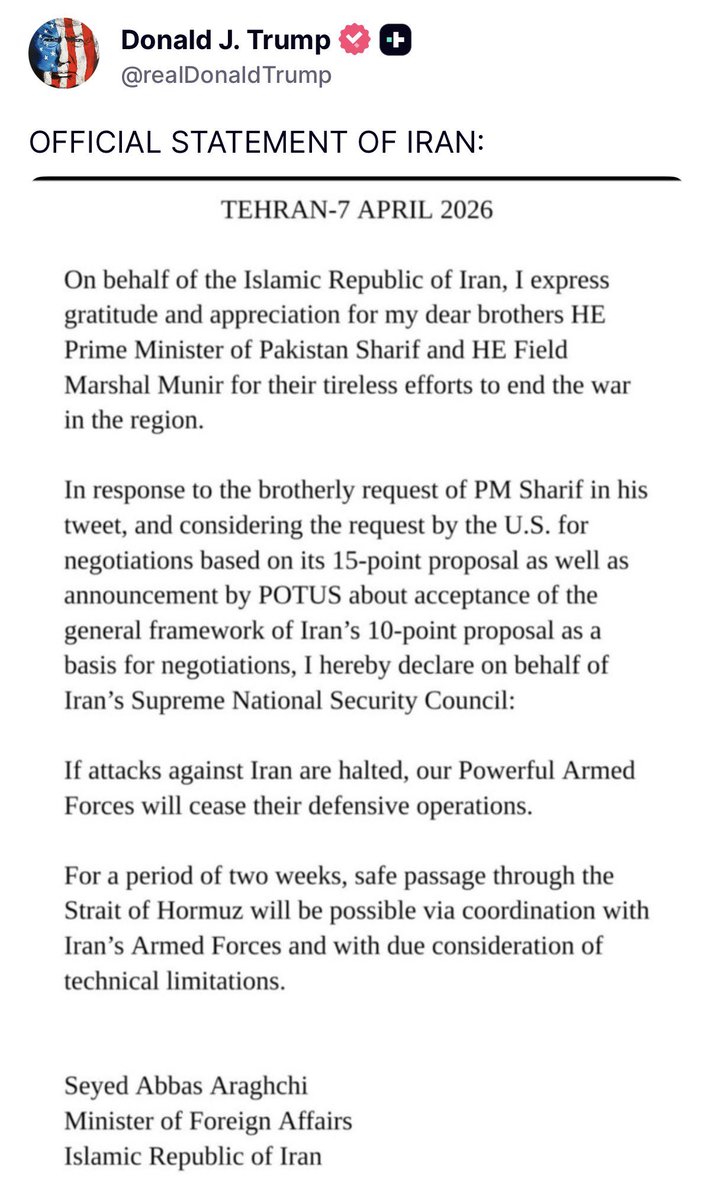
President Trump suspended attacks for two weeks. Iran accepted through its Supreme National Security Council with Mojtaba Khamenei’s explicit approval. Hormuz reopens for safe passage under Iranian military coordination. Pakistan mediated. China applied last-minute pressure. Vance is expected to lead the US delegation to Islamabad on Friday. Trump called Iran’s 10-point proposal a workable basis for negotiation and said the United States has already met and exceeded all military objectives.
That last sentence is the one the market should be reading most carefully.
In 39 days, the campaign dismantled over 130 Iranian air defence systems. It rendered inoperable three petrochemical complexes responsible for 85 percent of Iran’s weapons-chemistry exports. It struck Kharg Island, destroyed transport aircraft and dozens of helicopters, severed ten railway bridges in a single day, killed the IRGC’s intelligence chief, and degraded Iran’s ballistic missile production to what the IDF called one of the few remaining facilities. The military architecture that allowed Iran to threaten the region with missile strikes, drone attacks on allied oil refineries, and Hormuz closure has been structurally reduced. That is not a pause in escalation. That is an accomplished fact.
The ceasefire preserves those gains. Iran gets a breathing window and the ability to declare victory on state television. The United States gets Hormuz reopened, oil prices falling, and a negotiating table in Islamabad where it sits with every card already played by the other side. The IRGC’s threat to deprive the region of oil and gas for years was credible when Hormuz was closed. It is less credible now that they agreed to reopen it under diplomatic pressure from Pakistan and China, neither of which will endorse a second closure.
But here is what the nine percent oil drop does not fix.
Asaluyeh is rubble. Mahshahr is rubble. The Shiraz nitric acid plant is rubble. The railway bridges that would carry reconstruction equipment to those sites are collapsed. The steel mills that would produce structural material for rebuilding are damaged. The heat exchangers required to restart cryogenic processing are manufactured by five companies with 18 to 36 month lead times. The force majeures across ten countries have recorded zero restarts. Dow’s CEO said petrochemicals will be last in the transit queue even after the strait reopens. C&EN says the war will debilitate petrochemicals for the rest of 2026 at minimum.
Oil flows through a chokepoint. Molecules flow through a cracker. The chokepoint just reopened. The crackers are destroyed. The market is celebrating the reopening of a pipe while the refinery at the end of that pipe no longer exists.
The $34 paper-physical gap in Dated Brent will narrow. The physical premium on Dubai and Oman will ease. Shipping insurance will reprice. These are real, immediate, tradeable moves. But the polyethylene, the propylene, the ammonia, the methanol, and the helium that the global economy runs on are not produced by a strait. They are produced by facilities that take years to rebuild, and the ceasefire does not rebuild a single reactor.
Trump achieved the military objectives. The strait is reopening. The negotiation begins Friday. The molecule deficit remains.
https://t.co/0fIdGsM5qH
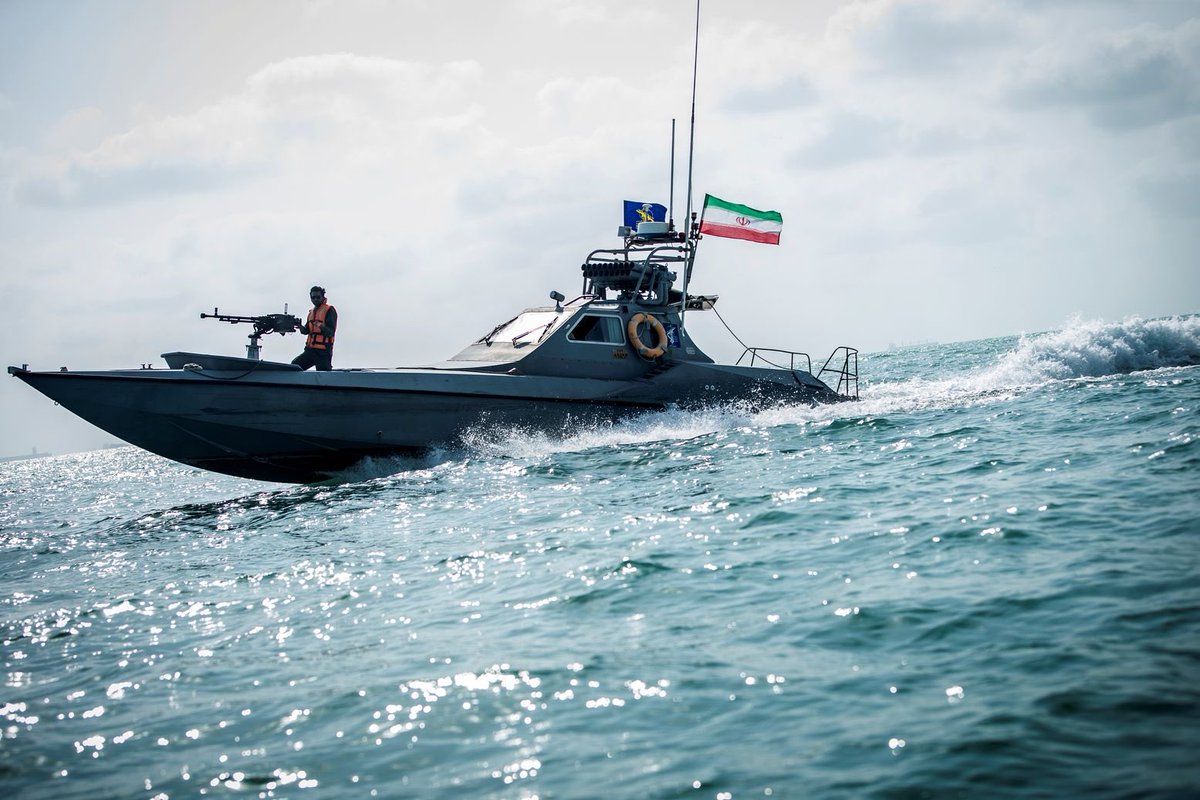
The Strait of Hormuz is not closed. It is sorted.
Iran has built a three-tier access system for the most important waterway on earth. Tier one: allies transit free. Malaysia cleared seven vessels through diplomacy at zero cost. India negotiated zero-fee passage. Pakistan secured clearance for 20 ships. Iraq transits without charge. These countries proved geopolitical alignment and the IRGC waved them through the Larak corridor without collecting a rial.
Tier two: compliant neutrals pay. At least two tankers, likely Chinese-linked, paid up to two million dollars each in yuan through Kunlun Bank intermediaries. COSCO container ships attempted the corridor, were turned back on first approach when documentation was incomplete, then succeeded days later with revised paperwork. These are the vessels that prove the system works. They submit IMO numbers, ownership chains, cargo manifests, and crew lists to the IRGC’s Hormozgan Command. They receive clearance codes. They are escorted by pilot boats through the five-nautical-mile channel between Qeshm and Larak. They pay in a currency that does not route through SWIFT. Every successful yuan transit is a live proof-of-concept for non-dollar energy settlement.
Tier three: adversaries are denied entirely. The committee plan bans American vessels, Israeli vessels, and vessels from any country participating in sanctions against Iran. These ships do not get vetting. They do not get codes. They do not get escorts. They get the AL SALMI, burning off Dubai, as illustration of what the corridor looks like without permission.
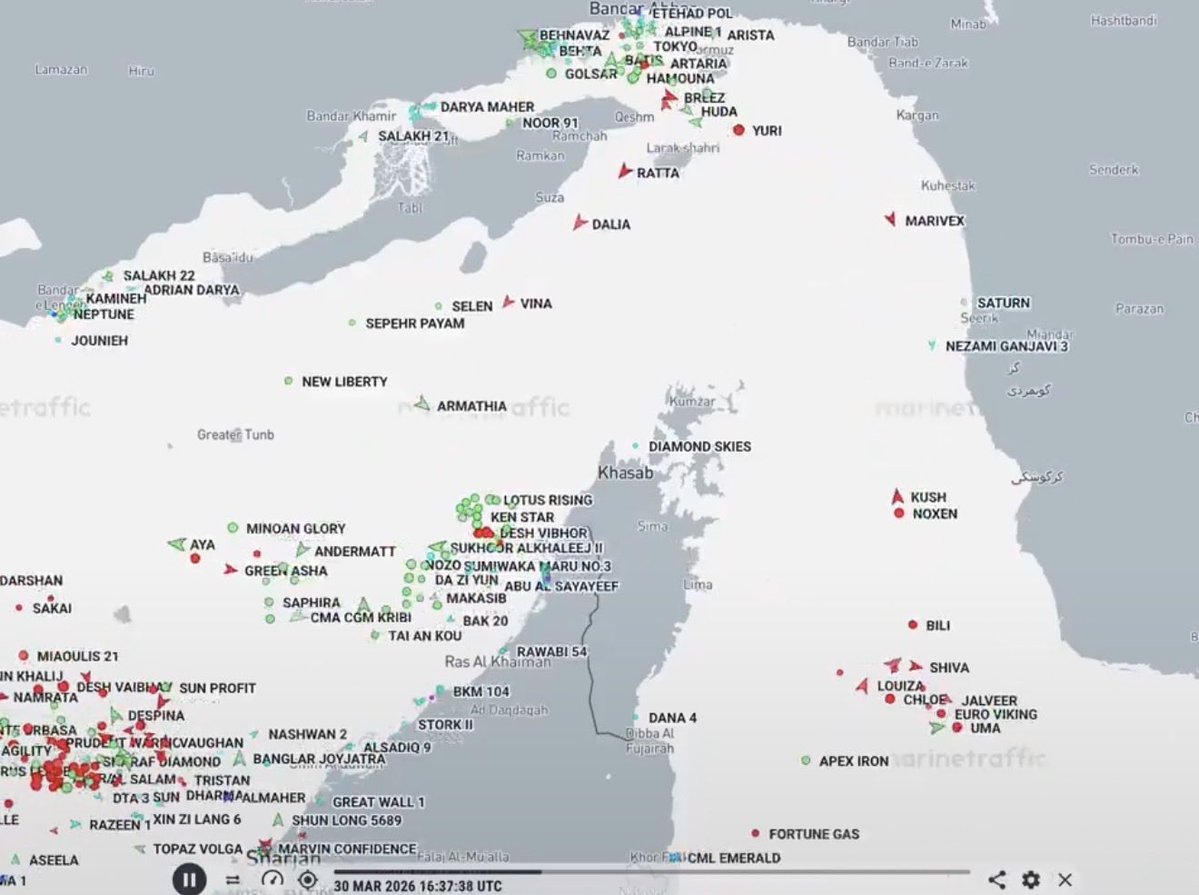
But the toll is not the real cost. War-risk insurance is. Premiums have surged from $40,000 per VLCC transit before the war to $600,000 to $1.2 million today, a 30-fold increase, now running five to ten percent of hull value. A VLCC carrying $50 million in crude oil can absorb a combined $3 million in toll and insurance as a fraction of cargo value. A container ship carrying $5 million in manufactured goods cannot. The insurance premium alone exceeds the profit margin on non-oil cargo. The strait has become an oil-only VIP lane. Crude flows selectively for those who can pay the combined cost. Everything else waits, reroutes around the Cape of Good Hope, or does not move at all.
And the US Navy is not inside the strait. The Abraham Lincoln strike group operates from standoff in the Arabian Sea. Three Littoral Combat Ships sit in the Persian Gulf. Marine expeditionary units are positioned for contingency. But zero American warships have transited the strait or escorted commercial traffic since the war began. The Navy told the shipping industry it has “no availability” for Hormuz escorts. The world’s most powerful fleet keeps respectful distance from a waterway controlled by a country whose navy is 92 percent destroyed because the mines, drones, and shore missiles that remain make close-in presence prohibitively risky.
The result is a geopolitical sorting algorithm operating at the molecular level. One hundred and eighty-one vessels transited in all of March. Pre-war traffic was 138 per day. Of those 181, roughly 70 percent were Iranian-affiliated. The remaining 30 percent were vetted allies or yuan-paying neutrals. The 20 percent of global oil that once flowed freely through this strait now flows selectively, conditionally, and in currencies chosen by Tehran.
Iran lost its air force. It lost its navy. It lost two thirds of its production capacity. It retained the only thing that matters: 39 kilometres of coastline on both sides of the narrowest point. The US Navy will not enter. Chinese tankers will. And the sorting algorithm processes another vessel, collects another yuan payment, and demonstrates once more that geography is the one military asset that cannot be degraded by precision strikes.
The strait is not closed. It is under new management.
https://t.co/dAOBBMrIOk
JUST IN: Ten heavy bombs hit the IRGC Aerospace Forces headquarters in western Tehran overnight. The facility was a command node for ballistic missile coordination and drone operations, buried beneath reinforced concrete in a city of nine million people. Secondary explosions confirmed penetration. Fires burned for hours. Iranian state media acknowledged the strike and claimed “no strategic impact,” which is what you say when the strategic impact is too large to admit on television.
Within 48 hours of the strike, Iranian missile and drone launches against Israel fell to their lowest level since the war began on February 28. The correlation is not coincidental. The command architecture that selects targets, assigns launch sequences, and coordinates saturation barrages was physically degraded by GPS-guided munitions dropped from aircraft that took off from English countryside and Indian Ocean coral. The IRGC Aerospace Forces headquarters was the brain. The brain was hit. The body slowed.
This is the pattern across the entire campaign. Over 200 strikes in 48 hours. B-52s from Fairford delivering JDAMs on bunkers in Isfahan and Tehran. A-10s from Lakenheath suppressing IRGC boats in the Strait. Cruise missiles from Diego Garcia reaching targets beyond surviving air defences. Interception rates above 90 percent. The barrages fewer and less coordinated than at any point since the first week. By every military metric, the war is being won.
And the crisis is getting worse.
The bombs cannot open the Strait of Hormuz. They cannot restart a helium plant that takes three to five years to repair. They cannot put fertiliser on Indian fields before the planting window closes. They cannot stop the 200 cryogenic containers from losing pressure on a thermodynamic schedule that ignores successful sorties. They cannot make 20,000 stranded seafarers less thirsty or convince the IRGC to dismantle a toll system that generates revenue with every $2 million yuan payment. The strikes solved the military problem. The molecular problem is untouched.
This is the paradox at the centre of Operation Epic Fury. The better the bombing works, the less urgent the deal appears, and the longer the molecular crisis deepens unchecked. Every successful strike on a command node makes the next Pentagon briefing sound more optimistic. Every reduction in Iranian launches makes the April 6 deadline feel less like a cliff and more like a formality. And every day the war continues because the air campaign appears to be winning, the helium boils off, the urea does not ship, the rice does not grow, and the 3,000 vessels sit in water that nobody can insure at a price that makes commerce viable.
The war is being won in the air. The crisis is being lost on the water and inside 200 pressurised containers drifting in the Gulf. Both clocks are running. One measured in sorties, the other in molecules. The sortie clock says America is ahead. The molecule clock says nobody is. And the molecule clock does not reset.
Ten bombs hit a command node in Tehran. Attacks on Israel dropped to their lowest level. The air campaign is a masterpiece of precision. And the strait is still closed, the helium is still boiling, the rice is still waiting, and the deal is still unsigned.
The bombs have a five-metre accuracy. The crisis has a five-year repair timeline. Precision does not solve duration. And duration is winning.
https://t.co/dAOBBMsgDS
In January 2026, the United States overthrew Nicolás Maduro and seized operational control of Venezuela’s oil exports. In February 2026, the United States and Israel launched strikes on Iran that closed the Strait of Hormuz. These are not separate events. They are the same strategy executed in sequence.
Before the first bomb fell on Tehran, the US had already redirected 900,000 barrels per day of Venezuelan crude away from China and toward American, European, and Indian refiners. Chevron, Vitol, and Trafigura now market PDVSA oil under General License 52, with all proceeds flowing to a US Treasury account. China’s share of Venezuelan exports collapsed from over 600,000 barrels per day to 48,000 in February, a 67 percent drop in weeks. The US did not announce this as war preparation. It announced it as democracy promotion. But the barrel does not care what you call it.
Now connect the second move. China buys 80 to 91 percent of Iran’s oil exports, approximately 1.38 million barrels per day transiting the Strait of Hormuz. The strait is now closed. Iran’s export infrastructure is under sustained bombardment. Kharg Island, which handles 90 percent of Iranian crude, is on the Pentagon’s contingency list. In two months, the United States has cut China off from its two largest non-traditional crude suppliers simultaneously: Venezuela by regime change, Iran by war. Combined, China has lost access to roughly two million barrels per day of supply it was receiving 60 days ago.
This is why Dar is in Beijing today. China is not mediating the Iran war out of altruism or diplomatic ambition. China is mediating because it is running out of affordable oil. The country that controls 90 percent of the world’s rare earth processing, that supplies BeiDou navigation to Iranian missiles and neodymium magnets to American interceptors, that holds the leverage to end or extend this war, is sitting at the negotiating table because the United States methodically cut its energy supply lines before the first missile was fired.
The grand bargain is not a theory. It is a pressure system. The US needs Chinese rare earths to rebuild 2,400 depleted Patriot interceptors. China needs Hormuz open and Venezuelan barrels restored. The US controls the Venezuelan spigot. China controls the rare earth pipeline. Each side holds a chokepoint the other cannot survive without. The deal writes itself: rare earth guarantees for oil access, semiconductor export relief for Hormuz security, Taiwan status-quo assurance for NPT compliance. Every variable has a price. Every price has a counterparty. And both counterparties are now desperate enough to pay.
Venezuela was the opening move. Iran is the middle game. Beijing is the endgame. The molecule that connects all three is crude oil, and the country that controls where it flows controls the terms of the peace.
The US did not stumble into this war. It secured alternative supply, redirected barrels away from its principal competitor, launched the campaign that closed the competitor’s primary import route, and is now negotiating from a position where the competitor must choose between its rare earth leverage and its energy security. That is not improvisation. That is the most sophisticated energy weapon deployed since the 1973 Arab oil embargo, except this time, America is not the victim. It is the architect.
The arithmetic leads to Beijing. It always did. The only question was whether Beijing would arrive at the table voluntarily or be starved into it. The answer, as of March 31, is the latter.
https://t.co/dAOBBMsgDS