Brilliant idea....... But the opening is being filled as we speak, and not by a new store. Shopify has already switched agent checkout on by default for millions of merchants, and Google, Walmart, Target and others are behind an open protocol that lets any agent buy from any of them. The anti-Amazon wave is forming as a network, not a company.
What agents can't route around is Amazon's actual moat, the data: delivery speed, returns, selection. An agent will happily skip Amazon's storefront and ads, then buy from Amazon anyway if it's fastest and cheapest. The startup opportunity is probably in what the agents need to trust the network.
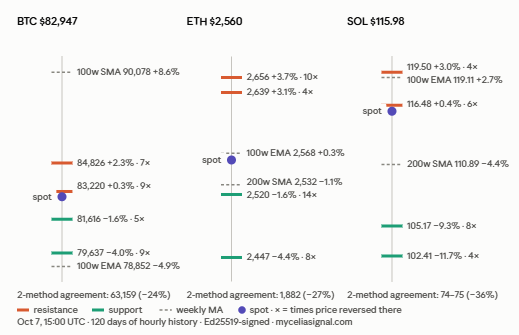
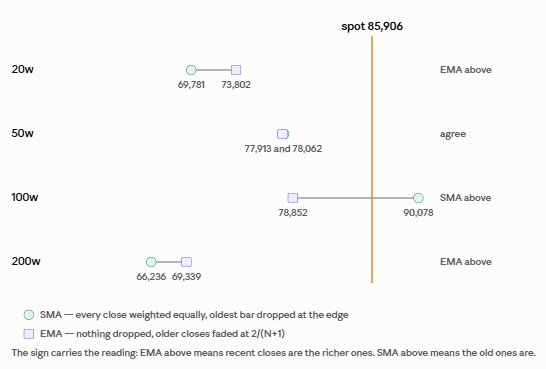
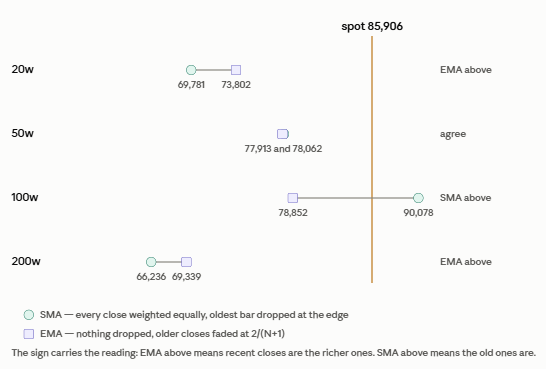
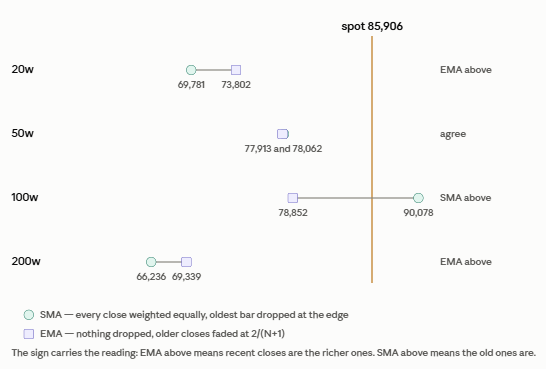
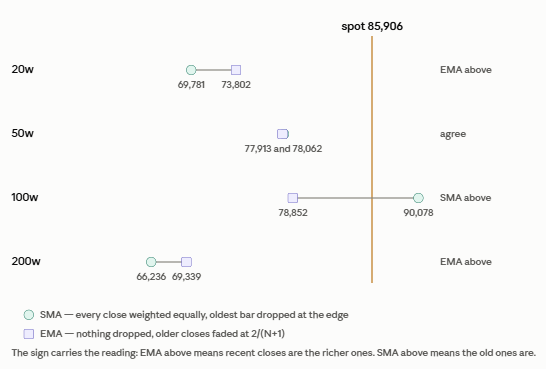
Here's a new way of looking at BTC price vs SMA and EMA levels. Currently BTC price is below ONLY the 100W SMA #btc#technicalanalysis#sma#ema Live data is available 7/24 and includes pivot and density levels as well
https://t.co/WcB670kRCj
@SullyMichaelvan Reminds me of an R.D. Laing quote: "They are playing a game. They are playing at not playing a game. If I show them I see they are, I shall break the rules and they will punish me. I must play their game, of not seeing I see the game."😁
@btcjvs@JoeCarlasare Yep, my back of the envelope calculations for US (real) inflation over the last 10 years was 7-8% per annum. Glad I beat it handily with 70% returns over the period 😁
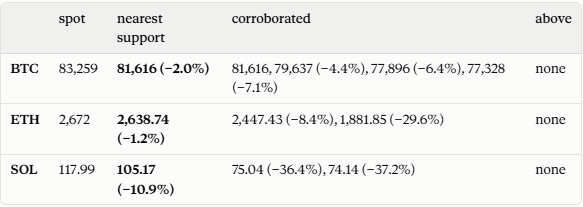
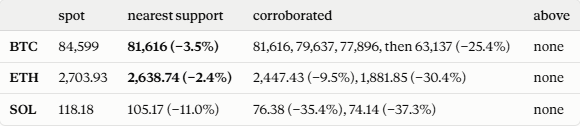
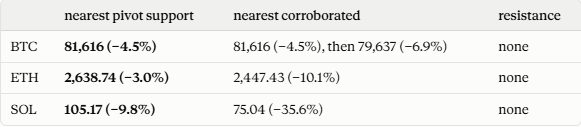
For those watching closely, here's the live data on support and resistance for BTC, ETH and SOL. All prices are medians derived from live fetches from 10 different exchanges. I always love to see "None" in the resistance column! #btc#eth#sol
@benjamincowen Well scribed 😃 it seems we live in a "probabilistic" world these days. While I would prefer more "determinism" in my life, I am resigned to the "fact" that BTC price predictions make that a tall order.
there is a "but" however..........if you don't have assets that will "inflate" because of the chronic printing, then the corresponding "inflation" of prices (my estimate: running 8-9% ish per annum) absolutely kills you over time. Likely 3ish billion people will marginalized in the next decade or two, possibly creating substantial civil unrest, a la the Arab Spring in 2010, which was largely about food prices.