“Even a single collision can generate thousands of fragments, creating a cascade effect that threatens other spacecraft and, in the worst case, could render certain orbits unusable” Why space urgently needs a clean-up #spacedebris https://t.co/1R6XkaanMB
@uyducusirin I have never worked in systems engineering, so don’t know what should be covered when teaching it. All I have done is make sure students are aware of it and refer them to relevant NASA & ECSS documents as a place to get more info.
@uyducusirin It was for a module I used to teach to aerospace master’s students that included a section on aerospace R&D, including TRL’s and the develop process, funding and the current priorities in UK,Europe and the US.
@astrogrant@uyducusirin@DrChrisCombs Thank you. I have explained TRL’s to students many times, I suspect if I had also shown this they would have helped the understand and remember.
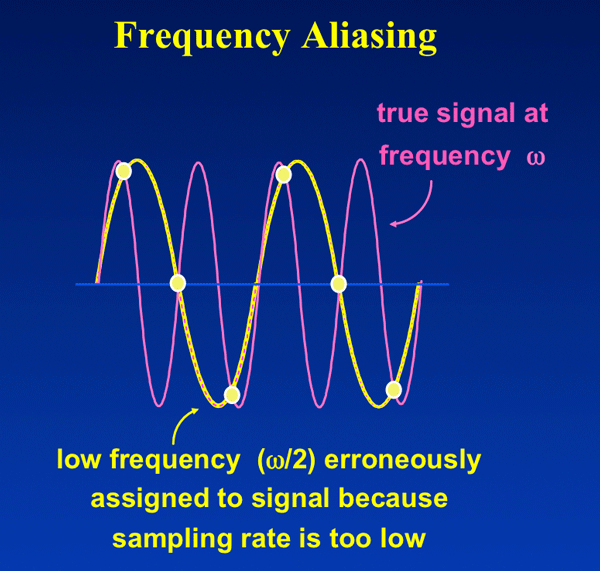
Everyone who loves planes knows the odd videos of the propellor spinning backwards. This is a very interesting example of some thing similar to what happens when you try to do vibration analysis using a signal which has been captured at an insufficient data-rate, when the sample points are taken at just under the actual frequency, Aliasing begins, the effect of this is to give a "false return" that a source signal contains a lower frequency than it actually does.
Here the propellor frequency is higher than the frame rate of the camera, the frames are taken at the position of the yellow dots in the image below, whilst the actual propellor frequency is the pink curve.
To (nearly) guarantee this doesnt happen, you need to sample at ABOVE TWICE the highest source frequency. At certain relationships between the source and sample frequency, the blade can appear not only to spin too slowly, but actually spin backwards. Picture it like watching a propellor spin, and give your eyes an infinitely fast shutter speed, now if you "blink" at a speed just a bit SLOWER than the propellor blade passing frequency, it will appear to spin backwards. The "frames per second" of the video camera, is you blinking.
This is known as the Nyquist Rate, which was just the name of the person who figured this out, Harry Nyquist, he was born Swedish and so has an "odd" name, later setting in the USA.
Its essentially common sense really, but Nyquist conducted the early work, it was later formalised in 1949 and thereafter known as the Nyquist-Shannon Theorem.
This is one reason why it is very important if you are interested in serious damage prevention and analysis, that your data logger is sampling at the highest practical frequency, and needs some internal cleverness, to "chop away" any frequencies which are above the Nyquist limit, before they are stored, because if you dont, you can store false vibration frequencies.
In an air accident investigation, this may become very problematic, especially when audio from amateur video is used as a data source where it has very possibly been recorded without being first passed through an anti-aliasing filter.
Interestingly much the same thing happens in 2D images ! Which is why the term "anti aliasing" is known to all computer nerds in a non-audio context.
Your regular reminder (thanks to @planet4589) that the Hubble Space Telescope's lifetime is limited by how angry the Sun gets, since the Sun puffs out Earth's atmosphere and increases drag on HST. We should be OK until the 2030s, but HST lost a bunch of altitude last year.
Its absolutely nuts that some very high up people are seriously suggesting that young people should not learn code anymore because AI will do it.
For a start, its actually irrelvant even if it CAN, because this is no different to asking your big brother at school to do your homework for you.
Yes, he CAN, but the result wont be something you`ll understand, own or grow from.
Secondly, its also very shortsighted, because writing it yourself, forces you to think carefully and logically though a problem, often its only when you start writing the equations in, and looking at the results that you start spotting things you`ve forgotten, omitted or just got plain wrong.
This is EXACTLY the same as the act of writing your spoken language, writing focuses the mind and teaches you about what you`re writing about AS you`re doing it, because the act of having a thought, writing it out, and LOOKING at what you though of in front of you, is a profound and powerful learning tool.
If you`re at school, or college and are reading this, do NOT under any circumstances listen to anyone who tells you not to learn computer programming "because AI" blah blah.
AI in its current Large Language Model form, has many uses, but I view it as a useful assistant, not an older brother to whom you lazily palm off tasks to you cant be bothered to learn.
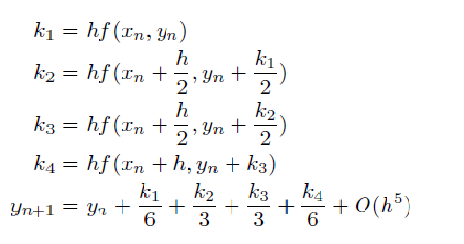
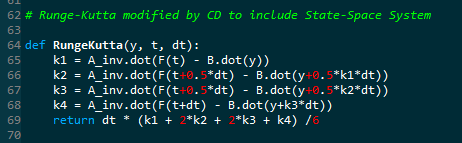
Here is now to employ a Runge-Kutta 4th order numerical solver in Python.
GPT can probably write you this in 3 seconds, but you wont know what it does or why. I use this to make time domain torsional vibration models for engines.
Make the German mathematicians Carl Runge and Wilhelm Kutta happy, go and read their equations, and type them in yourself, and own it.
I`ll let you in on another secret, unless YOU write your own code, you will NEVER really enjoy it, the buzz when your code works - will instead feel just like it did when you handed in your homework - that your brother did.
Empty.
ISN Breaking News:
(cc: @straczynski)
Babylon 5 Is Now Free to Watch On YouTube
"The strategy involves posting one episode each week, allowing audiences to experience the story at a paced rhythm that mirrors the original broadcast schedule."
https://t.co/Z0JM8cGEd8
Engineering and aerospace is full of twists and funny turns, where clever people are concerned even ostensibly negative occurances can end in good.
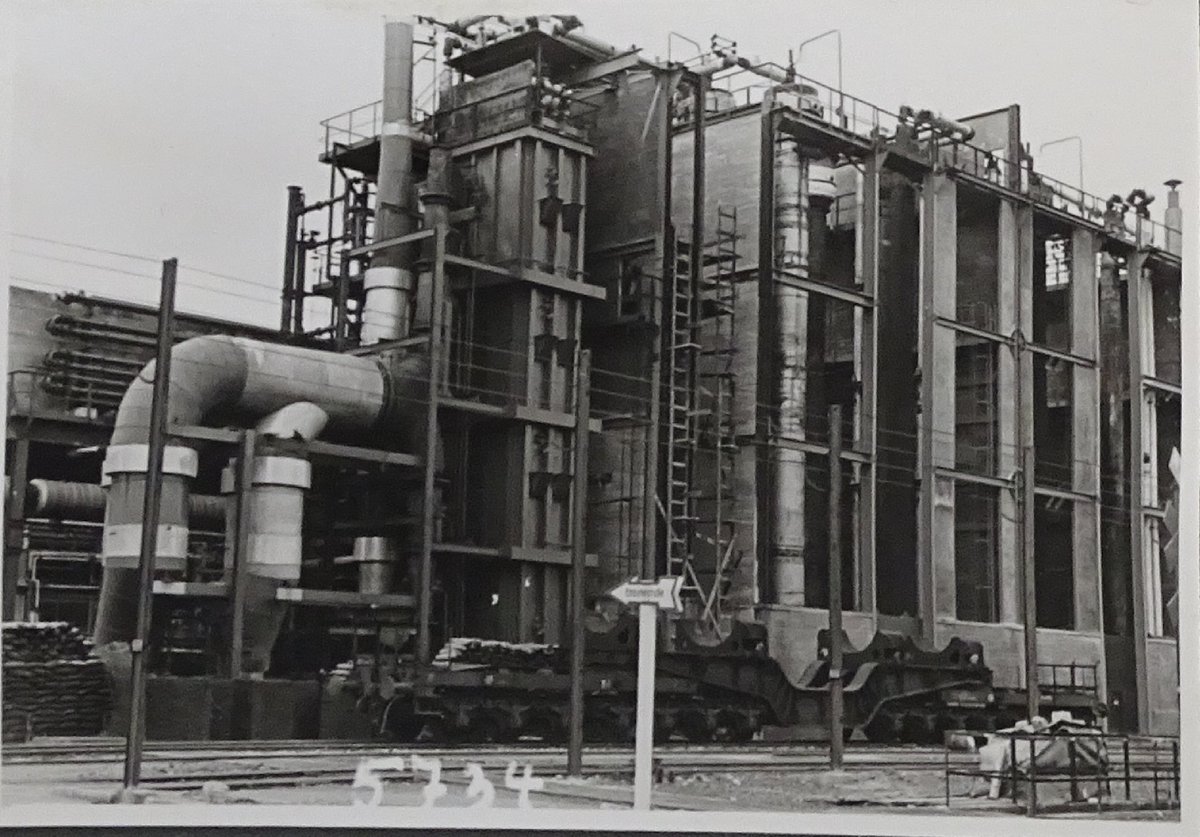
Below, is the sad remains of one of the most advanced turbojet testing and research establishments on the planet earth. This almost unknown site in a small town in England was the NATIONAL GAS TURBINE ESTABLISHMENT (NGTE).
NGTE was able to ground test turbojet engines to equivalent Mach 3 up to 70,000feet, it had the largest compressor drives in the western world, at over three hundred thousand horsepower.
In CELL 4, Concordes OLYMPUS engines were ground tested to 2000mph equivalent, at the time, this was globally unprecedented.
Today, it lies defunct, a victim of the enormous energy costs of conducting such tests, the move towards simulations, and the lack of any indigenous military supersonic turbojet programmes to make use of its astonishing facilities.
For decades however it was pivotal in western cold war jet development, at its peak 1,600 people worked there, and the site grew to the size of a small town.
Before his death, I discussed NGTE with former Director Frank Armstrong, who considered that only a brand new indigenous military turbojet programme would have been able to save Pyestock (as it was known before being renamed NGTE, due to the name of the town nearby).
NGTE however was born from equally sad beginnings. As British turbojet work ramped up, eventually in March 1944, Frank Whittles firm POWER JETS, was taken into government ownership, and directed to concentrate on research. Many of the staff felt this was a misuse of their group, and sixteen of the enginees (eventually including Whittle) resigned.
The story made the news, and in THE TIMES newspaper on 15th April 1946 it was recorded:
“…some of them will pass out of aviation altogether… Whittles successful design team has therefore, been dispersed, and there is little hope of it being reformed.”
Despite this seemingly appauling event, to one of the most important groups of engineers who had ever worked together in Britain, all was not lost, for POWER JETS was reformed into the NGTE, seeing Britain through its glory years of the Turbojet, and Concorde.
The once incredible site, at the very pinnacle of global aerospace science, is now a newbuild housing development and shopping center.
Perhaps, something new can be born from the ashes, as happened at least once already, but it till take a government with vision, clarity and a committment to science, something which has not even been heard since 1963, when British Labour leader Harold Wilson, made his famous speech on his vision for the "white heat of technology" which outlined his vision for a modern Britain driven by science and technology.
Something that despite his failure to enact it, due to huge inherited deficits, the 1967 Sterling devaluation, and a failure to address a more general lack of industrial investment, whilst focusing only on R&D, appears entirely absent even as an ambition, in todays dire political offerings on all sides of the house.
The current Downing Street cabinet have just 2 out of 27 members with a scientific or engineering degree of any kind, so the rebirth will have to wait a little longer...
As Bath University noted on 18th August 2021:
"Greater scientific expertise needed in Parliament to improve decision-making. A new academic study finds that an over-representation of MPs with social sciences backgrounds limits debate on STEM topics."
In WW2 history, with the possible exception of Chamberlain`s policies in the 1930`s and entrenched views about Britain vs. Nazi Germany`s relative level of organizational prowess, almost nothing is as badly explained, misunderstood, and stupidly presented as that of aircraft fuels in the Second World War, which as it was the first "Air War" was utterly pivotal.
I have helpfully pre-prepared a 1/4 million word treatise for you on this topic. However, accepting that this might appear to be an unreasonable response to a reasonable question, I will do my best within the laws of space and time to explain a few of the more important aspects of that in a shorter format.
Fuel in an aeroplane can make the difference between basically the same plane going at 350 or 450mph, which is the rough difference in top speed between a pre-WW2 plane, and the peak of final wartime development, in other words, the difference between being shot down immediately witout even seeing your attacker, and winning a war (or at least being one of the prerequsites to it).
The fuel in a WW2 fighter (and any petrol engine) needs to do several things very well all at once.
1) To not boil at low pressure, otherwise it will boil in the fuel tanks in the wings and in the float carburettor float bowl (which is connected to external atmosphere, if you`re daft enough to use a float carburettor.)
2) To DEFINETLY boil at a temperature LESS than the oil temperature of the engine, or, the fuel will progressively accumulate in the oil, and slowly destroy your bearings, as it is very thin compared to engine oil.
3) To not eat your fuel tanks and fuel lines and rubber seals (useful chemicals such as Methanol and sulphuric and nitric acids tend to do this, these acids carry extra oxygen which are chemically very useful)
4) To not immediately kill everyone who touches it (unfortunately many very useful fuel type chemicals are absurdly toxic and can kill through simple skin exposure)
5) To not explode if roughly handled (sadly making Hydrogen Peroxide and pure oxygen rather tricky)
6) Not to burn invisibly, Methanol does this, and is quite unamusing as everyone else just sees you running around shouting, apparently at nothing, until you die.
7) To be able to be made in millions of gallons and distributed all over the world in simple barells without going "off".
8) To burn instead of exploding with a shockwave when ignited at extreme pressures and temperatures, the ability NOT to do this was known as the Octane number, higher being "better". The higher this number (sort-of) the more power you can get out of the engine, as you can shove more air and fuel into the cylinder with a massive supercharger which means more atoms reacting and more energy release.
9) To preferably be supplied irrespective of enemy trade interventions, which basically means you have to make it with your own equiptment and raw materials.
There are more, but you get the idea, making aeroplane fuels is bloody hard work.
In the early days of the first world war, almost nothing was known about any of the above, and the engines started off with the carburettor being a bit of rope with one end dunked in the fuel tank. Fuels introduced thusly, had only one overriding reqirement, to be easy to evaporate, since this was linked to the specific gravity of the fuel, in WW1, aero engine fuels were graded by sticking them in a bucket and weighing them !
This soon proved to be of only limited use as some engines started blowing themselves to bits anyway, and it was realised that some fuels burned "nicely" and some "grumpily".
Eventually in the USA this resulted in the Co-Operative Fuel Research Committee being formed in the 1921, and the Waukesha company was tasked with the design and manufacture of a standard test engine which would be used by all firms for testing new fuels. Thus in 1928 was born the first “CFR” Test engine (Co-operative Fuels Research). It operated by moving the whole cylinder head up and down relative to the piston crown with an easily adjustable mechanism. Which was regarded at the time as a far better solution than previous methods which included taking the cylinder head off and installing a thicker head gasket to decrease the compression ratio. The man mostly responsible was the Chief Research Engineer, Arthur W. Pope. Thousands of engines were built and sent all over the world in the following years. It was a tremendous commercial sucess.
This led to the invention of the "Octane" number, where zero octane was how Hexane reacted to being burned (it merrily exploded at the slightest provocation) and 100 Octane was how Iso-Octane behaved, which was very stoic and burned predictably and nicely even when boosted to high pressures in the cylinder.
In Britain Sir Henry Tizard, Randal Pye and Ricardo collaborated and came up with the "Toluene Number", which was in theory even better, because Toluene was even more stoic than Iso-octane. However, for reasons nobody really understands from a technical perspective, the Octane scale stuck.
There was however, as Captain Blackadder liked to say, "ONE... SMALL...PROBLEM". The Octane scale was only useful as it was better than literally weighing fuel in buckets on a bathroom scale.
But, it was tested on a laboratory engine, which bore NO resemblance in any design respect to the engines in aeroplanes (or cars) at ONE specific speed and ignition point. It was in fact possible for a fuel with a higher octane number to have LOWER power in one engine type than another.
The engineers to first realise and record this, were of course the Germans. For they had pursued Direct Fuel injection, after the British had thrown away a lead in this technology in the 20`s, and had understood tha the nuances of the new state of the art aero engine made the octane number worthless. By the mid 1930`s German aero engine designers consigned the conventional octane number to the scrap heap.
However, they had rather serious supply issues, and after experience in the first world war, they realised that since there was almost no crude oil in Germany, and that neighbors got grumpy after wars started that they needed to get fuel by "other means".
They invested heavily in the Bergius Hydrogenation process, which involved compressing Hydrogen gas and carbon rich slurry together under immense pressure. Obviously reacting the carbon and hydrogen to create Hydrocarbons..... of almost any type depending on the process control. In other words fuel and oil.
To get both of these you need only ONE thing, Coal mines, which Germany had in VAST quantity.
In the 1930`s Germany began building a huge Hydrogenation fuel capability, which could in principal produce virtually ANY Hydrocarbon needed. But, there was a catch, with the type of coal Germany had, if you wanted to run the plants to their maximum throughput, you ended up with fuels very high in "Aromatics", Benzene, Toluele and Xylene. These just so happened to give you extraordinarily high engine power but ONLY if you ran the engines at fuel rich mixtures. At lean mixtures needed for economic running, they were average.
What were to become the Allied countries had no such worries, Britain had an enormous global empire with numerous productive crude oil sources, and the USA was so full of crude oil it was almost farting through the rivetts.
However it was actually surprisingly difficult to make really outstanding fuels without additives to boost the Octane number, the best that had been found, through trial and error, was Tetra-Ethyl-Lead, and its manufacture was guarded by US patents. But commercial skullduggery was at work, and the US Firm Ethyl Corporation, sold Nazi Germany the complete plans to build T.E.L. manufacturing plants.
This was though hardly bucking the trend, because who had invested in, build, and even underwritten the German hydrogenation fuel plants?
Britain and America, this we know as sheepishly in WW2 intelligence files, the British lay out why they knew nearly everthing about German aviation fuel plant capability, we had the reciepts. For Britain was also interested in Hydrogenation, we had the 5th largest coal deposits on earth (Germany being 3rd) and the diffiulties to supply which U-Boats might pose had not been lost on us. Britain also embarked on a large fuel from coal programme with I.C.I., the goal was that a battle of the size of the Battle of Britian, could be supplied by our own coal alone, with no supplies from America. Own own fuels chemists on our Hydrogenation Programme kept close tabs on that which was happening in Germany.
Although Britian had this contingency in motion, we had also since 1935 been in close contact with the US Army Air Corps, about supply of aviation fuel from America, the USA had pioneered the Alkylation process, which enabled production of a huge volume of the Octane scale top reference fuel at economic cost.
Britain planned for it, but we built our own synthetic plants at vast cost anyway, in case a U-Boat embargo prevented imports.
Germany meanwhile had built a massive underground system of fuel storage sites under a fake trade name "WIFO" which was ostensibly a trade organization, but was really, a secret military avaiation fuel storage capacity, they began purchasing vast volumes of fuel from abroad to fill the tanks.
When the Lufwaffe began operating they were using foreign imported fuels, and slowly the migrated from 1939 to 1941 to their own synthetic fuels from coal.
However it was very rushed and disaster struck twice in sucession, first the latest (and in my view very best) Messerschmitt Bf 109-F model with a new engine, and array of aerodynamic advances such as radiator boundary layer bypass, started dropping out of the sky.
After months of investigation, it was found that the new fuel tanks, made of synthetic rubber impregnated fabrid, safe with the generic internationally sourced fuels, reacted chemically to the German synthetic fuels, ruining its octane resistance. The reaction took 2 weeks to occur fully which made diagnosis extremely difficult.
At about the same time, the engine bearings were being destoyed, after the German synthetic fuels were modified at the last minuite to maximise production rates, the modified fuel, evaporated at too high a temperature, and so the direct injected engines accumulated fuel in the oil gradually until the bearings gave out once the fuel fraction in the oil reached about 15%.
These problems were solved eventually, but the Germans were left a quandry, their fuels, could only perform at their best with very fuel mix mixtures, which meant very high power. But, they had run out of Cobalt and Nickel, which rendered their valves suceseptible to corrosion, which generated lethal detonation.
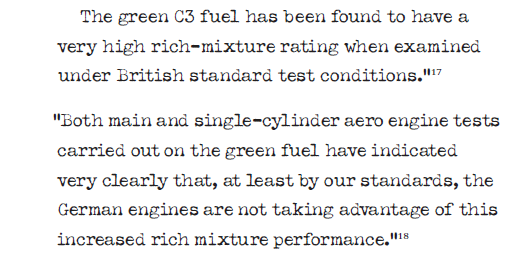
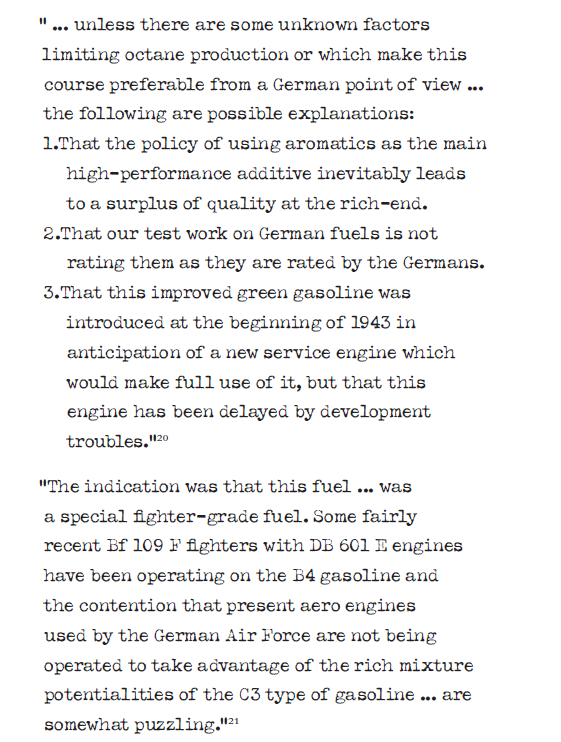
British Intelligence, being immensely well infomed and capable, with the scientists from I.C.I. who had helped Germany build their infrastructure, discovered it first, "it is a mystery" they wrote... wht the Germans are not using aero engines with extremely high power, because their fuels clearly permit it.
The Germans could not, becuse their metallurgists were powerless to use the fuel to its potential, which was always equal to or even better than the best Allied 100 Octane fuel throughout the whole war.
This led to the idea that German synthetic aero engine fuel was useless, in fact a lot of it was of low potential, but their top grades, C2 and C3 were probably better in terms of maximum power potential to even the ultimate Allied 150 grade fuel of 1945, but this was never realised in combat due to metallurgically induced hot corrosion of the valves, which capped the maximum possible supercharger boost pressure.
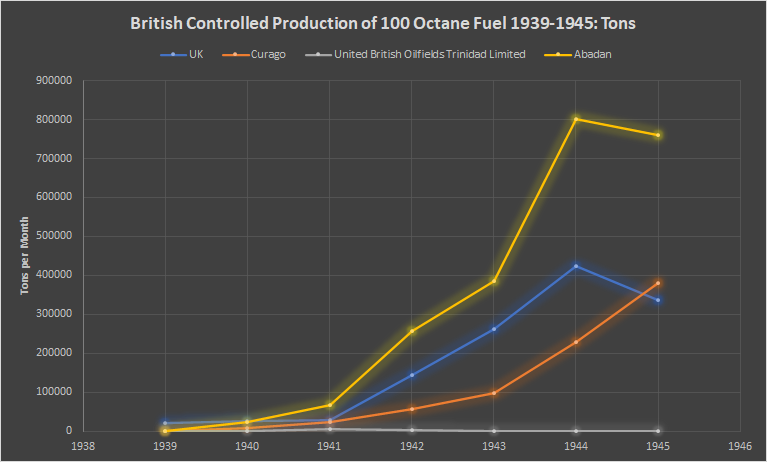
The British, once it became clear that US imports would be able to satisfy R.A.F. requirements, stopped erection of an even bigger synthetic fuel plant, but the British synthetic programme operated throughout WW2 supplying aviation fuel for the R.A.F. Had it been needed, it would likely have been able to supply the R.A.F. with aviation fuel in the Battle of Britain, although once the immense air fleets of 1944 had materialised, with 1000 bombers per raid plus escorts only the fuel from the USA and the British empire combined was enough to satisfy it, just.
In short, the Allies had reliable, consistent fuel, and engines with the metal alloys to take maximum advantave of them.
Germany had in some ways more advanced fuels for maximum power but due to the requrements to push for maximum throughput, were hadicapped with constant changes in the fuel composition and engines which never had the metals needed to make the most of them. Because their fighter fuel was necessarily of aromatic compound, it naturally produced this huge excess of power potential by default, which is why they kept making the C3 fuel in addition to the very basic 87 octane "bomber fuel" B4. C3, at rich mixture, had an effective octane number at rich mixture of about 150+ octane.
Because the Octane scale "ended" at 100, anything above it was called the "Performance Number" which was a simple multiple of its performance at 100 Octane, a fudge which would probably not have been needed had Toluene been chosen as the top reference scale as the British scientist Tizard had wanted....
So to this day, German fuels are regarded as useless and Allied fuels are regarded as superlative.
Neither is an accurate statement because the qualities of he fuels and the chemists behind them did not manifest in terms of the measured performance potential of the fighters and bombers which used them.
When SHELL Thornton Aero Engine Laboratory tested the BMW 801 aero engine on British 100/130 octane fuel, as opposed to the original German C3 fuel, the power went DOWN.
Here is one I know not a single person here has seen, a P-51 Mustang wing being tested in France in WW2 under German direction at the Chalais Meudon wind-tunnel.
Whilst like the Mosquito, I`m also often banging on about the Mustang, the qualities of the P-51 are often centered on aerodynamic drag.
However its actually a far cleverer aircraft than just that, like the Fw190, the Mustang has exceptional aileron control, especially at high speeds.
This means it can (crucially) retain its roll-rate at very high speed, meaning it can outperform fighters which may be nearly as fast but have inferior controls.
The Mustang has a flexible fabric web, between the leading edge of the aileron and the inside of the wing structure, which in effect "seals" the upper and lower side of the aileron as two separate chambers.
When the pilot rolls left or right, the ailerons pivot, and air is either forced into or out of these chambers, the pressures act such that the aero forces dramatically lower the control effort required by the pilot to actuate these control surfaces. This means the P-51 maintains outstanding acrobatic performance at speeds when fighters like the 109, start to develop very heavy controls.
The French aerodynamicists reported:
"The most important result of these measurements is the powerful force compensation effect obtained through the internal connecting fabric web. Such a design must be recommended whenever a strong additional control compensation force must be achieved using rapid and easy-to-implement methods. This obviously assumes that the compensation fabric and the wing thickness leave the necessary space for the aileron's physical movements. The pilots control stick effort curves are nicely rectilinear, and unlike the compensation obtained through usual methods, errors in the build prescision of the surfaces here have very little influence as long as the slots chosen are sufficiently wide"