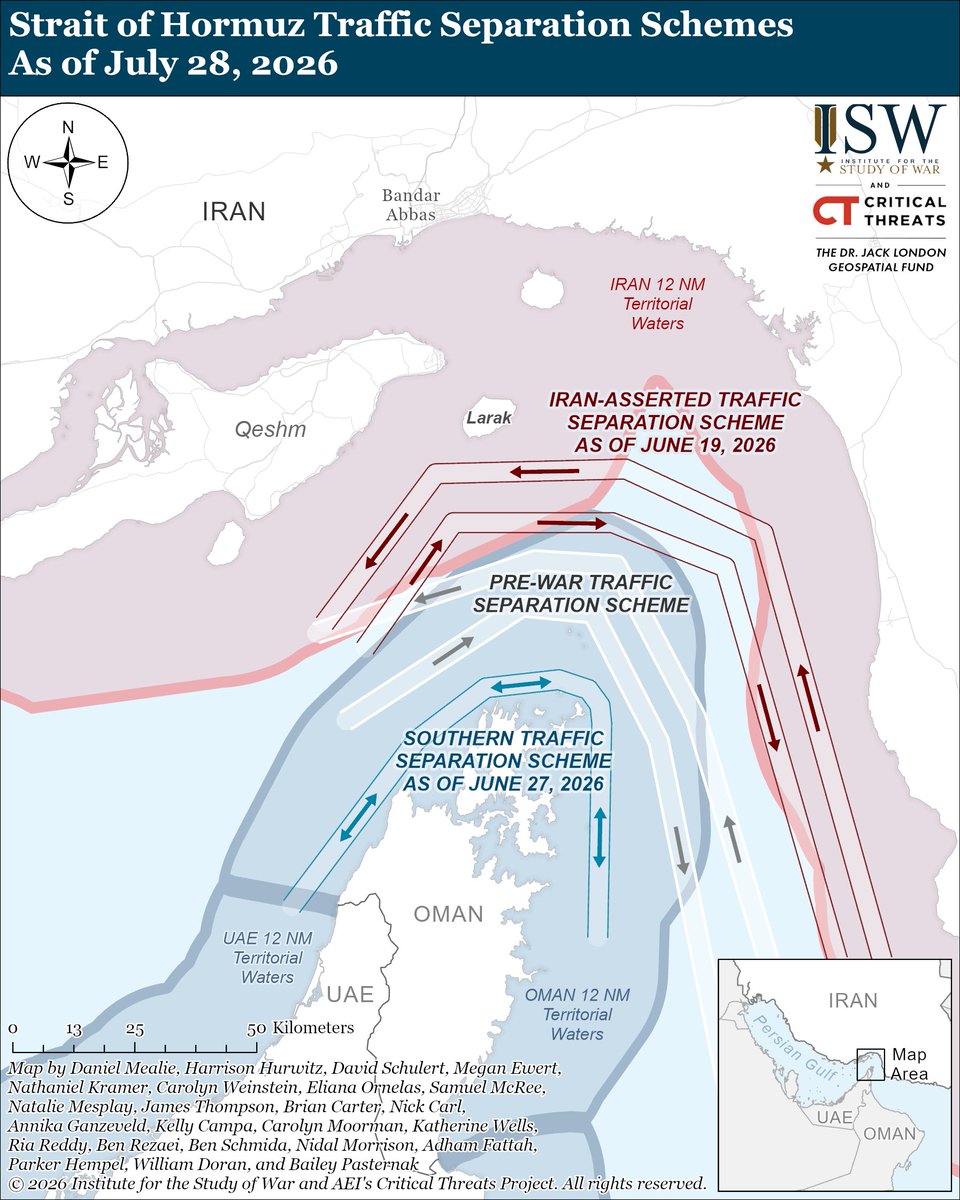
After a brief lull in fighting, the U.S.-Iran war is heating up again this week—and it appears to be pulling in more countries. https://t.co/feImNjexil
A Roadmap for Completing the Implementation of President Trump’s Comprehensive Peace Plan in Gaza
Principles:
1. All parties reaffirm their commitment to President Trump’s Comprehensive Plan to achieve peace in Gaza, which constitutes, together with the UN Security Council Resolution no. 2803 (2025), the agreed upon international framework guiding the implementation of this process. Through this process, the parties aim at ending the cycle of destruction, securing the complete Israeli withdrawal from Gaza Strip, restoring normal life, enabling Palestinian governance, reconstruction, security, recovery and economic development, rehabilitating damaged sectors and facilitate launching a credible political path that achieves self-determination and Statehood.
2. Israel shall fully complete, without delay, all remaining commitments under Sharm Sheikh Protocol, particularly the cessation of military operations as detailed in annex (1). Hamas and the Palestinian factions shall complete the cessation of all military operations in accordance with Sharm Sheikh Protocol and the Peace Plan. In parallel, the timetable and implementation mechanisms of this Roadmap (“Implementation of Phase 2”) shall be prepared within 14 days after all parties approve the Roadmap, which could be extended by a decision by the International Verification Committee (IVC). Upon the completion of the timetable and implementation mechanisms, the National Committee for the Administration of Gaza (NCAG) shall enter the Strip and start to assume its responsibilities. The IVC, that shall be established by the Board of Peace (BoP), comprising representatives from the guarantors, BoP and the International Stabilization Force (ISF), shall certify that both parties fulfill their commitments under the Roadmap before proceeding to the implementation of Phase 2.
3. Progression from one phase to the following one shall be contingent on the verified completion of the commitments of the previous phase. This verification shall be done by the IVC, which shall also observe any violations by either party through an enhanced monitoring mechanism.
4. Hamas and other factions agree that all civilian governance and security functions in Gaza shall be handed over to NCAG in accordance with President Trump’s Comprehensive Peace Plan in Gaza. They also assert that NCAG shall enjoy full independence in carrying out its responsibilities and that the factions shall not interfere in NCAG affairs during the transitional period, in accordance with UNSC Resolution 2803 (2025).
5. Upon fully assuming its responsibilities in Gaza, NCAG shall maintain the continuity of civilian institutions and public services.
All civil servants shall be treated lawfully, fairly and with dignity with respect to their rights. Those whose services are terminated or who are retired during the transitional period shall receive their rights in accordance with the Palestinian law.
With international support, NCAG shall carry out a comprehensive audit of the financial and administrative affairs in Gaza, and protect, recover and administer public assets and resources.
NCAG shall seek to assess the legitimate commitments to suppliers, contractors and other parties – up to a total amount of no more than $400M USD - and address them.
The implementation of these measures will be undertaken gradually, within three years, in accordance with priorities determined by the NCAG.
Any unresolved financial rights, liabilities or claims shall be addressed within the context of a wider national process later, and in accordance with the relevant Palestinian law.
Board of Peace officials reveals contents of disarmament proposal accepted by Hamas, while top Trump aide warns Israel against trying to obstruct the deal from moving forward
👇👇👇 https://t.co/MRW0FHcYJG
A joint-production agreement gives Israel final say over the Iron Dome’s air defense batteries use.
Now, U.S. lawmakers are looking to expand that relationship beyond missile defense to encompass a range of technological areas, including AI. https://t.co/bcjV4p07Ic
"Hundreds of Jordanian political, legal and other figures signed an open letter last week calling for the withdrawal of U.S. forces from Jordan in a rare public challenge to the government..." from @RajaAbdulrahim
🎁 Free Gift Link:
https://t.co/Sjfx70XhL5
Officials now believe the IRGC is firmly in control of Iran’s decision making, leaving political figures the US has been talking with as figureheads.
Complicating matters are internal dynamics of the IRGC itself, where a handful of senior commanders are all jockeying for control. That is a leading reason why US officials & regional partners fear the conflict is likely to drag on.
New reporting w/ @Kevinliptakcnn & @jmhansler https://t.co/BDFblmerb9
Quoted here in @jchaltiwanger's piece in @ForeignPolicy 👇
Some experts say it shouldn’t come as a shock that Iran is leveraging its influence with militias in Iraq to cause problems for the United States and its allies. Though Iraq has not been a focal point in the U.S.-Iran war so far, it’s debatable whether this week’s strikes represent the opening of a new front.
“We shouldn’t be surprised,” Victoria J. Taylor, a former deputy assistant secretary of state for Iraq and Iran who is now at the Atlantic Council, told SitRep. Iraq has been “frequently pulled into regional conflict” over the years, “particularly when Iran feels it’s useful to do so.”
The United States in recent years has repeatedly targeted groups such as Kataib Hezbollah, the most powerful militia in the PMF, in response to attacks on U.S. forces and facilities in the region. But the recent uptick in attacks by Iran-backed militias in Iraq, including on Saudi oil facilities, is part of a “broader Iranian effort to increase pressure on the United States and the region,” Taylor said.
The United States has warned Iran-backed militias in Iraq to cease attacks if they hope to avoid “further U.S. military response.” But much like the U.S. air campaign against Iran has failed to break Tehran’s resolve, it’s also an open question whether strikes will lead to a shift in behavior from militias in Iraq linked to Tehran.
“The real challenge in confronting the militia activity is that the most hard-line militias within Iraq are the most responsive to the Iranian regime,” Taylor said. “You can try to strike some of these bases, but it’s not likely to significantly degrade the capabilities of these militias, which are very strong. They’re dispersed throughout Iraq—very deep networks. And it’s also very unlikely to impact the decision-making. I see no evidence that Iran will think twice about directing further militia attacks if the U.S. manages to take out a small number of militia fighters.”
Is the U.S.-Iran War Expanding? - Violence is escalating, but it also follows familiar trends. https://t.co/pPIZUzgHdY
Iran Update Special Report, July 28, 2026: Three competing groups within the regime are attempting to influence negotiations policy. The group currently arguing for negotiations and total control over the strait is likely guiding policy at this time. This group is likely led by elements of the Islamic Revolutionary Guards Corps (IRGC), including IRGC commander Major General Ahmad Vahidi.
More Key Takeaways:
The “IRGC-Vahidi” group is under pressure from a pro-negotiations and pro-compromise group that likely includes but is not limited to President Masoud Pezeshkian, Foreign Affairs Minister Abbas Araghchi, and Parliament Speaker Mohammad Bagher Ghalibaf. This group primarily disagrees with the IRGC-Vahidi group over means, not ends. This group also seeks “control” of the strait, though its definition of control may be less expansive.
The third group is an ultra-hardline faction, the Paydari Front, which opposes all negotiations with the United States. This group is a small minority, but its proximity to power through regime insiders like Saeed Jalili, who is currently a Supreme Leader representative on Iran’s top national security decision-making body — the Supreme National Security Council — and previously chaired the council, would likely require Vahidi and other policymakers to take note of its views.
Concerns from pro-negotiation corners in Iran over continued US sanctions, the US blockade, and economic damage from the war underscore the risk Iran faces in continuing the war indefinitely. Economic challenges caused by the US blockade were among the reasons why Pezeshkian argued the Memorandum of Understanding’s (MOU) case to the supreme leader in June, according to the New York Times, which indicates that at least some regime actors believe the present situation is untenable for Iran.
Iran continues to reject compromises to Iranian control of the Strait of Hormuz because hardline decisionmakers perceive control of the waterway as the regime’s most reliable means of preserving future leverage. Iran is refusing to give up control of the strait in talks with Omani mediators as the mediators have proposed a formal 10-day truce, according to a US official and mediators speaking to Western media on July 27.
The Houthis claimed to have struck a Saudi vessel on July 28, marking their third claimed attack on Saudi shipping since July 22. Houthi military spokesperson Yahya Sarea announced on July 28 that the Houthis fired several ballistic missiles targeting the Saudi-flagged oil and chemical tanker NCC Ghazal for “violating” the Houthi blockade.
The People’s Republic of China (PRC) reportedly asked the Houthis to facilitate safe passage for Chinese-owned oil tankers through the Red Sea, according to six informed sources speaking to Reuters on July 28. Reuters, citing commercial ship tracking data, reported on July 28 that at least four tankers transporting Saudi oil to China transited the Bab al Mandeb since the Houthis announced their blockade on July 20. (1/2)
NEW: The Pentagon explains this new DCAS classification for KIA/WIA for the Iran war.
They say that it is necessary because Op. Epic Fury has concluded.
When asked when it concluded, officials wouldn’t provide a date.
Last week they claimed it was a data glitch.
Necessarily speculative, but if IRGC-AF used Emad rather than the more sophisticated Kheybar Sheikan (used with success in recent days), this "surprise attack" was meant as a signaling exercise--a warning shot--rather than a serious effort to break through AD and cause damage.
Reuters: Iran is expected to receive within weeks a first shipment out of up to 400 Chinese-made shoulder-fired air-defence missile launchers, three sources familiar with the deal told Reuters, as it rebuilds its defences amid war with the United States.
Interested tidbit from today's Trump-Bibi meeting, according to an Israeli official:
Before the two men left for the funeral, Netanyahu mentioned to Trump that Graham was the greatest friend to Israel. But Trump argued that no, Trump actually is.
The latest round of Hormuz talks ends, predictably, with Iran yet again rejecting Oman's compromise proposal.
This from Iran's deputy foreign minister is quite blunt: they are insisting on a deal that restricts what Oman can do in its own sovereign waters.
"The inbound shipping lane must be entirely under Iran's control, while part of the outbound lane may remain under Oman’s control." https://t.co/aGYTa6PAlh
On three occasions since 2020, Trump has been presented with the possibility the Russia is involved in targeting US troops.
Each time, he's basically shrugged it off.
https://t.co/WS3vJo8KHx