Director, Iraq Initiative @ Atlantic Council | Former Deputy Assistant Secretary for Iraq/ Iran @ StateDept | National Security Leader on Middle East and Europe
The departure of US troops represents an opportunity to turn the page on the United States’ complicated history in Iraq, but it should not lead to an end of American engagement with Iraq. Ambassador Alina Romanowski share our thoughts on why Iraq matters to US interests and why we don't need thousands of troops to advance Us interests.
https://t.co/N5JYdFNJuK
Great piece of reporting, @janearraf . There are amazing Iraqis who are deeply committed to their country and its future and who persevere in the face of numerous obstacles, including threats to their lives from the militias.
Our NPR story from the Iraqi marshes on the extraordinary Jassim al-Asadi - kidnapped, tortured and still devoting his life to the marshlands https://t.co/LjhpgfG3pK
I understand the temptation to frame it this way, especially with everything going on in the Jurf area. However, a quick fact-check: the Anbar police spokesman is talking about handing over security responsibility from the Ministry of Defense to the Ministry of Interior, a debate that has been ongoing since 2003 across different governorates. KH is not involved.
I’d be cautious about reading this as a move targeting KHA. It’s a redistribution of responsibilities between the Interior Ministry, which will take over al-Qa’im and al-Rumana, and the Defence Ministry, which will assume responsibility for other border areas and parts of the desert. The implications for KHA remain to be seen.
Iraqi Commander-in-Chief Ali al-Zaidi orders the transfer of responsibility for securing the al-Qa’im and al-Rumana border sectors in Anbar province with Syria (from Kataib Hezbollah) to the Iraqi army and police.
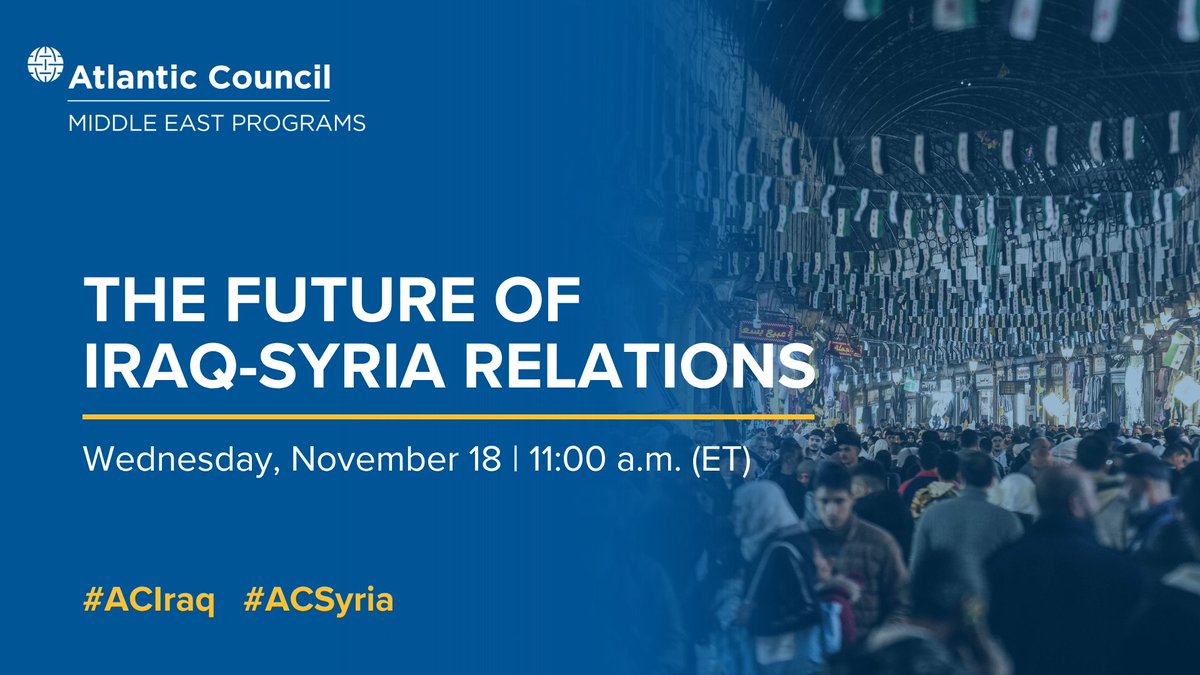
Iraq and Syria have taken initial steps to rebuild relations, but can practical cooperation on security and economic ties overcome domestic political considerations and lingering suspicion?
Join me on Nov. 18 at 11 a.m. ET when I'll moderate a virtual discussion with @IbrahimAlAssil, @yesar, @LahibHigel, and @Karam__Shaar to discuss where the relationship stands and what comes next.
Register: https://t.co/lr0bW7y9OB
In Iraq, looks like the system has de-escalate the stand off between PM Ali al-Zaidi and Kata'ib Hizballah through a negotiation to swap KH out of Jurf al-Sakhr in favor of some combo of army, police, and (hopefully non-KH) PMF. Details will matter here.
Ultimately, I remain skeptical that KH can be convinced to voluntarily disarm. But I also do not think that Iraq is ready for military confrontation in Jurf at this precise moment.
Iraq: Iraqi Al-Zaidi agrees to a proposal to replace the Iraqi Kata'ib Hezbollah in Jurf al-Sakhr with the army, police, and the Popular Mobilization Forces (PMF) - @SkyNewsArabia_B sources
Folks, I've been critical of this war. I never believed that the goals (and shifting goals) would be successfully achieved via military means.
But to be intellectually honest, you can be against this war and also acknowledge that Iran is a bad actor. There is extensive reporting about Iranian lethal plotting, including several US indictments and multiple successful plots. Look up Ahmad Molla Nissi, killed in 2017 in Netherlands and the stabbing of Iran International Journalist Pouria Zeraati in 2024. Google the DOJ indictment of Zindashti from January 2024, which included two Canadian citizens that were wrapped up in this murder-for-hire plot.
Do I think that Iran is capable of setting off a dirty bomb in the US? I'm skeptical that this is a plan that has been set in motion or one that Iran could execute. But could some random Iranian officials have thrown out the idea? Sure. Iran is always plotting. Do I think that US military action is the answer to stopping the plotting? No, I don't.
While I can't speak to this specific plot, I would like to remind that Iran has a whole unit that has been involved in lethal plotting against Iranian dissidents, Jews, Israelis, and USG/former USG officials for years. The plotting is not just limited to the United States, and multiple plots have been uncovered in Europe and in some cases, Iranian journalists or dissidents have been attacked or even killed.
The US has been successful in disrupting multiple plots, including one against Masih Alinejad in New York City. The scary thing about many of these plots is that the Iranians have used cut outs such as the Hells Angels or other organized crime figures, who are not Iranian and in some cases, may not even realize they are being hired by the Iranians.
So while we should always be worried about any Iranian plotting, we shouldn't forget about the assassination plotting against people like Mike Pompeo, John Bolton, and General McKenzie and many other Iranian activists. I'd also like to remind everyone that President Trump canceled the USG security protection for these former USG officials despite these very serious Iranian threats.
Rubio tells us he isn't worried about any imminent threat on DC from an Iranian dirty bomb. "I don’t think there’s any imminent threat," he tells us in Manila.
And another Iranian plot. This is the kind of plot that is much more likely from the Iranians and also harder to disrupt bc there are relatively few people involved and non-Iranians are fronting the operations.
For those in my comments questioning whether there is evidence of Iranian lethal plotting, below a classic example uncovered by North Macedonia and Greece.
"The case is consistent with Iran’s known practice of using criminal networks as proxies to conduct extraterritorial operations while concealing direct state involvement."
#NorthMacedonia and #Greece foiled a suspected terror plot by an #Iranian proxy network linked to the drug lord Naji Sharifi #Zindashti.
- North Macedonia’s National Security Agency (NSA), in cooperation with Greek intelligence, has dismantled a proxy network of local citizens that was allegedly preparing a terrorist attack or targeted assassination in Greece.
- The group was acting under the direct instructions of Iranian nationals linked to Iranian intelligence services.
- The intended target was an #Israeli company executive of Greek origin who is a person of interest to the Iranian services.
- Six North Macedonian citizens E.B., Š.R., M.B., K.I., Š.M., and M.R. (aged 22–73, from #Skopje and #Kumanovo, with ties to organized crime) were involved in the plot.
- E.B. is assessed as the primary intermediary within the Macedonian group who maintained direct contact with the Iranian coordinator, Edris Jahangiri Mavaneh.
- Four have been detained in pre-trial detention, one is under house arrest, and a sixth remains at large (believed to be outside the country).
- One of the suspects was arrested in Greece around 12 November and subsequently handed over to North Macedonian authorities.
- The network received direct operational and logistical instructions from Iranian national Edris Jahangiri Mavaneh, who is linked to Iranian security and intelligence proxies and to drug lord Naji Sharifi Zindashti.
- Zindashti is wanted by the FBI for plotting the murder of two individuals in #Maryland, USA, and for operations targeting Iranian dissidents.
- Under Mavaneh’s instructions, the network carried out preparatory logistical activities aimed at carrying out a terrorist act or assassination against a person in Greece.
- The six individuals were tasked with executing the assassination. The intermediary of the group met with Mavaneh both in Iran and in other third countries.
- The suspects attempted to enter Greece in order to be in proximity to their target. One was located and arrested in Greece before being handed over to North Macedonia; another attempted to enter via Alexandroupolis from #Turkey but was denied entry and returned to Turkey.
- During the operation, authorities seized weapons, ammunition, mobile phones, electronic devices, and sketches of locations.
- The case is consistent with Iran’s known practice of using criminal networks as proxies to conduct extraterritorial operations while concealing direct state involvement.
https://t.co/OxVGnr9gOo #Balkans
@ProletariatRis1@johanstrauss89@adamjohnsonCHI It was a non-binding resolution. Think of it as signaling protest without requiring action. The Iraqi government did not rescind the 2014 letter or take steps to implement the resolution.
Here's an explainer:
https://t.co/ofomrJ8Vzt
While I can't speak to this specific plot, I would like to remind that Iran has a whole unit that has been involved in lethal plotting against Iranian dissidents, Jews, Israelis, and USG/former USG officials for years. The plotting is not just limited to the United States, and multiple plots have been uncovered in Europe and in some cases, Iranian journalists or dissidents have been attacked or even killed.
The US has been successful in disrupting multiple plots, including one against Masih Alinejad in New York City. The scary thing about many of these plots is that the Iranians have used cut outs such as the Hells Angels or other organized crime figures, who are not Iranian and in some cases, may not even realize they are being hired by the Iranians.
So while we should always be worried about any Iranian plotting, we shouldn't forget about the assassination plotting against people like Mike Pompeo, John Bolton, and General McKenzie and many other Iranian activists. I'd also like to remind everyone that President Trump canceled the USG security protection for these former USG officials despite these very serious Iranian threats.
EXCLUSIVE: Iran is drawing up plans to target US officials in DC, sources say, but no attack appears imminent. Officials are divided on whether Tehran could pull it off. @KatieBoLillis@ZcohenCNN@NatashaBertrand@KristenhCNN report
https://t.co/9TeqUZizjI
It's not a yes or no question actually. The parliament vote is not the relevant decision; the legal basis of the US military presence (under the auspices of the Defeat ISIS Coalition's Operation Inherent Resolve) is the Iraqi letter to the UN requesting assistance to fight ISIS and retake Iraqi territory. OIR mission ended September 30 upon agreement with the Iraqi government. I'm happy to engage people, which is why I am willing to reply to you all, but I think you all are missing some of the important facts here.
@johanstrauss89@adamjohnsonCHI Dude, you are so out of date. US forces were in Iraq at request of Iraqi government to fight ISIS. It's a letter to the United Nations.
@johanstrauss89@adamjohnsonCHI I was part of the team that negotiated the end of Operation Inherent Resolve, which just departed September 30. Try again.
I think some kind of negotiated solution, such as bringing in the PMF, is more likely than an armed confrontation between Iraqi Security Forces and Kata'ib Hizballah. The problem, as @Mikeknightsiraq notes below, is that we have PMF that are "dual-hatted" with membership in the PMF and a militia.
I respect that the Prime Minister appears to be legitimately ready to confront KH and has already taken some steps by canceling contracts and challenging the smuggling. However, the Coordination Framework as a whole does not want armed confrontation and I question whether the security forces are ready to storm Jurf.
This may end up reminding of the Houthi handover of Hodeida port to the "Yemeni local security forces" who were actually Houthis in coast guard uniforms.