Political scientist | Senior Research Fellow @Harvard @MiddleEast_HKS leading the Syria Transition Lab | Nonresident Sr Fellow @AtlanticCouncil| Abstract Artist
We all know how to work with those who are similar to us, but it rarely leads to breakthroughs. To make a difference, however, we need to learn how to work with those who're different, to form alliances & build coalitions. Radicalism, dogmatism, & polarization will doom all of us
My latest in @TheNationalNews:
Lebanon and Syria have a historic opportunity to rebuild their relationship on the basis of mutual sovereignty, shared interests, and regional connectivity. After decades of intervention and mistrust, Beirut and Damascus have a chance to anchor the Levant as a zone of stability, trade, energy, and transport cooperation.
Read here:
https://t.co/srsXpiq9fT
#Lebanon #Syria #Levant #MiddleEast #EnergySecurity #EasternMediterranean
إلى المعنيين في وزارة الأوقاف،
مضى على فرض هذا السياج الغريب عن طابع المسجد الأموي أكثر من عام حتى الآن!
والسؤال هنا، هل أنتم أشد حرصا على الدين من عمر بن عبد العزيز وهو خامس الخلفاء الراشدين ولم يفرض سياجا فاصلا في عهده؟!
أم أكثر اهتماما من صلاح الدين الأيوبي محرر القدس؟
أم أعلم من ابن عساكر والغزالي وغيرهم ممن ارتادوا الأموي بانتظام ولم يستنكروا هيئته دون سياج؟
@SyMOfE
#وزارة_الأوقاف_السورية
Really enjoying these surreal "meanwhile, in Damascus" interludes
The rest of the region is on the brink of a renewed war, meanwhile Ahmed Sharaa is jamming to Missy Elliott
Join us at the Atlantic Council, in person on Monday, April 27 at 2:30 p.m. ET for a conversation featuring @RepJoeWilson.
The discussion will examine the evolving dynamics of Iraq–Syria relations and the political, security, and economic trends shaping bilateral engagement, regional stability, and US policy.
Joining the panel are @IbrahimAlAssil and @HoshyarZebari . @ElizHagedorn will moderate.
This event will also be livestreamed.
Register here: https://t.co/lr0bW7y9OB
We will always debate the hybrid regime that Orbán led, how it functioned, and what it meant. But one lesson we can learn today for sure is that democratic institutions can survive illiberalism if the public turnout is high enough. It shows that illiberal democracies are not lost causes and democracy does not only backslide, it is capable of democratic renewal and institutional resilience.
"A fair amount of disbelief, a lot of joy, a great deal of excitement:" @MelissaBellCNN describes the reactions from the huge crowds in Budapest, Hungary celebrating Viktor Orbán's defeat
Looking forward to joining the Global Prosperity Forum @AtlanticCouncil this Thursday.
I’ll be discussing my Syria chapter in the 2026 Freedom and Prosperity Atlas, diving into the need for a "rules-first" reset and how rebuilding institutions can move the country from survival to growth.
April 9 | 3:45–4:15 PM ET
📍 Atlantic Council
Full-day program in person or online: https://t.co/XbwX9LSEeW
Atlas2026 Syria chapter: https://t.co/5XIV25cU4o
@ACFPCenter@ACMideast
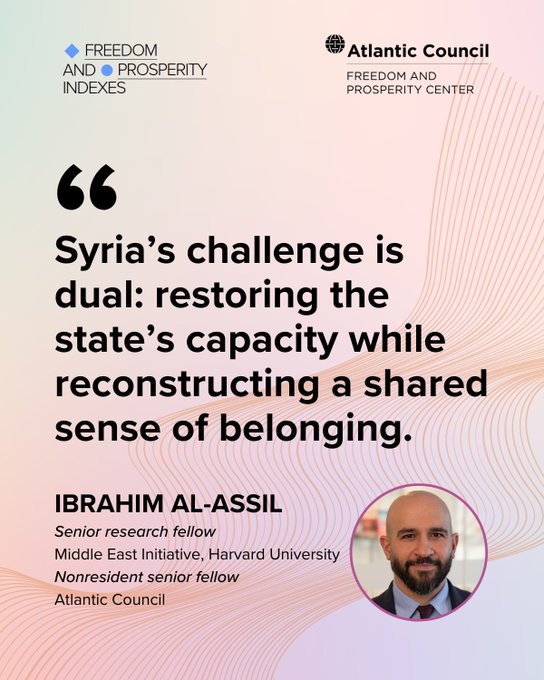
I’m pleased to have authored the Syria chapter in the Atlantic Council Freedom and Prosperity 2026 Atlas. One year into Syria’s transitional government, this chapter looks beyond immediate events to a longer trajectory, drawing on three decades of data on freedom and prosperity.
Syria’s collapse did not begin in 2011. The erosion of freedom, rule of law, and economic opportunity preceded the uprising, and the war exposed those underlying weaknesses. This matters for the present. Recovery will not come from reconstruction alone, but from restoring rule-based governance, predictable administration, and credible institutions.
The report proposes a three-part framework for the transition: stabilization, economic consolidation, and democratization. These are overlapping processes that must advance together. The real test ahead is whether governance becomes more predictable, inclusive, and accountable in practice.
Read the full chapter:
https://t.co/blIW2IhwF1
@ACFPCenter
I recently spoke at the Kelman Seminar at Harvard University on “When Wars End Without Settlement: Syria and the Crisis of Post-War Bargaining.”
Large-scale violence has receded in Syria but that hasn’t created a blank slate. It has created a quieter phase where informal deals, administrative practices, and local arrangements are already shaping the future political order.
https://t.co/DigSOV6eel
علاقة الاستقلال اللبناني بالاستقلال السوري علاقة معقدة، أحياناً كثيرة تضاربت، وأحياناً كثيرة أيضاً تقاطعت. يسعى الكثير من اللبنانيين إلى تحقيق ما حققه السوريون في العام الماضي من استعادة سيادة بلدهم وقرارهم في الحرب والسلم. تحدياتهم مختلفة، وفرصهم مختلفة.
لا نعرف ما تحمله الأيام القادمة لهذين البلدين في ظل الحرب الدائرة، ولكن النقطة الأهم هي أن تدعم سوريا لبنان في سعيه لاستعادة سيادته الكاملة. والخطوة الأساسية الواضحة لتحقيق ذلك هي احترام سيادة لبنان الكاملة، وحماية الحدود من الطرف السوري دون إغلاقها في وجه اللاجئين، والتأكيد على حق الدولة اللبنانية (كأي دولة) في احتكار السلاح داخلياً دون أن يكون هناك أي دور عسكري لسوريا في هذه العملية، مهما صغر أو كبر، وعدم الانجرار إلى التدخل في لبنان مهما تغيرت وتعقدت الوقائع، والتخطيط لترسيم الحدود بين البلدين في أقرب فرصة.
This Instagram account is calling for protests across Syria to demand a ban on alcohol. It’s based in Iran.
The image it uses is manipulated: a sign from a pro liberties sit-in has been altered to appear as a call for more alcohol.
Iranian-linked networks continue to use disinformation campaigns to destabilize Syria. If you think the ongoing war has distracted them, you’re mistaken.
Following criticism, #Damascus Governorate said its alcohol policy is based on laws dating to 1952. It apologized to residents of #BabTouma, al-Qassaa and #BabSharqi, and signaled possible easing for “touristic” restaurants without reversing the ban. #Syria#Freedoms
أطالب محافظة دمشق بالتراجع عن قرار حصر الكحول في المناطق المسيحية في دمشق. الموضوع ليس الكحول بحد ذاته، بل دفاعاً عن شكل الدولة التي نريد بناءها.
أولاً، لا تملك أي سلطة انتقالية تفويضاً لتغيير أسلوب حياة الناس. مهمتها إدارة المرحلة وتهيئة دستور وانتخابات.
ثانياً، المشكلة ليست في وجود تنظيم أو قوانين تضبط هذا القطاع، بل في المنع الشامل المفروض من الأعلى وبمنطق أيديولوجي، دون نقاش عام أو آليات تمثيل. هذا يطرح سؤالاً أخطر من الكحول نفسه: كيف تُتخذ القرارات في سوريا الجديدة؟
ثالثاً، نتائج هذا النهج تتجاوز هذه القضية:
– يبعث رسالة سلبية للمستثمرين حول تقلب السياسات وغياب الاستقرار في بيئة الأعمال.
– يفتح الباب لتوسع غير مضبوط لتدخل الدولة في الحياة اليومية.
– يعيد تقسيم المجتمع مناطقياً وطائفياً بدل توحيده.
يمكن تنظيم هذه المسألة عبر قوانين محلية ونقاشات مجتمعية منتخبة، لكن فرض المنع من الأعلى يفتح الباب لمسار يصعب التراجع عنه. التراجع عن القرار ليس ضعفاً، بل اختبار مبكر لقدرة الدولة على تصحيح نفسها قبل أن تترسخ أنماط حكم يصعب تغييرها.
كل عام والجميع بخير بمناسبة عيد الفطر ونوروز مبارك.
Sit-in held Sunday in #BabTouma, #Damascus, as protesters called for respect for public and personal freedoms and rejected sectarian discrimination. The protest followed a ban on alcohol service, bar closures, and restricted sales in Christian-majority areas. #Syria#Freedoms
📅 April 20 | 🕝 2:30 PM ET
🇮🇶 🇸🇾 RESCHDULED: Join us as our Iraq Initiative and Syria Project host Congressman Joe Wilson for a discussion on the future of Iraq–Syria relations.
Speakers include @JonWilksUK, @IbrahimAlAssil, and @LahibHigel, moderated by @Joyce_Karam.
🔗Register here ➡️ https://t.co/sapQHtSskw
My quick take for @BelferCenter on the Gulf States and the conflict with Iran:
The Gulf states are facing a strategic paradox. A weakened Iran may prove more immediately dangerous than a strong, deterred one.
For years, Gulf security thinking rested on a managed threat model. Iran could project power, but below the level of direct confrontation. The United States would deter attacks on Gulf territory. Confrontation would unfold through proxies in Lebanon, Syria, Iraq, and Yemen rather than inside the Gulf itself. Those assumptions were tested in previous crises over the past few years. This time, they appear to have broken down.
From the Gulf regional perspective, recent Iranian strikes on civilian and military targets inside Gulf states move the confrontation from the periphery to the center. Even states that cultivated mediation roles, such as Oman and Qatar, have not been insulated. The threat is no longer something to be observed from a distance. It is immediate, domestic, and politically and economically consequential.
The deeper concern in Gulf capitals has never been only a nuclear Iran. It has been Iran’s aggressive regional behavior and the predictability of that behavior. Today, the greater risk may be the prospect of an unstable or fragmenting Iran and the erosion of centralized control. A cornered regime facing sustained military and economic pressure is more likely to rely on asymmetric escalation to signal survival. More troubling still is the possibility that parts of the security apparatus, especially within the IRGC network, operate with increasing autonomy if central control weakens. For Gulf states, unpredictability is more destabilizing than rivalry.
There is visible convergence across the GCC in front of the Iranian attacks. Saudi Arabia, the UAE, Qatar, and others have publicly condemned violations of sovereignty and coordinated diplomatically. But this shouldn’t be overstated. Recent tensions between Riyadh and Abu Dhabi have not disappeared. What unites Gulf states in this moment is not strategic harmony but shared exposure and a sense of vulnerability.
Security doctrine is therefore being adjusted in real time. Requests for expanded air and missile defense systems signal recognition that U.S. guarantees alone are not enough. Maritime coordination is becoming more urgent. De-escalation channels with Iran remain necessary, but they are no longer assumed to shield anyone from retaliation.
For Washington, this recalibration should be instructive. The objective cannot be framed solely as degrading Iranian capabilities or speculating about regime survival. The more immediate task is preventing volatility from turning into fragmentation. Strengthening the integrated defense systems, encouraging deeper institutionalization of GCC military coordination, and avoiding rhetoric that treats regime collapse as cost free are central to stabilizing partners who now sit closer to the front line. This moment of shared exposure offers an opportunity to move from crisis-driven coordination toward institutionalized defense frameworks.
The central question is not only whether the Iranian regime survives this moment, but also whether Iran remains governable and all armed forces within its system remain under control. For the Gulf states, that distinction is not abstract. It is strategic and immediate, and it is reshaping how they think about security.
https://t.co/v93LFDBx2A
How are Kurdish leaders evolving into national Syrian figures?
@IbrahimAlAssil explores this question in “Syria in Transition: Between Stability and State Fragmentation,” unpacking power shifts, leadership, and the future of the Syrian state.
🔗 Watch the full discussion
https://t.co/oKUFmA29Yv