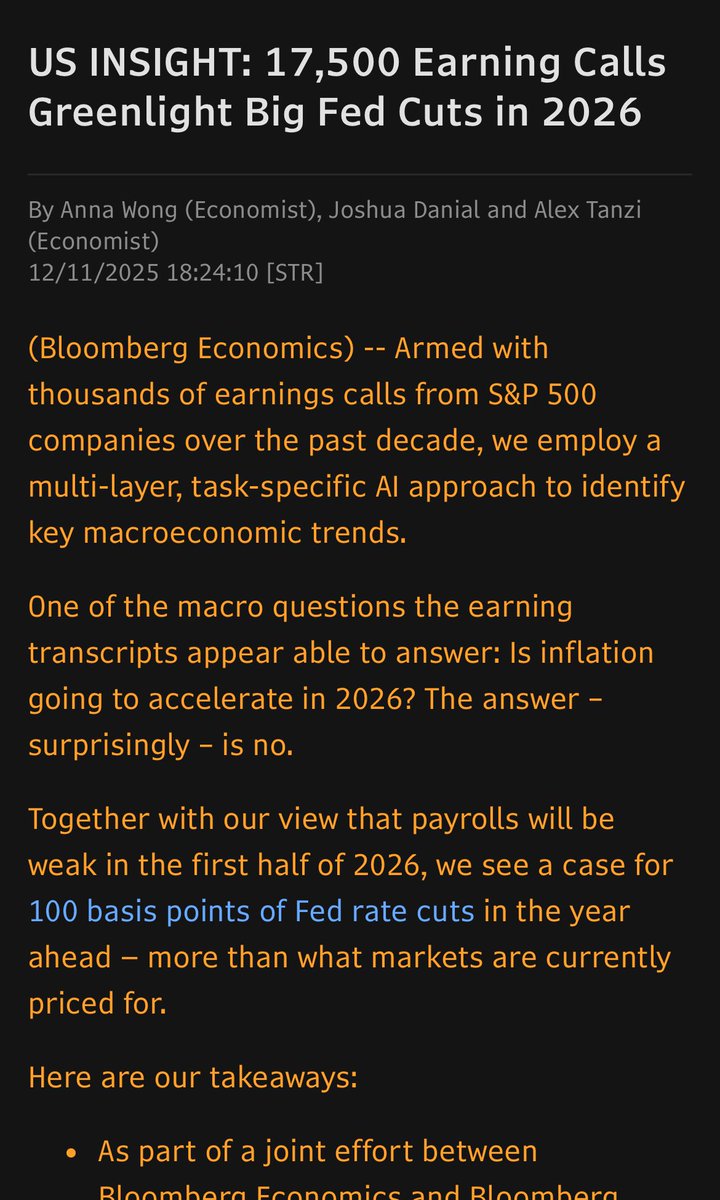
The Fed may worry about inflation, but there's one source that it doesn't need to worry about as much -- tariffs effects are fading (so Bloomberg Price Project shows)
Our full CPI preview (with @tdurie95) @theterminal https://t.co/mNZ7DHqFSp
One important signal I took from the latest Orange Book is that the Fed cannot be complacent about the labor market.
Businesses are responding to the widespread increase input costs by resorting to “operating efficiency”— code word for NOT HIRING—all but a couple industries talk about this.
How does that jive with next week’s payrolls, which we think could be hot, even blockbuster hot?
The recent strength is driven by leisure and hospitality, which is the World Cup and weather.
Once world cup is over, and state and local government takes center stage….
Hiking in October would be a mistake.
If you have a Bloomberg, check out the new Orange Book that came out last night (which synthesizes commentary from hundreds of earnings calls).
This is interesting: A wide swathe of companies showing accelerating growth, while also still not much inclination to add headcount.
Warsh said one of the data project he would undertake at the Fed with BLS and private sector is a survey of billion prices.
That is what my team has been doing in the past year. He should call me.
We are expecting several CPI items that saw brisk tariff pass through in June to slow the pace of price increase in July.
Among those that decelerated are, household appliances, indoor plants, linens, sports equipment.
Things that saw more tariff pass through are probably apparels items, such as men's furnishings, women's suits, infants and toddler apparels.
Our full CPI preview @TheTerminal : https://t.co/FSXn9yERBm
Another reason why FOMC not ready to cut: members not yet of broad agreement of that need. Here’s visualizing the dispersion of FOMC views with the help of our new weekly NLP Fed spectrometer. (Interactive version at @TheTerminal BECO models —> Fedspeak —> spectrometer)
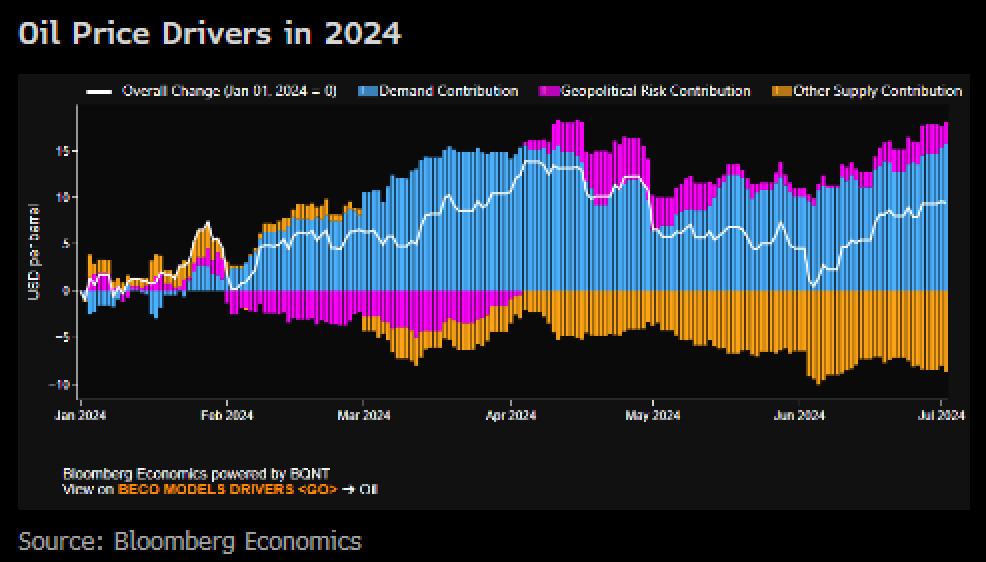
Oil price rose by $10 in the first half of the year
Drivers:
• Strong demand added $16
• War risks added $2
• Supply subtracted $9
Live update of the estimates at BECO MODELS DRIVERS <GO> on @TheTerminal
US Macro factor contributions to S&P500 returns over different timeframes according to bloomberg's BECO Models Drivers. It's interesting that risk sentiment has been the dominant driver which compares to US Macro being the main driver for European and Japanese equities.
Charts :
top - S&P 500
bottom - Eurostoxx50
The model employs a structural vector autoregression (VAR) model similar to the ones used in central banks and international institutions (e.g. Brandt et al. (2021), Matheson and Stavrev (2014)) to decompose daily movements in key US asset price variables – including government bond yields, inflation swaps, currencies, and equity indices – into the contributions from four underlying macroeconomic drivers. The S&P500 drivers are:
(i) monetary policy shocks, i.e. changes in the perception of the monetary policy stance,
(ii) economic demand shocks, i.e. changes in expectations about the demand for goods and services,
(iii) economic supply shocks, i.e. changing concern about supply-side disruptions, and
(iv) shifts in overall risk sentiment, i.e. higher or lower
risk aversion.
The VAR model expresses every variable as a function
of its own past and the past of other included variables plus a new information component. The new information component is assumed to constitute a linear combination of the underlying economic drivers, which are also known as structural shocks. However, because the weights attached to each driver are unknown, disentangling them requires imposing additional, economically credible restrictions on the model.
The main set of restrictions rests on the assumption that each shock provokes unique price movements across assets. Bloomberg combines this sign restriction approach with correlation and narrative restrictions that have been recently proposed in the econometric literature (Ludvigson et al. (2017), Antol´ın-D´ıaz and Rubio-Ram´ırez (2018)). These additional restrictions help to further sharpen the identification of the underlying drivers and get more precise estimates of their quantitative impact on the model variables.
#GDP #jobs #Fed #inflation #wages #unemployment #economy #payrolls #recession #earnings #Housing #trend #covid #election
Watching the ECB rate decision this week? Be sure to check out Bloomberg Economics' ECBspeak index on {BECO MODELS FEDSPEAK <GO>}
Since the Governing Council's last meeting, members have been taking on an even more Dovish tone as concerns of inflation undershooting target has increased.
Built on SOTA NLP, the index is the most accurate central bank sentiment model available, outperforming fine-tuned GPT-3.5 models and GPT-4.
@DsrPrivate Big divergence this month between Nowcast (.4) and analyst expectations for CPI (.2), not huge on absolute basis but meaningful on relative basis. Nowcast prob expecting big contribution from fuel costs but not sure what other buckets contribute…