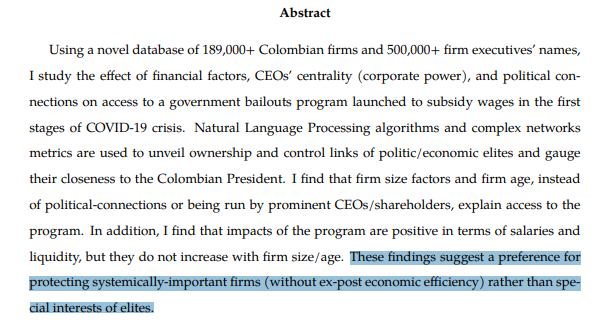
[RESUMEN] El programa #PAEF tuvo efectos positivos en términos de liquidez y protección del empleo, pero estuvo mal enfocado al estar significativamente sesgado hacia empresas grandes y viejas, que a la postre no contrataron/protegieron más empleados que las medianas/pequeñas.
Comparto con ustedes un pre-print de mi tesis de maestría, donde intento resolver grandes preguntas del programa de ayudas a las empresas #PAEF de @UGPP_Colombia durante 2020 utilizando microdatos y algoritmos. @ofiscalpuj
https://t.co/RhovX17CcU
Next-token prediction is myopic. What if transformers learn to predict their own next latent state?
🌠 We present 𝗡𝗲𝘅𝘁-𝗟𝗮𝘁𝗲𝗻𝘁 𝗣𝗿𝗲𝗱𝗶𝗰𝘁𝗶𝗼𝗻 (𝗡𝗲𝘅𝘁𝗟𝗮𝘁): a self-supervised learning method that teaches transformers to form compact world models for reasoning and planning. It also unlocks up to 3.3x faster inference via self-speculative decoding! 🚀
Lo que en El Salvador de Bukele se vende como un milagro de mano dura, en Ecuador naufraga en medio de un baño de sangre. La construcción de prisiones y la militarización de las calles no logran contener una ola de extorsiones y asesinatos https://t.co/NFXSQK7KL4
Por si les quedaban dudas, acá una nueva entrega de la investigación sobre Nova Soportes. Apenas fueron consultados por CAMBIO, en cuestión de 4 días crearon una página web llena de fotos generadas con IA, abrieron un Instagram con 18 post fugaces ofreciendo hasta yates y jets privados entre sus servicios y registraron una nueva dirección de su sede que no existe en la nomenclatura de Bogotá. Por lo menos en la dirección vieja vendían yuca y papa. ¿Esto de verdad les parece normal?
Claro que hay que reducir el número de ministerios y mejorar la ejecución de programas sociales. Petro es un desastre. Pero justificar con eso la eliminación/supresión de funciones del INVIMA es estar muy mal: https://t.co/XRojS6zGnq
Estoy exageradamente preocupada con la propuesta de la formula de Abelardo de ELIMINAR AL INVIMA, ¡gente, eso es gravísimo! Esa entidad es esencial. Vamos a quedar desprotegidos porque para ellos es más importante quitarle "complicaciones" al empresario que garantizar la seguridad de la salud y la vida de los colombianos.
Uno de los últimos argumentos de varios sectores gremiales económicos para apoyar a Abelardo De La Espriella, fue señalar que, en realidad, no esperaban que hubiera una respuesta agresiva contra otros sectores políticos y medios de comunicación si el candidato llegaba al poder. Es decir, que no habría ese potencial "destripamiento" del que los sectores más radicales de su movimiento han hablado.
De hecho, especulaban con la idea de que cualquier intento de atacar a una potencial oposición de izquierdas era imposible, pues implicaba romper la institucionalidad en sí misma.
Lo que no ven estos gremios (y subestiman los sectores de centroderecha y derecha que apoyan a De La Espriella) es que, bajo ese argumento de "defensa de la institucionalidad", De La Espriella sí puede lanzarse en una ofensiva mediática y judicial contra cualquier medio de comunicación y sector político de oposición que se vuelva incómodo a su ejercicio del poder, y que ejercerá presión pública con la finalidad de sacarlos del espacio mediático y la opinión pública.
La gran pregunta es saber si quienes apoyan a Abelardo De La Espriella en serio pretenden y quieren una "purga" de esas magnitudes en Colombia, y si no dimensionan el riesgo de la misma en términos de violencia política en el país.
De acuerdo, es GRA-VÍ-SI-MO pensar en la eliminación del INVIMA.
Es la única que le hace frente a productos fraudulentos que de por sí abundan en el mercado colombiano. El derecho del consumidor, pisoteado por enésima vez.
Nos queda clarísimo lo que se le viene a la prensa en un eventual gobierno de “el tigre”. Según su abogado titular, publicar una investigación sobre presuntas irregularidades en los manejos de la plata de su campaña me hace responsable del asesinato de Miguel Uribe Turbay y de la violation de niños. Una afirmación así en un país como el nuestro es una lápida. Mil gracias doctor Calderón. Quedamos avisados.
Por si lo dudaban, persecución, cárcel y muerte a cualquier ciudadano crítico u opositor democrático es lo que nos espera con Abelardo de La Espriella.
La derecha trumpicriollista nos cazará en las puertas de nuestras casas, sin defensa, sin derechos, sin razón y por la fuerza.
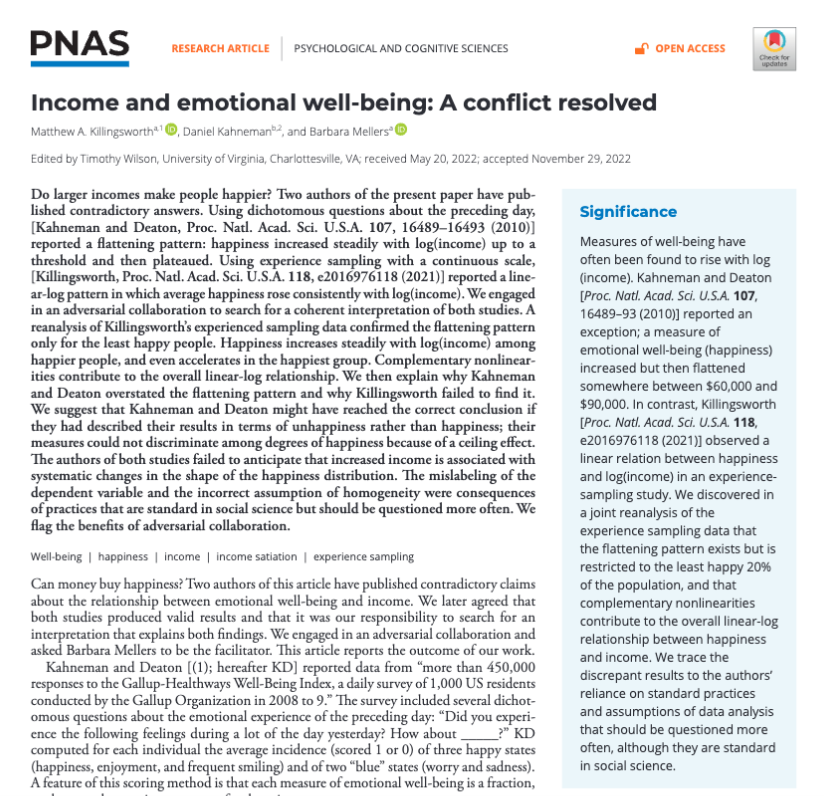
Does money buy happiness? A Princeton Nobel laureate said no above $75,000. A Penn researcher with 1.7 million data points said yes. The day they sat down together to settle the fight, the answer they reached should change how you think about your own life.
The Nobel laureate is Daniel Kahneman. The Penn researcher is Matthew Killingsworth.
The fight between them lasted 13 years, and the way it ended is one of the cleanest examples in modern science of two smart people being wrong in opposite directions about the same question.
In 2010 Kahneman and his Princeton colleague Angus Deaton published a paper that became one of the most quoted findings in the history of social science.
They analyzed 450,000 responses to the Gallup-Healthways Well-Being Index and concluded that emotional well-being rose steadily with income up to about $75,000 a year, and then flattened out completely. Above that line, the extra money was not buying any more daily happiness.
The headline traveled around the world. Every news outlet ran the number.
A CEO in Seattle famously cut his own salary to raise his employees to that exact threshold. The 75,000 dollar figure became cultural shorthand for the idea that the rich are not actually any happier than the rest of us once basic needs are met.
For 11 years almost nobody seriously challenged it. Kahneman had a Nobel Prize in Economics, the sample size was massive, and the conclusion was emotionally satisfying in a way that made everyone feel a little better about not being wealthy.
Then in 2021 a 33 year old researcher at the University of Pennsylvania published a paper that quietly destroyed the entire finding. His name is Matthew Killingsworth.
He had spent the previous decade building a smartphone app called Track Your Happiness that pinged users at random moments during their day and asked them a simple question.
How do you feel right now, on a scale from very bad to very good. The app was designed to catch happiness in the act, not to ask people to recall it later.
By 2021 he had collected over 1.7 million real-time happiness reports from 33,000 adults. When he plotted income against in-the-moment well-being, there was no plateau anywhere.
The line just kept rising. People earning $200,000 were happier on average than people earning $100,000. People earning $400,000 were happier than people earning $200,000. The curve flattened slightly but never stopped climbing.
The famous $75,000 ceiling that the world had been quoting for 11 years simply did not exist in his data.
Now there were two Nobel-quality findings sitting in direct contradiction with each other. One of them had to be wrong, and neither researcher was willing to walk away.
What happened next is the part of the story almost nobody knows.
Kahneman called Killingsworth and proposed something rare in academic science. He called it an adversarial collaboration. The two of them, joined by Penn psychologist Barbara Mellers as a neutral referee, would sit down together and reanalyze the raw data from both studies, line by line, until they figured out which one of them was wrong.
The paper they co-authored was published in March 2023 in the Proceedings of the National Academy of Sciences. And the answer they reached was not what either of them had expected.
Both of them had been right at the same time. They had been measuring two different populations without realizing it.
When the team broke Killingsworth's 1.7 million data points apart by baseline happiness, the picture clarified completely. For the happiest 70 percent of people, more money kept buying more happiness all the way up to $500,000 a year, with no sign of slowing down.
For people in the middle, the same pattern held. But for the bottom 20 percent of the sample, the ones who were already unhappy before the question of money even came up, the curve flattened almost exactly where Kahneman's original paper had said it would. Above roughly $100,000 a year, adjusted for inflation, more money did nothing for them.
This is the finding that changes how the question should be asked.
If you are not already unhappy, money keeps buying happiness for a much longer stretch than Kahneman's original paper suggested. The runway is wider than the world has been telling itself for a decade.
If you are already unhappy, money does almost nothing past a certain point. There is a ceiling, but the ceiling is not about income. It is about the underlying state of the person collecting it.
The deeper insight in Killingsworth's original research, the one almost nobody talks about, is the part that should sit with you longer than the income numbers. The Track Your Happiness app had been telling him for years that the single biggest predictor of in-the-moment well-being is not money at all. It is whether your mind is on the thing you are doing.
His most cited paper, written with Daniel Gilbert at Harvard, is titled A Wandering Mind Is an Unhappy Mind. The data from the app showed that people are mentally absent from what they are doing 47 percent of the time, and that mental absence is one of the strongest predictors of unhappiness in the entire dataset. More predictive than income. More predictive than the activity itself. More predictive than almost any demographic variable you could measure.
Which means the unhappy 20 percent that Kahneman's plateau actually described were probably not unhappy because they did not have enough money. They were unhappy for reasons that more money could not reach.
The reason the curve flattened for them at $100,000 a year is the same reason it would have flattened at $300,000 or $700,000. The thing they were missing was not buyable.
The most uncomfortable line in the entire 2023 paper is the one that nobody on the internet quotes. The authors note that the relationship between income and happiness, while real, is much weaker than the relationship between attention and happiness. A person earning $40,000 who is fully present in their own life will, on average, report higher in-the-moment well-being than a person earning $400,000 whose mind is somewhere else.
The fight about money was the wrong fight the entire time.
The two researchers spent 13 years arguing over whether the dollar ceiling was at $75,000 or $500,000, and the data from Killingsworth's own app was sitting there the whole time saying the ceiling was not about dollars at all. The ceiling is whether you can hold your attention on the life you actually have.
You can run the experiment yourself the next time you catch your mind drifting. Stop. Put your phone down. Look at the room you are in, the person across from you, the food in front of you, the work you are actually doing. That is the part the apps cannot sell you and the salary cannot buy you.
The data has been clear for over a decade. The plateau is not in your bank account. It is in your attention.
Scientists have mapped Earth’s vast underground fungal networks for the first time, revealing a staggering 68 quadrillion miles of fungal threads that help regulate the climate.
A groundbreaking new study estimates that arbuscular mycorrhizal fungi form an underground network stretching roughly 110 quadrillion kilometers (68 quadrillion miles), equivalent to nearly a billion times the distance from Earth to the Sun. These microscopic fungal threads create symbiotic relationships with over 70% of land plants, exchanging nutrients and water for carbon while locking away massive amounts of CO₂ in the soil.
The research, led by the Society for the Protection of Underground Networks (SPUN), used machine learning models trained on data from more than 16,000 global soil cores, combined with high-resolution robotic imaging of fungal hyphae.
However, these critical networks face a serious threat from modern industrial agriculture. Fungal density in croplands is nearly 50% lower than in undisturbed ecosystems, largely due to tilling, chemical fertilizers, and fungicides. This loss reduces the soil’s ability to store carbon, weakens nutrient cycling, and increases chemical runoff.
The findings underscore the urgent need to protect these hidden ecosystems. Researchers plan to present the data at the upcoming UN desertification summit to push for global conservation benchmarks.
[Stewart, J. D., et al. (2026). Global density and biomass of arbuscular mycorrhizal fungal networks. Science. DOI: 10.1126/science.adu4373]
Muy triste que los profesionales de Nutrición, Psicología y Periodismo tengan que hacer miles esfuerzos para contrarrestar la irresponsabilidad de influencers. Filtrar el ruido es cada vez más difícil y por lo mismo debemos ser más y más selectivos en cuanto a quienes leemos.
"AI is likely to produce neither a job apocalypse nor productivity utopia, but something harder to measure: a quiet degradation of the quality of the jobs that remain," per Bloomberg
Totale Kapitulation...
Die USA und Iran haben einen Friedensdeal. Unterzeichnung am Freitag, 19. Juni, in der Schweiz. Vermittelt von Pakistan und Qatar.
Die Kernpunkte des 14-Punkte-Memorandums:
1. Iran erhält $24 Milliarden an eingefrorenen Vermögenswerten zurück, $12 Milliarden davon direkt, bevor die finalen Verhandlungen überhaupt beginnen.
2. Im finalen Deal verpflichten sich die USA und ihre Verbündeten zusätzlich zu einem Wiederaufbaufonds für Iran in Höhe von mindestens $300 Milliarden.
3. Sofortige und permanente Waffenruhe an allen Fronten, ausdrücklich inklusive Libanon. 60-Tage-Verhandlungsfenster für die finalen technischen Details des Nuklearabkommens.
4. Die USA heben die Marineblockade auf und ziehen alle Truppen aus dem iranischen Umfeld zurück.
5. Die USA verpflichten sich, vollständige Sanktionsaufhebungen in den finalen Deal einfließen zu lassen.
6. Iran pausiert im Gegenzug die Toll Payments an der Straße von Hormuz für 60 Tage. Hormuz wird wieder geöffnet.
WAS BEDEUTET DAS FÜR DIE USA 🇺🇸
Das Bild amerikanischer Macht ist deutlich beschädigt. Washington konnte Iran nicht in die Knie zwingen. Konnte Hormuz nicht im Alleingang öffnen. Konnte Saudi-Arabien nicht in einen Krieg zwingen. Konnte die Normalisierung mit Israel nicht durchdrücken. Konnte seine Verbündeten nicht vor den günstigeren iranischen Raketen schützen, trotz der deutlich teureren Abwehrtechnologie. Konnte die NATO nicht zum Mitmachen bewegen. Konnte Europa nicht zum Mitmachen bewegen. Konnte China nicht zum Bruch mit Iran bewegen. Und konnte nicht verhindern, dass Golfstaaten hinter den Kulissen mit Teheran verhandelten, um sich selbst aus der iranischen Zielliste zu nehmen.
Jede einzelne dieser Niederlagen ist für sich klein. Zusammen sind sie das strukturelle Verschieben einer globalen Achse. Und am Ende zahlt Washington $300 Milliarden für den Wiederaufbau des Landes, das es zerstören wollte.
WAS BEDEUTET DAS FÜR ISRAEL 🇮🇱
Israel hat sich überstreckt und gescheitert. Es hat erfolgreich die USA in den Krieg mit Iran gezogen, aber keines seiner strategischen Ziele erreicht. Kein Regime-Change in Teheran. Keine arabisch-israelische Koalition. Keine neu annektierten Gebiete. Öffentlich von Trump zurückgepfiffen nach dem Angriff auf Beirut. Unter heftigem Protest in einen Deal gezwungen, den die eigene Regierung vehement abgelehnt hat.
Übrig bleibt eine US-Öffentlichkeit, die Tel Aviv offen die Schuld dafür gibt, Amerika in einen Krieg gezogen zu haben, den niemand führen musste. Mit potentiell generationenbestimmenden Konsequenzen für die US-israelische Beziehung. Und das in einem System, in dem Israel keinen Krieg führen kann ohne amerikanische Gelder, Truppen, Waffen und diplomatische Deckung.
Multipolar war lange Theorie. Diese Woche wird sie in der Schweiz mit zwei Unterschriften zur Infrastruktur. Empires kündigen ihren Niedergang nicht an. Sie unterschreiben ihn.
BREAKING: Iran says the US has agreed to pay $300 billion in reconstruction funds directly to Iran as part of the deal Pakistan announced, alongside the release of $24 billion in frozen funds with $12 billion released before negotiations even start, per Mehr News.
This directly contradicts Trump's & Vance's claim that no funds will be transferred to Iran at all.
If Trump denies this is true, there never was a deal. If Trump confirms, the US has fully capitulated to Iran's demands.
LOGICAL COURSE OF EVENTS
Gulf states, including the UAE, are finding that Iranian protection is more effective & less #fragile than one by remote Western powers or, of course, by the state currently known as Israel.
Wie so oft: Genau an den Orten, zu welchen es wenig Zuwanderung gibt, spricht sich die Schweizer Bevölkerung für weniger Migration aus. Also genau in den am wenigsten betroffenen Gebieten.
Jeder Erklärungsversuch, der damit argumentiert, die Dichte in den Ballungszentren oder Mieten in den Städten seien der Grund für die Ja-Stimmen, greift also zu kurz. Schon eher könnten Angst vor dem Unbekannten oder allgemeine Abstiegstängste mögliche Erklärungen dafür sein, warum gerade in schrumpfenden Gemeinden die Zustimmung besonders gross war.







![Rainmaker1973's tweet photo. Scientists have mapped Earth’s vast underground fungal networks for the first time, revealing a staggering 68 quadrillion miles of fungal threads that help regulate the climate.
A groundbreaking new study estimates that arbuscular mycorrhizal fungi form an underground network stretching roughly 110 quadrillion kilometers (68 quadrillion miles), equivalent to nearly a billion times the distance from Earth to the Sun. These microscopic fungal threads create symbiotic relationships with over 70% of land plants, exchanging nutrients and water for carbon while locking away massive amounts of CO₂ in the soil.
The research, led by the Society for the Protection of Underground Networks (SPUN), used machine learning models trained on data from more than 16,000 global soil cores, combined with high-resolution robotic imaging of fungal hyphae.
However, these critical networks face a serious threat from modern industrial agriculture. Fungal density in croplands is nearly 50% lower than in undisturbed ecosystems, largely due to tilling, chemical fertilizers, and fungicides. This loss reduces the soil’s ability to store carbon, weakens nutrient cycling, and increases chemical runoff.
The findings underscore the urgent need to protect these hidden ecosystems. Researchers plan to present the data at the upcoming UN desertification summit to push for global conservation benchmarks.
[Stewart, J. D., et al. (2026). Global density and biomass of arbuscular mycorrhizal fungal networks. Science. DOI: 10.1126/science.adu4373]](https://pbs.twimg.com/media/HK3cCMJXEAAgMVE.jpg)





