The Journal of International Economics is intended to serve as the primary outlet for theoretical and empirical research in all areas of international economics
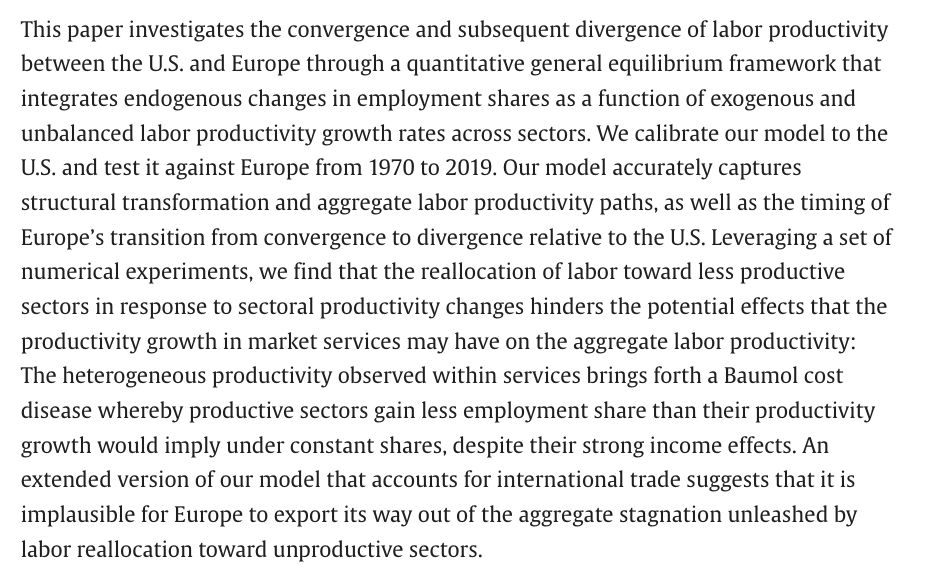
@JoaoBDuart3 Europe caught up to U.S. labor productivity by 1995, then fell back to 86% by 2019. Authors' GE model with Baumol cost disease + non-homothetic preferences shows labor reallocation into low-productivity services drives the reversal — a 5× bigger drag than in the U.S.
New at JIE: "Europe falling behind: Structural transformation and labor productivity growth differences between Europe and the U.S" by Cesare Buiatti, Joao B. Duarte (@JoaoBDuart3), Luis Felipe Sáenz
https://t.co/GqvAoCyDYH
The Journal of International Economics is pleased to announce that the Bhagwati Prize for the best paper in International Trade has been awarded to “Robots, Tasks, and Trade,” by Paulo Bastos, Bob Rijkers, and Erhan Artuc. Congratulations!
https://t.co/KzcS0MOPbx
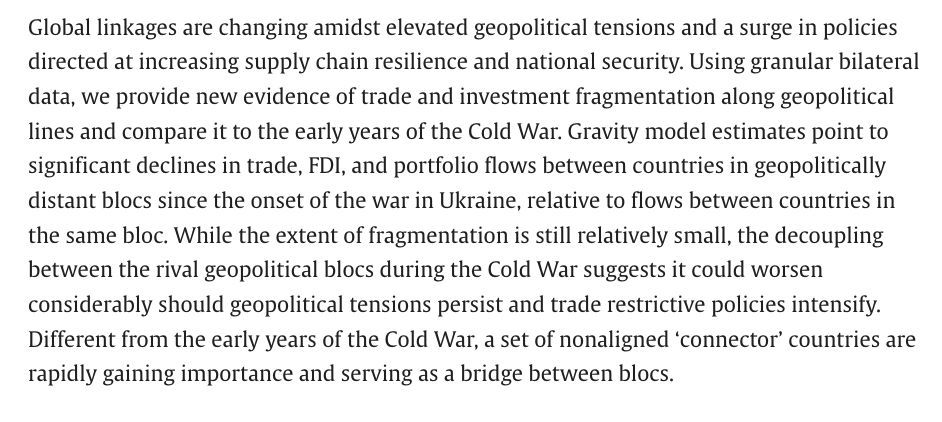
The JIE is pleased to announce that the Calvo Prize for the best paper in Open Economy Macroeconomics has been awarded to “Changing Global Linkages: A New Cold War?,” by @GitaGopinath, @pogourinchas, @a_presbitero and @PetiaTopalova. Congratulations!
https://t.co/6uAT0blDUK
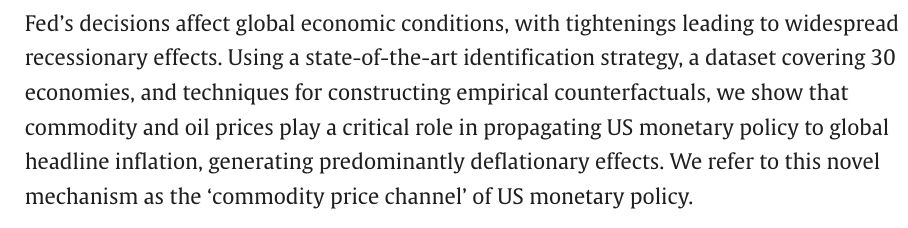
@RicDegasperi@SimonHon49@ricco_giovanni Using a dataset covering 30 economies, authors show that commodity and oil prices play a critical role in propagating US monetary policy to global headline inflation, generating predominantly deflationary effects.
New at JIE: "The global transmission of U.S. monetary policy" by Riccardo Degasperi (@@RicDegasperi), Seokki Simon Hong (@SimonHon49), Giovanni Ricco (@ricco_giovanni)
https://t.co/64rdJ1Scoy
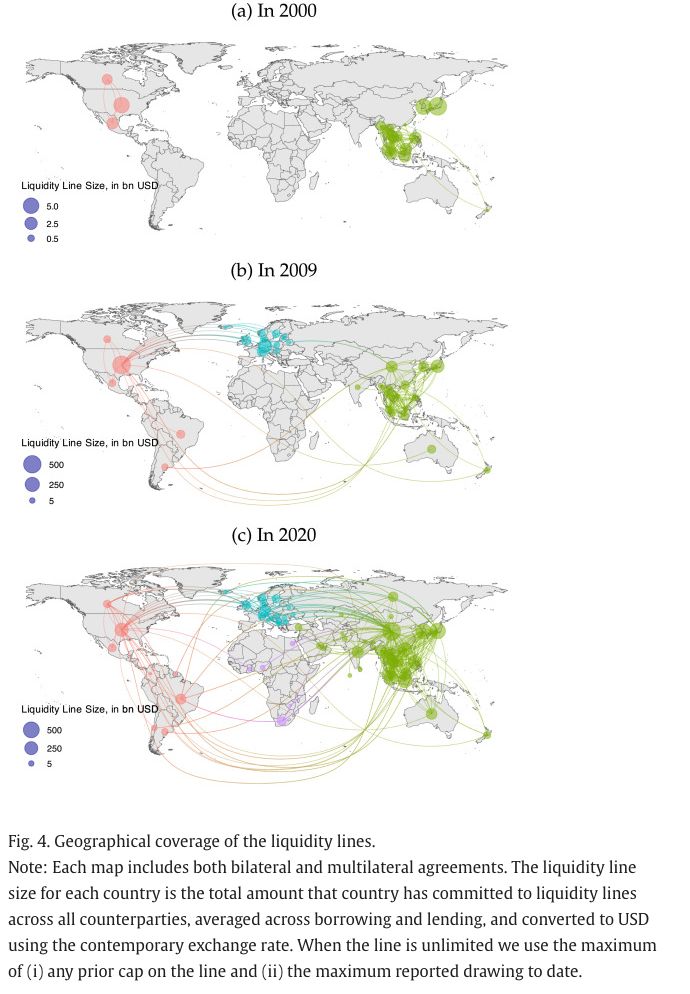
@FuchsMarie_@R2Rsquared This paper provides a historical account of central bank cross-border liquidity lines. It shows that a country can indirectly access foreign liquidity even without a direct line to the source. These indirect connections have a large impact on CIP deviations and FX reserves.
New at JIE: "Estimating export-productivity cutoff contours with profit data: A novel threshold estimation approach" by Peter H. Egger, Yulong Wang
https://t.co/CpPGLZqg55
@bjorci@AskerNygaard@BJavorcik@jrmunch We show that globalization widens the gender gap in mental health: when Danish firms trade across time zones, female workers become more likely to take antidepressants relative to men, particularly when college educated and younger. Effects are 3-4x larger for single mothers.
New at JIE: "Globalisation and the gender gap in mental well-being" by Björn Thor Arnarson (@bjorci), Asker Nygaard David (@AskerNygaard), Beata S. Javorcik (@BJavorcik), Jakob R. Munch (@jrmunch)
https://t.co/Y9yEB2HDaf
@DaisoonKim The paper examines how economic policy uncertainty (EPU) in host and competing countries reshapes U.S. multinationals’ greenfield foreign direct investment (FDI).
New at JIE: "Multinational investment activity under policy uncertainty in host and competing countries" by Daisoon Kim (@DaisoonKim), Sunhyung Lee
https://t.co/7HuLN0SKPL