THE BELL BEAKER CULTURE
2600-2100 BC, the Indo-European conquest of Western Europe.
A Complete map of the Bell Beaker Culture (14780 Catalogued Sites) in all its forms, displaying every site, find, type, as well as supplementaries detailing Genetic Makeup, C14 dating, and Individual Find Types.
The Bell Beaker culture represents the Indo-European migrations into Western Europe, as multiple ancient DNA studies have shown both with Autosomal DNA, Y-DNA, mtDNA and IBD sharing.
The dominant paternal lineage of the Bell Beaker culture was Y-Chromosome Haplogroup R1b-P312, which was absent anywhere west of the Rhine until 2600bc, and its father, R1b-L11, is found in Corded Ware males. R1b stands at 89% of all tested Beaker Males, while the dominant Megalithic Lineages of the previous period, I2a1, sits at only 5%, surviving strongest in peripheral regions far away from Central Europe. In addition to this, Beaker people almost all carry some percentage (sometimes majority) Corded Ware ancestry, with strong IBD links back to Central Europe. Materially, the Bell Beaker culture carries various Central-European elements invented in Corded Ware contexts west of the Rhine into every corner of Europe, notably Potruding Foot Beakers evolved into AOC and AOO Beakers, Begleitkeramik, Single Burials and Stone Wrist Guards. Despite this, the “Beaker Folk” were also highly syncretic with local cultures, adopting the Iberian “Maritime” Beaker, as well as Palmela Arrow-/Lance-heads, Atlantic Copper Halberds, and often re-using Megalithic Graves of the preceeding periods. Although it must be said that the extreme dominance of Y-Chromosome Haplogroup R1b-P312 reveals that Beaker Males replaced Local males in most places they migrated to, as well as introducing Corded Ware ancestry, therefore this process was likely violent in many places.
This expansion was unbelievably Rapid, with Indo-Europeans conquering all of Brittain, reaching Iberia from Germany and conquering all of France in just 100 years.
The Bell Beaker culture is the most important culture of the Late Chalcolithic / Earliest Bronze Age, defined by distinctive Bell Shaped Beakers and associated package of "warrior" or "archer" personal equipment. It runs roughly from 2600 BC to 2100 BC, with regional chronological variation. (Primarily in Iberia, where earliest forms of the Maritime Bell Beaker are as early as 2900 BC). The latest dates in Britain and Ireland stretch into the early 2nd millennium, while in Central Europe it already terminates in 2300 BC, with the transition into the Unetice Culture.
The full image is too massive for twitter (largest map i have ever made by far), Full Resolution including supplementaries can be found on Maptism (reply below)
Sites with evidence for the cult of Mithras.
Starting from the late 1st century, it rapidly spread, becoming one of the most popular cults in the Roman Empire before the rise of Christianity.
"At present, approximately 140 Mithraic temples over the entire area of the Imperium Romanum have been archeologically verified, and evidence for the cult itself – with its normally rather small cult communities – exists in more than 500 locations. Evidence can be found from almost all provinces: about 700 relief representations of the bull-slaying Mithras are known, plus a further 500 reliefs in connection with the cult.
To date, more than 1,000 inscriptions provide information concerning the cult, its members, distinct rituals, cult buildings and foundations. These form the basis of an at least rudimentary analysis of the social composition of almost 500 small cult communities... Among the followers of the cult are senators, men of the equestrian rank, decuriones (members of the local city–council, ordo decurionum), soldiers of all types, full Roman citizens, freedmen and slaves."
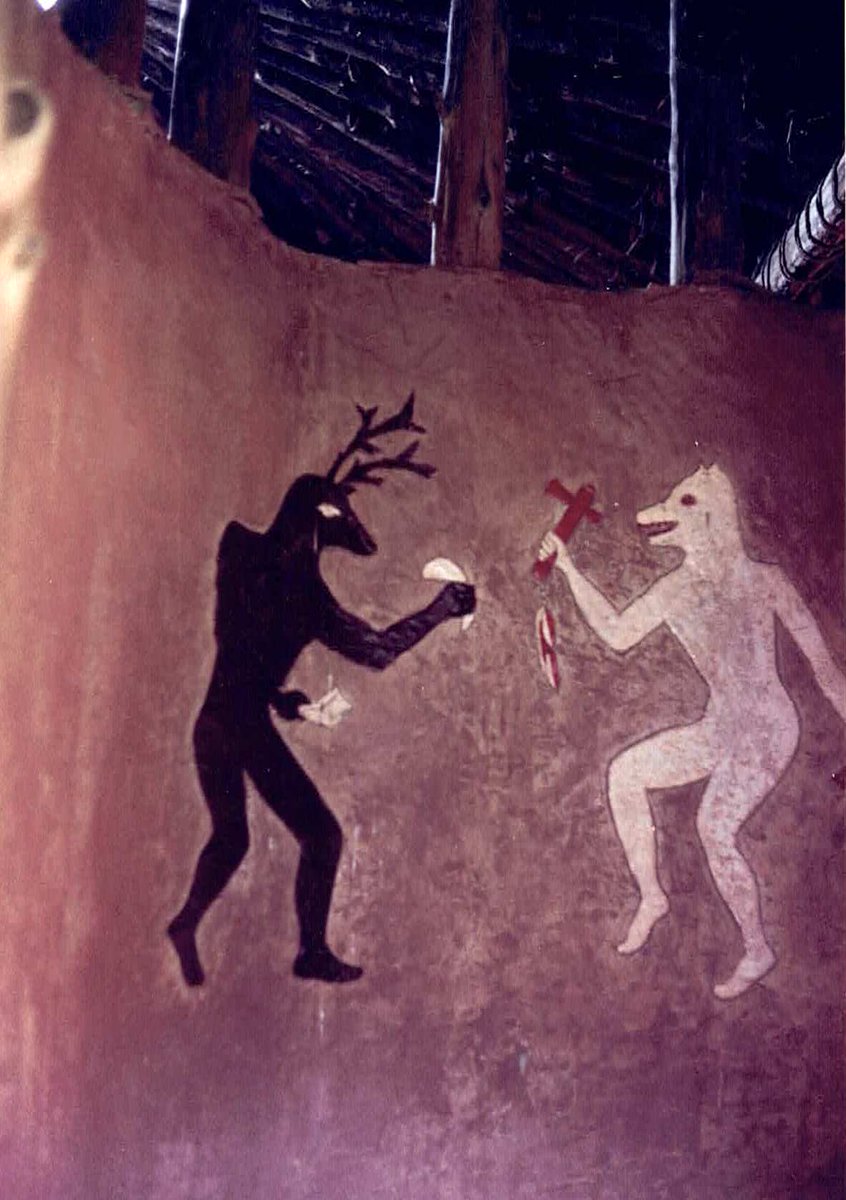
"Temple Mound" at Town Creek, North Carolina around 1990. The second photo shows one of the depictions on the interior wall of the temple on the mound.
@MaxThorneX@Rajatsoni I think the lower rates are only found in DeFi protocols, which come with a whole host of their own issues, which some people believe is not worth it.
"I am in fact a Hobbit in all but size. I like gardens, trees, and unmechanized farmlands; I smoke a pipe, and like good plain food (unrefrigerated), but detest French cooking; I like, and even dare to wear in these dull days, ornamental waistcoats. I am fond of mushrooms (out of a field); have a very simple sense of humor (which even my appreciative critics find tiresome); I go to bed late and get up late (when possible). I do not travel much".
― J.R.R. Tolkien