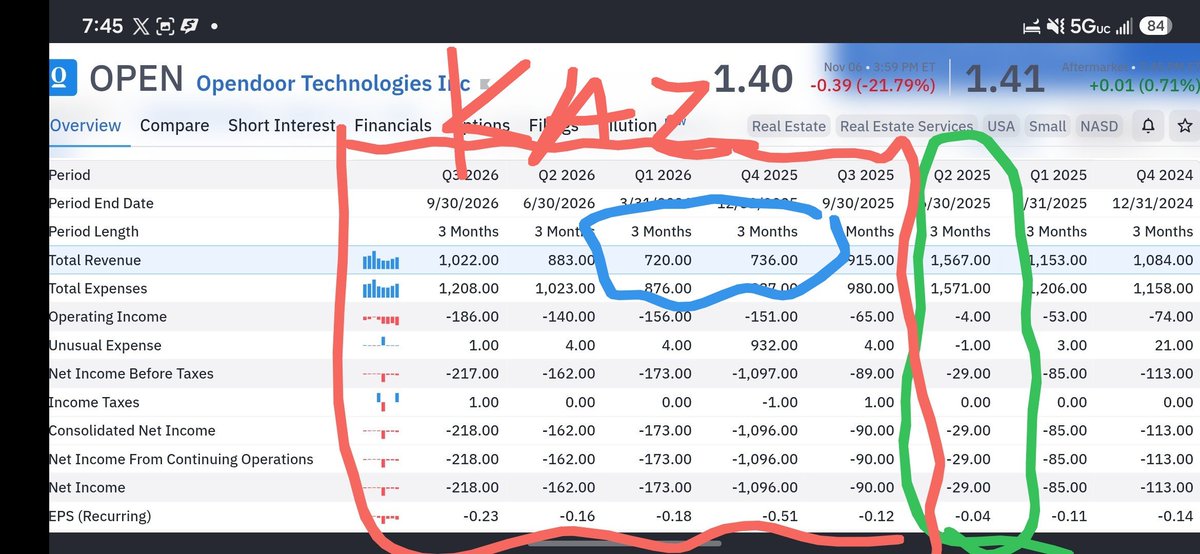
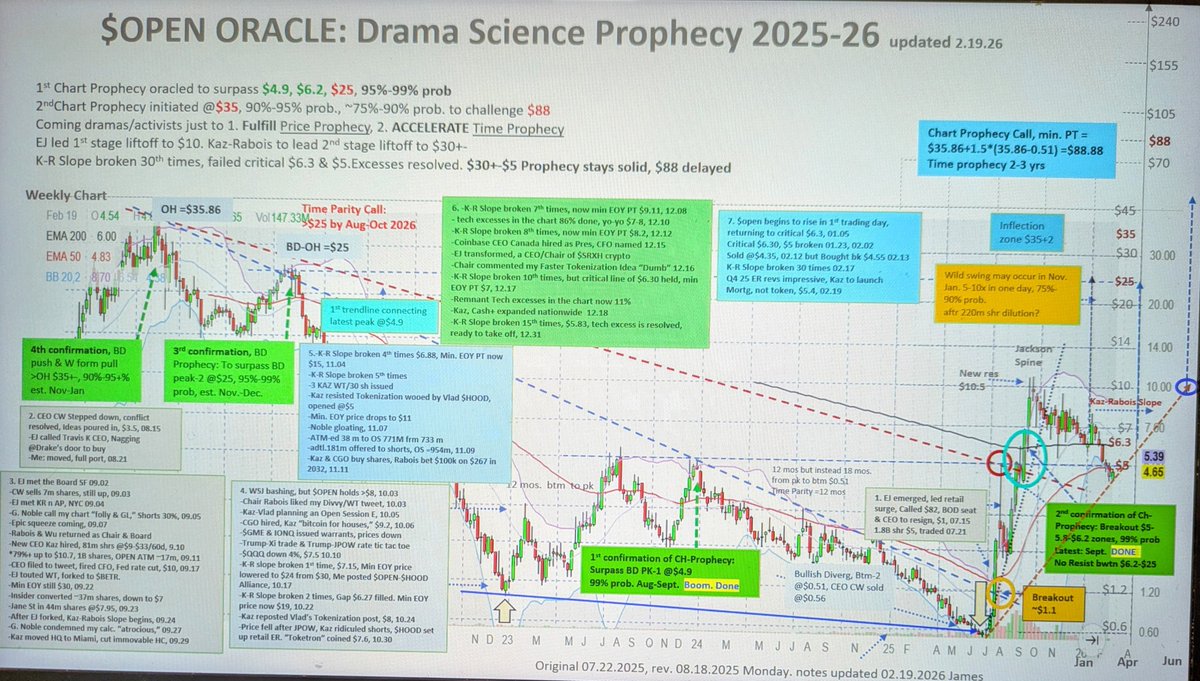
$OPEN updated. Chart prophecy of $88 delayed, but prophecy of $30+-5 stays solid in 9-12 mos, min PT is $10 in June
Kaz gets rid of some of inv. saved int.& inv. cost. Q4 25 revs blasted off. Congrats @nejatian@rabois. @jeffye888@founderwithadhd@mikealfred
@Mike_Pence Mike you speak of ideology not reality, the reality is Jensen creates, builds produces, makes and does the most advanced chips the atoms of modern days. why knocking him down, instead of protecting this kind of genius? You want US to be an africa w/ no talents to live n stay?
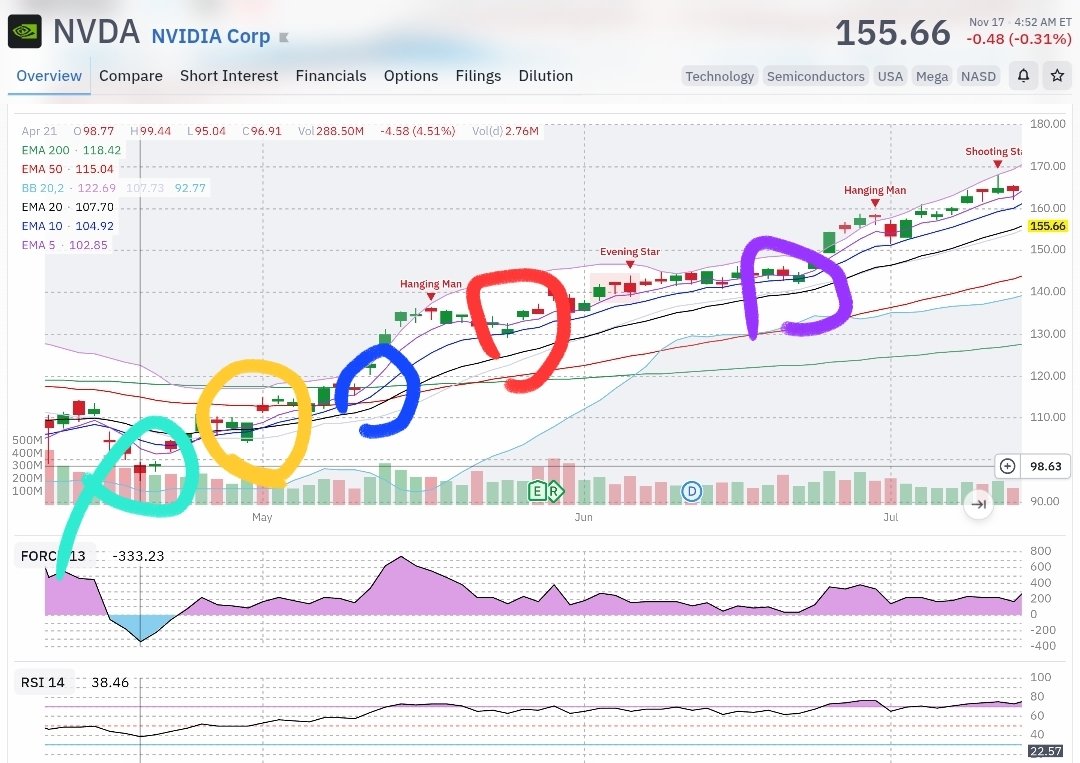
$nvda Jensen is recalled by the board.
still unbelievable, it is even sooner than I thought. My wildest imagination was before Christmas or after January 2nd.
But I have no shares so not like many overjoyed Jensen's return
$NVDA
totally agree @lexfridman
I wrote a note to my group aftr hearing the board rumors n Jensen resignation, in Casablanca
I think chances r months later they d have to recall Jensen to $NVDA
Among human fallacies, kill the lesser, protect the greatest: creater builder maker
70% shares at $5.88 bought at $12.5+-. options jan 27 expiration is all gone.
What a saydo miss that causes a small investor of 70% of his asset loss.
And because of the trust lost, I dare not to go back anymore. What a pain.
I just dont know how I can recoup the loss. Its sad
@paulpetertak Lost so much money by trusting what you have said on BLA filling by EOY. You and your company is out of my sight now. You just simply cant do that to your shareholders. Saydo is paramount for the company of your size.
@realsinya Lets not play rasist card. Too easy to get backfired. The reality in US is Asian Americans are as good as all good citizens of any races.
The race is not an issue here on Huang, but geopolitical competition.
Distancing yourself from AOC Omar.
Be foresighted. Hatred doesn't work
@paulpetertak The delay of BLA filing is a disastrous say do miss. The loss of trust is greater than anything. Its difficult for you to earn back in a long term.
Chance of going down below the baseline $5.
Now that Jensen Huang is gone, I think America is about to discover something the hard way:
Nvidia didn’t just lose a CEO. It lost the one guy who knew how to run an Asian supply chain like an old-school merchant.
You can replace him with a brilliant American executive, an Indian executive, a Chinese executive — whatever.
The title is replaceable. The relationships are not.
Anyone who grew up around old-school Chinese business culture will recognize Jensen’s style immediately. You eat together. You drink together. You remember who helped you twenty years ago. When you decide someone is your guy, you keep dealing with him for decades. Contracts matter, of course, but when things go wrong at 2 a.m., what matters even more is whether the person on the other side will pick up your call.
Look at Nvidia’s supply chain. TSMC makes the chips. SK Hynix makes the HBM. Foxconn, Quanta, Wistron, Pegatron and others build the systems. Jensen didn’t suddenly discover these companies when ChatGPT arrived. He spent decades personally building relationships with the people running them.
TSMC is probably the best example. Back in 1998, when Nvidia was still tiny and short on manufacturing expertise, TSMC sent two production people over to help. The relationship became so close that Morris Chang later asked Jensen twice if he wanted to become CEO of TSMC. Jensen said no both times.
Decades later, Jensen was still flying back to Taiwan, eating with Morris Chang, Barry Lam and half of the island’s tech establishment. At one Taipei dinner, the guest list looked less like a restaurant reservation and more like the control room of the global AI supply chain: TSMC, Quanta, Pegatron, Wistron, Asus, Acer, Inventec, Foxconn.
That stuff looks almost comically old-fashioned in an industry obsessed with AI agents and trillion-dollar market caps. But then you see what happens when Nvidia actually needs something.
In 2024, Jensen wanted SK Hynix to move its HBM4 supply schedule forward by six months. Six months in semiconductors is insane. You’re talking about engineering, capacity and production plans that were set long before Jensen showed up asking for more.
SK chairman Chey Tae-won publicly told the story later. Jensen asked. Chey went back to his people and pushed.
That is not something you reproduce by handing the next CEO a supplier spreadsheet.
And Jensen also knew what it meant to owe somebody.
In Nvidia’s early days, its project with Sega went badly enough that the company was in real trouble. Jensen went to Japan, admitted the technology wasn’t going to work, and Sega still gave Nvidia $5 million that helped keep the company alive.
Thirty years later, Jensen went back to Tokyo and thanked former Sega president Shoichiro Irimajiri in person. His message was basically: without what you did for us back then, there would be no Nvidia today.
He did the same thing on the other side of the table.
Serve Robotics CEO Ali Kashani has talked about December 2023, when his company was so close to dying that he had already discussed bankruptcy. An investor pulled out right before Christmas. Kashani called Jensen. Nvidia helped carry the financing, other partners joined, and a few months later Serve was ringing the Nasdaq bell.
That’s the Jensen playbook. Eat with people. Remember favors. Return favors. Call directly when there’s trouble. Keep relationships alive for twenty or thirty years.
Silicon Valley has a fancy word for this: “network.”
My family would probably just call it doing business,and now Jensen is gone.
Nvidia can transfer his office, his org chart, his contracts, his procurement team and every supplier database to the next CEO.
What it cannot transfer is the invisible ledger sitting inside the heads of dozens of people across Taiwan, Korea and Japan:
He helped me once. I helped him once.
We’ve known each other for 25 years.
If he calls, I’ll listen. There is no handover document for that.
Why some Board members want Jensen back as CEO despite the new Chaiman saying he is not considering the idea.
IMHO, I think Jensen was forced to resign as probably there were some "evidence" that were sent by someone powerful we will call China Hawk (CH) to the Board about Jensen or his daughter Madison that was responsible for Asia sales. The CH may want to persecute the daughter in order to make it very painful for Jensen, that was enough to force Jensen to resign immediately.
Jensen knew he was irreplaceable as he has 60 direct reports and the pace of innovation in Nvidia is unrelenting as Nvidia needs to be at least 2 generations ahead of his competitors to command a 75% monopolistic markup, and use the strong balance sheet to grow the AI ecosystem via financing startups.
Jensen knew all the potential candidates that the the Board is considering as they are his friends. All of the candidates told Jensen they don't want the CEO job at Nvidia as it is a hot seat as half the global market in China for AI cannot be addressed and the CH wants a trusted Chairman that can review and block international sales of Nvidia chips if it can be diverted to China on national security ground. Moreover, half of Nvidia's researchers are ethnic Chinese and the national security risks need to be addressed. So basically, Nvidia is being nationalized indirectly, so under the new regime it will be a repeat of Boeing or Intel saga again - slow descend into oblivion.
In addition, with a new CEO at the helm of Nvidia most of the Taiwanese ODMs that Jensen work with will all want a strict formal contract with upfront deposits for all commitments Jensen has made with them based on a handshake. Nvidia doesn't have a written contract with TSMC as Jensen and TSMC founder Morris Chang are pals and they have been working together for 30+ years.
Once all the key employees of Jensen resign - the share price of Nvidia will collapse and it will bring down the whole AI industry in the US. Remember all the key employees of Jensen are millionaires already from their stock holdings in Nvidia. So they can afford to resign and retire if they want to. The US government is afraid of that and Jensen doesn't want that either as it will destroy the AI industry that he created.
https://t.co/ysLusd8efs
Over the past week, I’ve been overwhelmed by the love and support of friends, industry colleagues, and people I've never met. Thank you to everyone who has shown kindness to my family and me. It means the world to me.
I came to the United States 53 years ago, and becoming an American citizen is one of the greatest gifts and proudest moments of my life. NVIDIA has been my life’s work. Building it into the company it is today alongside my colleagues has been a privilege and an honor. Nowhere but in America could a company like NVIDIA be possible. I love our country, and I love NVIDIA.
I did not live up to the standards expected of everyone at NVIDIA, and I have made serious mistakes in my personal life. I created problems for the Board that I deeply regret. I own my mistakes completely, and I am committed to cooperating with the Board’s independent investigation.
Since my departure, I’ve seen an outpouring of calls from NVIDIA’s employees, investors, business partners, and customers for me to return as CEO. Many continue to reach out to me directly as the company navigates complex technology, market, competitive, and geopolitical dynamics. NVIDIA is a once-in-a-generation company. If the Board of Directors decides that my return is in the best interest of our shareholders, our employees, the company, and America, I would be honored to answer these calls and return as CEO.
Thank you again to everyone who has shared their good wishes. I am profoundly humbled by your support. To my family: I love you, and I will spend the rest of my life being worthy of yours.
Jensen
$nvda
>5 downgaps to be filled bfr this downhill journey is complete
That's to touch $98
$85+-4 possible
So are we expecting a bear market?
$open 2 more gaps to fill $1.05-1.2, $0.8-$0.9
$cadl delayed the BLA filing to mid 2027 disappointed, man's words don't hold, trust lost
$cadl
The filing delayed for 7 mos, frustrating, but not canceled
The price may be yoyo in $4-$7 for 5 mos it will then shoot up big to $25 in june-july 2027
It seems to be inevitable they will file one day
Add more but in no hurry
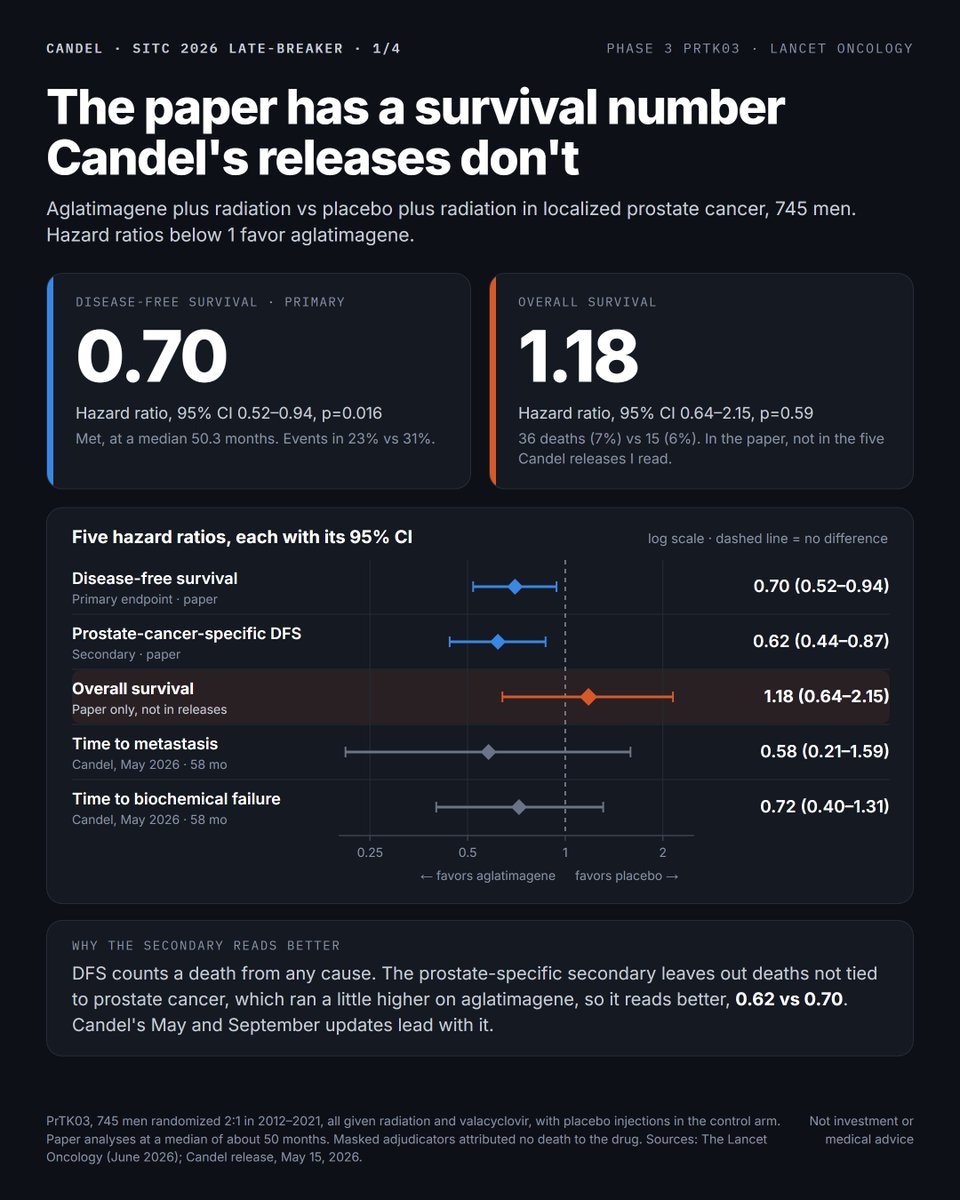
Candel $CADL plans to file its prostate cancer BLA this quarter on a Phase 3 that beat placebo on disease-free survival, HR 0.70. Its overall survival HR is 1.18, not significant, and no Candel release I read reports it. Candel's SITC late-breaker is shedding and immune data.
SITC (@sitcancer) put out its late-breaking abstract titles on Oct 29, and Candel's abstract 1172 is the one that sent me back to the footnotes of the trial its BLA rests on. So this piece tries to answer one question. What will the FDA actually be weighing when the filing goes in, and does the Nov 7 poster change any of it?
WHAT THE DRUG IS
Aglatimagene besadenovec (CAN-2409) is an adenovirus that can't replicate, built to carry a herpes virus gene, thymidine kinase, into the tumor. Each man gets three ultrasound-guided injections into the prostate, at least 14 days apart and timed around radiation, and takes valacyclovir, a common antiviral pill, for 14 days after each one. In the cells the virus reaches, the enzyme turns valacyclovir into a nucleotide analog that gets built into DNA and kills the cell. Candel's bet is that cells dying this way also show the immune system what to attack, which is why it keeps bringing immune data to meetings like SITC.
THE NUMBERS THAT DECIDE THE BLA (chart 1)
The pivotal trial, PrTK03, was published in The Lancet Oncology (@TheLancetOncol) in June. Between February 2012 and September 2021 it randomized 745 men with intermediate-risk (85%) or high-risk (15%) localized prostate cancer 2:1, double-blind. Everyone got radiation and valacyclovir, and the control arm got placebo injections. It ran under a Special Protocol Assessment agreed with the FDA.
• Disease-free survival (DFS), the primary endpoint, HR 0.70 (95% CI 0.52–0.94), p=0.016, at a median follow-up of 50.3 months, with events in 23% of men on aglatimagene and 31% on placebo
• Prostate-cancer-specific DFS, a predefined secondary endpoint, HR 0.62 (0.44–0.87)
• Tumor-free biopsies at about two years, 80% (167 of 209) vs 63% (62 of 98), in what the paper calls a post-hoc blinded review that left out six indeterminate biopsies
• PSA down to 0.2 ng/mL or lower, 67% vs 59%
• Grade 3 or worse adverse events, 8% vs 7%
I want to give this its due. It's a double-blind, placebo-controlled Phase 3, two masked central readers had to confirm tumor before a biopsy counted as positive, and the safety numbers look like the control arm's. The biopsies and the PSA numbers point the same way. That's a real result, and I'm not going to pretend otherwise.
WHAT COUNTS AS A RECURRENCE (chart 2)
This is the footnote I read first. The paper defines DFS as the time to "local (including positive biopsy) or regional failure, distant metastases, or all-cause death." The protocol called for a biopsy about two years after radiation, and tumor in that biopsy counted. Candel's own December 2024 topline filing said it plainly, the primary endpoint "included the evaluation of post-treatment biopsies, performed at two years from the end of radiation." A rising PSA on its own isn't on the list, and the paper says freedom from biochemical failure wasn't analyzed "due to the small number of events."
That stopped me. The trial counted 189 DFS events (113 plus 76), yet too few PSA failures to analyze. As I understand routine care, men are followed with PSA tests after radiation, and a biopsy usually comes only once PSA rises. So this endpoint counts something ordinary follow-up doesn't go looking for. 451 of the 745 men (61%) had the 2-year biopsy, 313 (42%) in the 22–26-month window. In that window, by my arithmetic from the paper's tumor-free rates, tumor was found in 42 of 209 evaluable men on aglatimagene (20%) and 36 of 98 on placebo (37%).
Here's the number that bothers me. Prostate-cancer events ran 17% vs 25%, a gap of about 8 points. If each of those positive biopsies was scored as an event, as the definition allows, they alone would make up about 6 of the 8 points (42 is 8.5% of 496, 36 is 14.5% of 249). That's my arithmetic, and it rests on an assumption the paper doesn't let me check, because it doesn't break the events down by type, and some of those men may have failed in other ways too. But it's why the first thing I'd ask Candel for is how many DFS events were a positive biopsy and nothing else.
The effect is also smaller than the trial was built to find. The sample-size plan assumed about 98 events would give 90% power to detect a hazard ratio of 0.5. The analysis had those 189 events and found 0.70.
WHAT THE RELEASES LEAVE OUT (chart 1)
Overall survival. In the paper it's HR 1.18 (95% CI 0.64–2.15), p=0.59, with 36 deaths (7%) on aglatimagene and 15 (6%) on placebo, one of them from prostate cancer in each arm. The most common cause of death on the drug arm was infection, 8, against 1 on placebo. The masked adjudicators attributed no death to the drug, the interval is wide, and I'm not reading harm into it. I wouldn't expect a survival benefit at four years in this disease anyway, and the authors say showing one would take about ten years of follow-up.
What I can't square is the presentation. I read five Candel releases on this trial, from the December 2024 topline to two on Sept 30, and none of them reports overall survival or all-cause deaths. The two updates with longer follow-up, in May and September, lead with prostate-cancer-specific DFS, HR 0.61 at 58 months and 0.59 in intermediate-risk men. That secondary endpoint leaves out deaths not caused by prostate cancer, and those ran a little higher on the drug. By my arithmetic from the event counts, 31 of the primary endpoint's events on aglatimagene and 14 on placebo were deaths not tied to prostate cancer (6.3% vs 5.6%), which is why the secondary reads better than the primary, 0.62 vs 0.70 in the paper. The May update didn't refresh the primary endpoint at all.
The later signals are small. At 58 months, metastases were 1.6% (8 of 496) vs 2.8% (7 of 249), HR 0.58 (0.21–1.59), and time to biochemical failure was HR 0.72 (0.40–1.31). Both lean the right way, and neither interval rules out no effect. The 90% improvement in time to metastasis that Candel highlighted for intermediate-risk men rests on 1 metastasis against 5 (HR 0.1, 95% CI 0.01–0.85).
WHAT THE LATE-BREAKER IS (chart 3)
Abstract 1172 is titled "Longitudinal immune profiling in the PrTK05 trial of aglatimagene besadenovec plus valacyclovir with radiation therapy for localized intermediate-risk prostate cancer." Candel says the poster adds biodistribution and viral-shedding data. The text goes public on Nov 6 at 9 a.m. ET, and the poster goes up on Nov 7, presented by Candel's chief scientific officer.
PrTK05 isn't a second efficacy trial. Its registry record calls it a Phase 2a "biomarker study", open-label and not randomized, planned for 45 men with favorable intermediate-risk disease, 30 getting the drug with radiation and 15 radiation alone. Its primary endpoint is viral DNA in urine, blood and semen up to 5 months after the last injection. It started in October 2025, it's still recruiting, and its estimated primary completion is February 2027. On Sept 30, Candel showed T-cell expansion in the blood of 13 treated men against 6 controls, and said the shedding data "have been compiled for inclusion" in the BLA.
So I read the poster as a box a gene therapy filing has to tick (the FDA has had guidance on shedding studies since 2015), not as a readout. It still matters. Jefferies, starting coverage on Oct 22, said the key near-term risk had shifted to finishing manufacturing work and the PrTK05 study, as the Investing news site reported the note. When the text goes up I'll be looking for three things:
• how many treated men the data cover, against the 30 planned
• how long viral DNA stays detectable in urine and semen, and whether any turns up in blood
• whether the immune changes seen in 13 men hold in more
I'm not expecting anything that changes the efficacy case. What I'd want explained is a filing going in this quarter while the study feeding its shedding data is still recruiting. That may be routine for shedding data, but I haven't seen Candel say how many men the BLA's data cover.
THE REALITY CHECK
• It's an old trial. Enrolment ran from 2012 to 2021. Of the 711 men treated, 72% got standard fractionation (median 78 Gy), and moderate hypofractionation was allowed only after a 2019 amendment (25% got it). I'd want to know how three injections and six weeks of valacyclovir fit the shorter radiation courses that are common now
• High-risk men were 15% of the trial, and only 18 of 105 treated high-risk men got more than six months of hormone therapy, a gap the authors flag themselves. Candel plans to file for intermediate- to high-risk disease
• Hormone therapy was optional, and 49% got a short course. Candel says exploratory analyses suggest benefit either way
• The SPA is real support, because the FDA agreed to the design. Candel's own filings also say it covers "certain aspects of the study design" and "does not guarantee any particular outcome from regulatory review"
• The endpoint academic groups have validated as a stand-in for survival in localized prostate cancer, in the ICECaP work, is metastasis-free survival. These data are too immature to show it
MY READ
The market will trade on the filing, whether it goes in this quarter and whether the FDA accepts it. The label will be decided on whether the FDA counts a gain that seems to sit mostly in a 2-year biopsy as clinical benefit, in a trial with too few PSA failures to analyze and a survival result none of the five releases I read has shown. My read is that the risks Jefferies named, manufacturing and PrTK05, are ones Candel controls. The endpoint is the one it doesn't.
What would change my mind:
1. An event breakdown showing most of the DFS gap isn't biopsies alone
2. The primary endpoint and overall survival updated at 58 months, with the survival gap closing
3. The FDA accepting the filing without asking for longer follow-up
A question for radiation oncologists and urologists. If a protocol biopsy finds tumor two years after radiation in a man whose PSA hasn't risen, what do you actually do with that result? Your answer decides how much this endpoint is worth to me.
Not investment advice. Not medical advice.
Sources: SITC's Oct 29 release and press policy; Candel's releases (Dec 11, 2024, and May 15, June 2, Sept 30 and Oct 29, 2026) and SEC filings; The Lancet Oncology (DeWeese et al., June 2026); the NIH trial registry; the FDA's shedding-study guidance; ICECaP-2 in Annals of Oncology; Jefferies' initiation as reported by the Investing news site.
#SITC26 #ProstateCancer #ImmunoOncology #GeneTherapy #ClinicalTrials #Biotech
$OPEN
a tough Q4 ahead, reporting in Feb.
My Spec:
1. R/S in April
2. Take it private, buy back @ $0.2-$0.8 quietly
3. Convert WT into shrs in Fri to stabilize the army not to dump @ $0.5-$0.8 prematurely
Look at the hottest Manhattan RE in Oct.
Big slow down
$open
2nd last gap s deemed filled @$1.05
The last unfilled gap:$0.80-$0.90
Aftr that gets filled, no technical requirement going down further
but driven by fundmntls
Carrie's low: $0.52
So Kaz's low d be <$0.5
But
What if Kaz gambles w/buyback @ $0.8-?
WO a 300m+ vol,25%+ day
$open
2nd last gap s deemed filled @$1.05
The last unfilled gap:$0.80-$0.90
Aftr that gets filled, no technical requirement going down further
but driven by fundmntls
Carrie's low: $0.52
So Kaz's low d be <$0.5
But
What if Kaz gambles w/buyback @ $0.8-?
WO a 300m+ vol,25%+ day
$OPEN
2 more gaps to fill $1.2, $0.8
They ll be filled in days/wks/mos aftr a pot technical rebound when gap@ $1.4-$1.6 s filled
I was an expert ftelling its ascent
Now its descent
upset by my losses, their reckless diluiton talking fail-delivery of$1.5B revs/Q in nxt 3 Qtrs