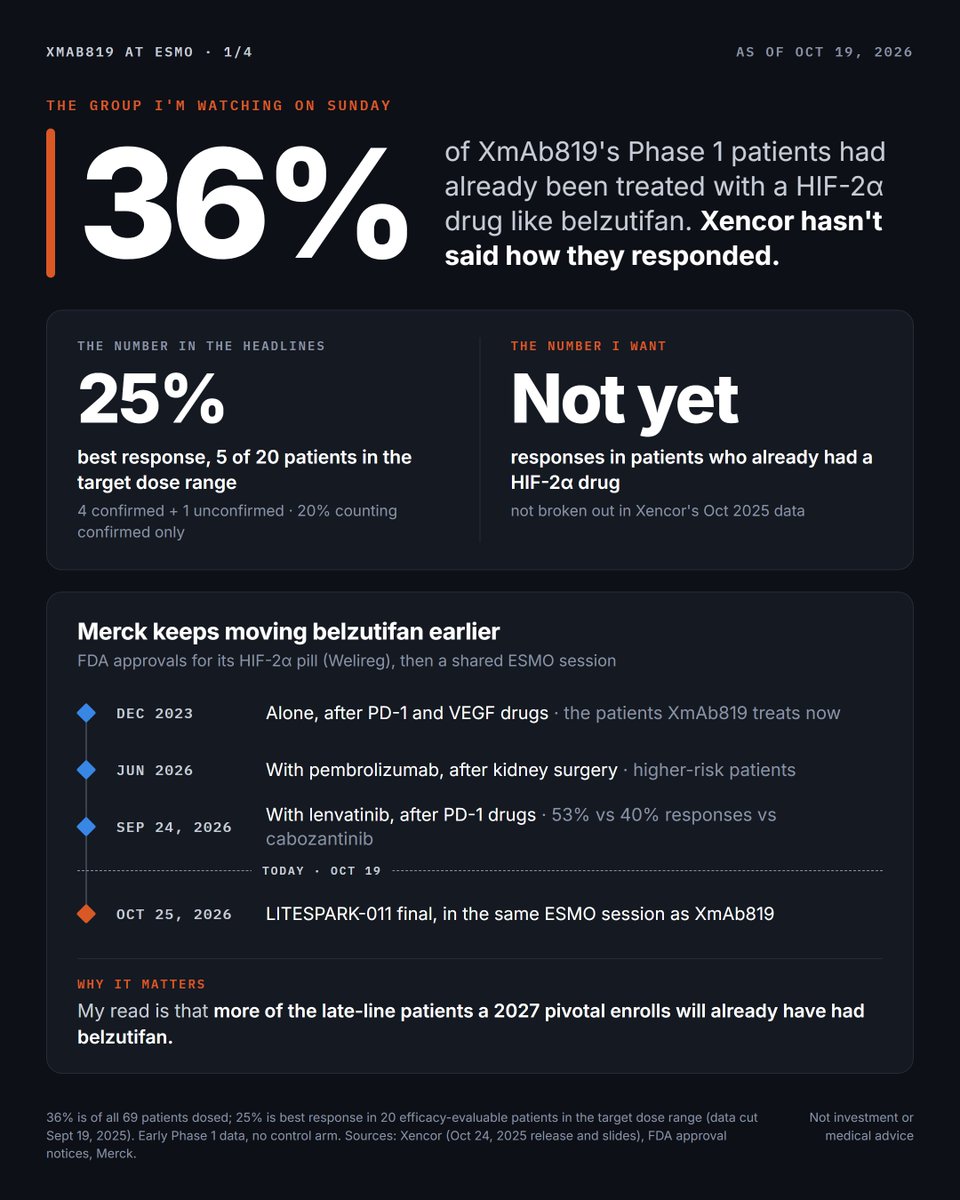
Iovance $IOVA has more than quadrupled this year on one cell therapy, approved in one cancer. By year-end it faces a rival that went on sale Oct 1, its first report since raising guidance, and a lung update that tests whether Amtagvi is a franchise or a melanoma niche.
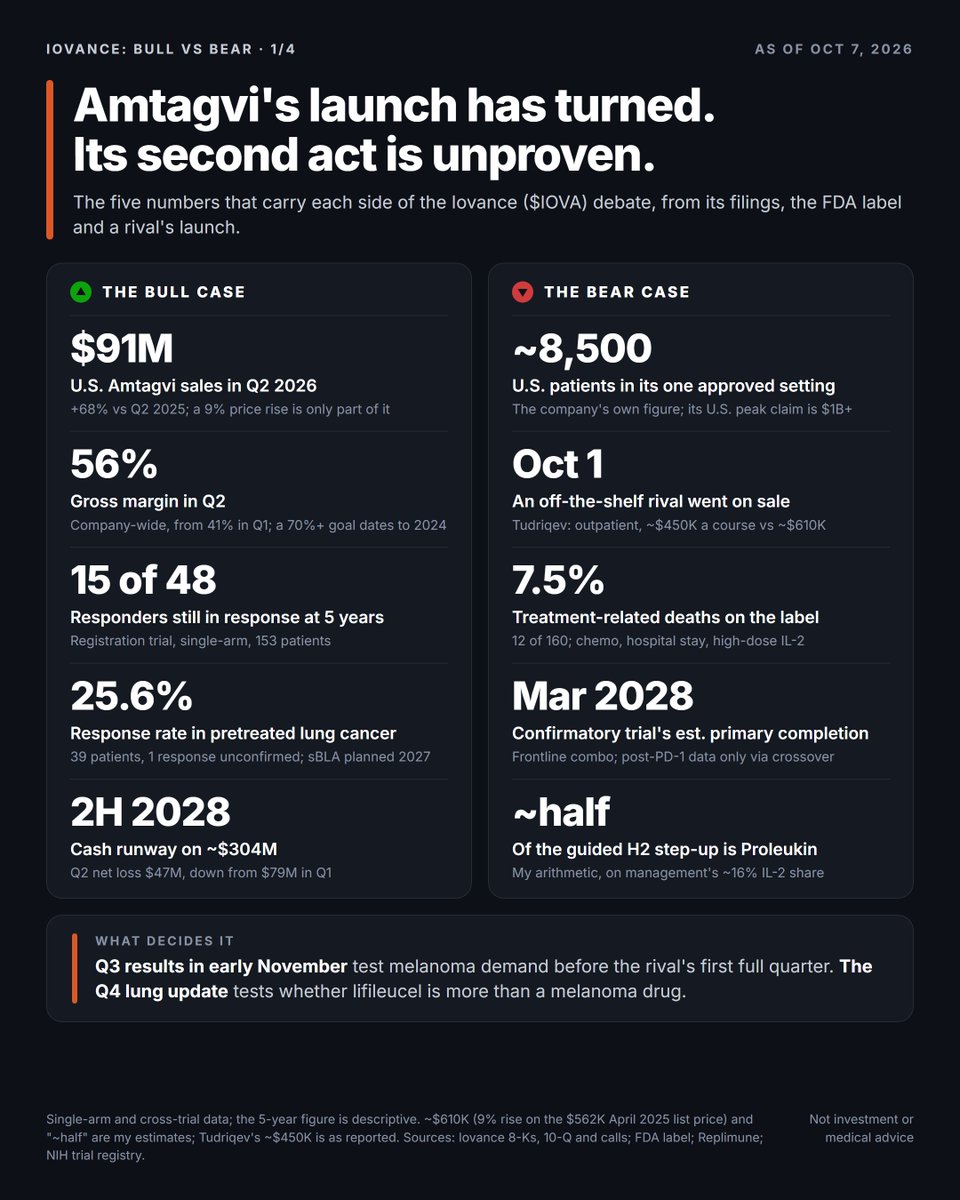
Both sides have real numbers, and most takes give you only one set. Below: the strongest case each way (chart 1), what the raised guidance actually asks of Amtagvi (chart 2), the new competition (chart 3) and the dates that decide it (chart 4). I'm not picking a side as a trade. I'll say what would move me.
WHAT JUST HAPPENED
• Sept 29: @iovancebio raised 2026 revenue guidance to $410–420M from $350–370M, "nearly 60%" growth on 2025's ~$264M. The stock closed up 31.5%, at $14.45.
• Behind it: Q2 revenue of $99.3M against guidance of $86–88M, U.S. Amtagvi sales of ~$91M (up 68% on a year earlier) and a 56% gross margin, up from 41% in Q1.
• Oct 1: Replimune $REPL (@replimune) put Tudriqev on sale. It's an oncolytic virus given with nivolumab, granted accelerated approval on Aug 6 for advanced cutaneous melanoma that progressed on a PD-1-based regimen.
• Oct 6 close: $12.96, about $5.9B in market value by my arithmetic, with about 22% of the float sold short.
THE BULL CASE
1. The launch has turned, and it isn't just price. Iovance raised Amtagvi's price 9% on Feb 1, but U.S. sales rose 68%. That implies roughly 150 patients in Q2 vs 102 a year earlier, volume up around 50% (my estimate). Management says it now treats "more than 50 patients a month" commercially. Unaided physician awareness has nearly tripled in a year, and a third of its ~100 treatment centers, across the U.S., Canada and Australia, are community sites.
2. The margins are finally moving. Company-wide gross margin, before depreciation, went from 41% to 56% in one quarter; in 2024 Iovance set a goal of passing 70% over several years, and repeated it as recently as May 2025. Its Philadelphia plant is sized for thousands of patients a year, with an expansion underway to more than 5,000; Q2's commercial pace was a bit over 600 a year. Gross-to-net is under 2%. The net loss fell to $47M in Q2 from $79M in Q1, and ~$304M of cash is guided to last into the second half of 2028.
3. When it works, it lasts. In the registration trial's five-year follow-up, 15 of 48 responders were still in response at five years, and the median response lasted 36.5 months. TIL has also beaten a standard drug in a randomized Phase 3: the Netherlands Cancer Institute's academic TIL (not Amtagvi) vs ipilimumab, median PFS 7.2 vs 3.1 months, hazard ratio 0.50, in 168 patients (NEJM, 2022). Overall survival wasn't significantly different.
4. Earlier use may work better. In a retrospective real-world study from four treatment centers, 44% of 41 patients responded (physician-assessed): 52% after two or fewer prior lines, 33% after three or more. Earlier referral is exactly what the expanded sales team is pushing.
5. One factory, more tumors. In previously treated nonsquamous lung cancer, lifileucel had a 25.6% response rate in 39 patients (23.1% counting only confirmed responses), two of them complete, with the median response not reached after 25 months of follow-up. Iovance plans an sBLA in 2027 and sizes that U.S. market at "about seven times" melanoma's. Front-line melanoma with pembrolizumab: 65.2% responses, 30.4% complete, in 23 patients. Sarcoma: 50% of the first six, with Fast Track. Outside the U.S.: conditional approvals in Canada and Australia, under review in the UK, a Swiss decision expected in the first half of 2027.
THE BEAR CASE
1. It's one label in one disease. Iovance's own deck puts U.S. second-line-or-later advanced melanoma at about 8,500 patients, and its own peak claim there is "$1B+" in U.S. sales. At an enterprise value near $5.6B, the stock trades at about 13.5x this year's guided revenue (my arithmetic). My read: that price already assumes a second act.
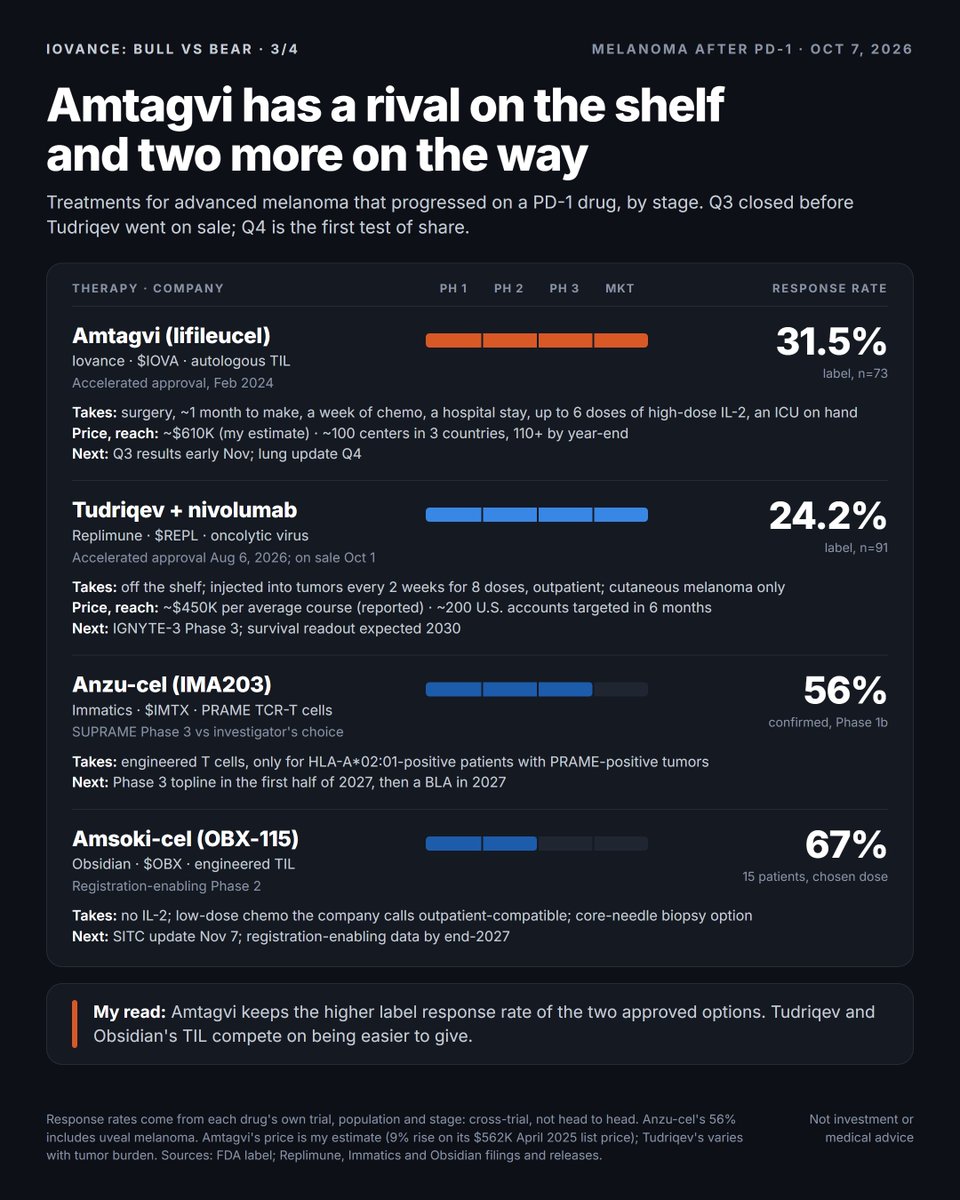
2. The competitor is on the shelf (chart 3). Tudriqev is injected into tumors every two weeks for eight doses, in outpatient clinics, with no surgery, no manufacturing wait, no lymphodepletion and no IL-2. An average course is reported at about $450,000, vs about $610,000 for Amtagvi: its $562,000 list price from April 2025 plus February's 9% (my estimate). Replimune is aiming for about 200 U.S. accounts in its first six months and about 1,200 eventually; Amtagvi has ~100 centers across three countries. Amtagvi's label response rate is higher, 31.5% (n=73) vs 24.2% (n=91), but those are different single-arm trials, so that's cross-trial. Behind it, Immatics' $IMTX PRAME-targeted cell therapy, anzu-cel, for patients with the HLA-A*02:01 tissue type, reads out a randomized Phase 3 against investigator's choice in the first half of 2027. And Obsidian's $OBX (@Obsidian_Tx) engineered TIL drops IL-2 and uses low-dose chemo its maker calls outpatient-compatible; 67% of 15 patients at its chosen dose responded at ASCO, with registration-enabling data due by end-2027.
3. The regimen caps the market. Surgery, about a month of manufacturing, a week of chemotherapy, a hospital stay and up to six doses of high-dose IL-2, with an ICU on hand. The label's treatment-related mortality is 7.5%, 12 of 160 patients. In the pivotal cohort, 22 of 111 patients who had surgery (19.8%) never got their infusion; for six, the product couldn't be made.
4. Regulators have accepted less than the company claims. The U.S. approval is accelerated, based on response rate and duration in a single-arm trial. The confirmatory trial, TILVANCE-301, compares Amtagvi plus pembrolizumab with pembrolizumab alone in untreated melanoma; patients who progress on pembrolizumab alone can cross over to Amtagvi alone. The registry estimates its primary completion in March 2028. On its early interim analysis, of response rate, management said in February it "cannot commit" to running it in 2026; in August, "hopefully relatively soon." In Europe, Iovance withdrew its application in July 2025, and the EMA then disclosed that its provisional opinion at the time was that Amtagvi "could not have been authorised": responses too low to judge benefit, deaths on the regimen, thin dose data, missing GMP documents. Refiling has slipped to 2027. In March the FDA told Iovance that promoting "19.7% of patients were alive at 5-year follow-up" was misleading, because survival data from a single-arm study are "uninterpretable."
5. Look at what the new guidance needs (chart 2). H1 revenue was $170.7M, so $410–420M implies about $120–125M a quarter in H2, 20–25% above Q2. In August management said Proleukin, its IL-2, would run at about 16% of revenue for the rest of the year. If it does, Proleukin more than doubles to ~$19–20M a quarter and Amtagvi needs only ~$100–105M, 10–15% above Q2 (my arithmetic). Nearly half the step-up would be IL-2 sold through three wholesalers, a line that has swung from ~$22M in Q4 to ~$9M in Q2 as they stocked and then sold down inventory.
6. Lung is 39 patients. Single-arm, and the company's docetaxel benchmark (a 12.8% response rate) comes from a different trial. The lung trial sat on a temporary FDA clinical hold from December 2023 after a death possibly related to the lymphodepletion. Management's "$10B" lung peak rests on 50,000 addressable patients; at today's price, that means treating about a third of them (my arithmetic).
7. The runway was partly bought with stock. Iovance sold 38.9M shares in H1 2026 for $148M, about $3.80 a share (my arithmetic). The CEO has been "interim" since June 2021.
WHERE I COME OUT
My read: each side is mostly right about a different half of the company. The bull is right that the launch has turned and the margins now work. The bear is right that it's still one melanoma label with a hard regimen, now facing an off-the-shelf rival, and priced as if a second act were coming. The two halves run on different clocks. Melanoma demand gets tested within weeks. Whether this becomes a franchise is a lung question, and that can't be settled before the 2027 filing.
What would move me toward the bull: U.S. Amtagvi at or above ~$100M in Q3 with the margin holding, little stock sold into the rally, and a lung update where responses hold near 25% across the full registrational cohorts, with durability and no new deaths.
What would move me toward the bear: Amtagvi stuck near $91M with Proleukin carrying the growth, community referrals going to Tudriqev, and lung responses drifting toward docetaxel's range as the cohorts fill.
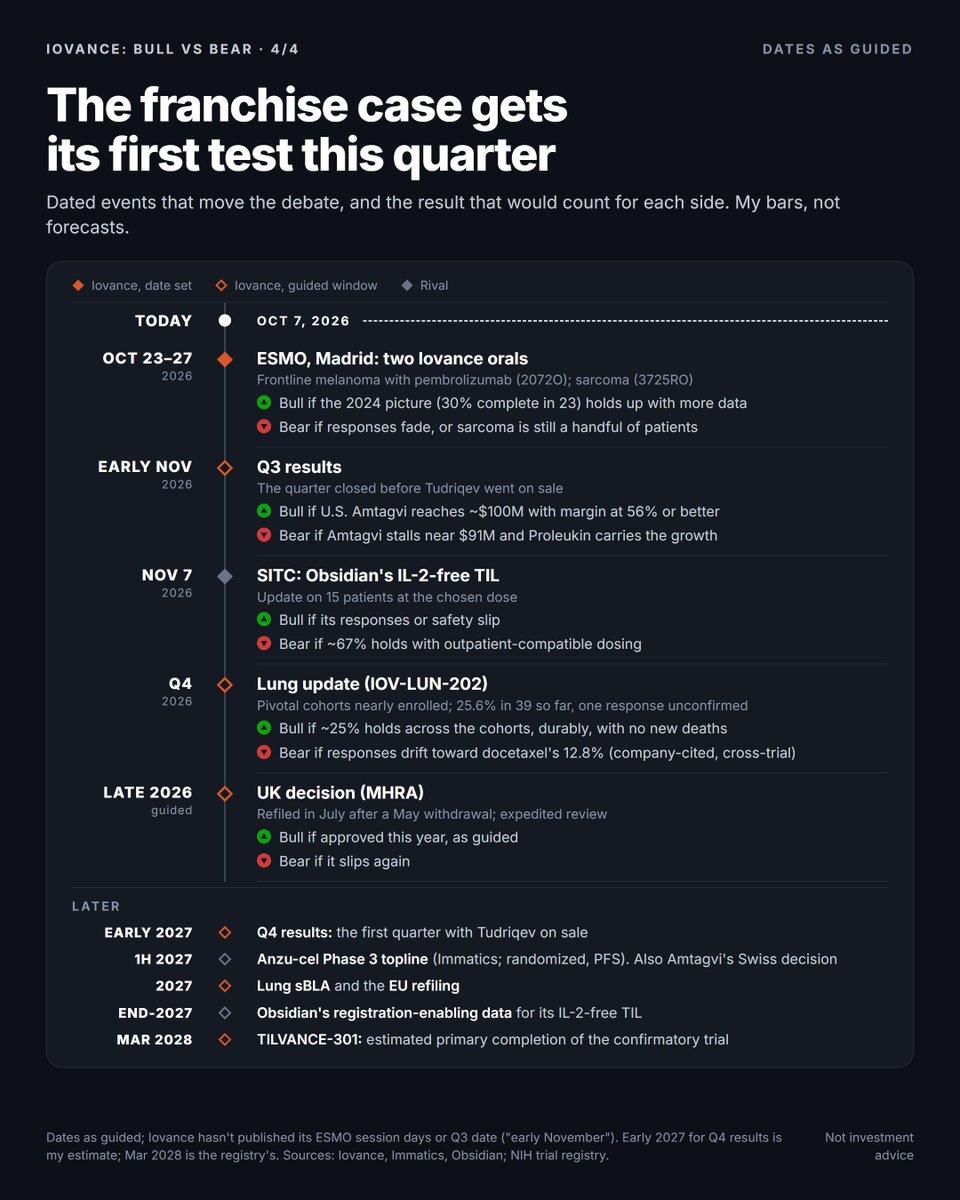
WHAT DECIDES IT (chart 4)
1. Oct 23–27, @myESMO in Madrid: two Iovance orals. Front-line melanoma with pembrolizumab (2072O): does the 2024 Phase 2 picture, 65% responses and 30% complete in 23 patients, hold with more follow-up or more patients? Sarcoma (3725RO): does 50% hold beyond six patients?
2. Early November: Q3 results. U.S. Amtagvi vs ~$91M, Proleukin's share vs 16%, gross margin vs 56%, and how much stock was sold after the run. The quarter closed before Tudriqev went on sale, so the tell is what management says about referrals since.
3. Nov 7, @sitcancer: Obsidian's update on its 15 patients at the chosen dose.
4. Q4: the lung update. The franchise question in one dataset.
5. Later this year: the UK decision.
6. Early 2027: Q4 results, the first quarter with Tudriqev on sale.
7. First half of 2027: Immatics' Phase 3 topline, a randomized trial against investigator's choice, the kind Amtagvi was approved without. Also the Swiss decision.
8. 2027: the lung sBLA and the EU refiling. By end-2027: Obsidian's registration-enabling data.
9. March 2028, by registry estimate: TILVANCE-301's primary completion, the confirmatory trial for the accelerated approval.
THE REALITY CHECK
• Every response rate here is single-arm and cross-trial, across different populations and prior lines.
• The five-year survival and real-world figures are descriptive. The FDA's point about survival in single-arm studies cuts both ways.
• My second-half split rests on a Proleukin comment made in August, before the raise. The Sept 29 release cites demand for both products without a split.
• Nobody's numbers include Tudriqev yet. It went on sale six days ago.
BOTTOM LINE
Amtagvi is a real business now: ~$91M of U.S. sales a quarter, a 56% company-wide gross margin and cash guided into 2028. It's also still one label, in a disease where a simpler rival went on sale last week and two more report in 2027, under an approval whose confirmatory trial isn't due to finish before 2028, after a European regulator was ready to say no last year. On management's Proleukin comment, the raised guidance asks Amtagvi for only modest growth: conservative to a bull, Proleukin-dependent to a bear. What turns a melanoma product into a franchise is lung, and the first real test of that comes this quarter.
Melanoma docs: with Tudriqev on the shelf, who still goes to TIL first?
Not investment or medical advice. Data as of Oct 7, 2026; prices at the Oct 6 close. Sources: Iovance releases, SEC filings and earnings calls; the FDA label and a March 2026 FDA letter; the European Medicines Agency; the NIH trial registry; Replimune, Immatics and Obsidian releases and filings; JCO, NEJM, ASCO and ASTCT data; BioSpace; Yahoo Finance and Stock Analysis.
#ImmunoOncology #CellTherapy #TILtherapy #Melanoma #LungCancer #Biotech #ESMO26
77 patients, all with CIS: that's what the FDA cited on Oct 14 to approve ImmunityBio's $IBRX Anktiva in BCG-unresponsive papillary-only bladder cancer. In 2025 it wouldn't file the papillary patients' own data. The day before, J&J $JNJ said the FDA invited it to file too.
I didn't expect the fight to end this way. Not the approval: the route. ImmunityBio (@immunitybio) spent 17 months arguing that its papillary-only patients had earned a label. On Oct 14 the FDA gave it one, and the approval notice doesn't mention a single result from those patients (chart 1).
HOW WE GOT HERE
April 2024: the FDA approves Anktiva, an IL-15 receptor agonist given into the bladder with BCG, for BCG-unresponsive non-muscle invasive bladder cancer (NMIBC) with carcinoma in situ (CIS), with or without papillary tumors. The evidence was Cohort A of the single-arm QUILT-3.032 trial: 77 patients, a 62% complete response rate.
That label left out the bigger group. Papillary tumors grow out from the bladder wall and are cut out before treatment, so nothing is left to respond; what gets measured is how long they stay away. Cohort B followed 80 papillary-only patients, and 58.2% were disease-free at 12 months by ImmunityBio's analysis.
ImmunityBio says FDA leaders told it in January 2025 to file on that single-arm cohort. By mid-April it had. On May 2, 2025 the FDA refused to file the application; ImmunityBio later said the agency wanted a randomized trial against chemotherapy. Patrick Soon-Shiong, its executive chairman, said at the time: "The Agency must explain the confounding inconsistency of approving ANKTIVA+BCG for patients with Papillary with CIS disease, while refusing to file the sBLA for patients with Papillary without CIS disease." In its August 2025 results release, the company said it was committed to starting that randomized trial.
If you'd asked me then, I'd have called the refusal by the book. The FDA's August 2024 draft guidance for this disease put "more emphasis on randomized control trials," in the agency's own summary. As the Regulatory Affairs Professionals Society (RAPS) reported it, the draft steered patients without active disease, which is what papillary-only patients are once resected, into randomized trials with a recurrence endpoint. Single-arm trials were acceptable for CIS, where a response can be measured.
Then 2026 got loud (chart 2). At a January meeting the FDA asked for more data but, per OncLive, no new trial. On Jan 19 Soon-Shiong went on The Sean Spicer Show for an episode titled "Is the FDA BLOCKING Life Saving Cancer Treatments?" ImmunityBio resubmitted in March. On March 13 the FDA's drug-promotion office sent it a warning letter over that podcast and a TV ad. Among the claims it cited: "we can treat the tumor, and it doesn't come back," and a "single jab" framing for a drug whose efficacy was shown only with BCG, noting that its single-agent cohort "was stopped early for futility." On March 17 ImmunityBio announced that the NCCN guidelines now list Anktiva plus BCG for papillary-only disease (category 2A), ahead of any label.
The turn came in May. On May 18 the FDA's Oncology Center of Excellence (@FDAOncology) held a public workshop to "Discuss the similarities and differences between the two types of histology (papillary and CIS) observed in NMIBC and implications for the demonstration of efficacy in clinical trials." On May 19 ImmunityBio announced the FDA had accepted the resubmission, goal date Jan 6, 2027, and said the review would focus on whether the overlap gave "adequate justification to allow for such an extrapolation and expansion." On Oct 14 the answer came back yes, 12 weeks early.
I don't read this as the FDA rewarding a podcast. My read of the record is the opposite: the agency put a science question to a public workshop and answered it with biology.
WHAT THE FDA ACTUALLY SAID
Four sentences from the approval notice, verbatim:
1. The scope: "This revises the prior indication for adults with BCG-unresponsive NMIBC with carcinoma in situ (CIS) with or without papillary tumors to include patients with high-grade papillary-only tumors."
2. The biology: "While high-grade papillary and CIS tumors have different architectural growth features, both are considered aggressive urothelial carcinomas, frequently coexist, can be difficult to distinguish pathologically, and, in the BCG-unresponsive setting, are associated with high risk for tumor recurrence and progression."
3. The move: "Based on the overlapping clinical and non-clinical features of these two histologic types, the FDA concluded that the prior demonstration of efficacy in patients with BCG-unresponsive NMIBC containing CIS could be extrapolated to patients with BCG-unresponsive high-grade papillary disease."
4. The policy: "FDA is working toward finalizing the Guidance for Industry, 'Bacillus Calmette-Guérin-Unresponsive Nonmuscle Invasive Bladder Cancer: Developing Drugs and Biological Products for Treatment' to address this approach."
The efficacy it cites is the 2024 CIS cohort: 62% complete responses (95% CI 51–73), with 58% of responders still in response at 12 months and 40% at 24. "Cohort B" isn't on the page. Neither is "disease-free," or any confirmatory or postmarketing trial. When I reached the end I scrolled back up looking for the papillary number. There isn't one.
The label itself "will be posted" in the FDA's drug database, so the exact indication wording is still to come. The prescribing information keeps its warning that "delaying cystectomy can lead to the development of metastatic bladder cancer, which can be lethal."
WHY IT'S BIGGER THAN ANKTIVA
Sentence 2 is about tumors, not a drug. Nothing in it is specific to IL-15 or to BCG. Sentence 4 points it at guidance, the document every sponsor in this disease designs its trials around. My read: the FDA just told the field that, in BCG-unresponsive disease, a CIS complete response rate can carry papillary-only patients too.
J&J (@JNJNews) went first, a day early. On its Q3 call on Oct 13, John Reed, its EVP of Innovative Medicine R&D, said Inlexzo's papillary use "is already in the NCCN guidelines, and the FDA has invited us to submit for expansion of our label into that population." His case for it: "nearly 75% of patients had no recurrence after one year" in its papillary cohort.
What I keep coming back to: J&J is already running the kind of trial ImmunityBio says it was asked for. SunRISe-5 randomizes Inlexzo against mitomycin or gemcitabine in papillary-only disease that came back within a year of BCG: 272 patients enrolled, estimated primary completion November 2030, per the NIH trial registry. If the CIS route works for J&J too, its papillary label could arrive years before its own randomized answer (my inference).
THE CIS NUMBER IS NOW THE PAPILLARY NUMBER
The field by complete response in CIS, with each drug's papillary-only cohort (chart 3):
• Inlexzo (J&J), a gemcitabine-releasing bladder device: 82% (83 patients), on the label since September 2025. Papillary: 74.3% disease-free at 12 months (52). No BCG.
• Cretostimogene, CG Oncology $CGON (@cgoncology), an oncolytic virus: 75.5% (83 of 110; The Lancet Oncology, July). BLA due to complete this quarter. Papillary: 80.4% free of high-grade recurrence at 9 months (51 evaluable, 6 months' median follow-up, so early). No BCG.
• Anktiva + BCG (ImmunityBio): 62% (77). Papillary: 58.2% disease-free at 12 months (80). Needs BCG.
• Detalimogene, enGene $ENGN (@engene_inc), a non-viral gene therapy: 54% interim (67 of 124, April 21 data cutoff). BLA due to start this quarter. Papillary: enrollment stopped in June. No BCG.
• Adstiladrin, Ferring (private): 51% (98). Papillary: 43.8% free of high-grade recurrence at 12 months (48). No BCG.
• Keytruda, Merck $MRK (@Merck): 41% (96), for patients who can't have or decline cystectomy. Papillary: 43.5% disease-free at 12 months (132). No BCG.
All single-arm, with different designs, endpoint definitions and follow-up: cross-trial comparisons, nothing more.
Two things jumped out at me. The papillary cohorts run from 43.5% to 74.3% at 12 months, and the FDA's notice used none of them. If the next approvals work the same way, the number that carries a papillary label is the CIS one, and Inlexzo leads it. And Anktiva is the only one of the six given with BCG, in a country where, in ImmunityBio's own words, urologists "have lived with a chronic BCG shortage for more than a decade." It has workarounds: a recombinant BCG under an FDA expanded-access program (over 570 patients at 58 sites by February) and a US supply deal for Japan BCG Laboratory's Tokyo strain. Its rivals don't need them.
WHAT THE BIGGER POOL IS WORTH
J&J sized it on the same call (chart 4). Tom Cavanaugh, who runs its Innovative Medicine business, called Inlexzo's CIS population "roughly 4,000 patients in totality, so relatively small in nature," and SunRISe-5's "a broader patient population, roughly 15,000 patients." He didn't say US or annual. And SunRISe-5 takes recurrences up to a year after BCG, wider than "BCG-unresponsive," so I treat 15,000 as a ceiling for the new label. ImmunityBio's frame is broader still: about 85% of the 64,000 Americans diagnosed with NMIBC each year present with papillary disease.
In dollars: Anktiva lists at $36,516 a dose on ImmunityBio's ordering page. A patient who stays on it through year one gets 15 doses: six weekly induction doses, then three-dose rounds at months 4, 7 and 10. That's about $548,000 at list, before discounts (my arithmetic, and a ceiling, since non-responders stop). Anktiva's net product revenue ran $16.5M in Q1 2025, then $26.4M, $31.8M, $38.3M, $44.2M and $50.7M in Q2 2026, up 92% on a year earlier.
The tempering: some papillary use was already happening. At the May workshop, by ImmunityBio's account, panelists said they treat papillary-only patients off-label with a drug approved for CIS. NCCN listed Anktiva for it in March, and Reed says Inlexzo is in the guidelines there too. My read: the label adds what a listing can't, on-label promotion and cleaner payer coverage. Real, but smaller than a nearly 4x patient count implies. And ImmunityBio will be promoting into papillary under the same office that sent it a warning letter in March.
The market reaction fits that read. $IBRX was up about 3% late in the session on 26 million shares, more than twice the day before (StockAnalysis), after a run of more than 400% this year (Stocktwits). CG Oncology slipped 0.4% and enGene fell 3.7%. I don't think anyone missed the news; my guess is it was mostly priced in May, when the FDA accepted the filing on exactly this argument. What I think is underweighted is who the argument helps.
WHO IT HELPS, WHO IT DOESN'T
1. J&J. My read: the biggest winner of ImmunityBio's fight. The highest CIS rate on any label, no BCG, "north of $90 million" in Q3 sales and "nearly one in three eligible patients" starting it. Approved 16 months after Anktiva, its Q3 already tops Anktiva's latest reported quarter (Anktiva hasn't reported Q3). Cavanaugh tied the bigger pools to "$5 billion+ for the platform." That's J&J's ambition, not a forecast I can test.
2. CG Oncology. The second-best CIS number, $1.0 billion of cash and securities at June 30 that it says funds operations "through 2029," and a BLA due to complete this quarter. I can't find anything from CG on a papillary filing. The question I'd put to it: papillary with the first approval, or after?
3. enGene. The one that stings. In June it stopped enrolling its papillary-only cohort "as part of cash conservation efforts" and cut about half its workforce. Under the new logic that cohort may matter less than its CIS number, but that number is the weakest of the newcomers: 54% interim, against 71% in a 21-patient look in 2024, when it guided to a BLA in mid-2026. The BLA now starts in Q4, with a decision possible in 2027. The market values enGene at about $105 million (StockAnalysis); it reported $266.3 million of cash and securities at July 31.
4. Merck and Ferring. Both hold CIS labels, and both ran papillary cohorts that came in near 44% at 12 months. To me, the FDA's sentence reads as if it covers them too. I haven't seen either respond.
5. ImmunityBio. First to the label, about $10.5 billion of market value on Oct 14 (StockAnalysis) on $50.7 million of quarterly sales, and the one drug in the race tied to BCG supply. It won the precedent. I'm not sure it wins the market the precedent opens.
THE REALITY CHECK
• Every efficacy number here comes from a single-arm trial. Extrapolation means the new indication rests on no papillary-specific efficacy bar (my read), in the very patients the FDA's 2024 draft steered toward randomized trials.
• Even Anktiva's papillary number comes in two versions: 58.2% at 12 months in ImmunityBio's 80-patient analysis, 55.4% in a 72-patient analysis OncLive reported on Oct 14.
• The label isn't posted. Its final words could read narrower than the notice.
• The guidance isn't final. If it ends up asking each sponsor for its own papillary data, or sets a floor, enGene's halted cohort matters again and the precedent is narrower than I think. That's what would make me wrong.
• J&J's 15,000 is J&J's count of its own trial's population, not an epidemiology study.
• I don't know what happens to the randomized trial against chemotherapy that ImmunityBio said in August 2025 it was committed to starting.
WHAT I'M WATCHING
1. Oct 16: Soon-Shiong's fireside chat at the Piper Sandler Virtual Oncology Symposium. The first chance to hear how ImmunityBio sells into papillary, and with which BCG.
2. The Anktiva label in the FDA's database: the exact indication, and whether Cohort B makes the clinical studies section.
3. Q4 2026: CG Oncology completes its CIS BLA. Does papillary ride along?
4. Q4 2026: enGene's pre-BLA meeting, its BLA start and updated complete response and 12-month durability data, and whether the FDA conversation revives its papillary cohort.
5. Later this year: the "data readout in high-risk non-muscle invasive bladder cancer" J&J says it expects (trial not named), and the Inlexzo papillary filing (no date given).
6. No date: the final FDA guidance. In my view, the most important document in this disease now.
7. November 2030 (estimated): SunRISe-5's primary completion, the randomized papillary answer the labels may arrive without.
BOTTOM LINE
ImmunityBio fought 17 months for its papillary patients and won something bigger than a label: a rule. In BCG-unresponsive bladder cancer, the FDA now says CIS efficacy can carry papillary-only disease, and it says its final guidance will address the approach. My read: that rule is worth most to whoever has the best CIS number and doesn't need BCG. Today that's J&J, with CG Oncology next in line. Anktiva got there first, but the race it opened runs on a number Anktiva doesn't lead.
Urologists: if the labels end up reading the same, what decides a papillary-only case for you: the CIS response rate, the papillary cohort or whether you can get BCG?
Not investment advice. Not medical advice. Sources: the FDA's Oct 14 approval notice, its 2024 draft guidance notice in the Federal Register, its May 18 workshop page and its March 13 warning letter to ImmunityBio; ImmunityBio releases and SEC filings; J&J's Q3 2026 call and prepared remarks; CG Oncology and enGene SEC filings; FDA labels and approval notices for Inlexzo, Adstiladrin and Keytruda; the NIH trial registry; The Lancet Oncology; Journal of Urology; SUO 2025 via The ASCO Post; OncLive; Urology Times; RAPS; StockAnalysis; Stocktwits. Data as of Oct 14, 2026.
#BladderCancer #NMIBC #FDA #ImmunoOncology #Urology #GeneTherapy #Biotech
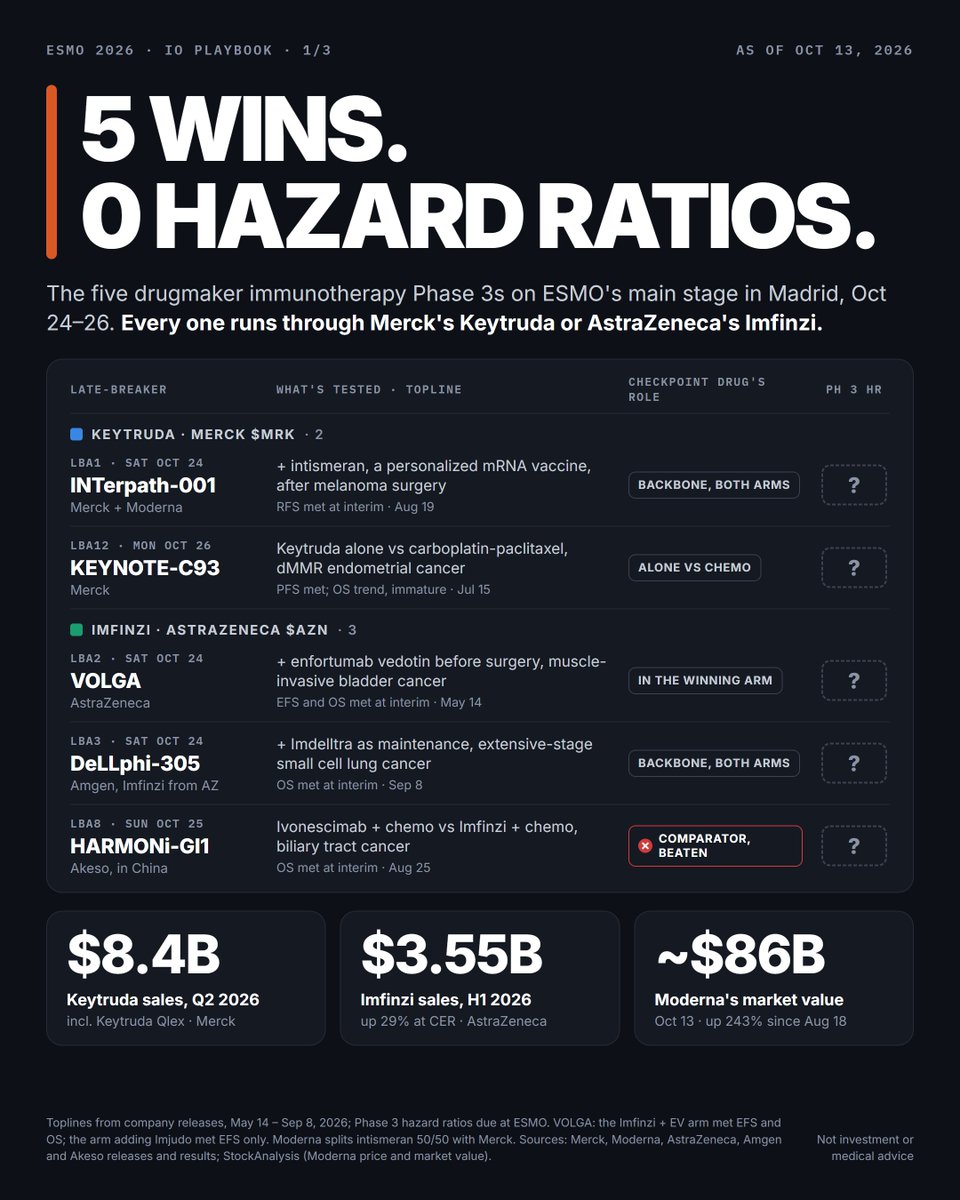
Five drugmakers' immunotherapy Phase 3s hit ESMO's main stage Oct 24–26. All say they won; none has shown a hazard ratio. Four go on over the weekend; the fifth, Merck's $MRK, on Monday, a trading day. AstraZeneca's $AZN Imfinzi is in three, once as the comparator that lost.
That last part is the turn I keep coming back to. In September 2022 the FDA approved Imfinzi plus chemo for advanced biliary tract cancer, and AstraZeneca billed it as "the first immunotherapy regimen" for the disease. On Sunday, Oct 25, a drug that beat Imfinzi on survival in that same cancer gets a Presidential Symposium slot at ESMO (@myESMO). The day before, Imfinzi sits in the winning arm of two other late-breakers. Merck's Keytruda is in the remaining two, so every one of the five runs through one of those two drugs (chart 1).
Each also has a number to beat that's already in a label, a journal or a share price (chart 3). So that's the question for this post: what does each of the five have to show, and when does the market get to see it?
THE CLOCK (chart 2)
ESMO posts its regular abstracts at 00:05 Madrid time on Monday, Oct 19, which is 6:05 PM ET on Sunday, per Immatics' release. Late-breakers go up at 00:05 on the day they're presented: that's the rule in Elicio's release for its own late-breaker this year, and the one ESMO announced for late-breakers last year. If the Presidential ones follow it, all times ET:
• Fri Oct 23, 6:05 PM: abstracts for INTerpath-001, VOLGA and DeLLphi-305, after the close, with only after-hours trading left
• Sat Oct 24, 10:30 AM to 12:15 PM: all three presented in Presidential Symposium I. Moderna's webcast at 1 PM
• Sat Oct 24, 6:05 PM: the HARMONi-GI1 abstract, then the talk in Presidential Symposium II, Sun Oct 25 from 11:30 AM
• Sun Oct 25, 7:05 PM: the KEYNOTE-C93 and MOIO abstracts (Madrid's clocks go back on the 25th)
• Mon Oct 26, 11:30 AM to 1:15 PM: Presidential Symposium III, KEYNOTE-C93 included, with US markets open
• Mon Oct 26, 2:30 PM: Merck's oncology investor event and AstraZeneca's, at the same hour
What surprised me when I lined it up: by Monday's open, all five abstracts should be public and four of the five talks finished. The market gets a weekend of numbers, then one live session.
LBA1 · INTERPATH-001 · SAT OCT 24
The trial adds intismeran, a personalized mRNA vaccine that Moderna (@moderna_tx) develops with Merck (@Merck), splitting costs and profits 50/50, to Keytruda after melanoma surgery, against Keytruda plus placebo. On Aug 19 the partners said it met its primary endpoint, recurrence-free survival, and a key secondary, distant metastasis-free survival, at a prespecified interim analysis in 1,137 patients randomized 2:1. No hazard ratio. Moderna $MRNA closed at $62.96 the day before and $174.38 that day, up 177%. On Oct 13 it closed at $216.25, up 243% from the eve of the readout, about $86B of market value. I still find it hard to get my head around a move that size on a release without the number that matters most.
The bars already set:
• The Phase 2b (157 patients, open-label): a hazard ratio of 0.561 at the primary analysis, with a 95% confidence interval of 0.309 to 1.017; 0.51 at five years (0.294 to 0.887)
• UBS (Sept 22) says the market is looking for about 0.65 or better, and that below 0.6 is unlikely given the 2:1 design and when the readout came
• Citi, in a framework published Aug 18, the day before the topline: 0.72 or lower would be positive, 0.65 or lower a clear win
• BofA (Aug 20): a clear benefit, 0.6 to 0.7, needed to turn more positive. Its checks with doctors suggested 0.8 could be enough for use
So the market's bar sits near 0.65 and the doctors' near 0.8, and a 0.75 would clear one and miss the other. On Oct 11 I wrote that the number I want more than the hazard ratio is "how many of the roughly 760 patients assigned to the vaccine ... actually got it, and how long it took." I still do. In an intention-to-treat analysis, a vaccine that arrives late or never gets made counts against the vaccine arm, so that number shows whether the factory keeps up with the biology.
LBA2 · VOLGA · SAT OCT 24
AstraZeneca's (@AstraZeneca) bladder trial is a story about arriving second. On May 14, AZ said Imfinzi plus enfortumab vedotin (EV, sold as Padcev) before surgery, then Imfinzi alone after it, improved event-free and overall survival at a planned interim analysis in muscle-invasive bladder cancer, in patients who couldn't have or refused cisplatin. 695 patients, three arms. The triplet arm, which adds Imjudo, improved event-free survival, but its overall survival wasn't statistically significant at the interim. The doublet is under FDA priority review, with a goal date in Q4.
The trouble is the incumbent. Keytruda plus Padcev was approved for cisplatin-ineligible patients last November on KEYNOTE-905: event-free survival hazard ratio 0.40, overall survival 0.50, pathologic complete response 57.1% vs 8.6% with surgery alone. In July the FDA extended that regimen to patients regardless of cisplatin eligibility.
My bar for VOLGA's doublet: hazard ratios near KEYNOTE-905's, with visibly less toxicity. It gives 3 cycles of EV, all before surgery. KEYNOTE-905 gives 9, three before and six after, and 71.3% of its patients had grade 3 or worse adverse events vs 45.9% with surgery alone. Less EV is the only edge I can see that beats being first. One cross-trial catch: VOLGA's control arm could get approved therapy after surgery while KEYNOTE-905's got surgery alone, so the same drug effect could look smaller in VOLGA.
The part I keep noticing: Padcev is in both regimens. Pfizer $PFE (@pfizer), which partners it with Astellas (Tokyo: 4503), reported $1.94B of Padcev revenue in 2025, and the two sell EV into this market whichever checkpoint drug is attached. Imfinzi, for scale, sold $3.55B in the first half of 2026, up 29% at constant exchange rates.
LBA3 · DELLPHI-305 · SAT OCT 24
The trial adds Amgen's $AMGN (@Amgen) T-cell engager Imdelltra to Imfinzi as maintenance after first-line chemo-immunotherapy in extensive-stage small cell lung cancer, against Imfinzi alone. On Sept 8 Amgen said the pair improved overall survival at a prespecified interim analysis in 563 patients, with progression-free survival and response rate also better. Amgen sponsors; AstraZeneca supplies the Imfinzi and part of the funding. No hazard ratio. AstraZeneca estimates about 195,000 people worldwide will be treated for this stage of the disease this year, with median survival on today's standard around a year.
The bar is already approved. Since October 2025, Jazz's $JAZZ Zepzelca (lurbinectedin) plus Roche's $RHHBY (@Roche) Tecentriq has been an FDA-approved first-line maintenance option on IMforte: overall survival hazard ratio 0.73, 13.2 months vs 10.6, with grade 3 or 4 adverse events in 38.0% vs 22.1%. Imdelltra's own second-line trial set a higher bar for the molecule: 0.60 vs chemo, 13.6 months vs 8.3.
My bar for DeLLphi-305: a hazard ratio at or below IMforte's 0.73 (cross-trial, so a guide, not a test), with cytokine release and neurologic side effects that look manageable in patients whose cancer is under control.
The detail I didn't expect came six days after the topline. On Sept 14 the FDA cut the monitoring Imdelltra needs after each of its first two doses from 22 to 24 hours to 6 to 8 hours, plus a next-day check. For a maintenance drug that has to work in community clinics, I'd argue that label change matters as much as the hazard ratio. Imdelltra sold $288M in Q2, up 115%, on a label limited to patients whose cancer progressed on or after platinum chemo.
LBA8 · HARMONI-GI1 · SUN OCT 25
This is the one I've been most curious about since August. On Aug 25, Akeso (https://t.co/25Bl6wcQEs, @AkesoInc) said its PD-1/VEGF bispecific ivonescimab plus chemo beat Imfinzi plus chemo on overall survival in first-line biliary tract cancer: a 682-patient, double-blind Phase 3 in China, at a prespecified interim analysis. By Akeso's account, it's the first Phase 3 in this cancer to beat a PD-L1 drug plus chemo on survival. No hazard ratio.
Imfinzi's own biliary approval came on TOPAZ-1: a hazard ratio of 0.80 vs chemo, 12.8 months vs 11.5. Keytruda followed in 2023 on KEYNOTE-966: 0.83, 12.7 months vs 10.9. So checkpoint drugs bought this cancer about 1.3 to 1.8 months of median survival over chemo.
My bar has two parts. First, the gap: a hazard ratio near 0.80 against Imfinzi would be a second step the size of the first one, taken on top of it. Second, the control arm: if Imfinzi plus chemo lands near TOPAZ-1's 12.8 months, the comparison is clean. If it lands well below, I'd discount the gap.
Who's exposed? Less than the headline suggests, outside China. Summit $SMMT (@SMMT_TX) holds ivonescimab's rights in the US and Europe, but says this trial was run, and its data generated and analyzed, by Akeso in China, and that the drug isn't approved anywhere in Summit's territories. I haven't found a biliary trial of Summit's own. For Summit, Sunday is a read on the molecule. Its own date is Nov 14, the FDA goal date for its lung cancer filing.
LBA12 · KEYNOTE-C93 · MON OCT 26
This is Merck's chemo-free case in endometrial cancer with mismatch repair-deficient (dMMR) tumors. 299 patients, open-label: Keytruda alone every six weeks for up to 18 cycles vs carboplatin and paclitaxel for six. On July 15 Merck said Keytruda won on progression-free survival, one of two primary endpoints. On the other, overall survival, it saw "a trend toward improvement," with the data not yet mature. Merck says Keytruda is the first PD-1 drug to beat platinum chemo on progression-free survival on its own in this setting.
The real bar isn't chemo, though. It's Keytruda plus chemo, approved since 2024. In the dMMR subgroups of the chemo-immunotherapy trials, adding a PD-1 or PD-L1 drug to chemo cut the risk of progression by roughly 60% to 70%: hazard ratios of 0.28 (dostarlimab, RUBY), 0.30 (Keytruda, NRG-GY018) and 0.42 (durvalumab, DUO-E). Cross-trial again, but it's the comparison doctors will make. My bar: a hazard ratio in that range, no early dip in the curve from patients who progress fast without chemo, and a survival trend that doesn't need squinting at.
The catch I'd watch is overall survival itself. Merck's release doesn't say whether chemo-arm patients could switch to immunotherapy when their cancer grew; if many did, survival may never separate. My read: the money here is small next to Keytruda's $8.4B second quarter. The value is a claim Merck says no other PD-1 drug has in this setting.
THE SLEEPER IN THE SAME SESSION
Presidential Symposium III also holds LBA10, MOIO, a French academic Phase 3 run by UNICANCER that asks almost the opposite question: once a patient has responded to six months of a PD-1 or PD-L1 drug, can the same dose be given every three months instead? 646 patients planned, primary endpoint progression-free survival, a non-inferiority margin of a hazard ratio of 1.3, cost-effectiveness among the secondary endpoints. The registry still lists primary completion in 2029 and the slot is billed as interim analyses, so I genuinely don't know what it will show. I didn't expect to see it on the main stage. For a drug given every three weeks, every three months is roughly one infusion where the standard schedule gives four (my arithmetic). If I made a checkpoint drug, that's the abstract I'd read first.
THE UNDERCARD
Two smaller reads sit in the same 8:30 AM Madrid slot on Saturday, 2:30 AM ET, with abstracts online from Oct 19:
• Immatics $IMTX: first data for IMA402, its PRAME T-cell engager, at its recommended Phase 2 dose range, the day after Friday's 7:30 AM ET oral on IMA203CD8, its PRAME cell therapy (63% response rate, 50% confirmed, in gynecologic cancers so far). The stock closed at $6.83 on Oct 13, near its 52-week low and 21% below the $8.69 at which it sold shares in August. Cash was $448.2M at June 30, with runway into 2028, and its melanoma Phase 3 topline is guided for H1 2027
• Innovent (https://t.co/NwWeHVRo0C) and Takeda $TAK: IBI363, a PD-1/IL-2 bispecific, plus bevacizumab vs docetaxel in lung adenocarcinoma after immunotherapy, in a randomized Phase 1b. In recent Phase 3 control arms, docetaxel's median survival ran about 10 to 12 months. Takeda agreed last October to pay $1.2B upfront, including a $100M equity stake, for a package led by IBI363
THE REALITY CHECK
• Every bar in this post is a cross-trial comparison: different patients, regions, control arms and eras. HARMONi-GI1 is China-only, and VOLGA's control arm isn't KEYNOTE-905's
• At least four of the five toplines came from interim analyses, and hazard ratios move as data mature. Moderna's Phase 2b went from 0.561 to 0.51 with follow-up; it can go the other way
• My abstract timing assumes the Presidential late-breakers follow the 00:05 rule. If ESMO holds them to the session, the first numbers arrive Saturday at 10:30 AM ET instead, and even a posted abstract can leave the full data for the talk
• The sell-side bars for INTerpath-001 disagree with each other, and with the doctors BofA checked with
• What would change my read on VOLGA: toxicity no better than KEYNOTE-905's. Then it's a second regimen without an edge
WHAT I'M WATCHING
1. Sun Oct 18, 6:05 PM ET: regular abstracts, including Immatics' and Innovent's
2. Fri Oct 23, 6:05 PM ET: the INTerpath-001, VOLGA and DeLLphi-305 abstracts, if the late-breaker rule holds
3. Sat Oct 24, 10:30 AM ET: Presidential Symposium I. For INTerpath-001, the hazard ratio, its upper confidence limit, and how many vaccine-arm patients got their doses, and when. Moderna's webcast at 1 PM
4. Sun Oct 25, 11:30 AM ET: HARMONi-GI1. The gap over Imfinzi, and the Imfinzi arm's median
5. Mon Oct 26, 11:30 AM ET: KEYNOTE-C93 and MOIO. At 2:30 PM, Merck's and AstraZeneca's investor events
6. Oct 29 to Nov 12: Merck's Q3 results (Oct 29), AstraZeneca's (Oct 30), Moderna's (Nov 6), then Moderna's Analyst Day (Nov 12)
7. Nov 14: Summit's FDA goal date for ivonescimab in EGFR-mutant lung cancer
8. Q4: the FDA's goal date for Imfinzi plus EV in bladder cancer
BOTTOM LINE
My read: these five are past the question of whether they hit their endpoints. What's left is how much, at what cost and against which number, and every one of those numbers is already sitting in a label, a journal or a share price. The single number with the most money on it is INTerpath-001's hazard ratio, with about $86B of Moderna leaning on a market bar near 0.65 and a doctors' bar near 0.8. The session I think is under-watched is Monday's, where Keytruda asks to replace chemo and an academic trial asks whether checkpoint drugs can be given far less often. And for AstraZeneca the weekend is a strange mirror: Imfinzi is the backbone of two wins and the benchmark a rival beat in the third.
Which of these five bars do you think is set in the wrong place?
Not investment or medical advice.
Sources, as of Oct 13, 2026: Merck, Moderna, AstraZeneca, Amgen, Akeso, Summit, Pfizer, Astellas, Immatics, Innovent and Takeda releases and SEC filings; ESMO session listings via company releases, OncoDaily and KOL Pulse; FDA approval notices; the NIH trial registry; trial data via The Lancet, ASCO Post, OncLive, CancerNetwork and Targeted Oncology; the MOIO protocol in BMC Cancer; UBS, Citi and BofA via Investing and Yahoo Finance; prices from StockAnalysis.
#ESMO26 #ImmunoOncology #CancerVaccines #BladderCancer #SCLC #BiliaryCancer #EndometrialCancer #Biotech
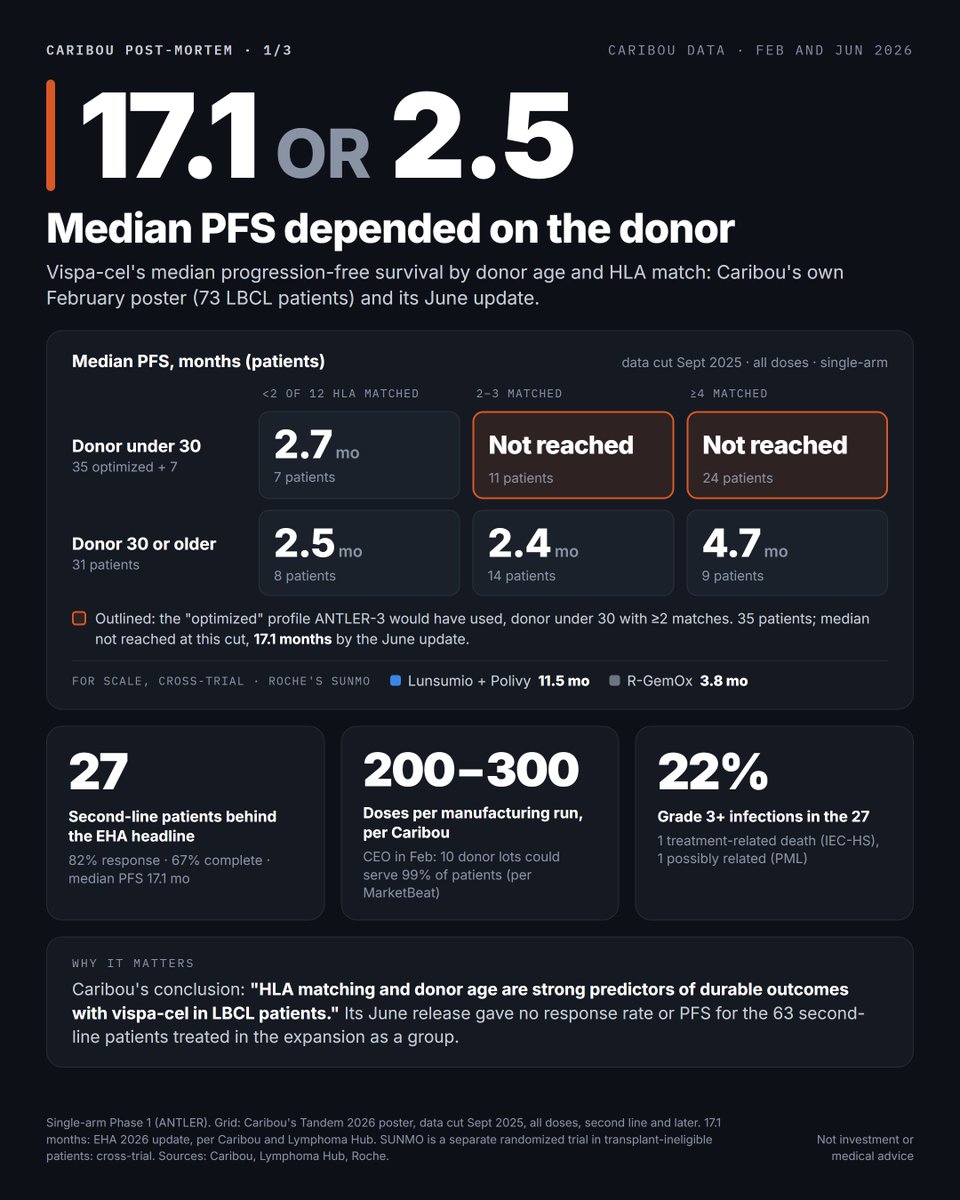
17.1 months or 2.5? Median PFS on Caribou's $CRBU off-the-shelf lymphoma CAR-T: young, matched donors vs older, mismatched ones. Its FDA-aligned Phase 3 would have used only the first kind. Caribou dropped it Oct 6 and blamed the money. I think the money was reading the data.
Last week, writing about Caribou and Cellectis $CLLS together, I took Caribou at its word that this wasn't about the data. I'd put it differently now. Below: what the data rested on (chart 1), what "FDA-aligned" covered (chart 2), who would and wouldn't pay, and who shares each problem (chart 3).
WHAT CARIBOU SAID
Oct 6, after the close: @CaribouBio stopped vispa-cel (CD19, second-line large B-cell lymphoma) and CB-011 (BCMA, myeloma), began a "substantial" workforce cut and hired Wedbush to look at a sale, merger or other deal. Estimated restructuring charges: $15–19M.
The reason, in its words: "the current financing environment for allogeneic CAR-T cell therapies has made it increasingly challenging to secure the capital necessary to responsibly advance these programs." CEO Rachel Haurwitz said the decision is "in no way a reflection of our belief" that the two could help patients. Vispa-cel was "pivotal trial-ready, with FDA alignment" on its Phase 3.
The stock: $1.14 on Oct 6, $0.46 on Oct 9. That's about $49M of market value, by my math, against $113.8M of cash at June 30, before Q3 spending and the charges.
The coverage I read mostly treated it as a verdict on the modality. BioCentury's Lauren Martz asked on Oct 8, "is the allo CAR T era ending?" Her answer: "Unfortunately, I think it might be," though she hopes Allogene, CRISPR Therapeutics and others prove her wrong. My read: part of it was a verdict on this product.
THE DONOR WAS PART OF THE DRUG (chart 1)
27. That's how many second-line patients sit behind the numbers Caribou took to EHA in June: 82% response, 67% complete response, 17.1-month median PFS. All 27 got 80 million cells from donors under 30 with at least two HLA alleles matched, the profile Caribou calls "optimized." The trial had treated 63 second-line patients in its expansion phase; the release gave no response rate or PFS for them as a group. That's the number I'd want first.
What happens outside the recipe, Caribou showed in February. Its poster at the Tandem meetings split 73 LBCL patients by donor age and HLA match (data cut Sept 2025, all doses):
• Donor under 30, two or more of 12 alleles matched (35 patients): median PFS not reached
• Donor under 30, fewer than two matched (7): 2.7 months
• Donor 30 or older (31): 2.5 months with fewer than two matched (8), 2.4 with two or three (14), 4.7 with four or more (9)
By the June update, the 35 optimized patients' median was 17.1 months, per Lymphoma Hub. Caribou's own conclusion: "HLA matching and donor age are strong predictors of durable outcomes with vispa-cel in LBCL patients."
And the rule moved. In 2024, looking back at 46 patients, Caribou reported median PFS of 14.4 months with four or more matched alleles (13 patients) and 2.8 months with three or fewer (33). The confirmatory cohort that followed required four or more matches. The young-donor, two-match profile was identified afterwards, per the poster, and by November it was the working definition. That's the product ANTLER-3 would have tested.
My read: with vispa-cel, the donor is part of the drug. That isn't damning on its own. The usual explanation is biology: younger donors' T cells tend to expand and persist better, and a closer HLA match gives the patient's recovering immune system less to reject. Caribou's poster points the same way: expansion and persistence tracked the HLA match. It changes what "off the shelf" means: a bank of young donors' lots, matched to each patient. Caribou says that's manageable. One manufacturing run yields 200 to 300 doses, per the poster, and at an investor conference in February Haurwitz called two matched alleles out of 12 "incredibly modest"; MarketBeat's account has her saying 10 donor lots could serve 99% of patients. I don't think logistics were the problem. The question was whether the subgroup's result would hold.
The safety bill in the 27: grade 3+ infections in 22%, one treatment-related death (IEC-HS, a hyperinflammatory syndrome) and one possibly related (PML, a viral brain infection).
I'd want the whole second-line group before I believed that 17.1-month median. I suspect the people asked to fund a 250-patient trial wanted the same.
WHAT "FDA-ALIGNED" COVERED (chart 2)
Dec 2023: for a randomized second-line trial, the FDA said Caribou's proposed comparator, platinum chemo then high-dose chemo and a stem cell transplant, was acceptable. Start: by year-end 2024.
June 2024: start pushed to the second half of 2025, pending a confirmatory cohort of partially matched patients.
Nov 2025: the FDA recommended a different trial, randomized, in CD19-naive patients who can't have a transplant or an autologous CAR-T. Caribou planned about 250 of them.
May 7, 2026: alignment announced. One dose of 80 million cells vs investigator's choice of Pola-BR, R-GemOx, Pola-R-GemOx or tafasitamab plus lenalidomide, crossover to vispa-cel after progression, PFS as the primary endpoint. In June Caribou specified optimized cells and about 75 sites. In February it had been aiming for a PFS readout in 2028, per MarketBeat's account of the same investor talk.
Caribou pitched it at "the 75% of second-line large B cell lymphoma patients who do not receive autologous CAR-T cell therapy." The trial was narrower: those who also can't have a transplant. Caribou said the FDA recommended the narrower population; it didn't say why.
What alignment settled: the design. Not the cost (Caribou never disclosed one), and not the competition at the finish.
That competition was already visible. In June 2025, Roche $RHHBY reported SUNMO, a Phase 3 of Lunsumio plus Polivy against R-GemOx in relapsed LBCL patients who can't have a transplant: median PFS 11.5 vs 3.8 months, HR 0.41. The FDA accepted the filing this June, and @Roche says a decision is expected by Feb 9, 2027.
So one of ANTLER-3's control options had already lost to a bispecific combination, one Roche says may enable outpatient community care, nearly a year before the design was agreed. I had to check that date twice. Lunsumio plus Polivy wasn't among the control options; it isn't FDA-approved in that setting, though Japan approved it in March, before Caribou announced alignment. My read: a trial reading out in 2028 would be judged against whatever replaces R-GemOx, not against R-GemOx.
Cross-trial, for scale: the optimized group's 17.1 months is longer than SUNMO's 11.5. The older, least-matched donors' 2.5 months (8 patients, earlier cut) is shorter than R-GemOx's 3.8. Single-arm subgroups against randomized arms, different patients. That spread is the problem.
WHO WOULDN'T PAY, AND WHO DID
$2.03. That's the average price Caribou got for 9.0M shares sold through its at-the-market program in Q2, $18.3M gross. Each of its results releases this year said it was "exploring multiple options to fully fund" the trial. On Oct 6, before the news, the market valued the whole company at about $122M, roughly $8M above its June cash.
Leerink's Daina Graybosch, cutting to Market Perform on Oct 7: "Evidently, investors were unwilling to fund the trial." BioPharma Dive summed up her reasons as lingering questions about clinical risk, Caribou's matching strategy and the strength of the data; Investing's account of the note adds that the terms would have been highly dilutive. One analyst's read, and it's mine too. RBC's Luca Issi, also downgrading, pointed to conditions in the allogeneic CAR-T sector, per Investing.
The contrast I keep coming back to. On Apr 13, @AllogeneTx $ALLO reported the interim futility look at its pivotal trial: 7 of 12 patients on its donor-cell CAR-T turned MRD-negative, with no lymphoma DNA detected in the blood, vs 2 of 12 on observation. The next day it priced a stock sale at $2.00 a share. With part of the underwriters' option, it raised $200.4M gross.
My read: the money didn't leave allogeneic CAR-T. It asked for a control arm. Allogene had one, if only 24 patients deep. Caribou had a donor-selected subgroup.
Even the funded one is under water: Allogene closed at $1.46 on Oct 9, 27% below April's offering price.
WHO ELSE SHARES THE PROBLEMS (chart 3)
Three problems, three lists.
1. Results that may depend on the donor. That's every allogeneic CAR-T made from healthy donors' T cells:
• Allogene's cema-cel, randomized against observation in ALPHA3. Interim event-free survival comes in mid-2027.
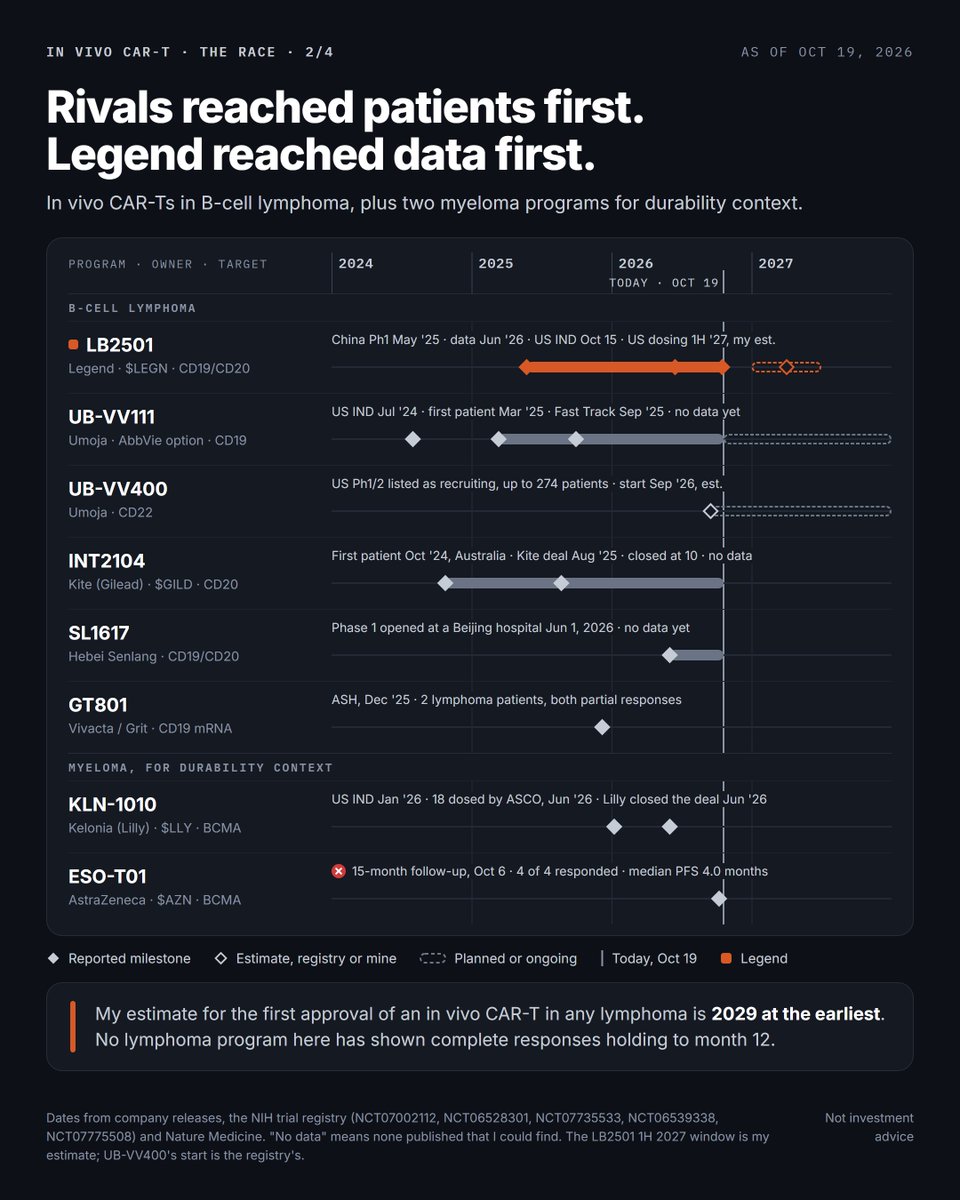
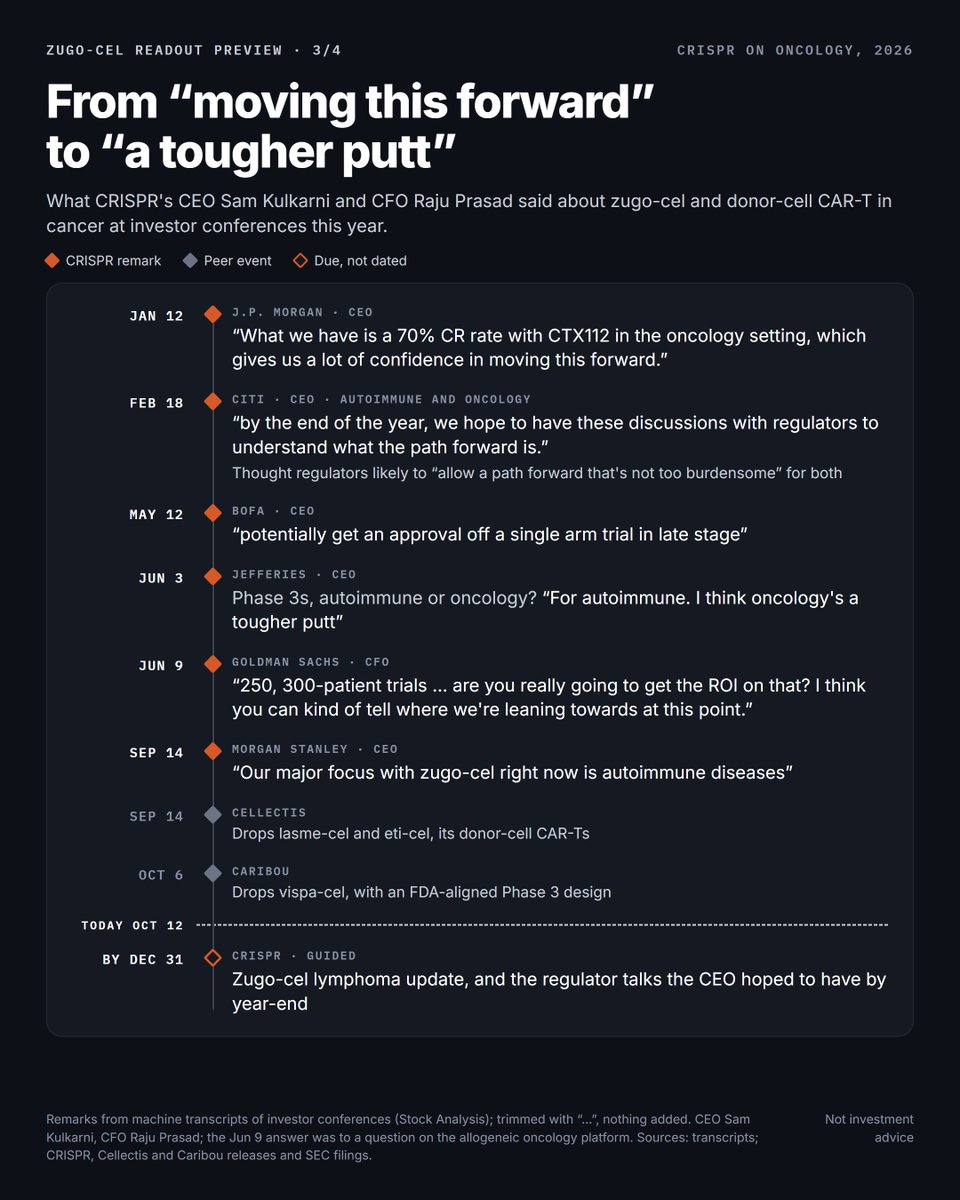
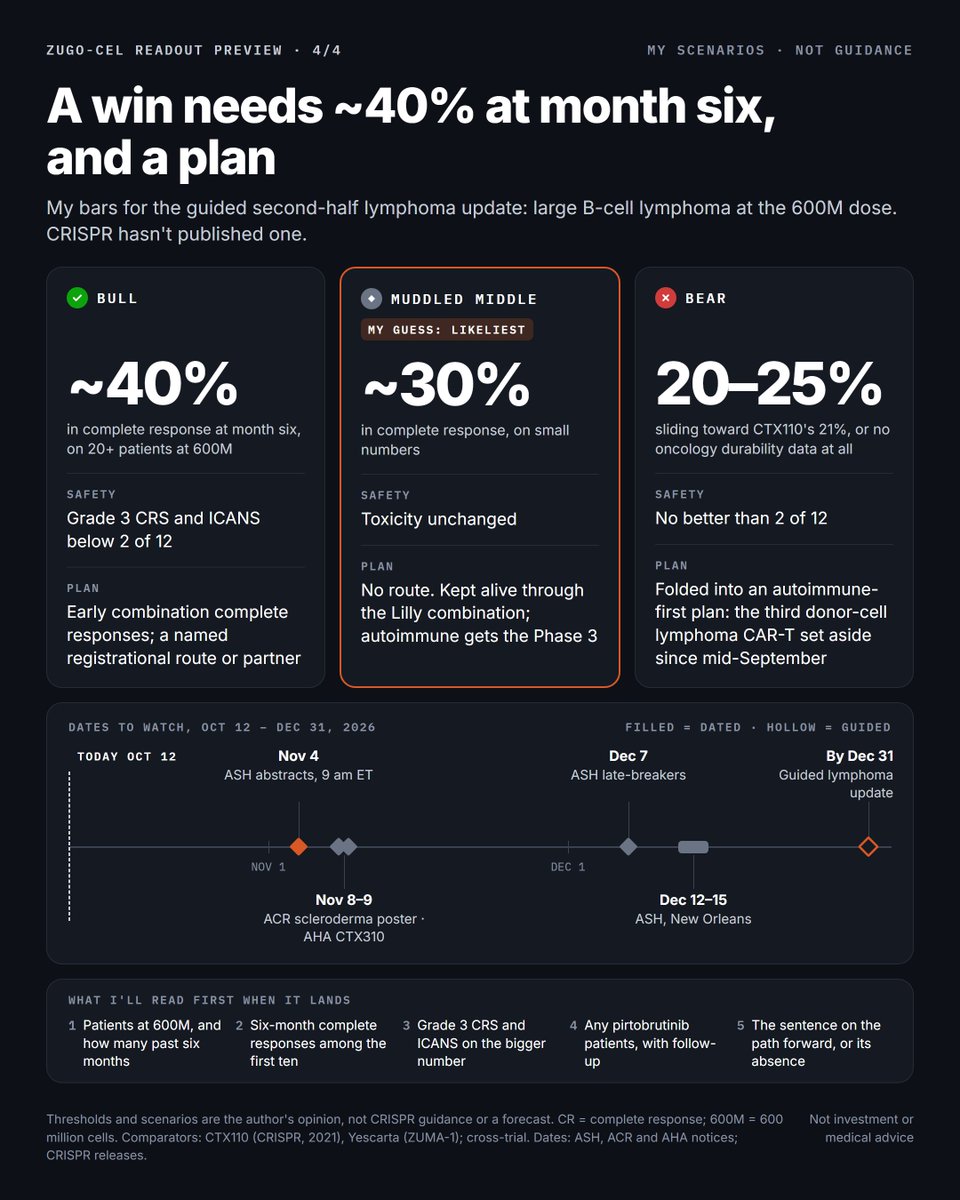
• CRISPR Therapeutics' $CRSP (@CRISPRTX) zugo-cel, formerly CTX112: Phase 1/2 in B-cell cancers, with an update promised for the second half of 2026 and a combination study with pirtobrutinib from Lilly $LLY.
• Imugene's azer-cel (ASX: IMU), given with low-dose IL-2, in Phase 1b.
The question I'd put to each: do outcomes track the donor, and how many lots does it take to cover most patients?
2. Relapsed B-cell lymphoma, where bispecific combinations are arriving. CRISPR and Imugene are aimed there. Allogene sidestepped it: first-line consolidation against observation, not against a bispecific. Cellectis left on Sept 14, dropping lasme-cel and eti-cel, its B-ALL and lymphoma CAR-Ts: frontline gains, bispecifics and in vivo CAR-T meant "slower enrollment, a potentially longer and more costly development pathway." It's looking for partners.
3. Needing money before pivotal data. Imugene is the acute case. In March it placed A$12M of stock at A$0.18 a share and raised A$4M more through a share purchase plan. Its cash report for the quarter to Mar 31 showed A$5.96M at quarter-end, 0.62 quarters of funding; the rest of the March money arrived on Apr 29. In July it raised A$11.1M at A$0.095, about half the March price, funding it "into calendar year 2027." Allogene says it's funded "into 2029," past ALPHA3's primary event-free survival analysis in mid-2028. CRISPR had $2.36B at June 30. Not its problem.
THE REALITY CHECK
• Caribou says the decision is no reflection on the drugs, and the optimized numbers are good. If they had held in 250 patients, ANTLER-3 could well have won.
• The donor split comes from a single-arm Phase 1: groups of 7 to 35 patients, mixed doses and lines, and an earlier data cut than the 17.1 months.
• Every comparison with SUNMO is cross-trial: single-arm subgroups against randomized arms, different patients.
• Donor selection can be a manufacturing spec rather than a red flag. The FDA aligned on a design that used it.
• Leerink is one analyst. RBC, per Investing, pointed to the sector.
• What would change my mind: a buyer paying real money for vispa-cel in Wedbush's process. That would say the data had value the public market missed.
WHAT I'M WATCHING
1. Nov 4, 9 am ET: @ASH_hematology abstracts. Any allogeneic CD19 data with durability, and any split by donor.
2. Nov 8, 10:30 am ET: CRISPR's zugo-cel poster at the American College of Rheumatology meeting. Systemic sclerosis, not lymphoma, but the next scheduled zugo-cel presentation.
3. Q4: Allogene's ALLO-329 autoimmune update; zugo-cel's B-cell cancer update, promised for the second half; Caribou's job cuts, with no timetable for the review.
4. Dec 12–15: ASH in New Orleans.
5. Dec 23: FDA goal date for Gilead's $GILD anito-cel, an autologous BCMA CAR-T, in the market CB-011 was built for (CB-011: 92% response in 12 BCMA-naive patients). Carvykti, from J&J $JNJ and Legend $LEGN, did about $657M in Q2, up 50%, per Legend.
6. By Feb 9, 2027: the FDA's expected decision on Lunsumio plus Polivy.
7. Mid-2027: ALPHA3's interim event-free survival.
BOTTOM LINE
Caribou had the FDA's agreement on how to test vispa-cel, but not data beyond a donor-selected subgroup strong enough for anyone to pay for the test.
For the cell therapy people: is "donor under 30, two HLA matches" a manufacturing spec you can scale, or a sign the cells don't persist without it?
Not investment or medical advice. Data as of Oct 12, 2026; prices at the Oct 9 close. Sources: Caribou releases, SEC filings and its Tandem 2026 poster; EHA 2026 via Lymphoma Hub; Allogene, Roche, Chugai, Cellectis, Legend, CRISPR Therapeutics, Gilead and Imugene releases and filings; BioCentury; BioPharma Dive and Investing on the Leerink and RBC notes; Stock Analysis.
#CARTcell #CellTherapy #Lymphoma #ImmunoOncology #Biotech #ASH26
AbbVie's $ABBV pitch for etentamig in community clinics is a calendar: one step-up dose, then monthly. Two rival US labels already go monthly at about the six-month mark. And on the FDA's clocks, J&J's $JNJ Tecvayli likely reaches its earlier-line goal date first (my estimate).
THE CALENDAR (chart 3)
The approved US BCMA bispecifics, per their labels:
• Tecvayli alone: two step-up doses, 48 hours in hospital after each. Then weekly; every two weeks only after six months in complete response.
• Tec-Dara (Tecvayli plus Darzalex Faspro): the same two step-ups and hospital stays. Weekly to week 8, every two weeks to week 24, monthly from week 25.
• Elrexfio (Pfizer $PFE): two step-ups, 48 then 24 hours in hospital. Weekly to week 24; for patients still responding, every two weeks to week 48 and monthly from week 49.
• Lynozyfic (Regeneron $REGN): two step-ups, 24 hours in hospital after each. Weekly to week 13, every two weeks from week 14, monthly from week 24 for patients in very good partial response or better.
Etentamig in CERVINO: one step-up, then monthly from the start. Some US patients were treated entirely as outpatients.
So "every week, every week for a long time," AbbVie's description of the field, is half right. It fits Tecvayli alone and Elrexfio. Tec-Dara is weekly for eight weeks.
What's left of the gap: one step-up against two, with a hospital stay on the label after each of the two, and roughly the first six months of dosing. That's also, per J&J, when most of MajesTEC-9's fatal adverse events happened. Whether dosing frequency has anything to do with it, I haven't seen anyone show. I'd like to.
CONVENIENCE HASN'T SOLD ON ITS OWN
$16.5M. Lynozyfic's Q2 sales. Its label already allows monthly dosing from week 24 for good responders.
$89M. Elrexfio's, $30M of it in the US, down 15%.
$260M. Tecvayli's.
Elrexfio and Lynozyfic are both labeled only after four prior lines, and both arrived after Tecvayli. My read: in this class, line and timing have beaten convenience so far.
THE CLOCK (chart 4)
July 31, R&D head Roopal Thakkar on AbbVie's Q2 call: if the interim was positive, "regulatory submission would occur later this year."
Sept 3, the topline release: AbbVie "plans to discuss" the results with regulators "to determine next steps."
Sept 9, commercial chief Jeff Stewart: "a very rapid filing and entry."
Sept 15, Thakkar: "get that submitted this year."
I read the Sept 3 wording as a hedge. Within two weeks, management said otherwise. The filing is on.
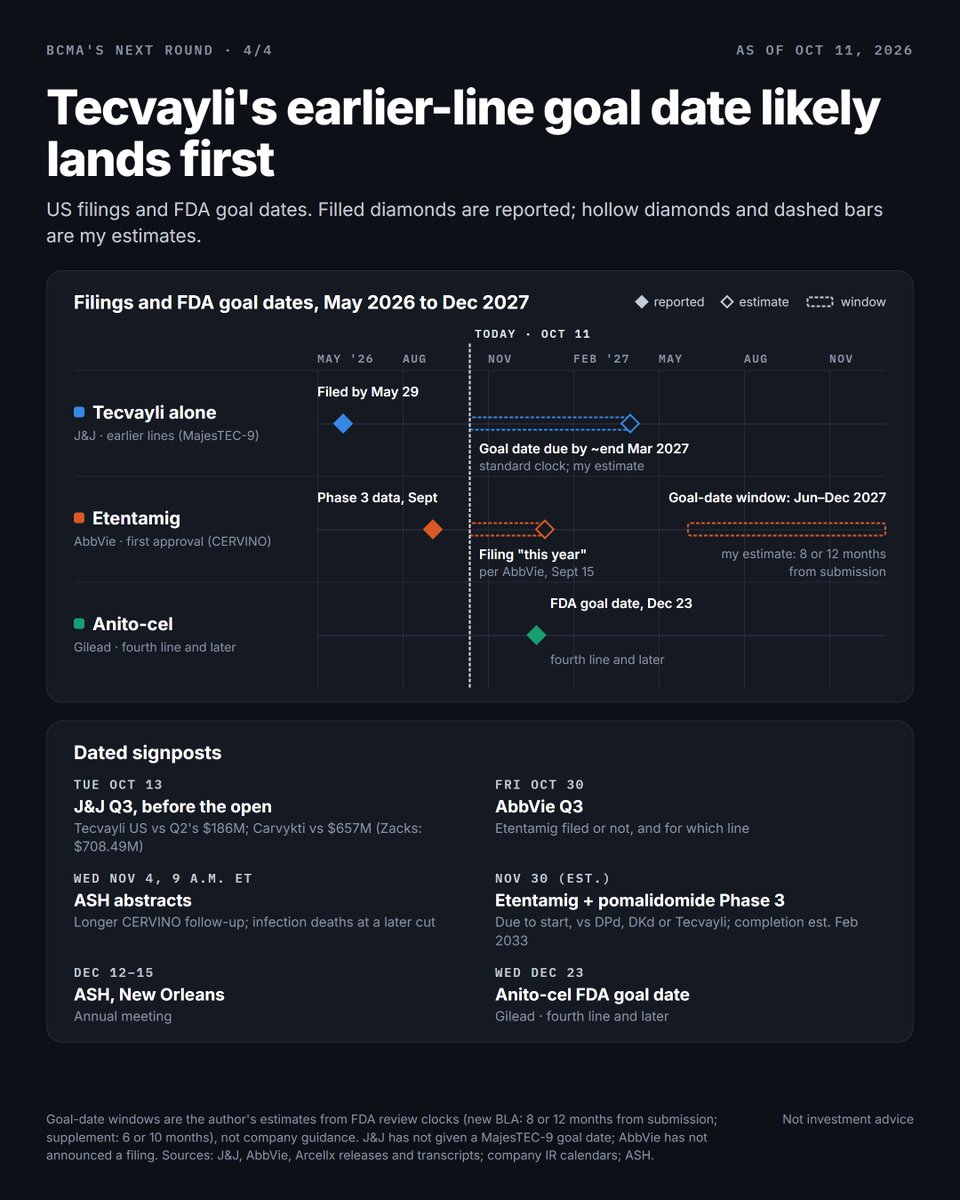
A new BLA runs 8 months from submission on priority review, 12 on standard. Filed between now and year-end, that puts the goal date between about June and December 2027 (my arithmetic).
J&J filed Tecvayli alone, on MajesTEC-9, in the US and EU by May 29. A supplement runs 6 or 10 months. On the standard clock, its goal date falls by about the end of March 2027 (my arithmetic; J&J hasn't given one).
The line matters too. On the July call, Thakkar referred to CERVINO as "the monotherapy third-line-plus trial." J&J pitches Tecvayli alone "as early as first relapse." CERVINO did let US patients in after one prior line if they'd been exposed to all three drug classes, and 14.5% of its patients were from the US. I wouldn't count on a second-line label from that.
The closest thing to a head-to-head, etentamig plus pomalidomide against DPd, DKd or Tecvayli, is due to start Nov 30 (estimated). Estimated primary completion: February 2033. More than six years out.
THE OTHER TWO NUMBERS
Dec 23. The FDA goal date for Gilead's $GILD anito-cel, fourth line and later. Its pitch is also a safety column: no delayed neurotoxicity, including no parkinsonism, in 117 patients in iMMagine-1 at a median 15.9 months.
$657M. Carvykti's Q2, up 49%. J&J shares the CAR-T with Legend $LEGN.
My read: both challengers are selling safety. J&J holds the efficacy column, the earlier labels and the clock.
WHAT I'M WATCHING (chart 4)
1. Tue Oct 13, before the open: J&J's Q3. Tecvayli US against Q2's $186M; Carvykti against $657M (Zacks: $708.49M). A MajesTEC-9 goal date would help.
2. Fri Oct 30: AbbVie's Q3. Filed or not, and for which line.
3. Wed Nov 4, 9 a.m. ET: @ASH_hematology abstracts. Longer CERVINO follow-up, and the infection deaths at a later cut.
4. Nov 30 (est.): the etentamig plus pomalidomide Phase 3 due to start.
5. Dec 12–15: ASH, New Orleans.
6. Wed Dec 23: anito-cel's FDA goal date.
7. By about end-March 2027 (my estimate): the goal date for Tecvayli alone in earlier lines, on the standard clock.
BOTTOM LINE
Etentamig doesn't beat Tecvayli on the hazard ratio; if it wins community clinics, it'll be on infection deaths, and I'd want CERVINO at 18 months before I leaned on that.
Not investment advice.
Sources: AbbVie, J&J, Gilead, Legend, Pfizer and Regeneron releases, SEC filings and conference transcripts; FDA labels; the NIH trial registry; IMS 2026 via OncLive, Targeted Oncology and CancerNetwork; ASCO 2026 via OncLive and CancerNetwork; BMO via BioSpace; GlobalData via Clinical Trials Arena; Zacks. Data as of Oct 11, 2026.
#MultipleMyeloma #BCMA #Bispecifics #TCellEngagers #CARTcell #ImmunoOncology #Biotech #ASH26
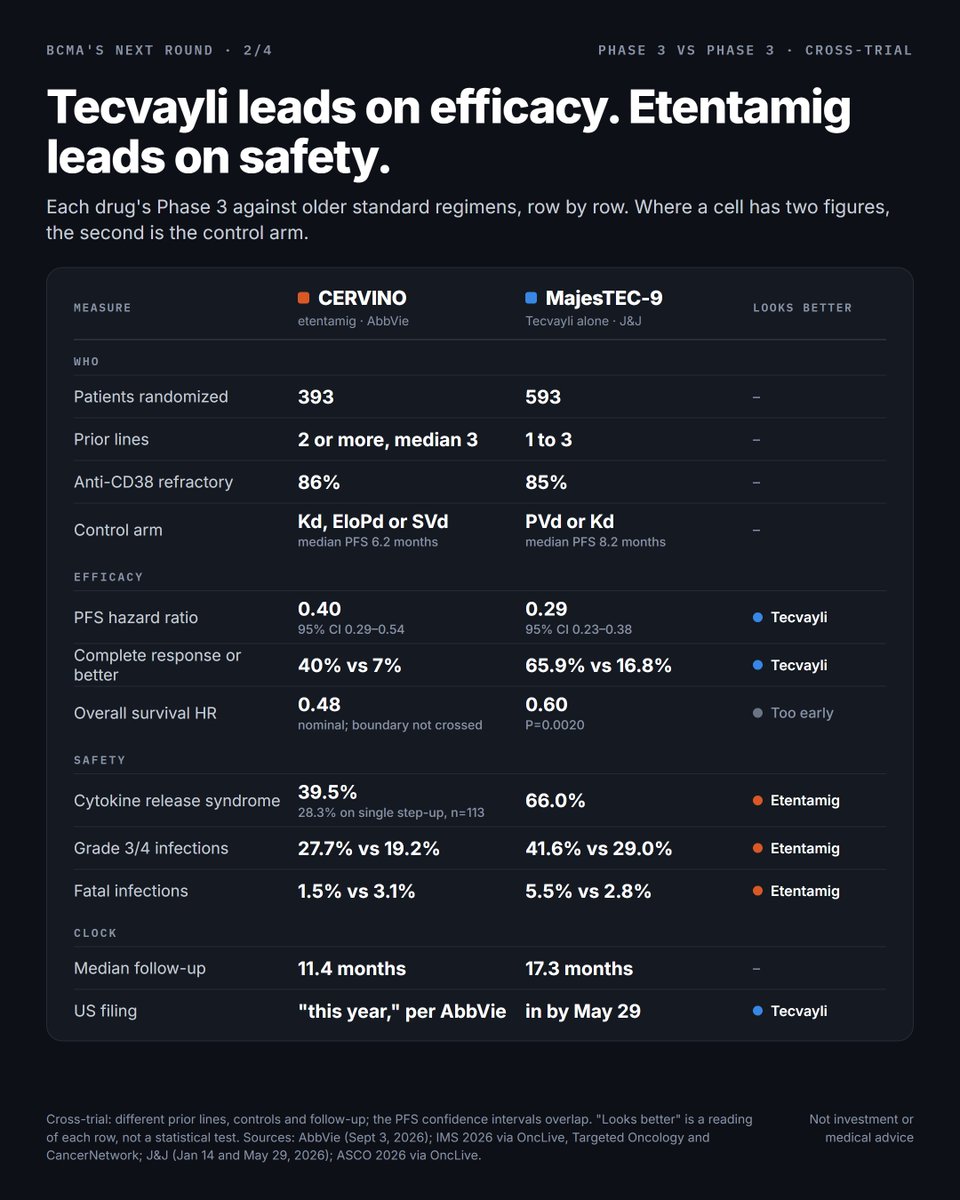
Etentamig's hazard ratio is the least interesting number in its Phase 3.
AbbVie's $ABBV 0.40 trails J&J's $JNJ 0.29 for Tecvayli, both against older regimens.
The one I'd flag: infection deaths. 1.5% on etentamig vs 3.1% on standard regimens. In Tecvayli's trial, 5.5% vs 2.8%.
Cross-trial, and thin. I'll get to both (chart 1). It's still the column the community-clinic story skips.
THE PITCH
BMO, quoted by BioSpace on Sept 4: "clear efficacy," a "potentially differentiated administration profile," a "relatively low" CRS rate, and "a potentially attractive BCMA option that could expand use beyond large academic centers and into community settings."
AbbVie (@abbvie) CEO Rob Michael, Sept 15: "The opportunity in the community setting is tremendous with this asset."
R&D head Roopal Thakkar, same conference: AbbVie will "bring a once-a-month dosing regimen to a field that currently it's every week, every week for a long time, with multiple step-ups."
Fair. One step-up dose, then monthly from the start, is a real difference. Some US patients in CERVINO were treated entirely as outpatients.
Two of BMO's four points I'd qualify. Clear efficacy, yes, against the older regimens. Against Tecvayli's own Phase 3, I see no edge. And CRS isn't the safety number I'd lead with.
THE 0.40 (chart 2)
393 patients in CERVINO, presented at IMS (@Myeloma_Society) on Sept 25. Triple-class exposed, two or more prior lines, a median of three. Etentamig vs Kd, EloPd or SVd. PFS HR 0.40 (95% CI 0.29–0.54). Median not reached vs 6.2 months. Overall response 74.0% vs 45.7%.
593 patients in MajesTEC-9. One to three prior lines. Tecvayli alone vs PVd or Kd. HR 0.29 (0.23–0.38). Median not reached vs 8.2 months.
Similar patients where it counts: 86% refractory to anti-CD38 drugs in CERVINO, 85% in MajesTEC-9. Neither let in anyone who'd had a BCMA drug. Kd was the most common control in both.
65.9% vs 16.8%. Complete response or better, Tecvayli vs control. CERVINO's: 40% vs 7%.
0.60 (0.43–0.83). Tecvayli's overall survival hazard ratio, P=0.0020. Etentamig's is 0.48 (0.29–0.77), nominal: it hadn't crossed its prespecified boundary at 11.4 months of follow-up.
My read: the intervals overlap, and 26% of CERVINO's etentamig arm had four or more prior lines, so I wouldn't call it a gap. I'd call it no edge. J&J (@JNJNews) had its application in with the FDA and EMA by May 29. AbbVie says it will file this year.
THE NUMBER I'D QUOTE (chart 1)
1.5% vs 3.1%. Deaths from infection in CERVINO, etentamig vs standard regimens. Below control, by 1.6 points.
5.5% vs 2.8%. The same measure in MajesTEC-9, Tecvayli vs PVd or Kd. Above control, by 2.7 points. J&J says most of its fatal adverse events came in the first six months.
I didn't expect the sign to flip.
27.7% vs 19.2%. Grade 3/4 infections, etentamig vs control. Tecvayli's: 41.6% vs 29.0%. Both above control: etentamig by 8.5 points, Tecvayli by 12.6 (my arithmetic).
28.3%. CRS on the single step-up regimen AbbVie is pitching. 39.5% across all 195 treated. Tecvayli in MajesTEC-9: 66.0%. Grade 3 was rare in both: 1.0% and 0.7%.
AbbVie says etentamig's low-affinity CD3 binding domain is "designed to reduce cytokine release syndrome (CRS) and infections." That's the company's claim. CERVINO is the first randomized data pointing its way.
Thakkar's pitch mostly survives a check: "grade 3 plus infections under 30. The current molecules are 40+%." MajesTEC-9: 41.6%. The labels, less so: Tecvayli's says 35% for monotherapy, Elrexfio's 31%, Lynozyfic's 38%.
THE REALITY CHECK
• About 3 infection deaths vs about 6 (my arithmetic, on 195 and 193 treated). One case either way moves those percentages a lot. Fatal adverse events of any cause point the same way, 2.6% vs 5.7%, still small numbers.
• 11.4 months of follow-up vs 17.3. J&J's "first six months" helps the comparison. I'd still want CERVINO at 18 months.
• Prophylaxis: I can't find either trial's rules on immunoglobulin replacement or antimicrobials. A difference there could explain part of the gap.
• 113 of 195 treated patients got the single step-up regimen; it came in by amendment partway through. The infection figures cover the whole arm.
• Different lines, different controls. CERVINO's patients were further along; MajesTEC-9 took patients after one prior line. Cross-trial, all of it.
• What would change my mind: CERVINO's infection deaths catching up at a later cut, or a prophylaxis difference that explains the gap.
MY READ
Right drug, wrong column. Etentamig isn't a better Tecvayli on efficacy, and its calendar edge narrows after month six (next post). Its case is that in its one randomized trial it didn't add infection deaths. If that holds, it's a stronger argument for community clinics than the calendar.
GlobalData, one forecaster, has etentamig at $756M in 2032 and Tecvayli at $5B. If the infection numbers hold, I think that gap is too wide. If they don't, it looks about right.
BCMA's next round, as I read it: both challengers' sharpest edge is a safety column. Etentamig's is infection deaths. Anito-cel's, with an FDA goal date of Dec 23, is no delayed neurotoxicity so far. J&J holds the efficacy column.
Myeloma doctors: choosing a bispecific for an older patient today, what weighs more, the dosing calendar or the infection risk?
Not investment advice.
Dec 23 is read as the day Carvykti's lead starts to slip. Legend's $LEGN numbers say otherwise. Gilead's $GILD anito-cel is filed in the US for fourth line and later. By my math, that's $24M of Carvykti's $218M Q2 sales growth. Asked to size the overlap, Legend didn't.
Here's my sizing, inputs included. J&J $JNJ (@JNJNews) reports Q3 on Tuesday, so part of it gets tested fast.
THE MARKET'S READ
Legend's shares closed Friday at $18.62, down 42% in 52 weeks.
• UBS, downgrading on July 24, expected anito-cel to gain significant traction when it launches in late 2026 or 2027, and cut its 2032 Carvykti sales forecast to $1.3B from $2.2B.
• Oppenheimer, downgrading in August, said the CEO's exit adds strategic uncertainty ahead of anito-cel's commercialization.
• Dec 8, 2025, the first trading day after anito-cel's pivotal data at ASH: Legend fell 7.1%.
Fair enough. Anito-cel looks like a good drug; on Oct 7 I called its safety edge over Carvykti real, if narrower than the headline. My question is smaller: how much of Carvykti can it reach, and when?
THE SPLIT (chart 1)
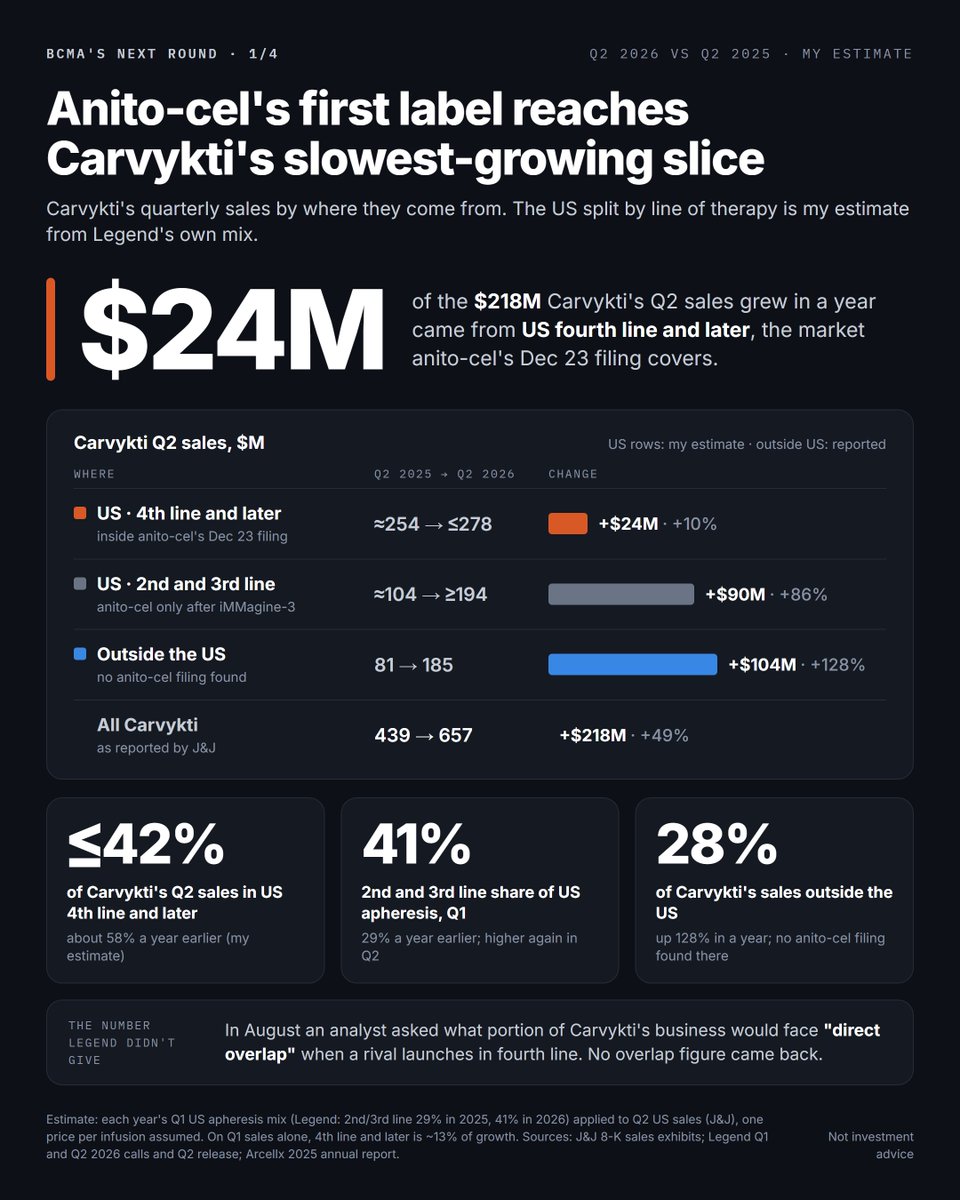
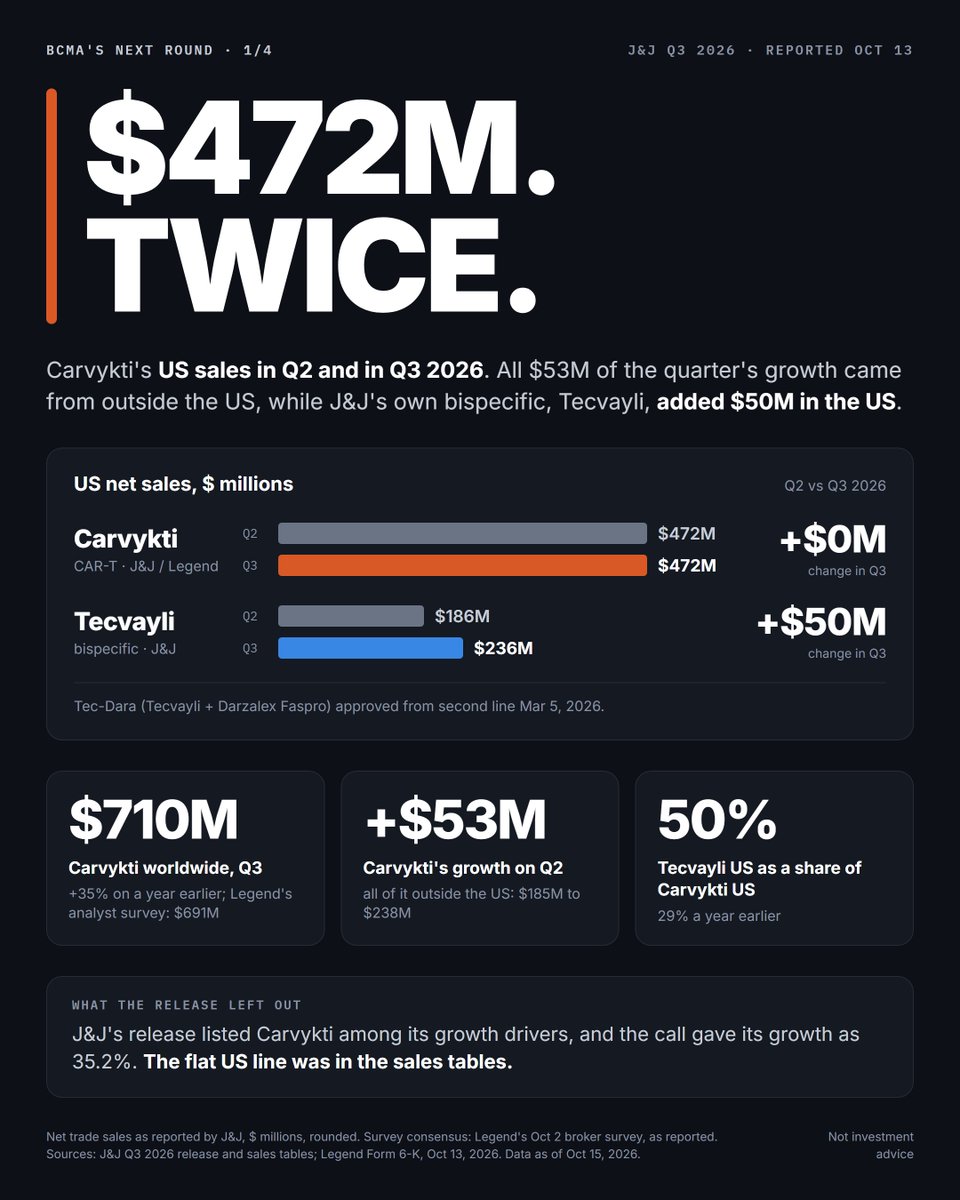
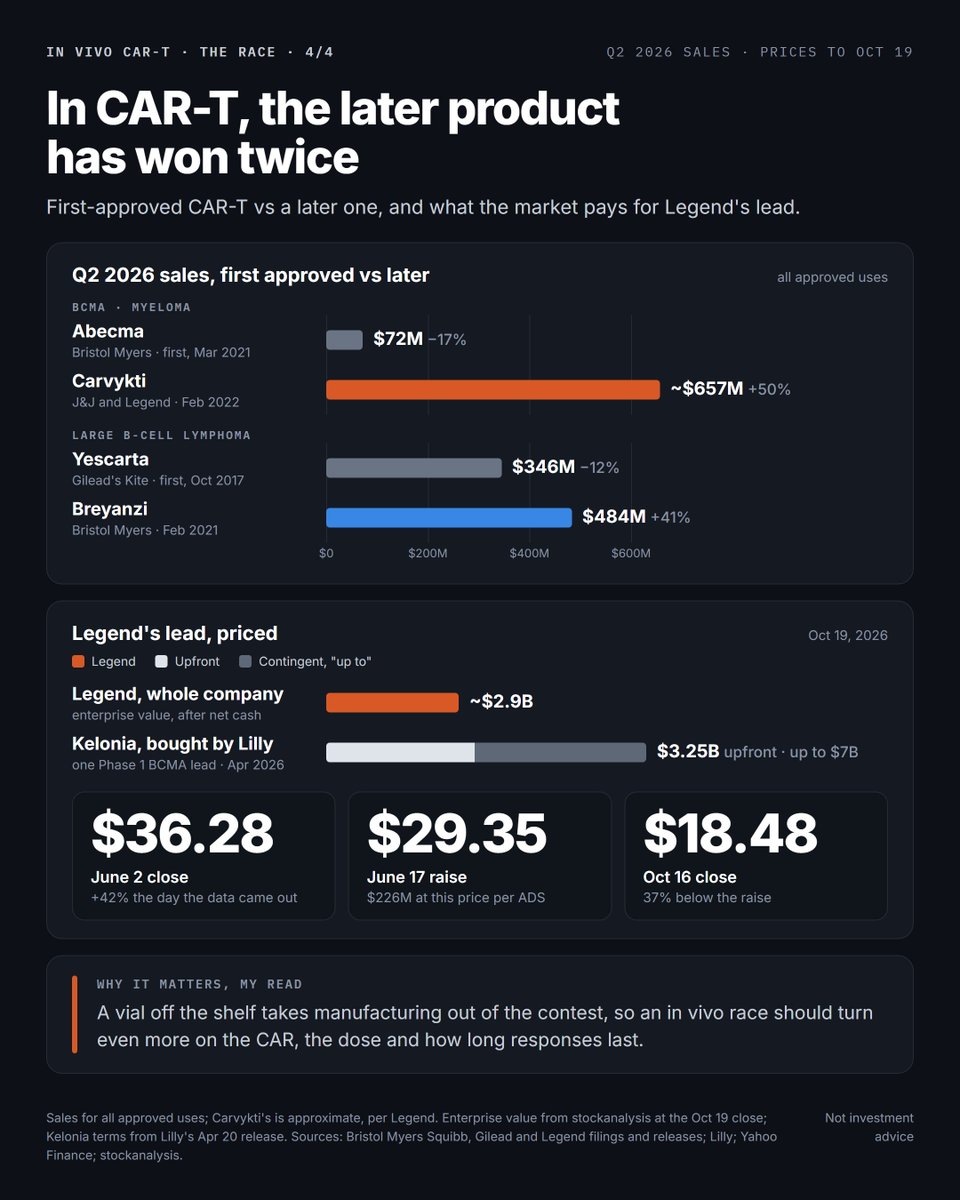
$657M. Carvykti's Q2: $472M in the US, $185M outside it.
41%. Second and third line's share of US apheresis volume in Q1, per Legend (@legendbiotech). A year earlier: 29%. It rose again in Q2. Legend didn't say to what, and said it won't update the figure every quarter.
Put the two together. My arithmetic: each year's Q1 mix applied to the Q2 sales that follow it, one price per infusion in every line.
• US fourth line and later: about $254M a year ago, at most about $278M now. Up about $24M, roughly 10%.
• US second and third line: about $104M, now at least about $194M. Up about $90M, roughly 86%.
• Outside the US: $81M, now $185M. Up $104M, or 128%.
So the slice anito-cel's first label can reach went from about 58% of Carvykti's sales to at most about 42%, and supplied about a ninth of the year's growth. Run it on Q1 numbers instead and it's about 13%.
I didn't expect it to be that lopsided.
In August, an analyst asked Legend what portion of Carvykti's business would face "direct overlap" when a rival launches in fourth line. No overlap figure came back. That's the number I'd want.
WHAT DEC 23 REACHES (chart 2)
The BLA, per Arcellx's last annual report: anito-cel "to treat patients with fourth line or later rrMM." Submitted Dec 23, 2025, accepted Feb 20. Gilead (@GileadSciences) expects revenue to begin in early 2027.
Outside the US, I can't find a filing anywhere. That's 28% of Carvykti's sales and nearly half its growth, out of reach on what's filed.
US second and third line is out of reach until iMMagine-3. Carvykti has held a label there, for lenalidomide-refractory disease, since April 2024. iMMagine-3 is anito-cel's Phase 3 in one to three prior lines: 452 patients, enrollment finished in Q2. Its primary endpoints are PFS and the rate of MRD-negative complete response at nine months, and Gilead says it could file on both "as early as 2027." That filing, not Dec 23, is the one that reaches Carvykti's growth.
GILEAD'S OWN MATH (chart 3)
Gilead's table agrees with me, even if its pitch doesn't.
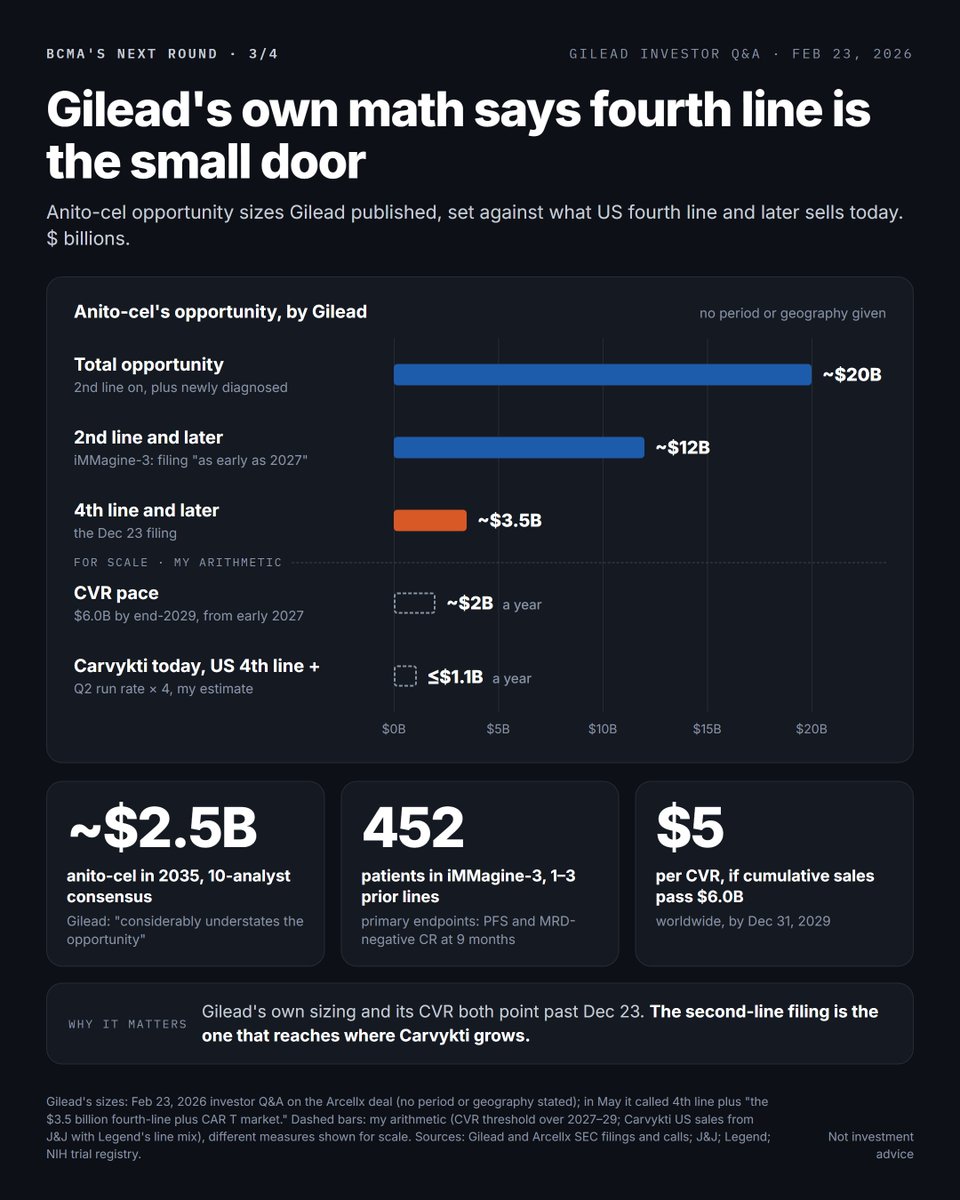
• Its Feb 23 investor Q&A put anito-cel's opportunity at about $3.5B in fourth line and later, about $12B from second line and about $20B in all.
• The same Q&A said the 10 analysts modeling anito-cel had it at about $2.5B in 2035, and that this "considerably understates the opportunity."
• In May, Gilead called fourth line plus "the $3.5 billion fourth-line plus CAR T market."
That's an opportunity, not today's spending. Carvykti's whole US fourth-line-plus business runs at about $1.1B a year at most, by my math. On Oct 7 I passed along Kite's $3.5B without asking what it measured. My miss.
The CVR points the same way. Arcellx holders get $5 more a share only if anito-cel's cumulative worldwide sales pass $6.0B by the end of 2029. From an early-2027 start, that's about $2B a year, about 1.8 times Carvykti's US fourth-line-plus book. My read: it can't pay out of fourth line alone.
WHO'S ALREADY WHERE CARVYKTI GROWS
Tec-Dara: J&J's Tecvayli plus Darzalex. US approval from second line on March 5; EU approval announced Aug 21.
• J&J's Jennifer Taubert said in July that "the vast majority of patients" on Tec-Dara "are starting in that second to third line setting."
• Q2 in the US: Tecvayli up $59M on the quarter, Carvykti up $39M.
• Q2 outside the US: Tecvayli flat at $74M, Carvykti up $21M. That was before the EU approval.
So the drug already competing where Carvykti grows belongs to J&J, Legend's own partner. Tuesday will say more about that than Dec 23 will.
THE HR 0.40
0.40. The PFS hazard ratio AbbVie $ABBV (@abbvie) reported for etentamig at CERVINO's first interim analysis (95% CI 0.29 to 0.54): 393 patients, a median of three prior lines, against Kd, elotuzumab-Pd or SVd. Dosed monthly.
The line I'd circle is in the registry: CERVINO let US patients in after a single prior line if they'd been exposed to all three drug classes. If AbbVie files on that and the FDA agrees, a monthly bispecific could reach US second line before anito-cel does.
Will it file? July 31: a positive interim means "regulatory submission would occur later this year." Sept 3, after a positive interim: AbbVie "plans to discuss the Phase 3 CERVINO results with global regulatory authorities to determine next steps." Odd change of verb after a win, to me. I'd want the line it files for before calling etentamig a Carvykti problem.
Its next Phase 3 pairs it with pomalidomide against DPd, DKd or Tecvayli, and AbbVie says it will take patients who lost response to a BCMA CAR-T or ADC. Estimated start: Nov 30. Estimated primary completion: February 2033.
WHO SITS INSIDE THE DEC 23 LABEL
Two US labels start at fifth line, wholly inside anito-cel's filing:
• Pfizer's $PFE Elrexfio: $30M in the US in Q2, down 15%.
• Regeneron's $REGN Lynozyfic: $16.5M, nearly all US.
And Bristol Myers' $BMY Abecma, labeled from third line: $72M worldwide, down 17%.
Small dollars. In percentage terms, my read is they're more exposed to Dec 23 than Carvykti is.
THE REALITY CHECK
• It's an estimate. Apheresis volume isn't dollars, I'm mapping Q1 mix onto Q2 sales, and I assume one price per infusion. Push Q2 2025's second- and third-line share up four points and the fourth-line-plus gain rises to about $39M: still under a fifth of the growth. A higher Q2 2026 share shrinks it.
• About $278M a quarter is still Carvykti's biggest single slice. Share lost there is real money.
• Habits start in 2027. A center that likes anito-cel in fourth line will reach for it earlier once iMMagine-3 lands. My guess, not data.
• Ex-US growth is partly launches: 19 markets and 348 sites now. It will slow, and Tec-Dara's EU approval can start to show from Q3.
• The market may simply be pricing 2028 today. Fair. My point is size and timing, not direction.
• What would change my mind: US Carvykti flat in Q3 while Tecvayli climbs again; Legend saying second and third line stopped rising; an anito-cel filing outside the US.
WHAT I'M WATCHING (chart 4)
1. Tue Oct 13, release about 6:45 a.m. ET: J&J's Q3. Carvykti US against $472M, ex-US against $185M; Tecvayli ex-US against $74M. Zacks's estimate for Carvykti sales: $708.49M.
2. Fri Oct 30: AbbVie's Q3. Is the etentamig filing still this year, and from which line?
3. Wed Nov 4, 9 a.m. ET: @ASH_hematology abstracts.
4. Dec 12–15: ASH, New Orleans.
5. Wed Dec 23: anito-cel's goal date. The line on the label first.
6. 2027: iMMagine-3's filing, "as early as 2027." The one that reaches Carvykti's growth.
7. Legend's Q3, date not set: any update on the line mix.
BOTTOM LINE
Dec 23 opens the slowest-growing part of Carvykti; the growth itself faces J&J's own Tec-Dara now, and iMMagine-3 and etentamig's label later.
Myeloma doctors: what share of your CAR-T referrals are second or third line now?
Not investment advice.
Sources: J&J, Legend, Gilead, Arcellx, AbbVie, Pfizer, Regeneron and Bristol Myers releases, SEC filings and earnings calls; FDA labels; the NIH trial registry; UBS and Oppenheimer notes via Investing; Zacks; Stock Analysis; Yahoo Finance. Data as of Oct 11, 2026; prices at the Oct 9 close.
#MultipleMyeloma #BCMA #CARTcell #CellTherapy #Bispecifics #ImmunoOncology #Biotech #ASH26
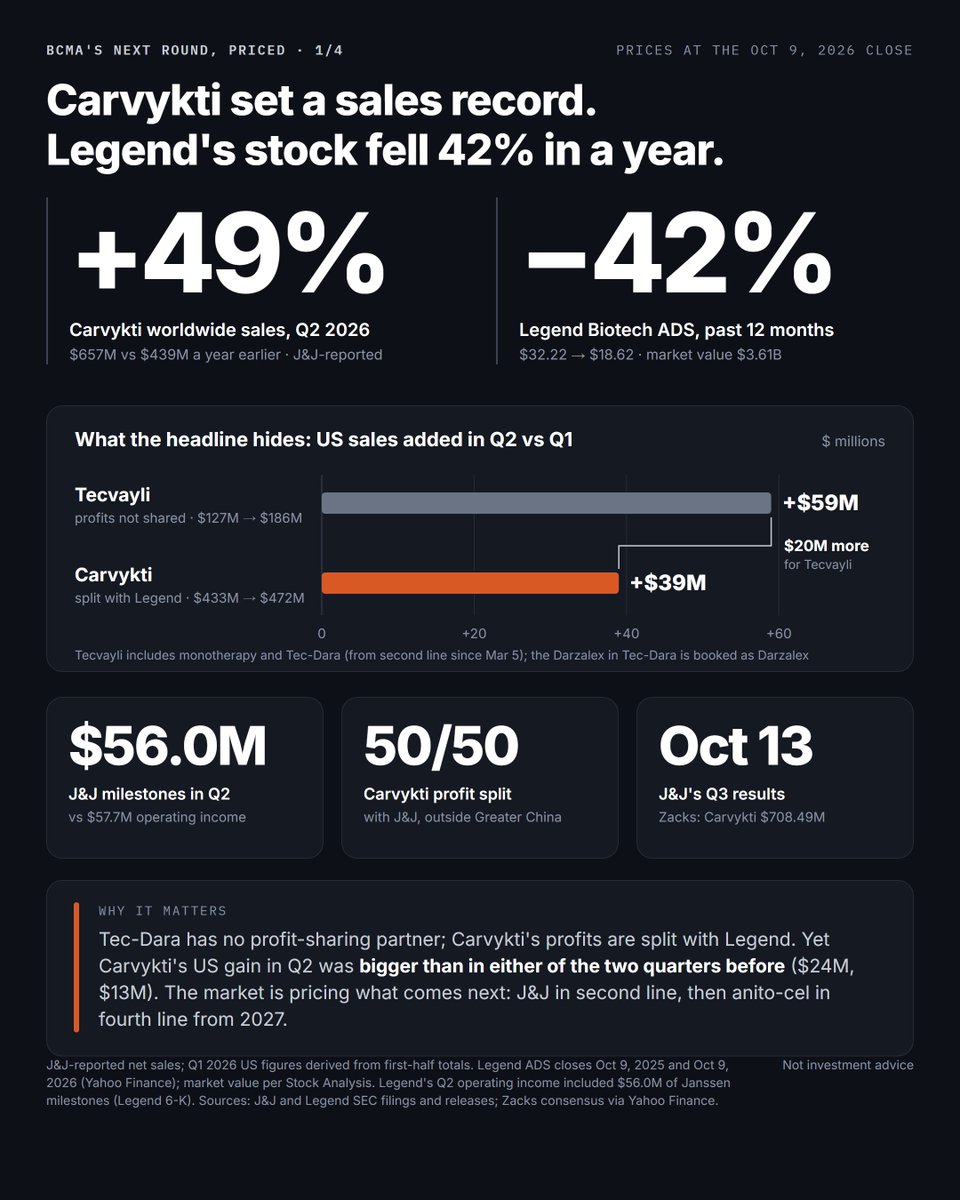
42%. That's how far Legend Biotech's $LEGN shares have fallen in a year. Meanwhile Carvykti, the CAR-T it splits with J&J $JNJ, had its best quarter yet: $657M, up 49%. What the headline hides: in the US, J&J's own bispecific grew $59M on the quarter. Carvykti grew $39M.
Both of those numbers are true, and for a while I couldn't make them sit together: a drug that has set a new quarterly sales high in each of the last five quarters, and a company with a claim on about half its profits that the market keeps marking down (chart 1).
So this is a bull vs bear piece with one question. Is the market pricing the erosion of Carvykti's lead before it shows up in the sales? The first real test comes Tuesday, when J&J reports Q3.
HOW LEGEND GOT HERE (chart 2)
I'd have dated Legend's troubles to June. The price history says last fall, and J&J's own drug was part of the story.
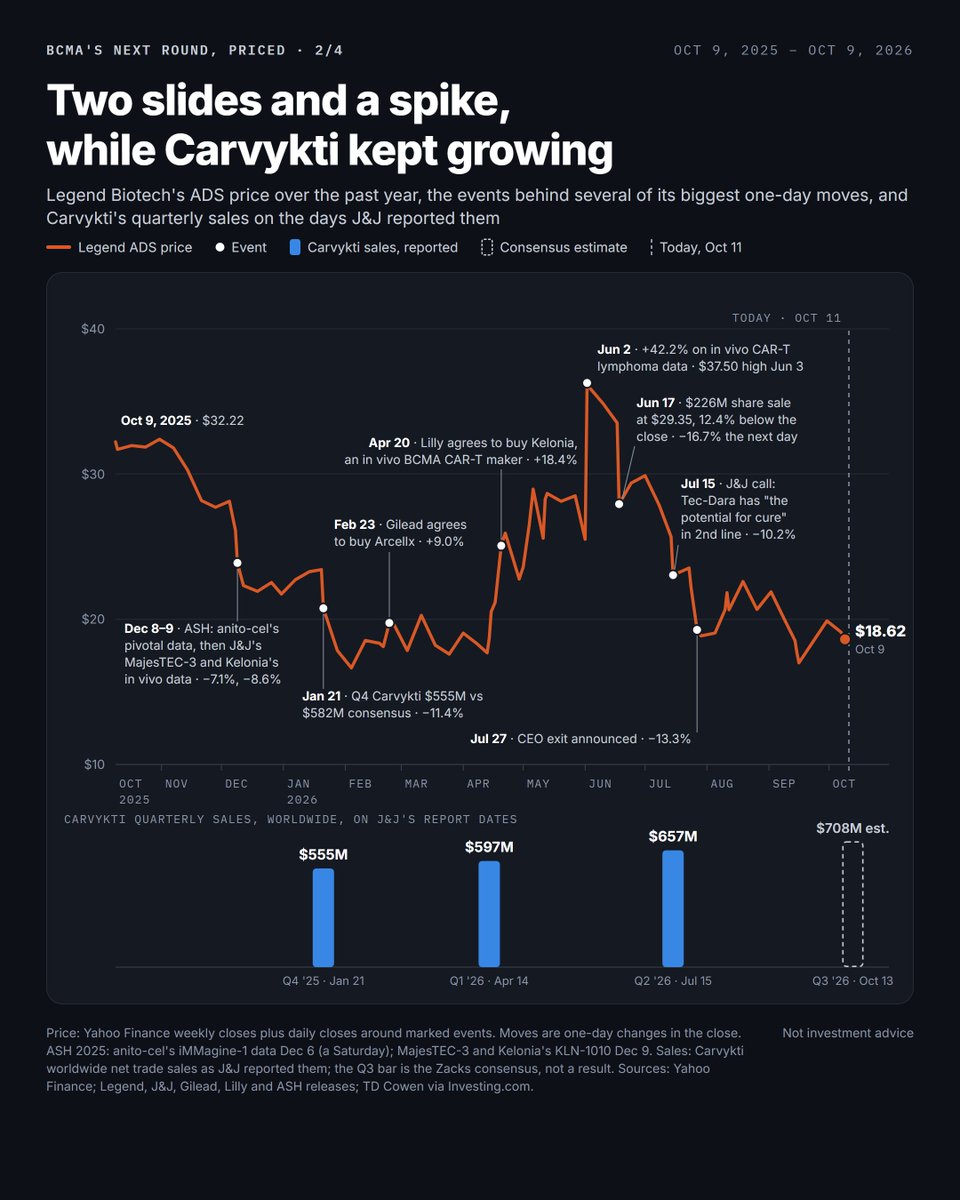
The ADSs had already slipped from about $32 to $28 in November. Then came ASH (@ASH_hematology) in December. Gilead's anito-cel showed its pivotal data on Dec 6, and on Dec 9 J&J presented MajesTEC-3: 83.4% of patients on Tec-Dara, its bispecific Tecvayli given with Darzalex, were alive and progression-free at three years vs 29.7% on standard regimens. Kelonia presented early data for its in vivo BCMA CAR-T the same day. Legend fell 7.1% on Dec 8, the first trading day after the anito-cel data, and 8.6% on Dec 9. On Jan 21, J&J reported $555M of Q4 Carvykti sales, a record but short of the $582M consensus TD Cowen cited when it downgraded the next day. Legend fell 11.4%. By early February the ADSs were below $17, from $32 in October.
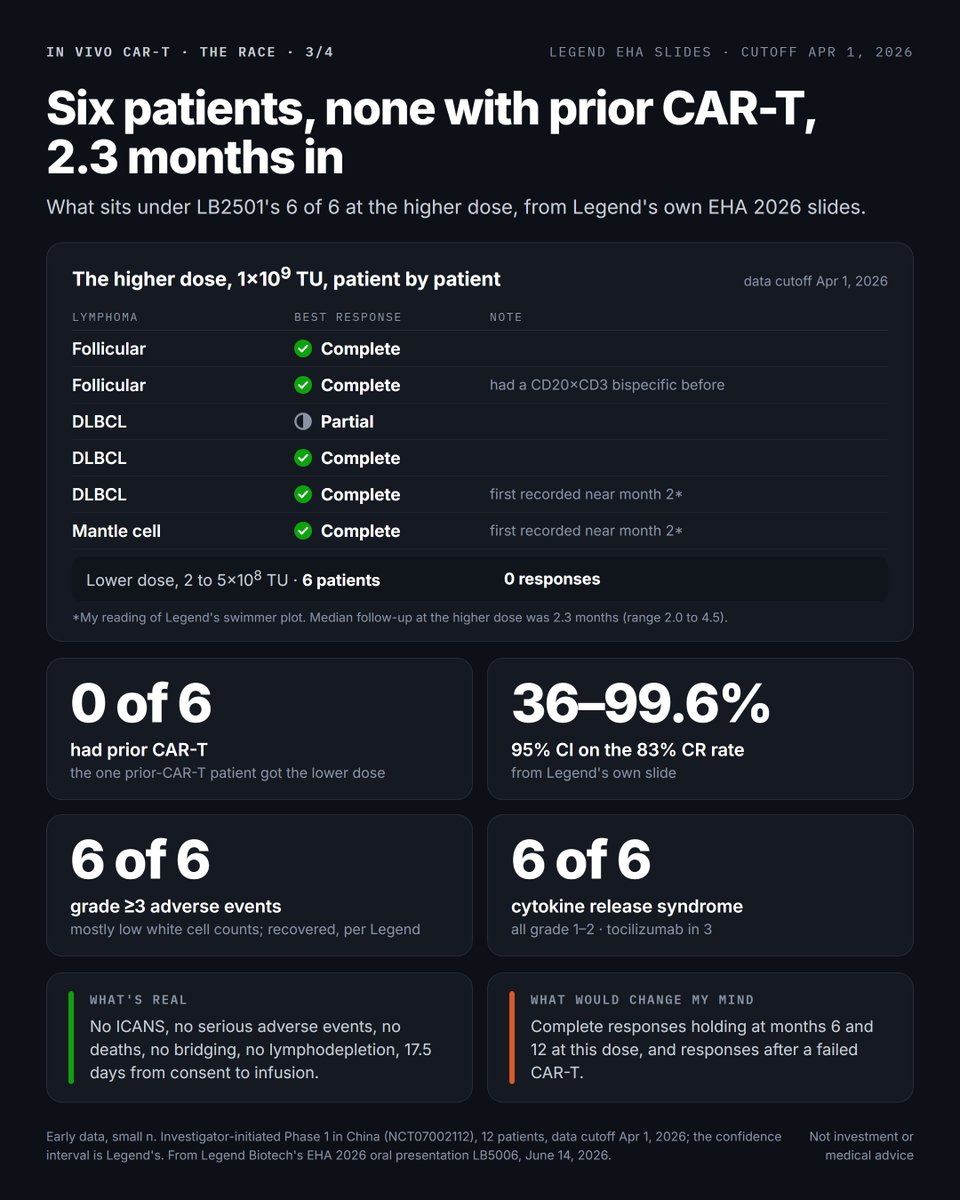
Then came a four-month rally, much of it on deals and early data. Legend rose 9.0% on Feb 23, the day Gilead agreed to buy Arcellx, anito-cel's developer; 18.4% on Apr 20, the day Lilly agreed to buy Kelonia, a deal RBC said "highlights large pharma interest in the BCMA CAR-T market"; and 42.2% on June 2, on its own in vivo CAR-T data in lymphoma. LB2501 is built to make CAR-T cells inside the body, with no cell manufacturing and no lymphodepletion. Twelve patients were treated across two doses; of the six on the higher dose, all six responded and five had a complete response. The next day the ADSs touched $37.50.
The air came out from there. On the evening of June 17, Legend priced 7.7M new ADSs at $29.35, about $226M, 12.4% below that day's close, and the stock fell 16.7% the next day. On July 15, J&J reported Carvykti's record quarter, and on the same call Jennifer Taubert, then head of J&J's Innovative Medicine business, said Tec-Dara has "best-in-class efficacy and the potential for cure for patients in that second-line setting." Legend fell 10.2% that day. I read that line several times. Earlier lines are where Legend has been taking Carvykti: its US sales rose 9% from Q1, "primarily driven by accelerating adoption in earlier lines of therapy," Legend said in August.
Nine days after the call, Ying Huang's resignation took effect, after nearly six years as CEO and seven at the company. That morning UBS downgraded the stock. When Legend announced the change on July 27, the ADSs fell another 13.3%.
In August came what the CFO called "the first quarter of company-wide profitability on both an IFRS and an adjusted basis": $57.7M of operating income, $33.2M of net income. And here's the detail I didn't expect when I opened the filing. $56.0M of that quarter's revenue was milestone revenue from J&J. Take it out and operating income was about $1.7M (my arithmetic), and the gross margin also had a few points of one-time help, so the underlying figure was lower still. The next day Oppenheimer downgraded. It said J&J, which it saw as the most likely buyer, was now off the table, and pointed to weak IQVIA data on Carvykti next to strong Tecvayli sales, management's fading confidence in its 2026 sales projections, and the CEO's exit ahead of anito-cel's launch.
On Sept 15, Ingrid Zhang became CEO of Legend (@legendbiotech). She comes from Novartis $NVS, where she was chief commercial officer of Novartis International. On Friday the ADSs closed at $18.62, half their June 3 high and 14% below where 2026 began, for a market value of $3.61B.
THE BEAR CASE (chart 3)
The strongest version of the bear case starts with Carvykti's own partner, J&J (@JNJNews), and then adds the next round.
• Tec-Dara has been approved from second line since March 5, after at least one prior line including a proteasome inhibitor and an IMiD. Carvykti's second-line label also requires the myeloma to be refractory to lenalidomide. Tec-Dara's doesn't.
• Taubert, same call: "the vast majority of patients now with Tec-Dara are starting in that second to third line setting."
• Tecvayli doesn't even need the Darzalex. In MajesTEC-9, Tecvayli alone beat PVd or Kd in patients with one to three prior lines, 85% of them refractory to anti-CD38 drugs and 79% to lenalidomide: PFS HR 0.29, overall survival HR 0.60 (topline, Jan 14). That's close to Carvykti's own second-line population, and J&J says the results will go to health authorities.
• In the US, Tecvayli went from $127M in Q1 to $186M in Q2. Carvykti went from $433M to $472M. And the Tecvayli line understates Tec-Dara, because the Darzalex in it is booked as Darzalex.
• The incentive is plain. J&J splits Carvykti's profits 50/50 with Legend outside Greater China. Tec-Dara has no profit-sharing partner.
J&J also has the next one lined up. In MonumenTAL-6, Tecvayli plus Talvey cut the risk of progression or death by 89% (HR 0.11) and the risk of death by 62% (HR 0.38), in patients with one to four prior lines who'd had both an anti-CD38 drug and lenalidomide. That survival number stopped me. It's a topline with no confidence interval given, and J&J hasn't said when it will file, only that the results will be shared with health authorities. Legend's interim CEO said in August that J&J intends the combination "to be primarily used in later lines," though J&J's own release calls it an earlier-line result. If it holds, J&J would have a third off-the-shelf regimen with a survival benefit, after Tec-Dara and Tecvayli alone. Its trispecific, ramantamig, is also in two Phase 3s against Tecvayli, one in patients with as few as one prior line.
Then come the challengers everyone calls BCMA's next round:
• Gilead's $GILD (@GileadSciences) anito-cel has a Dec 23 FDA goal date, for fourth line and later. That sounds narrow until you check Legend's own split: second and third line were 41% of Carvykti's US apheresis volume in Q1, so fourth line and later was the rest, about 59% (my arithmetic; the mix has moved earlier since). No delayed neurotoxicity has been reported for anito-cel (no parkinsonism, cranial nerve palsy or Guillain-Barré), and its median manufacturing time in trials was 18 days, against the roughly 29 days Legend cites for Carvykti (trial lots vs commercial supply, so not like for like). Gilead paid $7.8B for Arcellx, and its own cell therapy sales fell 14% in Q2. It needs this launch.
• AbbVie's $ABBV (@abbvie) etentamig beat standard regimens in CERVINO, 393 triple-class-exposed patients, with a PFS hazard ratio of 0.40. Dosing is monthly, and the trial allowed outpatient starts. In July AbbVie said a positive interim would mean a submission later this year; its September topline release spoke only of discussing next steps with regulators.
• Pfizer's $PFE Elrexfio won its Phase 3 from one prior line in April (MagnetisMM-5, against DPd). Pfizer hasn't disclosed the hazard ratio, and I haven't found a filing.
• Bristol Myers' $BMY iberdomide won accelerated approval from one prior line in August, given with daratumumab. Not a BCMA drug, but one more option in the lines Carvykti is moving into.
And Legend itself:
• It guided Q3 gross margin on product sales to the "lower 50% range," with a "mid-50%" rebound in Q4, after 58% in Q2. The CFO said Q2 included "a few percentage points" of one-time favorability.
• UBS's July downgrade cut its 2032 Carvykti forecast to $1.3B from $2.2B, citing J&J's off-the-shelf Tecvayli and Talvey as setting new clinical benchmarks and expecting anito-cel to gain significant traction. It said the stock was pricing in about $1.1B of sales.
• TD Cowen wrote in August, per TheFly, that the $2.74B consensus for Carvykti's 2026 sales may be optimistic, given rising competition.
THE BULL CASE (chart 3)
The strongest version of the bull case is that Carvykti's edges are built on time, and time is the one thing a challenger can't buy.
• Durability. In CARTITUDE-1, 32 of 97 heavily treated patients were alive and progression-free five years or more after a single infusion, with no maintenance. In cohort A of CARTITUDE-2, patients with one to three prior lines, it was 10 of 20, shown on Sept 25. Tec-Dara's data run to three years, and J&J's 86.6% "cure fraction" for survival is a model, not an observation.
• The label. Carvykti is the only CAR-T approved from second line in myeloma, since April 2024, and its label carries an overall survival benefit (HR 0.55).
• The mix is moving earlier, away from anito-cel's launch range. Second and third line were 41% of US apheresis volume in Q1, up from 29% a year earlier, and higher again in Q2. Over 70% of US volume is second to fourth line, about 60% is outpatient, and ex-US sales rose 128% year on year.
• The clock. In the US, no outside BCMA drug is approved from second line, and on the timelines I can find, none of this round's challengers can be before 2027. Anito-cel's second-line trial has an estimated primary completion of July 2028, though Gilead says it could file as early as 2027. Etentamig's second-line Phase 3 hasn't started (estimated start Nov 30, estimated completion February 2033), though CERVINO let US patients in after a single prior line if they'd had all three drug classes, so where its first label starts is an open question.
• In vivo CAR-T is early. Lilly $LLY agreed to pay $3.25B upfront for Kelonia on early results shown at ASH 2025. An extended follow-up of AstraZeneca's $AZN ESO-T01, from an investigator-run study in Wuhan published in Nature Medicine on Oct 6, showed a median PFS of 4.0 months in four patients; three relapsed and died.
• The balance sheet. About $965M in cash and time deposits at June 30, against $156.4M still owed to J&J in advance funding, plus guidance for sequential sales growth in both second-half quarters, confidence in adjusted profit in Q3 and Q4, and an extra selling week in Q4.
Legend's pitch is "one and done" against continuous therapy, and its interim CEO argued in August that "patients will benefit if they can get to CAR-T first before other options in BCMA." That's Legend talking its book, and the evidence can't settle it: CARTITUDE-4, MajesTEC-3, iMMagine-1 and CERVINO all excluded patients who'd already had a BCMA drug.
THE NUMBER THAT SURPRISED ME
When I lined the quarters up, I didn't expect this: Carvykti's US gain in Q2, $39M, was bigger than in either of the two quarters before it, $24M in Q4 and $13M in Q1 (my arithmetic from J&J's reports). That's back to its mid-2025 pace, in Tec-Dara's first full quarter on the market, and worldwide Carvykti still added slightly more than Tecvayli, $60M to $58M. Two caveats. CAR-T is made to order, so some of those infusions were set in motion before or around Tec-Dara's approval. And both earlier quarters were seasonally soft: TD Cowen blamed part of Q4's miss on the holidays, and Legend said Q1 began with a post-holiday lag in appointments. Still, if Tec-Dara is eating Carvykti, it hasn't shown up in Carvykti's numbers yet. Both grew.
MY READ
As I read it, the market is pricing two threats on different clocks. The one already visible in the numbers is J&J's own bispecific in second line: in Q2, in the US, the drug whose profits J&J doesn't share outgrew the CAR-T whose profits it does. The next is anito-cel, with revenue from early 2027 on Gilead's guidance, and it's bigger than "fourth line only" sounds, because that's still a large part of Carvykti's US volume. UBS's downgrade cited both. What none of this round's outside BCMA challengers can reach in the US before 2027 is second line, the part of the business that's growing.
The forecasts disagree by more than two to one. GlobalData, one forecaster, said in September it expects Carvykti to sell $6.3B in 2032. UBS's 2032 figure is $1.3B. UBS doesn't say whether that's total sales or Legend's half, but its June note had 2026 at $1.3B too, about Legend's current collaboration revenue run rate ($326.1M in Q2). So I read it as Legend's half: roughly $2.6B of total sales in 2032, about where Carvykti is running today. If that reading is right, UBS sees no net growth from here to 2032, a big claim against a drug whose US growth just picked up again. Legend still says peak sales can top $5B.
I'm not sure who's right, and I don't think anyone can be until two more quarters show whether Carvykti's US gains keep pace with Tecvayli's.
WHAT WOULD MOVE ME (chart 4)
1. Tue Oct 13, release around 6:45 a.m. ET: J&J's Q3, its first earnings call since Taubert retired on Sept 1. Zacks has Carvykti at $708.49M. On Oct 7 I said the number to watch was Carvykti's US sales against Q2's $472M; I'd add Tecvayli's US sales against $186M. A second quarter of Tecvayli outgrowing Carvykti in US dollars, by a wider gap, would move me toward the bears. A Carvykti US gain near the $38–40M of its better quarters would move me the other way.
2. Fri Oct 30: AbbVie's Q3, and whether the etentamig submission is still this year.
3. Wed Nov 4, 9 a.m. ET: ASH abstracts, then the late-breakers on Dec 7. I'll look for longer anito-cel follow-up, and any full MonumenTAL-6 or MagnetisMM-5 data.
4. Legend's Q3, the first under Zhang (date not yet announced): gross margin against the "lower 50%" guide, and whether adjusted profit holds without a large milestone.
5. Dec 12–15: ASH in New Orleans.
6. Wed Dec 23: anito-cel's goal date. The line on the label first, then the boxed warning. Carvykti's names parkinsonism and Guillain-Barré; Abecma's doesn't. A box without them, plus the one-week stay near the treatment center that Abecma's label now asks for, would be Gilead's whole pitch for 2027.
7. Later: a MonumenTAL-6 filing (timing not given), an iMMagine-3 filing as early as 2027, and CARTITUDE-5 in newly diagnosed patients, which Legend said could read out in '26 or '27.
THE REALITY CHECK
• Every efficacy comparison here is cross-trial. MajesTEC-3 excluded patients refractory to anti-CD38 drugs, MajesTEC-9's were mostly refractory to them, and CARTITUDE-4 required lenalidomide-refractory disease. Different patients.
• The five-year numbers are small: 97 patients and 20.
• Record sales aren't beats. Q4's $555M missed consensus, and the stock fell 11.4% that day.
• Quarter-on-quarter dollars are noisy, and neither company says how second-line patients split between Carvykti and Tec-Dara.
• The incentive argument is an inference, mine and the market's. J&J's sales priorities aren't visible from outside.
• My readings of Legend's mix and UBS's numbers are mine, and forecasts are positions, not facts.
• What would change my read: toward the bears, Tecvayli's US gains outrunning Carvykti's for two more quarters and a fast anito-cel launch in fourth line; toward the bulls, Carvykti's gains holding while Tec-Dara ramps, and an anito-cel label with class-style warnings.
BOTTOM LINE
Carvykti is still growing, and in Tec-Dara's first full quarter on the market its US gain got bigger, not smaller. Legend's stock is pricing erosion anyway, and J&J's own bispecific turns up in both of its slides: the data in December, the "potential for cure" pitch in July. Anito-cel's fourth-line launch in 2027 is the second threat, and a real one. My read: the bear case is real but early, and the bull case needs Carvykti's US gains to keep pace with Tecvayli's for two more quarters. Tuesday is the first of them.
Myeloma doctors: in second line, when Carvykti and Tec-Dara are both options, what tips it for you today?
Not investment advice.
Sources: J&J, Legend, Gilead, AbbVie, Pfizer, Bristol Myers and Lilly releases, SEC filings and earnings calls; FDA labels; the NIH trial registry; ASH; IMS 2026 via OncLive and Targeted Oncology; JCO; Nature Medicine; UBS, TD Cowen, Oppenheimer and RBC notes via Investing, TipRanks and The Motley Fool; GlobalData via Clinical Trials Arena; Zacks; Yahoo Finance and Stock Analysis. Prices at the Oct 9, 2026 close.
#MultipleMyeloma #CARTcell #BCMA #Bispecifics #CellTherapy #ImmunoOncology #Biotech #ASH26
Ivonescimab's survival p-value went from 0.057, a miss, to a nominal 0.0151. The FDA told Summit $SMMT it needed statistical significance. Updates tracked only the Western 38%. The other 62%, frozen in April 2025, came from Akeso's (https://t.co/25Bl6wcQEs) China-only trial. Goal date: Nov 14.
On Oct 13 I ranked that FDA date second among Summit's catalysts, behind HARMONi-3. This is the deep dive on the date itself, and it starts with a correction to what I wrote then.
The question: can a nominal p-value clear the bar the FDA set? My answer is no, not on its own. Nominal means no error budget was left for that analysis. The test the FDA counts was the trial's final survival analysis, and it missed. So Nov 14 really asks whether the FDA relaxes its own bar, and on what evidence. Below: what 0.0151 is (chart 2), where the 62% came from (chart 1), what this setting's history says about PFS without survival (chart 3), and the three ways the date can go (chart 4).
THE FILING
Summit (@SMMT_TX) wants approval for ivonescimab, a PD-1xVEGF bispecific it licensed from Akeso (@AkesoInc), plus platinum chemo in EGFR-mutant non-squamous lung cancer that has progressed after a third-generation EGFR inhibitor. The trial is HARMONi: 438 patients, placebo-controlled, with PFS and overall survival as dual primary endpoints. The goal date is a Saturday, and the FDA can act before it. There's no advisory committee on the calendar. It would be the first PD-1xVEGF bispecific approved in the US.
The bar, in Summit's words (May 2025): "The FDA noted that a statistically significant overall survival benefit is necessary to support marketing authorization." The Q2 10-Q, filed in July, still carries it, adds "in this setting," and says "the PFS results from this study may not be sufficient." Summit has disclosed no change.
WHAT 0.0151 IS (chart 2)
PFS isn't in dispute: HR 0.52, 6.8 vs 4.4 months, now peer-reviewed in @TheLancetOncol.
Survival:
• April 2025, the final OS analysis in the words of the WCLC 2025 presentation (Summit calls it the primary analysis): HR 0.79 (95% CI 0.62–1.01), p=0.057. The plan needed 0.0448.
• September 2025, which Summit's 10-Q calls ad hoc: HR 0.78 (0.62–0.98), nominal p=0.0332.
• June 2026 cutoff (HRs out July 22; CIs and the p-value at WCLC on Sept 15): HR 0.76 (0.61–0.95), nominal p=0.0151.
Median survival: 16.8 vs 14.0 months at all three.
Both later cuts added follow-up only for the 165 Western patients. Their median follow-up went from 9.2 to 13.7 to 23.2 months, and their HR from 0.98 (0.55–1.73) to 0.84 (0.53–1.32) to 0.76 (0.52–1.10). The 273 Asian patients stayed locked at the April 2025 analysis.
Credit where it's due: 9.2 months of follow-up was shorter than the control arm's 14-month median survival, so that first Western read was immature, and Summit's case for a longer look is fair. But the CI still crosses 1, and as far as I can tell the sponsor chose when to look.
THE CORRECTION: WHERE THE 62% CAME FROM (chart 1)
On Oct 13 I wrote: "Same setting, two answers: HARMONi-A in China hit OS (HR 0.74, p=0.019); the global HARMONi didn't." That undersold how much the two share.
HARMONi-A is Akeso's Phase 3 in the same setting: 322 patients, all in China, with PFS as its primary endpoint. In October 2024 Summit wrote that "the HARMONi analysis will include all patients from the HARMONi-A trial who previously received a 3rd generation TKI." Akeso had put that at about 276 patients, 85% of its trial. HARMONi's Asian subgroup is 273. Summit's latest 10-Q says it plainly: "Patients enrolled in China were also enrolled as a part of the HARMONi-A study."
So HARMONi is mostly a re-cut of a China-only trial, plus 165 Western patients. Three things follow, on my reading:
1. HARMONi-A's significant survival result (HR 0.74, p=0.019, its only planned and final OS analysis, at the same April 2025 cutoff) isn't independent support. It's largely the same patients.
2. Summit's July subheadline, "Western Patients Achieved OS HR of 0.76, Consistent with Asian Patients," compares Summit's 165 with Akeso's 273, followed to different dates.
3. Set the Chinese cohort aside and the multiregional evidence is 165 patients, 93 of them North American: HR 0.76, CI 0.52 to 1.10.
Here's what I can't square: Summit still cites HARMONi-A as support, as recently as August, for a "statistically significant overall survival benefit in both the HARMONi-A and HARMONi-6 studies." I don't know whether the FDA agreed to this structure when the trial was designed; Summit hasn't said. The FDA's 2024 draft guidance on multiregional cancer trials prefers enrollment spread across regions over trials run mostly in one country or region.
WHY THE FDA MAY HAVE ASKED FOR SURVIVAL HERE (chart 3)
Randomized Phase 3s after an EGFR inhibitor (cross-trial: different eras, regions and crossover):
• ORIENT-31, Innovent (https://t.co/NwWeHVRo0C), China: sintilimab, a PD-1 antibody, plus a bevacizumab biosimilar and chemo. PD-1 plus VEGF, the nearest two-drug cousin of ivonescimab. PFS HR 0.51. OS HR 0.98, or 0.79 to 0.84 after adjusting for crossover.
• KEYNOTE-789, Merck's $MRK Keytruda plus chemo: PFS 0.80, OS 0.84. Both missed.
• CheckMate-722, Bristol Myers's $BMY Opdivo plus chemo: PFS 0.75, which missed; OS 0.82, descriptive only.
• HERTHENA-Lung02, HER3-DXd from Daiichi Sankyo (Tokyo: 4568) and Merck: PFS 0.77, significant. OS 0.98. The application was withdrawn on May 29, 2025, the day before Summit's topline.
• MARIPOSA-2, J&J's $JNJ Rybrevant plus chemo: PFS 0.48. OS 0.73 (0.54–0.99), not significant at the second interim. Approved Sept 19, 2024.
• HARMONi: PFS 0.52. OS 0.79, missed at the final.
The number that stops me is ORIENT-31's. A PD-1 plus VEGF regimen got ivonescimab's PFS hazard ratio, almost to the decimal, and a survival hazard ratio of 0.98. Outside ivonescimab's own China data, adding a PD-1 drug in this setting hasn't produced a survival win in these trials, even when PFS moved a lot. My guess is that's why the FDA asked for survival here. It hasn't said.
The bar is rising from the other side, too. In China, Kelun-Biotech's (https://t.co/hDxrunzSLo) TROP2 ADC sac-TMT beat chemo on survival in this setting (OptiTROP-Lung04: HR 0.60, P=0.001). Merck, which co-developed HER3-DXd, now lists survival as the only primary endpoint of its own Phase 3 of sac-TMT here, TroFuse-009.
THE CASE FOR APPROVAL
• Rybrevant. Cross-trial, ivonescimab's survival looks like Rybrevant's did at approval: HR 0.79 vs 0.73, a median gap of 2.8 vs 2.4 months. Summit made the point itself in May 2025: "There are no current FDA-approved regimens that have demonstrated a statistically significant overall survival benefit in this patient setting." The caveat I raised on Oct 13 stands: PFS was MARIPOSA-2's only primary endpoint, and its survival was read at an interim. HARMONi's was co-primary and missed at the final.
• The FDA's August 2025 draft guidance on survival treats it as a safety endpoint as well as an efficacy one. On harm, HARMONi passes: every cut of the full trial shows an HR below 0.8, and the upper bound has stayed below 1 since September 2025.
• Consistency. Stifel, July 22: "Bears can still point to the lack of explicit statistical-significance language, but in our view the more relevant FDA question is whether the global data are consistent, and this update directly addresses that concern."
• The FDA filed the application, and Summit said in January that the agency planned to share proposed labeling before the goal date, "subject to major deficiencies not being identified."
THE CASE AGAINST
• "Necessary," still in the July 10-Q.
• The final analysis is spent. Nothing later can be significant in the sense the FDA used.
• Applicability. In July 2025 the FDA turned down Roche's $RHHBY Columvi combination in lymphoma even though its STARGLO trial met survival (HR 0.59). FDA advisers had voted 8 to 1 that the results didn't apply to US patients: 48% of enrollment was in Asia, about 9% in the US. HARMONi: 62% from a China-only trial, 21% North American. A bigger North American share than STARGLO, but a missed survival endpoint where STARGLO had a win.
• BioPharma Dive reported in September 2025 that Leerink's Daina Graybosch believed the FDA wouldn't approve ivonescimab. I haven't seen her say whether the July update changed that.
• The climate. In August two House members asked the FDA to refuse China-generated clinical data in trial and marketing applications, BLAs included, unless it had audited the site in person in the 12 months before submission (the trigger was deaths in gene-editing trials, not cancer). In September the FDA said it would step up oversight of foreign trial sites.
THE MUDDLED MIDDLE
• Approval with an asterisk: a label that prints the April 2025 analysis and says survival wasn't statistically significant, as the FDA's announcement did for Rybrevant. Summit gets its first product sales; the class gets an ambiguous precedent.
• A three-month extension, if the FDA treats the June 2026 data as a major amendment. None announced. Under the FDA's user-fee commitments it should, except in rare cases, extend only when new data could lead to approval in this cycle, so I'd read an extension as mildly good news for Summit.
• A missed date. It happens: in June 2025 the FDA told KalVista $KALV it would miss a goal date, citing heavy workload and limited resources.
WHAT I'LL READ FIRST WHEN IT LANDS
1. Approval or a complete response letter. The FDA said in September 2025 that it would publish new CRLs promptly, and it was posting them again in July after a pause over a company's petition against the practice. So a rejection should come with reasons: survival, applicability or something else, such as manufacturing. Akeso supplies the drug substance, and Summit hasn't disclosed the status of inspections.
2. If approved, section 14 of the label. If it prints only the April 2025 analysis, the FDA approved on PFS plus no sign of harm. If it prints the June 2026 cut, the FDA accepted a later, nominal update after a missed final analysis. As I asked on Oct 13, I can't find a clean precedent for that; it would be the bigger signal.
3. The indication's wording, the bleeding and VEGF warnings, and any postmarketing requirement on survival.
4. If it's a CRL: what the FDA asks for. HARMONi-3's survival data, or a new trial.
WHAT IT CHANGES
For Summit, approval means first product sales, in a niche. Summit counts more than 14,000 US patients a year in this setting. Per Fierce Pharma in May 2025, Cantor's Eric Schmidt put the indication's sales potential at about $500 million to $1 billion a year. J&J's Rybrevant/Lazcluze, every line included, sold $320M last quarter. Summit closed at $15.13 on Oct 14, about $12.1B on the 797.7M shares in its last 10-Q (my math), so most of what the market prices sits beyond this label. A CRL would cost time, not the first-line thesis.
For the class, Nov 14 is the first FDA ruling on how much survival it wants from a PD-(L)1xVEGF drug:
• HARMONi-3, ivonescimab plus chemo vs Keytruda plus chemo in first-line lung cancer: OS and PFS co-primary, powered for both. Squamous PFS events are expected in 2H 2026, with an early OS look alongside; an OS interim follows in 1H 2027.
• @pfizer's $PFE PF-08634404, licensed from 3SBio (https://t.co/OFGEjdfI8N), against Keytruda plus chemo in 1,410 planned patients: OS and PFS co-primary.
• @BioNTech_Group's $BNTX pumitamig with Bristol Myers, a PD-L1xVEGF, in ROSETTA Lung-02: PFS by blinded central review is the Phase 3's only primary endpoint; OS is secondary.
My read: a CRL built on survival would land hardest on PFS-only designs. The FDA's statement, as Summit reports it, covered "this setting," not first-line lung, so that's an inference, not a rule.
THE REALITY CHECK
• I can't see the review. "Necessary" may have been said before the data existed, and the FDA approved Rybrevant without significance.
• The overlap rests on Summit's own words, in the 2024 release and the 10-Q. The exact count (about 276 planned, 273 in the subgroup) is for The Lancet Oncology paper's methods to settle; I couldn't read the full text.
• ORIENT-31's survival was muddied by crossover, and every comparison above is cross-trial.
• The people changed. Richard Pazdur ran the FDA's oncology center when Summit disclosed the advice; he retired in December, and Angelo de Claro runs it now. I have no evidence that moves the bar either way.
• What would change my mind: a Summit statement before Nov 14 that labeling talks have started, or a label that prints the June 2026 cut.
WHAT I'M WATCHING
1. Oct 25, 16:30 Madrid: Akeso's HARMONi-GI1 at @myESMO (LBA8), biliary cancer vs AstraZeneca's $AZN Imfinzi plus chemo. China-only. A read on the molecule, not on this label.
2. Late October: Summit's Q3 results, date not announced. Any word on labeling talks.
3. Nov 14, a Saturday: the goal date.
4. 2H 2026: HARMONi-3 squamous PFS and the early OS look.
5. 1H 2027: HARMONi-3's OS interim and non-squamous PFS.
BOTTOM LINE
0.0151 can't clear a bar the FDA set at statistical significance: the test was the April 2025 final analysis, and it missed. What Nov 14 decides is whether the FDA approves on PFS plus a survival trend that never showed harm, as it did for Rybrevant, or holds the line it drew for this setting, as the HER3-DXd withdrawal suggests it can. Set aside the cohort that came from Akeso's trial and the new evidence is 165 Western patients with a CI that still crosses 1. My read hasn't moved since Oct 13: approval is possible, not my base case.
Trialists: should a "global" Phase 3 be able to fill 62% of its patients from a separate single-country trial? I'd like to hear the case for it.
Not investment or medical advice.
Sources: Summit releases and SEC filings, including the Q2 10-Q; Akeso releases; IASLC (WCLC 2025 and 2026); The Lancet Oncology; the FDA; the NIH trial registry; J&J, Merck, Daiichi Sankyo, Innovent, Kelun-Biotech, BioNTech, Pfizer and Roche releases; the House China Select Committee; The ASCO Post, OncLive, Targeted Oncology, BioPharma Dive, BioSpace, Fierce Pharma; StockAnalysis. Data as of Oct 14, 2026.
#ImmunoOncology #NSCLC #LungCancer #EGFR #Bispecifics #FDA #Biotech
Carvykti beat on Oct 13: $710M in Q3, up 35%, above the $691M analysts expected in a survey by Legend $LEGN. Then I read the US line: $472M, the same as in Q2. All $53M of growth came from abroad, while J&J's $JNJ own bispecific, Tecvayli, added $50M in the US.
Legend (@legendbiotech) splits Carvykti with J&J. When I put its last two earnings calls side by side, one word had changed. In May, a UBS analyst asked whether Carvykti could keep growing each quarter, and what J&J's MajesTEC-3 trial might do to it. Alan Bash, who then ran the Carvykti business and has been interim CEO since July, said he expected sequential growth "both in the U.S. and OUS for the remainder of this year." In August, the same analyst asked about J&J's newest myeloma data. Bash said Legend wanted "to just maintain the comment that we had previously, which is around global sequential growth quarter on quarter."
Global is what Q3 delivered. Nothing was hidden: both answers are on the record, and Legend kept the promise it made last. But the sentence got shorter over the summer, and the US is the part that fell off.
My read: this is the first scoreboard of BCMA's next round, and in the US the drug that comes off the shelf is winning it. Below: what the sales tables show (charts 1 and 2), Legend's words against the result (chart 3), why one flat quarter could still be noise, and what it means for Gilead's anito-cel on Dec 23 and AbbVie's etentamig (chart 4).
WHAT THE TABLES SHOW (charts 1 and 2)
J&J (@JNJNews) books Carvykti's sales. Its Q3 tables:
• Carvykti, US: $472M in Q2, $472M in Q3. It had risen nine quarters running before this, by $13M to $40M a quarter over the last six. Growth on a year earlier slowed from 36.2% in Q1 to 31.7% in Q2 and 19.4% in Q3.
• Carvykti, outside the US: $185M to $238M. That's the whole $53M, and 85% more than a year earlier.
• Tecvayli, US: $186M to $236M, double the $115M of a year earlier. Q3 was its second full quarter since March 5, when the FDA approved Tecvayli with Darzalex Faspro (Tec-Dara) from second line.
• Since the quarter of that approval, Tecvayli's US sales are up $109M and Carvykti's $39M. In the US, Tecvayli now sells half as much as Carvykti. A year ago it was 29%.
• Talvey, J&J's other myeloma bispecific, was flat in the US too, at $112M. Darzalex US rose $93M, to $2.53B.
J&J's own words for the quarter: Carvykti grew on "share gains across earlier lines of therapy and continued site expansion." Tecvayli grew on "launch uptake and share gains across earlier lines of therapy." Same lines, same quarter. Only one of them grew in the US from Q2.
The detail that stopped me came on the call. Tom Cavanaugh, who took over J&J's Innovative Medicine business in September, said "roughly in the U.S., 50% of the utilization of CARVYKTI lies in lines two and three." In Q1, Legend put those lines at 41% of US apheresis volume. Those aren't the same measure, but they point one way: the mix keeps moving earlier while the US total has stopped moving. If both hold, the late-line half of the US business got smaller this year. That is the half anito-cel's first label can reach.
WE'VE BEEN HERE BEFORE. ALMOST.
Carvykti has stalled before, twice that I can find. In Q3 and Q4 2022 it sold $55M both times, short of viral vectors. In Q1 2024 it slipped from $159M to $157M, and J&J pointed to "the timing of orders." On April 16, 2024, ApexOnco ran the headline "Tecvayli threatens to eclipse Carvykti."
It didn't. The second-line label had come 11 days earlier, on April 5, and Carvykti sold $963M that year and $1.887B in 2025. Reading the 2024 pause as a peak would have been wrong.
I keep coming back to that headline, because the picture is back with two differences:
1. The factory isn't the excuse. Legend reported a 99% manufacturing success rate and over 95% on-time releases in Q1.
2. In 2024, Carvykti reached second line before any bispecific. In 2026 the bispecific is there too, off the shelf, from the same company.
WHAT THE RELEASE LEFT OUT
J&J's release lists Carvykti among its growth drivers, and the call script put its growth at 35.2%. The flat US line sits in the sales tables, not the headline. I found no explanation for it, and in the transcripts I read, the one analyst question on myeloma was about first-line trials. Legend's own filing gave "approximately $710 million," based on J&J's figures, with no split by country.
THE REALITY CHECK
• One quarter is one quarter. The 2024 pause came before Carvykti's two best years, and Legend's CFO said in August that Q4 gets "an extra selling week." That week alone could add about $36M to a $472M quarter (my arithmetic: one week on 13), so Q4 has to clear more than that to count.
• Dollars aren't patients. Carvykti is billed once per patient. Tec-Dara is ongoing treatment, weekly at first, every two weeks through about month six, then monthly, so Tecvayli's extra $50M includes patients who started months ago. It doesn't tell us who is winning new second-line patients. That's my analysis; J&J doesn't report either drug by line.
• Price and mix are a black box. In August, Bash said outpatient care is "starting to become approximately 60%" of Legend's mix, with dynamics that "could potentially impact gross margin." Whether the net price per infusion moved isn't disclosed.
• J&J says Carvykti is now sold in over 20 markets, and outside the US it grew 85% on a year earlier. The franchise grew 8% from Q2; the US didn't grow at all.
• What would make me wrong: US Carvykti growing in J&J's Q4 by more than the extra week explains. Then Q3 was 2024 all over again.
WHAT IT DOES TO BCMA'S NEXT ROUND
Legend's pitch is sequencing. "Patients will benefit if they can get to CAR-T first before other options in BCMA," Bash said in August. The durability is real: in a 20-patient CARTITUDE-2 cohort with one to three prior lines, 10 were alive and progression-free five years after a single infusion. J&J's answer is MajesTEC-3, where 83% of Tec-Dara patients were alive and progression-free at three years, against 30% on standard triplets. That's a cross-trial comparison, with different patients and designs. But only one of the two comes off the shelf.
Q3 is the first quarter whose US sales fit the opposite story, the off-the-shelf drug getting there first. That's my read, not a proven fact: one quarter, and no sales by line.
What it means for the three threads in this story:
• Anito-cel, Dec 23. Gilead's $GILD (@GileadSciences) CAR-T is filed for fourth line and later, with revenue expected from early 2027. Its first label reaches the late-line half of Carvykti's US use, roughly $236M a quarter (my rough math: half of $472M), and Q3 suggests that half is shrinking. Its second-line trial, iMMagine-3, is fully enrolled at 452 patients, and Gilead says it could file "as early as 2027". So anito-cel launches into the part of the US market that BCMA's next round is draining.
• Etentamig. AbbVie's $ABBV (@abbvie) monthly bispecific beat standard regimens in CERVINO (PFS HR 0.40), in patients who had never had a BCMA drug. iMMagine-1 and iMMagine-3, anito-cel's pivotal and Phase 3 trials, excluded prior BCMA therapy too. Every second-line patient who gets Tec-Dara or Carvykti is one fewer who looks like CERVINO's patients later. I can't confirm a filing date; I've seen both end of 2026 and 2027 cited. AbbVie reports Oct 30.
• A rival that isn't BCMA. Bristol Myers' $BMY (@bmsnews) Zenbexus (iberdomide) won accelerated approval from second line on Aug 13, taken with Darzalex Faspro and dexamethasone. On Oct 8 that regimen showed median progression-free survival of 42 months against 20 on DVd (HR 0.49). Its first launch quarter reports Oct 29.
And J&J? Joaquin Duato said 80% of myeloma patients get a J&J therapy somewhere along the way. Zenbexus is taken with J&J's Darzalex Faspro. J&J splits Carvykti's profits 50/50 with Legend outside Greater China; on Tecvayli it pays Genmab $GMAB a mid-single-digit royalty. A second-line patient on either BCMA drug is a win for J&J. For Legend, only one of them is.
WHAT THE STREET HEARD
Carvykti's $710M beat Legend's survey; against the $708.49M Zacks consensus that Yahoo Finance carried on Oct 8, it was in line (chart 3). Legend's shares rose 0.45% on Oct 13 and 6.49% on Oct 14. I can't find a stated reason for the second move. The Investing news site's write-up of an H.C. Wainwright note did catch the flat line: "Third-quarter U.S. sales remained flat, with international markets contributing all $53 million of incremental revenue." The same write-up cites FactSet's forecast of about $3.4B for Carvykti by 2027. Q3's run rate is about $2.84B ($710M times four, my arithmetic). With the US flat, that gap has to close abroad or through a US restart.
WHAT I'M WATCHING (chart 4)
1. Thu Oct 29: Bristol Myers' Q3, the first quarter of Zenbexus sales.
2. Fri Oct 30: AbbVie's Q3. An etentamig filing date, if it gives one.
3. Wed Nov 4, 9 am ET: @ASH_hematology abstracts go online. The most useful thing in them for me would be real-world data on who gets Tec-Dara or CAR-T first.
4. November, date not yet set: Legend's Q3 call. The US mix by line, and whether "global" still describes Q4.
5. Dec 12–15: ASH in New Orleans, where BMS presents the EXCALIBER-RRMM data.
6. Wed Dec 23: anito-cel's FDA goal date. The line of therapy on the label first.
7. January, date not yet set: J&J's Q4, the second US number. US growth beyond the roughly $36M the extra week could add on its own says pause. Anything less says new shape.
BOTTOM LINE
Carvykti's Q3 headline was a beat, and outside the US it is still launching. Inside the US, the quarter J&J's own bispecific added $50M is the quarter Carvykti stopped growing, after Legend's guidance had already narrowed from "both" to "global." Carvykti has stalled before and come back stronger, so one quarter doesn't settle it. But this time the factory isn't the excuse, and the rival sits in the same line, sold by the same company. For anito-cel, Dec 23 opens a late-line US market that's thinning. For etentamig, fewer BCMA-naive patients each quarter. For Legend, a partner that wins either way.
Clinicians: in second line, are you seeing Tec-Dara go first with CAR-T held for later, or the reverse?
Not investment or medical advice. Data as of Oct 15, 2026. Sources: J&J's quarterly releases and sales tables (Q4 2025 to Q3 2026); J&J and Legend earnings calls (May, August, October); Legend's SEC filings; Gilead, AbbVie and Bristol Myers releases; FDA; the NIH trial registry; Genmab's interim report; the Investing news site, Yahoo Finance (Zacks), BioPharma Dive and ApexOnco.
#MultipleMyeloma #CARTcell #BCMA #Bispecifics #CellTherapy #ImmunoOncology #Biotech #ASH26
@Water46333865 Fair point on speed, a month barely matters in progressive MS. The donor-cell case is really your pricing point. One batch serves many patients, not one batch per patient. That only holds if MS patients don't need lymphoma-level chemo to get donor cells to expand.
Oct 23, 20 minutes apart: the first MS data for TG's $TGTX donor-cell CAR-T, then Stanford on Kyverna's $KYTX own-cell version. Novartis $NVS has paused its autoimmune CAR-T trials, MS included, after 3 deaths. TG hasn't shown one MS patient yet. Stanford's last count: 6.
Both drugs target CD19, both are aimed at progressive MS, and they make opposite bets on where the cells come from. Which bet is right? The two talks at MSToronto2026, the joint @ACTRIMS and @ECTRIMS meeting, can't settle that on disability scores, and I'd be wary of anyone who says they do. What they can show is whether either looks safe enough to keep dosing after Novartis's deaths, whether the cells reach the brain, and, for TG, how much chemo donor cells need and how long they last. Here's what I'll be reading, and what the releases so far leave out.
THE TWO BETS (chart 1)
• Azer-cel, TG Therapeutics (@TGTherapeutics). A late-breaking oral at 10:45 ET from Daniel Ontaneda of Cleveland Clinic, with the first results in primary progressive MS. The cells come from healthy donors and sit on a shelf. An ARCUS edit inserts the CD19 CAR into the T-cell receptor gene, which TG says minimizes the risk of graft-versus-host disease. It's an early Phase 1 at eight US sites, taking MS patients with EDSS 3.0 to 6.5 whose disability worsened without a relapse in the prior 12 months. On Aug 3, TG's CEO said it had enrolled more than 20 patients, "primarily with progressive forms of multiple sclerosis," and mentioned "anecdotal reports emerging from some study participants." He also said TG was "focused on generating rigorous clinical evidence before drawing conclusions." Fair enough: anecdotes aren't data.
• Miv-cel, Kyverna (@Kyverna_Tx). An oral at 11:05 ET from Jeff Dunn, on Stanford's investigator-run Phase 1. Each patient's own T cells, made one batch per patient, with a fully human CD19 CAR and a CD28 costimulatory domain. One site, 12 patients planned; six treated by May (three at 33 million cells, three at 100 million), four of them followed for 12 months by August. Kyverna reports no high-grade CRS or ICANS in them. The FDA granted RMAT designation in non-active secondary progressive MS in August.
TG's pitch for donor cells is "rapid availability, consistent product quality, and scalable manufacturing." If it works, that's the better business. Kyverna's is the only one of the two with human MS data. That's the trade, and it's why I'd judge them on different questions.
WHAT THE RELEASES LEAVE OUT
1. The number that bothers me is one TG hasn't given: what chemo its MS patients get before the cells. For donor cells it's close to the whole question, because the conditioning has to hold off rejection long enough for the cells to expand. In cancer patients in 2020, a heavier regimen raised azer-cel's peak expansion about 95-fold (it was called PBCAR0191 then). In its lymphoma data at ASH in December 2025, the regimen chosen for the cells was fludarabine 30 mg/m² plus cyclophosphamide 750 mg/m², each daily for three days, with low-dose IL-2 added in the expansion cohort. For comparison, UCSF's registry entry for miv-cel in progressive MS lists one three-day cycle of cyclophosphamide 300 mg/m², with the same fludarabine. MS isn't lymphoma, and TG's MS protocol may well be lighter. It's the first line I'll look for when the abstract text comes out on Oct 21.
2. The only human safety record for these cells is in cancer. The ASH 2025 data came from 18 patients whose lymphoma had relapsed after an earlier CAR-T, in a study funded by Imugene (ASX: IMU), which holds the cancer rights. CRS hit 72%, all grade 1 or 2. Grade 3 neurotoxicity hit 11%, grade 3+ infections 33%, and one patient died of a fungal infection. There was no graft-versus-host disease. Those patients were far sicker than anyone in an MS trial, so I wouldn't carry the rates over. What I would carry over is the question: how much immune suppression does it take to make donor cells work?
3. Kyverna's disability wording has moved (chart 2). On March 26, pooling Stanford and UCSF (eight treated), it said "83% (5/6) achieved improvements in their disability scores... with the remaining patient showing stability at last follow up," and all four with fatigue data improved. On May 12, for Stanford alone (six treated): "Of the 5 patients with post-treatment assessments, all achieved improvement or stability in their disability scores at last follow up." On Oct 7: "encouraging clinical activity." These are different subsets, so it isn't necessarily a step back. But the May release no longer says how many improved, and none of the three says what EDSS change counts as improvement. I hope Dunn shows the table.
4. Stanford's chemo isn't the one in Kyverna's own protocol. Stanford conditions with bendamustine. UCSF used fludarabine plus cyclophosphamide, and so does Kyverna's randomized protocol in progressive MS. A clean record on one regimen doesn't automatically carry over to another.
5. Kyverna's "no IEC-HS" is narrower than it sounds. Kyverna names it for its 26-patient stiff person syndrome trial. Its statement covering more than 100 patients says no high-grade CRS or ICANS and no "safety findings that would lead us to pause or halt any of our clinical programs." My guess is that covers it. I'd still like the sentence on a slide.
THE BAR IS SAFETY
On Aug 24, @Novartis paused eight autoimmune trials of its CD19 CAR-T, rap-cel, two of them in MS (one relapsing, one non-active progressive). Three patients had died of complications of IEC-HS, an HLH-like hyperinflammatory syndrome. As far as I can find, Novartis hasn't said which diseases they had. Bristol Myers $BMY (@bmsnews) then paused enrollment in its zola-cel autoimmune trials after "transient and reversible inflammatory events." Zola-cel's Phase 1 in MS and myasthenia gravis has a progressive MS cohort.
BioPharma Dive noted that both companies used speedier manufacturing than the more traditional processes at Kyverna, Cabaletta $CABA and Autolus $AUTL. William Blair's Sami Corwin suggested the faster approach "could be driving increased cell expansion and the reported toxicities." TD Cowen's Phil Nadeau: "Given the difference in protocols, we see limited read-through." Kyverna says miv-cel "has a distinct construct design" and a "well-established, validated manufacturing process."
My read: that hypothesis doesn't tell you which way donor cells cut. They aren't rapidly made autologous cells, which may help. But they need more conditioning to expand at all, and in the lymphoma data their average level peaked within about two weeks and was a small fraction of that by day 28 (responders kept them longer). Whether a short, chemo-assisted burst is enough in MS, or whether persistence is the point, is something I'm not sure anyone knows yet. So on Oct 23, in MS patients specifically, I want: any IEC-HS; grade 3+ CRS, neurotoxicity or infection; prolonged low blood counts; peak expansion; and how long donor cells stay detectable.
WHY THE DISABILITY NUMBERS WON'T SETTLE IT
Progressive MS moves slowly. ORATORIO was the 732-patient trial that won Roche's $RHHBY Ocrevus its approval in primary progressive MS, with treatment lasting at least 120 weeks. In it, 39.3% of placebo patients had disability progression confirmed at 12 weeks, against 32.9% on Ocrevus (HR 0.76). Put the other way, about six in ten placebo patients never had a confirmed progression event during the trial. So "stable" in five or six uncontrolled patients after a year is what you'd expect from many patients on nothing (chart 3).
And the two talks aren't comparable on efficacy anyway. TG's is in primary progressive MS. Stanford enrolls primary and secondary progressive, and Kyverna's RMAT is in non-active secondary progressive. Chemo, follow-up and the neurologists scoring EDSS all differ. Any comparison between 10:45 and 11:05 is a cross-trial comparison of a handful of patients each.
What I'd credit is the biology. The UCSF team writes that B cells resident in the central nervous system "are resistant to peripheral B cell depletion by anti-CD20 monoclonal antibodies," the class that includes Ocrevus and TG's own Briumvi. In their preprint (not peer reviewed, posted Sept 11), two refractory progressive MS patients given miv-cel had CAR-T cells expanding in spinal fluid by day 14. Their disease-associated oligoclonal bands disappeared, and both were clinically stable at 48 weeks even as B cells came back in the blood. Two patients and a preprint, but that's the signal the whole CAR-T-in-MS thesis rests on. For TG, the matching question is whether donor cells reach the spinal fluid at all, and for how long.
THE BUSINESS
TG ($7.71B market value) runs on Briumvi, an anti-CD20 antibody for relapsing MS. It guides to $890–905M of US Briumvi sales this year and had $612M of cash at June 30. Primary progressive MS is outside Briumvi's label. Azer-cel is TG's option on that segment, licensed from Precision BioSciences $DTIL (@PrecisionBioSci) for $17.5M upfront and near-term, plus up to $288M in milestones and royalties. That's less than half of Kyverna's $38.3M net loss in the second quarter alone. If the data disappoint, TG loses a cheap option. If they're clean, it gets a second leg in a market where Roche says Ocrevus is "still the only approved treatment for PPMS." Ocrevus sold CHF 7.0B last year across all its MS uses; Roche doesn't break out the progressive share.
Kyverna ($357M market value, $199.4M of cash at June 30, $25M drawn on a loan) rides on miv-cel. Its near-term value is the stiff person syndrome filing, which it says it will complete this quarter for a potential 2027 launch, then myasthenia gravis. MS is the big option. Its stock closed at $8.48 on Aug 31, a week after Novartis's Aug 24 pause, and at $5.77 on Oct 13: down 32%, through positive one-year stiff person syndrome data on Sept 24. TG is flat over the same stretch. I can't pin Kyverna's slide on the pause alone. My read is that the market isn't paying it much for MS today.
The rest of the field isn't crowded with winners. Sanofi's $SNY tolebrutinib got an FDA complete response letter in non-relapsing secondary progressive MS last December and missed its primary endpoint in primary progressive. Cabaletta withdrew its MS CAR-T trial before enrolling anyone, to reprioritize. Roche's oral fenebrutinib was accepted for FDA priority review in relapsing and primary progressive MS at the end of September. AbelZeta got FDA clearance in September for a progressive MS trial of C-CAR168, a CD20/BCMA CAR-T made from patients' own cells.
HOW WE'LL ACTUALLY KNOW (chart 4)
What would settle this is randomized data: a CAR-T against an anti-CD20 antibody, with confirmed disability progression as the endpoint. Donor vs own would need each product tested that way, or against each other. Kyverna registered exactly that kind of trial: KYSA-7, an estimated 120 patients, miv-cel against an anti-CD20 antibody. Its registry record hasn't been updated since January 2025, lists it as active but not recruiting, and names a single site. Kyverna says it will lay out its progressive MS plan by early 2027. Until somebody randomizes, neither design can win on efficacy. They can only win on safety, on reaching the brain, and on how long the cells last.
WHAT I'M WATCHING
1. Oct 21: TG's abstract text. The patient count, the data cut, the follow-up and, first, the conditioning regimen. Kyverna's stiff person syndrome poster goes up that afternoon.
2. Oct 23, 10:45 and 11:05 ET: any IEC-HS; grade 3+ CRS, neurotoxicity or infection; CAR-T cells in spinal fluid; how long donor cells persist; oligoclonal bands; and how many patients have at least 6 months of follow-up.
3. Oct 27: Novartis's Q3 results, for any word on restarting rap-cel.
4. By year-end: Kyverna says it will complete its stiff person syndrome filing.
5. Dec 1 (registry estimate): primary completion of TG's Phase 1, built to pick a dose.
6. Early 2027: Kyverna's progressive MS plan. Does KYSA-7 restart, change, or quietly go away?
BOTTOM LINE
My read: if both work, donor cells are the better business and own cells are the better-evidenced bet today. Oct 23 won't change that on efficacy, but it can on safety. Clean safety on modest conditioning, plus donor cells in the spinal fluid, would make TG's off-the-shelf case real, and TG paid little for it. The table behind "improvement or stability," with no IEC-HS, would keep Kyverna ahead on data. Neither will prove a disability benefit, and I'd discount any slide that claims one from a handful of uncontrolled patients. What would change my mind about the whole approach is randomized data against anti-CD20, and the one trial registered for miv-cel hasn't been updated since January 2025.
Neurologists: what would you need to see in spinal fluid before you'd believe a donor-cell CAR-T reaches what Ocrevus can't?
Not investment advice. Sources: TG Therapeutics, Kyverna, Precision BioSciences, Novartis, Bristol Myers Squibb, Roche, Sanofi and Cabaletta releases and SEC filings; the NIH trial registry; ASH 2025; NEJM (ORATORIO); medRxiv; BioPharma Dive; CGTLive.
#MultipleSclerosis #CARTcell #CellTherapy #Neuroimmunology #Autoimmunity #MSToronto2026 #Biotech
Four patients in Wuhan got a CAR-T made inside their own bodies, no chemo first. One is in complete remission at 15 months. The other three relapsed at 3, 3 and 5 months and died. Median PFS: 4.0 months. Three months earlier, Lilly $LLY paid $3.25 billion cash for the same idea.
I'd been waiting on this dataset for a year. @NatureMedicine published it on Oct 6, and my first read left me grim about the whole modality. My second read changed my mind, and the reason sits in the baseline table, which almost nobody has quoted.
So here's the question this post tries to answer: is 4.0 months a verdict on in vivo CAR-T, or a verdict on who got it? Below: what happened to the four (chart 1), the comparison that reframed it, how Lilly's rival programme is built differently (charts 2 and 3), and the dates that settle it (chart 4).
THE TRIAL THAT DIED OF A TAKEOVER
ESO-T01 is one intravenous infusion of a lentiviral vector that finds T cells in the bloodstream, drops a BCMA CAR gene into them, and lets the body do the manufacturing. No apheresis. No factory. No lymphodepleting chemotherapy. Four patients were enrolled at Wuhan Union Hospital between Nov 19, 2024 and Jan 17, 2025; five more in a separate trial across the city at Tongji Hospital.
The vector came from EsoBiotec, in Belgium. The CAR construct came from Shenzhen Pregene. In March 2025, AstraZeneca $AZN agreed to buy EsoBiotec for $425 million at closing plus up to $575 million in milestones, and completed it in May.
Then this, in the paper's own words: "Following the acquisition of EsoBiotec by AstraZeneca, the ESO-T01 clinical trial was discontinued." The methods section is blunter: "Due to the acquisition of the sponsor, EsoBiotec, by AstraZeneca, the study was terminated, and no more patients were enrolled." The NIH trial registry lists it as suspended, with the reason given as the collaborator's acquisition. The second trial was discontinued in 2025 as well, by its own paper's account, though its registry entry hasn't caught up.
I don't read that as sinister. Folding an investigator-initiated Chinese study into a global pharma's development plan is genuinely hard. But it does mean the longest-followed in vivo CAR-T dataset in cancer will always be four people, because its new owner closed the door behind it.
WHAT HAPPENED TO THE FOUR (chart 1)
Data cutoff March 2026. Longest follow-up 15 months.
• All four responded: two stringent complete responses, two partial responses.
• Patient 2 is still in sCR at 15 months. She was 40, with two prior lines and the lowest tumour burden in the group: two paraskeletal lesions.
• The other three relapsed or progressed at 5, 3 and 3 months, and all three died, at 8.1 months (infection during salvage chemotherapy), 5.5 months (intracranial haemorrhage after a second, factory-made CAR-T) and 10.9 months (progressive disease).
• Median PFS 4.0 months, range 3.0 to 15.0.
The line everyone pulled out is that relapse came as the CAR-T cells disappeared. In two of the three, true: "relapse and disease progression occurred when CAR-T cells became undetectable." The third progressed with CAR-T cells still sitting in his cerebrospinal fluid at month 3. They just couldn't clear the disease. Even at n=4, persistence isn't the whole story.
One comparison inside the paper is the most uncomfortable thing in it. Patient 3 progressed, then received a conventional, factory-made BCMA-GPRC5D CAR-T. Her in vivo cells had peaked at 86 per microlitre; the manufactured product peaked at 419. By droplet PCR, 6,600 copies per microgram of DNA against 155,500. At the in vivo peak, 72.2% of her CAR-positive T cells carried a senescent phenotype. At the ex vivo peak, 4.4%. Same patient, same target, roughly 24 times the vector copies. It's an n of 1 and I can't build a thesis on it, but I haven't stopped thinking about it.
THE NUMBER THAT CHANGED MY READING
Now the baseline table. All four patients had extramedullary disease, meaning myeloma growing as soft-tissue masses rather than in the marrow. All four had a plasmacytoma larger than 5 cm; the biggest was 11.6 by 3.3. One was penta-refractory with central nervous system involvement before dosing. Another already had a heavy myeloma burden in his spinal fluid and had already failed a conventional, factory-made BCMA-GPRC5D CAR-T.
So what does approved, chemo-conditioned, factory-made CAR-T do in that population? In a real-world series of 152 patients across three US academic centres, published in Blood Cancer Journal in May 2024, 108 received ide-cel (Bristol Myers $BMY) and 44 cilta-cel (J&J $JNJ and Legend $LEGN). The 47 patients with extraosseous extramedullary disease had a median PFS of 5.1 months and median overall survival of 12.2. The 105 without had 12.4 and 27.5. Extramedullary disease was an independent predictor of worse PFS, hazard ratio 2.12.
5.1 months, with lymphodepleting chemotherapy and a manufactured product. 4.0 months without either, in four patients who were if anything sicker: every one with bulky disease, half of them with CNS involvement before they were dosed.
My read: 4.0 months isn't a platform verdict. It's roughly what this population hands any BCMA CAR-T. The authors say as much, more carefully. Most patients "had extensive extramedullary disease or CSF involvement and were relapsed or refractory at baseline, suggesting poor T cell fitness," and "the local tumor burden may have overwhelmed the CAR-T cells."
This is a cross-trial comparison in every direction: 4 patients against 47, China against the US, a first-in-human study against a retrospective registry, different years. I'd still rather make it than pretend the baseline table doesn't exist.
THE OTHER BET: 18 PATIENTS, AND A LINE IN THE PROTOCOL (chart 2)
KLN-1010 is the same basic idea from Kelonia, which Lilly agreed to buy on April 20 and closed on June 25. A lentiviral particle, a modified VSV-G fusogen, an anti-CD3 antibody on the envelope to steer it into T cells, a BCMA CAR inside, no lymphodepletion.
The data, from 18 patients, presented at ASCO at the end of May and at the European Hematology Association meeting in June:
• 100% overall response rate.
• All 14 patients with a one-month MRD result were MRD-negative at the 10 to the minus 5 threshold, sustained through six months.
• Among the 6 followed at least four months, four stringent complete responses and two very good partial responses.
• Median follow-up 2.8 months. The first patient treated is past 10 months and still MRD-negative.
• CRS in 16 of 18, all grade 1 or 2. Two ICANS events, one grade 1 and one grade 3 lasting three days. Grade 3 or worse neutropenia in 61%, resolving in a median of three days.
• Median 13 days from consent to infusion.
Then the line that matters most, and it isn't in the results. The trial excludes patients with CNS involvement of myeloma. Extramedullary disease was present in 28% at baseline, not 100%. Enrolment requires at least three prior lines including a proteasome inhibitor, an immunomodulatory drug and a CD38 antibody.
Which produces an irony I find hard to hold in my head: Patient 2, the one durable remission in the entire ESO-T01 dataset, had two prior lines and no prior CD38 antibody. She wouldn't have qualified for Lilly's trial.
WHERE THE TWO DESIGNS ACTUALLY DIVERGE (chart 3)
Start with what doesn't separate them. Both are lentiviral vectors with a modified VSV-G envelope, steering into T cells through the TCR/CD3 complex: ESO-T01 with an anti-TCR nanobody plus CD47 overexpression and an MHC-I knockout to hide from the immune system, KLN-1010 with an anti-CD3 antibody. These are cousins, not strangers. The vector is the least of the differences.
1. Dose. ESO-T01 gave every patient a flat 0.2 x 10^9 transduction units. KLN-1010 doses by weight: 4 x 10^6, 6 x 10^6 and 2 x 10^7 infectious units per kilogram. For a 70 kg patient that's roughly 2.8 x 10^8, 4.2 x 10^8 and 1.4 x 10^9 (my arithmetic). ESO-T01's single dose sits at or below Lilly's lowest rung and about seven times below its highest.
The caveat I can't resolve: ESO-T01 reports transduction units, Kelonia reports infectious units, and I can't find a published bridge between the two assays. Treat this as directional, not arithmetic. Directionally, though, the programme with the short remissions is also the one that dosed lowest.
2. Patients. 100% extramedullary disease against 28%. CNS myeloma in at least two of four against excluded by protocol. Median four prior lines against 3.5.
3. Follow-up. Fifteen months against a 2.8-month median. These two datasets are not answering the same question yet, and treating them as a head-to-head on durability flatters the newer one.
A THIRD READING, IN THE SAME UNITS
Ten days before the Nature Medicine paper appeared, at the International Myeloma Society meeting in Glasgow (@Myeloma_Society), IASO Bio presented first-in-human data on IASO206: another in vivo BCMA CAR-T, no lymphodepletion, 10 patients, three dose levels of 1, 3 and 9 x 10^8 transducing units. The same unit ESO-T01 used, which makes this the cleanest dose comparison available.
Overall response 90%, MRD negativity 90%. In the high-dose cohort, 100% and 100%, with three stringent complete responses overall. Vector copies peaked on days 12 to 21 and stayed detectable through six months. No dose-limiting toxicities, no ICANS, no treatment-related deaths. Not an easy cohort either: 90% had high-risk cytogenetics and 70% ultra-high-risk.
ESO-T01's flat 2 x 10^8 sits between IASO's lowest and middle rungs; IASO's top dose is 4.5 times it. Ten patients and short follow-up, so I'm not over-reading it. But two independent programmes have now dosed well above ESO-T01 and reported deeper responses. If this modality has a dose-response curve, ESO-T01 was sitting on the wrong part of it.
WHAT ASTRAZENECA DID WITH ITS OWN MONEY
Here's what gets lost when people call ESO-T01 "AstraZeneca's in vivo CAR-T". AZ owns it, and AZ stopped its trials. I could not find a single AstraZeneca-sponsored in vivo CAR-T study registered anywhere, and its own cell therapy page lists in vivo as a platform it acquired without naming a clinical candidate.
What AZ is actually running in myeloma is DURGA-4: a 508-patient Phase 3 of AZD0120, a dual BCMA and CD19 CAR-T made the old way, in a factory, from the patient's own collected cells. It began on Feb 23, 2026, in patients with one to three prior lines, against investigator's choice of four standard regimens built on daratumumab, carfilzomib, pomalidomide and bortezomib, with PFS and nine-month MRD-negative complete response as co-primary endpoints. Estimated primary completion: June 14, 2028.
So the company that owns the in vivo platform put its Phase 3 money on ex vivo. Lilly, which has no ex vivo myeloma CAR-T, put $3.25 billion of cash on in vivo. Two very different reads of one technology, by two companies that can each afford to be wrong.
THE MONEY, AND WHERE IT SITS
The press release said $3.25 billion upfront and up to $3.75 billion in milestones, $7 billion all in. The 10-Q is more interesting.
Lilly booked Kelonia as a business combination. Total consideration of $4,897 million, of which $3,086 million was cash paid net of cash acquired, with the $3,750 million of milestones shown as the maximum Lilly could ever owe rather than what it has booked. On the other side of the entry: $4,695 million of acquired in-process R&D attributed to KLN-1010, capitalised as an intangible asset, plus $1,052 million of goodwill.
Capitalised, not expensed. That's the word that matters. Lilly's other in vivo CAR-T purchase this year, Orna, ran through the income statement: $1,233 million of acquired IPR&D expense for ORN-252 in the first half. Kelonia didn't. The $4.7 billion sits on the balance sheet, carried at that value and tested for impairment. Which means the durability question in this post has a number attached to it, and that number stays on Lilly's books until the data say otherwise.
AstraZeneca's exposure, for contrast: $425 million paid at closing, plus milestones it may never owe.
THE REALITY CHECK
• Four patients. I keep repeating it because it keeps mattering. This is a case series, not a trial result.
• The extramedullary comparison is cross-trial in every dimension, and real-world registries select differently from first-in-human studies.
• I can't convert transduction units to infectious units. The dose argument is directional.
• KLN-1010's 100% rests on very little time. At the June cut, only 6 of the 18 had reached four months and 14 had a one-month MRD result. Relapses arrive later than responses, so the events in that cohort are ahead of it, not behind it.
• Response rate was never the bottleneck in BCMA CAR-T. Cilta-cel's median PFS in CARTITUDE-1 was 34.9 months in 97 patients with a median of six prior lines, and about a third were progression-free five years after one infusion. Anito-cel's 24-month PFS in 117 patients was 61.7%. That's the bar, and no in vivo programme has a 24-month number at all.
• ESO-T01's safety wasn't trivial: CRS in all four, grade 3-4 cytopenias in all four. In the separate five-patient trial, one patient died, which the authors attribute to spinal cord compression from an extramedullary lesion.
• If the dose thesis is right, higher doses should mean more cytokine release. Nobody has shown where the window closes.
HOW WE'LL KNOW (chart 4)
1. Now through Oct 28: @ASH_hematology's late-breaking abstract window is open. KLN-1010's first data were ASH 2025's LBA-1, so the route is well worn.
2. Thu Oct 29: Lilly's Q3, its first full quarter owning Kelonia.
3. Fri Oct 30: AstraZeneca's nine-month and Q3 results. Does in vivo cell therapy get a sentence?
4. Wed Nov 4, 9am ET: ASH abstracts post. This is the one that counts. How many KLN-1010 patients are past six months and past twelve, and how many have progressed.
5. Mon Dec 7: ASH late-breakers. Dec 12-15: the meeting, in New Orleans.
6. Wed Dec 23: the FDA's goal date for anito-cel (Gilead $GILD), fourth line and later. The ex vivo bar keeps rising while this argument runs.
7. March 2027, by registry estimate: inMMyCAR's primary completion, 70 patients, recommended Phase 2 dose.
8. June 14, 2028, by registry estimate: DURGA-4's primary completion, which is AstraZeneca's actual answer.
What would change my mind: if KLN-1010's extramedullary subgroup, small as it is, relapses on roughly ESO-T01's clock, then the problem is the modality and I'm wrong. If its six- and twelve-month curves hold at the top dose while that subgroup does worse than the rest, then 4.0 months was always a story about who got treated.
BOTTOM LINE
Two lentiviral vectors, one target, one disease, no chemotherapy before either. One produced a 4.0-month median PFS and a paper asking for the platform to be optimised. The other produced a 100% response rate and a $4.7 billion intangible on Lilly's balance sheet. The temptation is to read them as evidence against and for the same idea, and I don't think they are. ESO-T01 dosed low, into four patients with bulky extramedullary disease and half of them with CNS myeloma, in a trial its new owner shut; KLN-1010 doses higher and by weight, with CNS disease screened out, and has under three months of median follow-up to its name. Neither has answered the durability question. The first instalment of the real answer lands on Nov 4.
Myeloma specialists: what 12-month PFS would an in vivo BCMA CAR-T need, with no lymphodepletion, before you'd call it competitive with cilta-cel?
Not investment or medical advice. Data as of Oct 15, 2026. Sources: Nature Medicine (Oct 2026 and Mar 2026), The Lancet (2025), Blood Cancer Journal, ASH 2025, ASCO 2026, EHA 2026 and IMS 2026 presentations reported by the ASCO Post, OncLive and Targeted Oncology, Eli Lilly's Q2 2026 10-Q, AstraZeneca and IASO Bio releases, and the NIH trial registry.
@EliLillyandCo@AstraZeneca@NatureMedicine@ASH_hematology@Myeloma_Society
#MultipleMyeloma #CARTcell #InVivoCART #BCMA #CellTherapy #ImmunoOncology #Biotech #ASH26
Ziihera sold $15 million in the second quarter. Jazz $JAZZ now says it can reach $3 billion to $5 billion a year at peak. Honestly, I read that pair twice, a quarter in the tens of millions next to a year in the billions. The ESMO talk on Oct 23 won't settle that range, but it will show how much of it rests on randomized survival data. Here's the money, who's exposed, and the dates.
THE MONEY
• Ziihera's Q2 2026 net sales were $15M, all in biliary cancer, out of $362.3M for Jazz's oncology drugs, and $28.7M in the first half. The first-line launch in gastroesophageal adenocarcinoma (GEA) began Aug 25.
• Jazz raised its peak-sales view to $3B to $5B, from "$2 billion+," on its Aug 25 approval call. It covers biliary cancer and GEA plus planned work in colorectal, lung, early GEA and early breast cancer, with no split by indication.
• Two sell-side views of GEA alone (chart 4), BofA at about $1.3B at peak (June 10) and Stifel at $650M to $700M in US GEA sales (reported Aug 25). Forecasts, all of them.
• Jazz's US math, from September, is about 8,000 HER2-positive cases a year, 3,000 to 4,000 treatable in first line, and trastuzumab used in only about 60% of eligible patients.
You might ask why the second look at an approved drug matters at all. Here's how I think about it. In the US the triplet carries the launch, and Jazz calls it "the preferred choice for all patients." So the doublet's hazard ratio matters less as a product than as proof, because it's the trial's cleanest measure of Ziihera against trastuzumab, the drug Jazz says it wants to replace. The PD-L1 split decides where Ziihera only has to beat trastuzumab and where it has to beat Keytruda's regimen. And the IHC 2+ numbers decide whether roughly one treatable patient in six is really in play.
WHO'S EXPOSED
• Jazz $JAZZ. Its 2026 revenue guidance is $4.60B to $4.75B, so Ziihera is small today and large in the plan. The stock closed at $214.42 on Oct 15, about 18% below its $260.23 close on approval day (my math). I can't tie that slide to Ziihera, and I won't guess.
• BeOne $ONC. Tevimbra rides in the triplet, and a formal triplet-beats-doublet result would be its best evidence. BeOne also holds Ziihera in China, where regulators have accepted filings for both drugs in this setting.
• Zymeworks $ZYME. A $250M milestone on the US approval, royalties of 10% to 20% on Jazz's sales, and up to $190M more in first-line GEA regulatory milestones (my math from its $440M total). In March it pledged 30% of its Ziihera royalties to Royalty Pharma $RPRX under a $250M note.
• Merck $MRK. Keytruda plus trastuzumab and chemo is the approved regimen for PD-L1-positive tumors, the slot the triplet has to take.
• AstraZeneca $AZN and Daiichi Sankyo. DESTINY-Gastric05 tests Enhertu against the Keytruda regimen directly, years from now.
WHAT I'M WATCHING
1. Fri Oct 23, 16:15 to 17:45 Madrid time (10:15 to 11:45 a.m. Eastern), LBA79, the second survival look
2. Sun Oct 25, 12:00 to 12:45 Madrid time (7:00 a.m. Eastern), poster 4484, side effects adjusted for time on treatment
3. By Dec 31, the EU filing Jazz expects to submit by year-end. On its Aug 25 call it first said approval, then corrected itself, so an EU decision comes later
4. November by data-site listings (Jazz hasn't announced the date), Jazz's Q3 results, the first with first-line GEA sales (about five weeks of them)
5. No date, an NCCN guideline listing, which Jazz expects at Category 1; it wasn't listed as of Sept 15
6. No date, the trial's final survival analysis
7. June 2027 (registry estimate), primary completion of the Phase 3 of HLX22 from Henlius (https://t.co/BsqzWCe03u), another HER2 antibody added to trastuzumab and chemo
8. June 2028 (registry estimate), primary completion of DESTINY-Gastric05
BOTTOM LINE
Jazz has the approval and both survival wins, and Oct 23 shows what kind of wins they are. For Jazz, the doublet's hazard ratio is the cleanest measure of how far Ziihera alone beats trastuzumab, the premise of its pitch to replace it. The PD-L1 split says whether Ziihera's edge is broad or concentrated where Keytruda can't go. The IHC 2+ numbers say how much of the label holds up in practice. The headline won't change in Madrid; the shape of the win is what's on the slides.
Not investment advice. Not medical advice. Sources: Jazz releases, SEC filings and Aug 25 webcast; Zymeworks, BeOne and Royalty Pharma releases; FDA notices for Ziihera and Keytruda; Jazz's Ziihera prescriber site; NEJM and ASCO 2026 coverage (OncLive, OncoDaily); the FDA's KEYNOTE-811 summary in Clinical Cancer Research; The Oncologist; ESMO 2026 listings via BeOne Medical Affairs and OncoDaily; the NIH trial registry; BioPharma Dive; the Investing news site; StockAnalysis. Data as of Oct 16, 2026.
#ESMO26 #GastricCancer #HER2 #Bispecifics #ImmunoOncology #Biotech
On Oct 23, in US market hours, Jazz $JAZZ shows the Ziihera survival numbers it held back on Aug 31. Here's the oddity I keep rereading. Against trastuzumab, the version with the PD-1 drug cut the risk of death 57% in PD-L1-negative tumors and 18% in PD-L1-positive ones.
That's the reverse of what PD-1 drugs usually do. In the same cancer, adding Merck's $MRK (@Merck) Keytruda to trastuzumab and chemo showed no benefit in PD-L1-negative patients in an exploratory analysis (hazard ratio 1.10), and the FDA limited its label to PD-L1-positive ones (chart 1). So which drug is doing the work in Ziihera's regimen, the HER2 antibody or the PD-1? The trial has an arm that can tell us, Ziihera with chemo and no PD-1. On Aug 31 Jazz said that arm now wins on survival too, and gave no numbers. They come on Oct 23 at @myESMO in Madrid.
THE SLOT
It's LBA79, a Rapid Oral talk by the trial's principal investigator, Kohei Shitara of Japan's National Cancer Center Hospital East, in a session running 16:15 to 17:45 Madrid time on Friday, Oct 23 (10:15 to 11:45 a.m. Eastern). A safety poster from the same trial (abstract 4484) follows on Sunday, Oct 25, at 12:00 Madrid time, which is 7:00 a.m. Eastern once Europe's clocks go back that morning.
FIRST, WHAT ZIIHERA IS
HER2 is a receptor that drives growth, and some stomach and esophageal cancers carry far too much of it. First-line treatment for those patients has long been chemo plus trastuzumab (Herceptin), an antibody that grabs HER2 at one spot, with Keytruda added for PD-L1-positive tumors. Ziihera (zanidatamab) grabs HER2 at two different spots, so one antibody can bridge two neighboring receptors; in its makers' lab work, that pulls HER2 into clusters the cell swallows. Jazz (@jazzpharma) licenses it from Zymeworks $ZYME (@ZymeworksInc). BeOne $ONC (@Beonemedicines), which makes Tevimbra, the PD-1 drug in the regimen, holds Ziihera in Asia outside Japan and India, and in Australia and New Zealand.
Jazz counts about 8,000 new HER2-positive cases a year in the US, and 3,000 to 4,000 patients it can treat under the new label.
WHAT'S SETTLED
• On Aug 25 the FDA approved it in first line, two ways. Ziihera plus Tevimbra and chemo (the triplet) for tumors scored HER2 IHC 3+, or IHC 2+ with gene amplification confirmed by ISH. Ziihera plus chemo (the doublet) for IHC 3+ only.
• The trial, HERIZON-GEA-01, randomized 914 patients to three arms: trastuzumab plus chemo, the doublet and the triplet.
• At the first look (data to Oct 1, 2025), the triplet won on survival, a median 26.4 months vs 19.2 and a hazard ratio of 0.72, or 28% lower risk of death. The doublet missed the bar for significance at that look, with 24.4 vs 19.2 months, HR 0.80, p=0.0564.
• On Aug 31 Jazz said the doublet is now statistically significant on survival and that both arms' hazard ratios "improved." No numbers. Shitara, quoted in the release, called it "definitive superiority of Ziihera over trastuzumab."
THE FIVE NUMBERS I'LL READ, AND MY BAR FOR EACH (chart 2)
1. The doublet's hazard ratio. It's the trial's cleanest test of Ziihera against trastuzumab, same chemo and nothing added, and Jazz's head of US oncology commercial said in September that the goal is "to obviously replace trastuzumab." All we know is that it's now below 0.80. My bar is 0.75 or lower, with the median gap holding at five months or more (5.2 at the first look). A 0.78 or 0.79 still counts as a win. It would just mean more follow-up made a modest effect certain, the way more flips of a slightly weighted coin make the lean certain without making it bigger.
2. The gap between the two Ziihera arms. At the first look it was 0.72 vs 0.80, and the triplet's responses lasted longer (median 20.7 months vs 14.3). The statistical plan allows a formal test of triplet against doublet, investigator Manish Shah said in May. My bar is that test on a slide, favoring the triplet. It would be randomized evidence that Tevimbra adds survival on top of Ziihera, which makes it BeOne's number as much as Jazz's. And it has a cost to justify, with grade 3+ adverse events of any cause in 83.3% vs 73.8% and treatment-related deaths in 2.4% vs 0.3%.
3. The PD-L1 split, for both arms. The triplet's, shown at ASCO in June, is the hook above. The doublet has never been shown by PD-L1, and I wonder why June's analysis left it out. If its PD-L1-negative hazard ratio lands near the triplet's 0.43, Ziihera is doing that work itself. If it lands nearer 0.8, Jazz's view that Ziihera's immune activation works together with the PD-1 gains ground. For the triplet, my bar is a PD-L1-positive hazard ratio clearly below 0.82, because in that majority Keytruda's regimen posted 0.79 against the same kind of control (cross-trial).
4. HER2 IHC 2+/ISH+, about one patient in six. Honestly, I checked which arm was which twice. In this group, at the first look, the doublet's progression-free survival was worse than trastuzumab's, a median 6.2 months vs 10.0 (HR 1.73, 51 vs 52 patients). That's why the FDA gave the doublet IHC 3+ only. The triplet, approved for this group, wasn't clearly better either, with a survival HR of 0.83 and a 95% range from 0.50 to 1.39 (chart 3, in the next post). My bar is a triplet survival HR still below 1 with more deaths counted, and a doublet no worse than trastuzumab.
5. Safety over longer treatment. At the first look, grade 3+ diarrhea hit 24.8% on the triplet, 20.0% on the doublet and 12.9% on trastuzumab, and diarrhea is in the label's boxed warning. Jazz says the gut effects were generally time-limited. Sunday's poster adjusts side-effect rates for time on treatment, and my bar is rates that fall the longer people stay on the drug, with no new signals.
WHAT ELSE IN MADRID
• LBA80, updated survival for anbenitamab, another two-spot HER2 antibody, from Alphamab (https://t.co/0cXUTozvu8) and CSPC (https://t.co/0mIUFJ27dc). It's a Phase 3 from China in previously treated gastric cancer, and its first look had a survival HR of 0.29 against chemo plus placebo, with no HER2 drug in the control arm. I read it as support for the two-spot design, not as a US rival.
• 2876RO, a Phase 2 from China of TQB2102, a two-spot HER2 antibody-drug conjugate, in first-line combinations. Early, and I'll skim it.
My read is that the headline is settled and Oct 23 shows the shape of the win, meaning how much of it is Ziihera's, how much is the PD-1's, and in which patients. Which of the five would change your view of Ziihera most?
The PD-L1 puzzle and the IHC 2+ problem are in the next post, the money and the dates in the one after.
Not investment advice. Not medical advice.
Two subgroups decide how far Ziihera's survival win reaches, and both are small enough to fool us. Jazz $JAZZ shows the trial's second survival look at ESMO on Oct 23. Here's what each subgroup showed at the first look, what could explain it, and what the talk could settle.
THE PD-L1 PUZZLE
PD-L1 is the signal tumors use to press the PD-1 brake on T cells, and PD-1 drugs keep that brake from engaging. The usual rule is that tumors showing more PD-L1 get more from a PD-1 drug. Here's overall survival on Ziihera plus Tevimbra plus chemo vs trastuzumab plus chemo, by PD-L1 (CPS score), from ASCO in June:
• PD-L1-negative, a median 30.3 months vs 15.7, hazard ratio 0.43
• PD-L1-positive, 26.4 vs 20.8, HR 0.82
• A second scoring method, TAP, gives the same picture, 0.49 vs 0.82
• For contrast, Keytruda added to trastuzumab and chemo in KEYNOTE-811 had 0.79 in PD-L1-positive patients and 1.10 in PD-L1-negative ones (cross-trial, different PD-L1 test)
Three explanations fit, and I can't rule any out yet:
1. Ziihera does most of the work in PD-L1-negative tumors, and the PD-1 adds little there. The test is whether the doublet's PD-L1-negative hazard ratio lands near the triplet's.
2. Jazz's view. Its chief medical officer, Rob Iannone, said on Aug 25 that "immune activation occurring with zanidatamab ... is probably synergizing with immunotherapy." The test is a doublet PD-L1-negative number clearly weaker than the triplet's.
3. The comparison arm. PD-L1-negative patients on trastuzumab lived a median 15.7 months and PD-L1-positive ones 20.8, and a weak control group flatters any hazard ratio. The talk can't test this one; other trials will have to.
This is the part that matters for money. In PD-L1-positive tumors, the majority here, US doctors already add Keytruda to trastuzumab and chemo. Against the same kind of control, Keytruda's regimen posted 0.79 and Ziihera's triplet 0.82. Different trials, years and PD-L1 tests, so I won't call that a tie; I'd call Ziihera's edge there unproven. Researchers writing in The Oncologist in July rebuilt patient-level data from published survival curves and put the triplet against the Keytruda regimen at a survival HR of 0.84, with a 95% range from 0.65 to 1.09. Favorable, not conclusive, and reconstructed rather than randomized.
In PD-L1-negative tumors, Keytruda isn't approved, the alternative is trastuzumab plus chemo, and Ziihera's case is at its strongest. My read is that if the pattern holds, Ziihera's clearest edge sits in the minority of patients where Keytruda can't follow, while its edge in the majority needs a trial HERIZON wasn't built to be. The one that races the Keytruda regimen head on is DESTINY-Gastric05 from AstraZeneca $AZN (@AstraZeneca) and Daiichi Sankyo $DSNKY, Enhertu plus chemo and Keytruda against trastuzumab, chemo and Keytruda. The NIH trial registry estimates its primary completion for June 2028.
One more thing I noticed in the registry. Jazz is listed as a collaborator on ZANGEA, an 80-patient Phase 2 run by a German cancer research institute that gives Ziihera with Keytruda, not Tevimbra, to PD-L1-positive patients. It's single-arm, with primary completion estimated for March 2029. I read it as Jazz wanting data for doctors who'd rather use the PD-1 they already know.
THE IHC 2+ PROBLEM
Pathologists score HER2 by staining, from 0 to 3+. A 2+ is borderline, so it counts as HER2-positive only when a gene test (ISH) confirms extra copies. In HERIZON that group was about one patient in six (17%, per the label). At the first look (chart 3):
• IHC 3+, doublet, progression-free survival HR 0.55. Jazz's chief medical officer put the doublet's median survival in this group at 25.5 months, against 19.8 for trastuzumab.
• IHC 3+, triplet, survival HR 0.70 and progression-free 0.54
• IHC 2+/ISH+, doublet, progression-free HR 1.73 (95% range 1.06 to 2.83), worse than trastuzumab
• IHC 2+/ISH+, triplet, survival HR 0.83 (0.50 to 1.39) and progression-free 1.08
The FDA wrote that for the doublet "the treatment effect in Arm B was primarily attributed to the subgroup of patients with HER2 IHC 3+ tumors." Iannone, on Aug 25, called IHC 2+ "a very small subset" where "the data are probably confounded by other factors." With about 50 patients a side, he may be right.
My guess, and it's only a guess, is that a drug that works partly by linking neighboring receptors needs neighbors close enough to link, and IHC 2+ tumors carry fewer. Ziihera's US label in biliary cancer is IHC 3+ only too.
In patients (illustrative, my math), a sixth of Jazz's 3,000 to 4,000 treatable US patients is roughly 500 to 700 a year. The triplet's label covers them. Whether doctors use it there is what the IHC 2+ numbers on Oct 23 help decide.
THE REALITY CHECK
• Every subgroup here is exploratory, and none was powered on its own. I haven't seen confidence intervals for the PD-L1 hazard ratios.
• PD-L1 was scored with a different test (SP263) from the one in Keytruda's trial (22C3).
• HERIZON was open-label. Survival is hard to bias, and progression was read by blinded central review.
• Cross-trial differences cut both ways. HERIZON's trastuzumab arm lived a median 19.2 months, KEYNOTE-811's control arm 16.8.
• The new data are still an interim look. The registry lists July 15, 2026 as the trial's primary completion date, which I read as the new data cut, about nine and a half months after the first; Jazz hasn't said. Investigator Elena Elimova said in May that a final survival analysis follows.
Not investment advice. Not medical advice.
Carvykti reached J&J $JNJ as a license, $350M upfront to Legend $LEGN in 2017. Gracell reached AstraZeneca $AZN as a purchase, ~$1.0B upfront for the company and its CAR-T platform. Beijing's Oct 16 draft keeps the first route open. On my reading, it shuts the second.
"Shuts" is my word, not Beijing's. The text is more careful than that, and in two places tougher on licensing than the headlines. So, clause by clause, here's what it bans, what it leaves open, which deal structures still work and who's exposed (chart 1). As of Oct 16.
THE TEXT
40 technologies. That's how many China's commerce and science ministries (MOFCOM and MOST) propose adding to the catalogue of technologies prohibited or restricted from export, in Announcement No. 48. 23 are in AI, 12 in solar, 5 in biomedicine. Comments close Nov 15.
The biomedicine five:
• Prohibited, cell and gene therapy "technology process platforms" with independent IP
• Prohibited, the same for siRNA drugs
• Prohibited, gain-of-function and directed-passage work on pathogens
• Restricted, discovery and validation of "completely novel" targets for cell and gene therapy
• Restricted, the same for siRNA
The definition does the work. A platform, in Geopolitechs' translation, is "a set of reusable underlying common technologies formed through long-term R&D accumulation and capable of supporting the development of multiple drugs." One drug isn't a platform. A novel target is one never disclosed anywhere, in patents, papers, databases or at conferences.
Then the line that matters, from MOFCOM's own Q&A. For these platforms, out-licensing and using the processes to provide outsourced R&D and production services "are not included in the scope of management" (my translation). Licensing the restricted target technologies gets "automatic licensing."
I didn't expect the carve-out to sit inside the ban. Under China's 2001 rules on technology imports and exports, a license is an export, and prohibited technology "may not be exported." A normal prohibited listing would catch licenses too. This one was drafted around them.
MOFCOM's stated reasons are human health and national biosecurity, and it says the revision targets no country, region or entity. Biosecurity fits the pathogen entry. For CAR-T and siRNA platforms, I read it as industrial policy.
THE PART THE HEADLINES SKIP
The same announcement put a pre-export registration in force on Oct 16. MOFCOM lists four export situations that must register (my translation, chart 2):
1. Transferring ownership of a technology abroad, such as an IP transfer
2. Licensing domestic technology for use abroad, such as an IP license
3. The owner or actual controller of domestic technology becoming a foreign entity
4. Other cases MOFCOM specifies
Three things I'd flag:
• Item 2 is licensing. Out of the ban, not out of the paperwork.
• Item 3 is the share deal. A buyer of the offshore parent of a Chinese biotech takes control of whatever its Chinese subsidiaries own.
• Exports already under way but not completed are in scope. Deals in progress register too.
No penalty is stated. No end date either, since registration runs until the final catalogue takes effect. Odd to leave both out, to me. I'd want to know what happens to an unregistered license before reading anything into that silence.
WHERE THE TEXT GOES QUIET
The ban is defined by ownership. The announcement's one example of an ownership transfer is an IP transfer. Geopolitechs renders the annex as prohibiting only outbound transfer of ownership, with anything that doesn't transfer ownership out of scope.
So where does a share deal sit? The registration list names a change of actual controller as an export situation of its own, separate from an IP sale. The draft doesn't say whether that counts as an ownership transfer for the ban. After a merger, the Chinese subsidiary still holds the patents.
My read is that Beijing didn't list item 3 by accident. Fierce Biotech's headline was "China looks to ban foreign acquisitions of critical biopharma platforms." Until the final text says otherwise, I don't see a buyer signing a Gracell rerun for a Chinese cell therapy or siRNA platform. That's my "shuts."
DEAL BY DEAL (chart 3)
Every license below would register if signed today.
• License, J&J and Legend, Carvykti (Dec 2017, $350M upfront). The template the draft keeps.
• Global license, Gilead's $GILD Kite and China's Pregene, in vivo cell therapy (Oct 2025, $120M upfront, up to $1.52B in milestones). Outside the ban.
• Options and licenses outside China, Novartis $NVS and Argo, siRNA (Sept 2025, $160M upfront). Outside.
• Global license, Madrigal $MDGL and Ribo Life Science (https://t.co/RGYhDSg1w8), six siRNA programs (Feb 2026, $60M upfront, up to $4.4B in milestones). Outside.
• Options on drugs from a platform, AstraZeneca and CSPC (https://t.co/0mIUFJ1znE), two siRNA kidney programs (July 2026, $30M upfront, up to $1.77B in all). Outside, though the platform is the point of the deal.
• Rights to one drug, AstraZeneca buying AbelZeta's half of the China rights to C-CAR031, a CAR-T in development for liver cancer (Jan 2026, up to $630M). One drug, not a platform. Outside, on my read.
• NewCo. If it licenses the assets and the Chinese company takes equity, it's a license with a stake. If it takes assignment of a platform, it's an IP transfer. I found no cell therapy or siRNA NewCo to test this on.
• Contract research and manufacturing. Explicitly outside.
• Buying the company, AstraZeneca and Gracell (Dec 2023, ~$1.0B upfront). Item 3. Banned, on my read.
Only the last one buys the whole company. It's the only one I'd call shut.
GRACELL, CLAUSE BY CLAUSE
$10.00 an ADS in cash, 62% over its last close before the deal, plus a $1.50 contingent value right tied to a regulatory milestone. About $1.0B upfront, about $1.2B in all. Announced Dec 26, 2023, closed Feb 22, 2024.
The structure was a Cayman merger. An AstraZeneca subsidiary merged into Gracell's Cayman parent, and Gracell, run from Suzhou, became a wholly owned AZ unit "with operations in China and the US." The only regulatory approval among the closing conditions was the US antitrust waiting period.
Were that deal signed today, AZ would take control of the Chinese companies behind FasTCAR, the platform it was buying. That's item 3, and on my read it's what the ban is for.
The closed deal isn't caught. Registration covers exports begun but not completed, and Gracell closed in 2024.
ASTRAZENECA
@AstraZeneca has used three of those structures, the buyout, the rights buy-in and options on a partner's platform, and its China plan already fits the draft.
• Jan 29, a $15B China investment through 2030, to become "the first global biopharmaceutical leader with end-to-end cell therapy capabilities in China."
• Mar 19, a commercial CAR-T manufacturing base in Shanghai's Lingang zone, for China and other Asian markets.
• AZD0120, the BCMA/CD19 CAR-T built on FasTCAR, in multiple Phase 3s in hematology, per AZ's Q2 call.
I'd call AZ less exposed than its Gracell deal makes it look. It built in China, which is what the draft rewards. My questions are narrower. Where does FasTCAR's IP sit legally today? And does moving that know-how to AZ sites outside China count as an intra-group license (registers) or an assignment (barred)? That's my inference, not anything AZ has said. AZ meets investors at ESMO on Oct 26 and reports Q3 on Oct 30. AZN closed down 0.8% on Oct 16.
LEGEND
@legendbiotech is a Cayman company with its principal offices in New Jersey. Nanjing-based GenScript (https://t.co/M2j08mAcpQ), its largest shareholder, holds about 45% of the votes. Legend began operating in China in November 2014 and makes cilta-cel for clinical trials at sites in the US, Belgium and China.
Carvykti is the license route. Nothing in the draft touches the J&J deal, on my reading.
What it touches is optionality. In July 2024 Legend was reported to have received a takeover bid from an unidentified bidder; nothing has been confirmed since. A takeover would put its Chinese subsidiaries under a foreign buyer's control, which is the situation item 3 describes, as I read it. Whether it would also trip the ban depends on what those subsidiaries own, which the filings I read don't break out, and on the final text.
The timing is awkward. On Oct 15 Legend said the FDA had cleared its IND for LB2501, an in vivo CD19/CD20 CAR-T on its TaVec platform that's already in a Phase 1 in China. LEGN rose 4.0% that day and fell 6.7% on Oct 16, to $18.48. I can't tell how much of the drop was the draft.
THE MONEY
About $110B. That's the headline value of 81 out-licensing deals by Chinese drugmakers in the first half of 2026, per drug-regulator data cited by state broadcaster CCTV.
ADCs, where China dominates most, aren't in the draft. In Korea Drug Development Fund data analyzed by the Seoul Economic Daily, Chinese companies had 91% of disclosed ADC licensing value in the first half ($11B of $12.1B) and 62% of RNA licensing value ($8.1B of $13.1B). siRNA is in the draft, but it moves by license.
What goes is the takeover premium. A buyout pays cash for the whole company at close, and Gracell's holders got 62% over its last close. A license pays a slice now and the rest on milestones. In VBInsight's first-half tally, upfronts were 5.8% of headline value.
My read is that a Chinese cell therapy or siRNA platform company has lost the foreign takeover as an exit, for now. The deal it can still do is a license, priced like one.
THE PRECEDENT
On Aug 28, 2020, Beijing added recommendation algorithms to the same catalogue, effective that day, in the middle of TikTok's forced US sale. Trade expert Cui Fan told Xinhua that "if ByteDance plans to export related technologies, it should go through the licensing procedures." The US joint venture that finally closed in January licenses the algorithm from ByteDance, as reported at the close.
Same catalogue, same line. You can rent out the core technology. You can't sell it abroad.
WASHINGTON IS DRAWING IT TOO
On Sept 18, Reuters reported that the US Treasury is drafting rules on drugmakers' investment in China that would likely preserve most licensing deals, with pathogens and weaponizable biotech the exception. Pathogens are fenced off on both sides. Licenses survive on both sides. I didn't expect the two capitals to land this close.
THE REALITY CHECK (chart 4)
• It's a draft. The last revision took about 51 weeks from draft (Dec 30, 2022) to final (Dec 21, 2023), and that one banned exports of human cell cloning and gene editing technology. The 2020 revision took effect the day it was issued.
• Registration is live now, with no end date. At 2023's pace it could run to around next October. That's my extrapolation, not guidance.
• "Ownership transfer" isn't defined beyond the IP example. My read on share deals is a read, not the text.
• I haven't read the annex's Chinese for the siRNA entries. I'm working from MOFCOM's summary and Geopolitechs' translation.
• No penalty is stated, so I can't size the cost of getting registration wrong.
• What would change my mind is a final text that limits the ban to IP assignments and leaves changes of control on the registration list only. Then Gracell-type deals come back, with a filing.
WHAT I'M WATCHING
1. Oct 20, Hong Kong's first full session on the draft. MOFCOM's Q&A went up at 4 pm Beijing time on Friday, as Hong Kong's trading day ended, and Monday's a holiday there. GenScript, Ribo and CSPC trade there.
2. Oct 26 and Oct 30, AstraZeneca at ESMO and its Q3. Where FasTCAR's IP sits, and whether AZ says anything about registering.
3. Nov 15, comments close. The answer I want most is whether a change of actual controller sits inside the ban or only on the registration list.
4. November, date not set, Legend's Q3. Whether it addresses registration, and LB2501's path from China to the US.
5. The final catalogue's effective date. None is set, and registration runs until then.
BOTTOM LINE
Beijing wants China's cell and siRNA platforms licensed to the world and never sold to it, and the draft says so plainly everywhere except the clause that matters most for M&A.
A question for the lawyers reading. Does buying the offshore parent of a Chinese platform company put a deal inside the ban, or only on the registration list? I'd like to hear how you read item 3.
Not investment advice. Sources: MOFCOM and MOST (Announcement No. 48 and the spokesperson Q&A), Xinhua, Geopolitechs, China's 2001 technology import and export rules, AstraZeneca releases, Gracell and Legend SEC filings, J&J's 2017 filing, Madrigal's 10-Q, Kite, Novartis, CSPC and AbelZeta announcements, Reuters, STAT, Fierce Biotech, Seoul Economic Daily, VCBeat, Global Compliance News, Arnold & Porter, Covington, HKEX.
#CellTherapy #CART #siRNA #GeneTherapy #ExportControls #BiotechBD #ImmunoOncology
@tigeryu2001 I'd read it less darkly. The WSJ reported the same $200M plan on March 17 and Moderna fell 2.8% the next day. By October the melanoma Phase 3 had taken it from $63 to $197. The facts barely moved between the two reports. But for whatever reason the market's appetite changed.
On March 17 the WSJ reported a $200 million public-private plan to fund cancer vaccine trials, mRNA included. Moderna $MRNA rose 1.2%, then fell 2.8%.
On Oct 9 the New York Times reported it again, with a December start. Moderna rose 14%, about $11 billion.
Same $200 million.
The Times headline called cancer vaccines the N.I.H.'s next "big bet." Novavax $NVAX rose 15.8% that day, BioNTech $BNTX (@BioNTech_Group) 5.3%, Merck $MRK (@Merck) 2.3% (chart 1). I went back through seven months of coverage to see what was new on Friday. Very little about the program was. Moderna was.
So the question I'm answering here: did Oct 9 price a new federal tailwind for Moderna's cancer business, or an old program seen through a new stock? I think the second, and here's the evidence.
THE CASE FOR THE RALLY
It deserves a fair hearing, because it isn't silly.
In August 2025, HHS cancelled 22 mRNA vaccine projects worth nearly $500 million, with Secretary Kennedy saying mRNA vaccines "fail to protect effectively against upper respiratory infections like COVID and flu." Now the National Cancer Institute (@theNCI) and the Foundation for the NIH are building a national public-private push for vaccines that treat cancer, mRNA among them, modelled on the COVID effort. The goal, as the Times reported it: anyone able to get a cancer vaccine within 7 to 10 years. "We can place big bets on new ideas," NCI director Anthony Letai told the paper.
And Moderna has the field's headline result. On Aug 19, Moderna (@moderna_tx) and Merck said intismeran, their personalized mRNA vaccine, plus Keytruda beat Keytruda alone in a 1,137-patient Phase 3 in melanoma removed by surgery: by their account, the first positive Phase 3 readout for an mRNA-based cancer therapy. If Washington now wants cancer vaccines, the company in front should benefit. That's how most of the coverage I read framed Friday.
WHAT WAS ALREADY PUBLIC (chart 2)
• March 17: the WSJ's exclusive. About $200 million through the NCI, public and private, mRNA vaccines included, for patients already treated and at high risk of recurrence.
• March 20: The Cancer Letter's cover story: "Hoping to hit a $200M target, NCI and FNIH develop a plan for advancing cancer vaccines." A target, in other words, not money in the bank.
• April 20: CNN quotes an HHS spokesperson: "NIH and NCI are focusing on high-impact areas of innovation, including mRNA-based cancer vaccines."
• This spring, at the AACR (@AACR) annual meeting: Letai explains how the money will be used. That part matters most, so it gets its own section below.
What the Times added: a start month (December), the first cancers (pancreatic, liver and colorectal, plus some pediatric tumors) and the 7-to-10-year goal. One caveat on my list: The Cancer Letter's March article is paywalled, and I couldn't read whether it already named the cancers.
THE SIZE OF IT
The program's summary, as reported, describes a $200 million initial investment over three years: $100 million federal, $100 million from companies, philanthropy and other partners. I found no private commitment reported so far.
$100 million over three years is about $33 million a year, by my arithmetic. The NCI's appropriation for fiscal 2026 was $7.35 billion. So the federal half comes to roughly 0.45% of one year of the cancer institute's budget.
Two numbers I kept next to that:
• Moderna's intismeran costs, net of Merck's reimbursements, were $198 million in the first half of 2026 alone (its 10-Q). One company's half of one vaccine program, in six months, is about the size of the program's whole three-year target.
• Nora Disis of the University of Washington's Cancer Vaccine Institute: "Operation Warp Speed spent $12 billion on the research, development, and manufacture of COVID-19 vaccines. Here we are talking $200 million for all cancer vaccines."
WHAT IT'S BUILT TO DO
This is the part that surprised me. At AACR, Letai said the goal was to fund three different trials over the next three years, to get go/no-go signals on which to take forward (AACR's account). Then: "We're going to stay out of the way of the trials that are already being performed by pharmaceutical firms."
The program's summary, as reported, spends its first three years on shared trial networks, data, infrastructure and demonstration studies, with definitive trials in a later phase. Accounts of the Times story describe a first phase of small studies lasting about three years, then larger trials across a national network taking at least four.
Now set that next to Moderna's pipeline. The NIH trial registry lists 11 intismeran trials: melanoma, lung, bladder, kidney and skin cancers, plus one early study in solid tumors generally. None lists pancreatic, liver or colorectal cancer, the three this program starts with, as its condition. The one exception sits inside that early solid-tumor study: a Phase 1 cohort of patients after pancreatic surgery. At ESMO (@myESMO) this month, the one place Moderna shows up in those cancers is a Phase 1 poster in pancreatic cancer on Oct 25.
My read: public money going where company money isn't is the right design for a public program. It's also why I can't draw a line from this program to Moderna's revenue this decade.
WHO MOVED ON FRIDAY
• Moderna: +14.2% to $225.00, its highest since January 2022. About $11.2 billion of market value, by my arithmetic ($28.00 a share on 399.2 million shares). On Monday it gave back 5%.
• Novavax: +15.8%. I found no cancer vaccine of Novavax's own. Its filings describe partner-led experiments with its Matrix-M adjuvant in oncology, and trade press reports one exploratory agreement with a big immuno-oncology drugmaker it doesn't name. Its Friday gain, about $287 million by my arithmetic ($1.74 a share on about 165 million shares), is more than the program's entire $200 million target. About 32% of its float was sold short at the last count. I'd guess some of Friday was short covering.
• BioNTech: +5.3%. Its personalized vaccine is in a 260-patient randomized trial after pancreatic surgery, sponsored by Genentech (Roche $RHHBY, @Roche). Its colorectal trial was stopped in August (next post).
• Merck: +2.3%.
• Elicio $ELTX (@eliciotx): +4.4% to $1.89, a company worth about $49 million. It ran a 144-patient randomized vaccine trial in pancreatic cancer, the first cancer on the program's list. That trial missed its primary endpoint in June; the full data are at ESMO on Oct 23.
That last line is the one I keep rereading. Moderna, whose only registered intismeran work in the program's cancers is one Phase 1 cohort, added about $11 billion. Elicio, with randomized (if disappointing) data in one of them, added about $2 million (my arithmetic).
WAS IT JUST THE INDEX?
Moderna also rejoined the Nasdaq-100 before Friday's open, and some coverage put part of the move down to passive flows. I don't think that's what happened. Index funds generally buy at the close before a change takes effect. Here that was Thursday, and Thursday was Moderna's heaviest-volume day of the week: 37.4 million shares, against 14.6 million on Wednesday. On Friday the stock opened about 1% higher and closed at its high of the day. My read: Friday's buying was about the story.
THE REALITY CHECK
What could make me wrong:
• Signals can matter more than dollars. A national trial network, and a government visibly backing mRNA cancer vaccines a year after cancelling mRNA vaccine contracts, could lower cost and friction for every sponsor, Moderna included. I can't put a number on that, and I found no analyst who has.
• Private money could come in well above $100 million.
• The program's trials could use company vaccines. Nothing public says which vaccines, or whose, the first trials will test.
• My index point is an inference from volume, not a measured flow. Nobody has published how many shares the funds bought, or when.
MY READ
The market paid on Oct 9 for a program it shrugged at on March 17. In between, Moderna went from $62.96 on Aug 18 to $197.00 on Oct 8 on the melanoma result (up 177% on Aug 19 alone), and a $200 million federal-private plan started to read like Washington's endorsement of Moderna.
I don't read it that way. About $33 million a year of federal money, three go/no-go trials, a promise to stay out of the drug companies' way, and a first list of cancers where Moderna's registered intismeran work is one Phase 1 cohort: I can't make that add up to $11 billion, and I don't think the program was ever meant to. Some of Friday was surely a hot stock meeting a headline.
What would change my mind: a Moderna product named in the first funded trials, private commitments far above $100 million, or an FDA role that shortens reviews for everyone.
The next post is about the first cancer on that list, where the record is hard and the next test is Oct 23.
Trialists and NCI-network veterans: when a federal trial network has helped a company's program, what did it actually shorten: enrollment, site start-up or review time?
Not investment advice.
Sources: the WSJ via NewsNation and Becker's; the New York Times via Yahoo Finance, Stocktwits and Oninvest; The Cancer Letter; CNN; AACR; the FNIH program summary via Karmactive; NCI; HHS via BioPharma Dive; UW Cancer Vaccine Institute; Moderna and Merck releases and SEC filings; Novavax, BioNTech and Elicio releases and filings; the NIH trial registry; Nasdaq; prices from StockAnalysis and Yahoo Finance. Data as of Oct 12, 2026.
12 of 12. That was Jemperli in rectal cancer at MSK in 2022. On Oct 19 the FDA approved GSK's $GSK drug on 47%. I don't read that as the drug fading. The FDA's own notice lists 38 more patients who'd already reached complete response by central review, just not a year in yet.
The @US_FDA approval covers adults with stage II/III rectal cancer whose tumors are mismatch repair deficient (dMMR) or MSI-H. In the agency's words, it "may allow certain patients with rectal cancer to avoid chemotherapy, radiation and surgery." It came 98 days after GSK's July 13 topline, which gave no numbers, four months before the February 2027 goal date set when the FDA granted priority review in August, and six days before the full data are presented at ESMO on Oct 25 (chart 4). So for now the FDA's and GSK's documents are all the public data there is, and I've gone through them to answer one question. What exactly did the FDA accept as proof that a drug can stand in for chemoradiation and surgery, and what does that do to GSK's business and to everyone else chasing the same idea?
12 FOR 12, THEN 8 TO 5
When the MSK (@MSKCancerCenter) paper came out in June 2022, I didn't believe a number like 12 of 12 could survive contact with other hospitals. All 12 patients who had finished dostarlimab and been followed for at least six months had a clinical complete response, meaning no tumor found on scans, endoscopy or exam, and none had needed chemoradiation or surgery. Twelve patients, one center, 6 to 25 months of follow-up.
The FDA wasn't sure either. For its Feb 9, 2023 advisory meeting on GSK's plan, the agency laid out its concerns, among them "the proposed and unprecedented use of cCR12 as an endpoint for accelerated approval" and "the variability in care, expertise, etc., across multi-disciplinary study staff and across study sites." cCR12 is a clinical complete response held for 12 months. At the meeting, Lola Fashoyin-Aje, a deputy director in the FDA's Office of Oncologic Diseases, said, "Single-arm trials are discouraged, because the results are uninterpretable in the absence of a comparative group." The committee still voted 8 to 5 that two single-arm trials totaling 130 patients could be enough to characterize the benefit and the risk.
For three years I've waited to see the two things the agency flagged, the endpoint and the sites, tested outside MSK. This approval is the first look.
WHAT THE FDA ACTUALLY SAID
The label covers adults with stage II/III locally advanced rectal cancer that is MSI-H or dMMR "as determined by an FDA-authorized test for solid tumors," at 500 mg every three weeks for up to nine cycles (chart 2). It rests on AZUR-1, a single-arm, open-label Phase 2 in 154 untreated patients, with MSK's 50-patient trial in support. The primary endpoint is cCR12 by independent central review, with the 12 months counted from the first assessment after the last dose that shows the complete response.
From the FDA's notice:
• Central review, 116 evaluable patients. 47% (54) reached cCR12. Another 38 (33%) were in complete response with less than 12 months of follow-up at the cutoff. Overall response 79%.
• Investigators, 144 evaluable patients. 68% (98) reached cCR12. Overall response 82%.
• All 154 treated. 110 (71%) had dostarlimab alone, no other treatment and no progression. 26 (17%) had surgery, and 13 (8%) other systemic therapy or radiation.
• Median follow-up 26.3 months, with no progression in any patient who had a complete or near-complete response.
• MSK's trial, 50 patients. 93% reached cCR12. Of the 27 followed for at least 3 years, one had a local recurrence.
It was the 11th approval under the FDA's national priority voucher pilot. GSK's drug got its voucher for rectal cancer in November 2025.
What struck me is that the same approval travels with different headline numbers depending on who's talking (chart 2). GSK's (@GSK) release gives the investigators' 68% first and the primary endpoint, 47%, in the next paragraph. The FDA's press release gives neither. It says "almost three-fourths of patients had not needed surgery, radiotherapy or chemotherapy," which is the 110 of 154, a count of treatments rather than a response endpoint, and the only response figures it gives come from MSK's trial, where 93% kept their "cancer-free status" for at least 12 months. None of these is false. They measure different things, and the label rests on the lowest.
One small thing I noticed. The FDA's notice prints the 47%'s confidence interval as 27% to 56%. GSK prints 37% to 56%, and the arithmetic on 54 of 116 gives 37%. It's almost certainly a typo, and I mention it only because the FDA's notice is the document everyone will quote this week.
WHY I READ 47% AS A CLOCK
Start with how long the endpoint takes. Nine doses three weeks apart take about six months, the first assessment comes about three weeks after the last dose, and then the response has to hold for 12 more months. That's roughly a year and seven months from first dose before a patient can count (my math). AZUR-1 started in April 2023, and the NIH trial registry puts its primary completion at Nov 2, 2026, two weeks after the approval.
That's why the 38 matter. They had reached a complete response by central review and simply hadn't been followed for 12 months by the cutoff. Add them to the 54 who made it and you get 92 of 116, 79% (my math), which happens to match the 79% overall response rate by central review. The other 24 were in neither group (my math). Not all 38 will hold, and the FDA doesn't say how many will. But with no progression among complete or near-complete responders at 26.3 months of median follow-up, I'd expect the central number to rise from 47%, not fall (chart 1).
Here's one way the central clock can run behind, and it's my inference, not something either document says. If the central readers confirm a complete response at a later assessment than the treating team, their 12 months start later, and a patient can count for the investigators months before counting for the central review.
THE NUMBER I'D WATCH INSTEAD
28. That's how many more patients the investigators could score, 144, than the central readers, 116. Neither the FDA nor GSK says why. It could be as dull as images that never reached the central readers. It could be something less flattering. I can't tell from the documents, and until Oct 25 it bothers me more than the 47%, because the denominator decides what the rate means.
If there's a real fade anywhere, I think it's in the second gap, the one the FDA worried about in 2023. MSK's trial reached cCR12 in 93% of patients. AZUR-1's investigators, at sites in about 10 countries, scored 68%. That's a cross-trial comparison, different patients and different readers, so I wouldn't put a size on it. But it runs in the direction the agency feared, results thinning as the drug leaves the center that pioneered it. And 26 of 154 patients, 17%, still went to surgery.
THE BAR THE FDA JUST SET
This is the part I think matters most beyond GSK. The FDA's press release says that because the approval rests on interim results, "the sponsor must continue following patients to show these responses create lasting clinical benefit." Angelo de Claro, who directs its Oncology Center of Excellence (@FDAOncology), said the agency is "requiring further studies to confirm that these treatments provide lasting benefits." AZUR-1 already has the registered endpoints for that, complete response at 24 and 36 months, event-free survival and organ preservation at 3 years, and survival to 5 years. The approval letter, which would spell out the formal requirement and its deadline, wasn't on the FDA's drug database when I checked.
As I read it, the main confirmation is the same single arm followed for longer, not a randomized trial against chemoradiation and surgery. There's one wrinkle. The FDA's 2023 concerns also covered "the role of a proposed study in patients with colon cancer" in the package meant to verify clinical benefit. I take that to be AZUR-2, GSK's randomized colon trial. Hold that thought.
Eleven days before Jemperli, the same agency showed what the other bar looks like (chart 3). On Oct 8 it gave Roche's $RHHBY (@Roche) Tecentriq a regular approval with fluoropyrimidine and oxaliplatin chemotherapy after surgery in stage III dMMR colon cancer. That rested on ATOMIC, an NCI-sponsored randomized Phase 3 in 712 patients, with a disease-free survival hazard ratio of 0.50 (95% CI 0.35–0.73) and 3-year disease-free survival of 86.3% vs 76.2% on chemo alone.
I don't read the two as inconsistent. Tecentriq adds a drug to an operation and chemotherapy that patients get anyway, so randomizing was straightforward. Jemperli asks patients to skip the operation, and once about 7 in 10 avoid all other treatment in a single arm, randomizing the next patient to surgery gets hard to justify. My read is that this is why the FDA took the risk it flagged in 2023. It leaves a template for organ sparing, a durable clinical complete response followed by years of follow-up, and the first company that could reuse it may be GSK itself. In MSK's 2025 update, 35 of 54 patients with early dMMR tumors outside the rectum had complete clinical responses.
WHAT IT DOES TO GSK'S BUSINESS
The money is smaller than the headlines suggest. The American Cancer Society projects 49,990 US rectal cancers in 2026. The FDA's press release cites published estimates that about 3% of locally advanced rectal cancers are dMMR or MSI-H, and GSK says 5–10% of rectal cancers. Apply 3% to 10% to all of them and you get roughly 1,500 to 5,000 patients a year (my math), a ceiling, since the label covers only stage II/III and the FDA's 3% is a share of locally advanced cases. At Medicare's Q4 2026 payment limit, nine 500 mg doses come to about $113,000 (my math). If every one of those patients got all nine, that's roughly $170M to $560M a year, an illustrative ceiling, not a forecast (chart 2).
Some of that use already exists. A 2025 review cites NCCN guidelines (version 3.2025, category 2A) recommending neoadjuvant immunotherapy for dMMR rectal tumors, so expert centers weren't waiting for a label. What the label adds is the right to promote, an FDA indication for payers, and a position no other PD-1 has here. I couldn't find another company with a registrational trial in this setting, only investigator-led Phase 2s.
Now set that against the drug. Jemperli sold £480M in the first half of 2026, up 33% at constant currency, and on its full-year call GSK credited 2025's 89% growth to its "differentiated profile in endometrial cancer." But the US line grew 18% in Q2, to £175M, and GSK said US growth "reduced in Q2 as new patient starts moderated." AnaptysBio cites GSK's peak monotherapy sales guidance for Jemperli as more than $2.7B, and even my ceiling is about a fifth of that. So my read is that the rectal label is worth more as a door into early, curative-intent disease than as a revenue line. The next door is colon.
The listed company most exposed to Jemperli isn't GSK. AnaptysBio $ANAB earns royalties of 8% on Jemperli sales below $1B a year, rising to 25% above $2.5B, booked $24.7M of them in Q1 and traded higher on the news. Sagard, which bought part of the stream, collects the 8% tier until it has received $600M, a paydown Anaptys expects in the second half of 2027.
THE COMPARABLES DON'T ALL POINT GSK'S WAY
• Colon. AZUR-2 is a randomized Phase 3 of dostarlimab alone before and after surgery vs standard care in T4N0 or stage III dMMR colon cancer, 892 patients planned, with event-free survival as the endpoint. AnaptysBio expects data in 2028. The registry describes the control arm as FOLFOX or CAPEOX chemotherapy, or observation. Since Oct 8, the FDA-approved options for stage III dMMR colon cancer after surgery include Tecentriq plus chemo. If AZUR-2 is part of the rectal confirmation, as the 2023 package suggests, that shift reaches the rectal label too. I'd like to hear GSK on it at its Oct 27 ESMO investor briefing.
• Endometrial. On Oct 26 Merck $MRK (@Merck) presents KEYNOTE-C93, Keytruda alone vs carboplatin-paclitaxel in first-line dMMR endometrial cancer, 299 patients. It met progression-free survival in July, with overall survival not yet mature. That's chemo-free PD-1 in the disease that built Jemperli, while GSK's own chemo-free test there, the academic DOMENICA trial of dostarlimab alone vs chemo, hasn't reported. C93's control arm was chemo alone, not chemo plus a PD-1, so it can't show Keytruda alone beats Jemperli's chemo combination.
REALITY CHECK
• It's a single-arm Phase 2 at an interim analysis, and the full results haven't been presented.
• A clinical complete response isn't pathology. Patients who skip surgery never get the tissue check, so durability is everything here. The FDA's own press release says "longer follow-up is needed to understand the duration of response and how often the cancer returns."
• 20% had serious adverse reactions and 3% stopped for side effects, in patients whose standard treatment is given with curative intent.
• The dMMR share is uncertain, 3% by the FDA's estimate and up to 10% by GSK's, which moves my sizing more than threefold.
• What would make me wrong about the clock is a meaningful share of the 38 losing their complete response before 12 months, or the 28 unscored patients turning out to have been dropped for reasons that flatter the drug.
WHAT I'M WATCHING
1. Sun Oct 25, 10:15 CET (5:15 am ET), ESMO LBA87 (@myESMO). MSK's Andrea Cercek presents the first full AZUR-1 data. I want three answers: why 116 and not 144, how many of the 38 have reached a year, and what surgery found in the 26.
2. Mon Oct 26, 16:30 Madrid time (11:30 am ET), KEYNOTE-C93 in ESMO's Presidential Symposium. The hazard ratio, and whether survival is still trending Keytruda's way.
3. Tue Oct 27, 14:30 GMT, GSK's ESMO investor briefing. Whether GSK sizes the rectal label or says anything on AZUR-2's comparator.
4. Wed Oct 28, GSK's Q3 results. Whether US Jemperli growth keeps slowing from Q2's 18%.
5. Nov 2, AZUR-1's estimated primary completion in the registry. After that I'd expect a more mature central number.
6. Further out, GSK's planned EU decision in rectal cancer in H2 2027, and the AZUR-2 colon data AnaptysBio expects in 2028.
BOTTOM LINE
The FDA didn't approve a 47% drug. It approved on a 12-month clock that hadn't finished running, with a promise to keep watching the same patients, and in doing so it showed what the bar for sparing an organ with immunotherapy looks like. For GSK the label is small money and a big precedent. The harder test of early dMMR disease is colon, where Roche got there first with a randomized trial and may have moved the bar GSK's own trial is judged against. On Oct 25, the number I'd watch isn't 47% or 68%. It's 28.
If you treat rectal cancer, would you trust a 12-month clinical complete response called outside a high-volume center, or does watch-and-wait still belong at the MSKs of the world?
Not investment advice. Not medical advice.
Sources: FDA approval notice and press release (Oct 19) and its Oct 8 atezolizumab notice; GSK releases and SEC filings; AnaptysBio and Merck releases and filings; the NIH trial registry; NEJM (2022) and AACR (2025); The Cancer Letter and OncLive on the Feb 2023 advisory committee; Alliance for Clinical Trials in Oncology; American Cancer Society; Cancers (Basel) 2025; Medicare payment limits; ESMO 2026 programme listings.
#ImmunoOncology #RectalCancer #ColorectalCancer #dMMR #FDA #ESMO26 #Biotech
Xencor $XNCR shows the doses it's weighing for a 2027 kidney cancer Phase 3 on Sunday in Madrid. The obvious bar is last year's 25% response rate. I'd look past it. I'm watching how it does after belzutifan, the Merck $MRK pill approved in two earlier settings this year.
In ESMO's 8:30 to 10:00 CET session on Sunday, Oct 25 (3:30 to 5:00 a.m. in New York), Sumanta Pal of City of Hope presents the Phase 1 of XmAb819, Xencor's T-cell engager for clear cell kidney cancer. Xencor says the talk covers the IV doses in its expansion cohorts that it's weighing as the Phase 3 dose. Next comes a registration-enabling study of XmAb819 on its own, which Xencor plans to start in 2027. Its webcast is Monday, Oct 26, at 7:00 a.m. ET, before the market opens.
The same 90-minute session holds Merck's final analysis of LITESPARK-011, belzutifan plus lenvatinib, which the FDA approved on Sept 24 for use after PD-1 drugs. Same room, same morning, and that pairing frames Sunday better than any slide will (chart 1).
One housekeeping note. ESMO was due to post the abstract on Oct 18. Xencor's Oct 19 release quoted no numbers from it, I haven't been able to read it, and the stock closed up 1.5% that day. Talks often carry a later data cut than abstracts anyway, so I'm setting the bar from what's on the record.
WHAT XMAB819 IS, IN PLAIN WORDS
A T-cell engager is an antibody with a hand for each cell. One end grabs a protein on the tumor cell, the other grabs CD3 on a T cell, and the T cell kills the cell it's been handed. XmAb819's tumor protein is ENPP3. Pal said 88% of the trial's patients had very high levels of it on the surface of their cancer cells. Elsewhere in the body it's scarce, mostly on basophils and mast cells, per Ritesh Kotecha of Memorial Sloan Kettering.
Xencor builds it "2+1", two arms for ENPP3 and one for CD3. The drug holds on hardest where there's enough ENPP3 for both arms to grab at once. That's the design's bet, kill the densely coated tumor cell and spare the thinly coated normal one.
ENPP3 has a history, though. Astellas (Tokyo: 4503), through its Agensys unit, took an ENPP3 antibody-drug conjugate, AGS-16C3F, into a randomized Phase 2 against axitinib in 133 patients. It missed its primary endpoint, median PFS 2.9 vs 5.7 months, with eye side effects in 44% vs 26%. My read is that was a payload problem more than a target problem, and XmAb819's responses support that. It's still why I don't treat "first-in-class" as a compliment on its own.
THE BAR FROM LAST OCTOBER
Xencor's first look came on Oct 24, 2025, at the AACR-NCI-EORTC meeting, from a Sept 19 data cut.
• 69 patients dosed, across 10 IV and 5 under-the-skin (subcutaneous) dose cohorts
• 20 evaluable patients in the target dose range Xencor's preclinical work predicted
• 5 partial responses, 4 confirmed and 1 unconfirmed. That's the 25%, with a 95% confidence interval of 9% to 49% on Xencor's own slide. Counting confirmed responses only, it's 20% (my math)
• Disease control in 70% (14 of 20). All 5 responders, and half of the 20, were still on treatment at the cut
• Across all 69, a median of 4 prior lines. Every patient had prior PD-1 and VEGF drugs, and 36% had a HIF-2α drug like belzutifan
• No PFS and no duration of response yet
Pal said later that the investigators felt they'd reached steady-state drug levels in cohorts 9 and 10, "the target dose range that we were aiming for," and called the data "encouraging." I'd agree with encouraging. But 20 patients and an interval running from 9% to 49% is a hypothesis, not a measurement.
THE PRIMING PROBLEM
T-cell engagers can set off cytokine release syndrome (CRS), a wave of fever, sometimes with falling blood pressure, when many T cells switch on at once. So patients start on small "priming" doses before the full one.
Here's the part I kept rereading. In early 2025 Xencor found that 18 patients had 3 to 8 times the intended drug level after priming, which it traced to "use of certain ports and syringes during drug dilution." Five of those 18 (28%) had grade 3 CRS. Of the 51 primed correctly, 2 did (4%).
The reassuring half is that the drug, given as intended, looks manageable on CRS, with no treatment-related neurotoxicity (ICANS) and no grade 5 events, the scale's term for deaths from side effects. The less comfortable half is that safety hinged on a dilution step. Xencor's slides list a low-concentration product this year to "eliminate dilution errors." I'd want to hear it's in use before a pivotal trial goes out to many more hospitals.
The side effects I'd watch at the chosen dose are grade 3 rash (16%) and grade 3 liver-enzyme rises (7%), plus one grade 4 liver-enzyme dose-limiting toxicity. Pal called rash "one of the unique toxicities" of the drug, managed with antihistamines and steroids. Since mast cells carry ENPP3 and the skin is full of them, I wonder whether that's where the rash comes from. I don't know, and I haven't seen Xencor say.
WHAT 25% MEANS IN THIS SETTING
This is a cross-trial comparison, so it's context, not a ranking (chart 2).
• Belzutifan alone, LITESPARK-005, Phase 3, 374 patients after PD-1 and VEGF drugs. About 22% responses and a median PFS of 5.6 months. Everolimus, the control, also had 5.6 months; the hazard ratio was 0.75
• Tivozanib, TIVO-3, Phase 3, 175 patients in third or fourth line. 18% responses, median PFS 5.6 months
• XmAb819, Phase 1, 20 patients, more heavily pretreated. 25% best response, 20% confirmed, PFS not reported
So on response rate XmAb819 sits in the same range as the pills it would follow, not above them. Xencor's own slide makes the same comparison. It sets its 25% beside belzutifan's 25% from a 55-patient Phase 1 and 23% from the Phase 3 (its figure; the paper reported 21.9%). The Phase 3 is the one I'd use.
What would set XmAb819 apart, then? Not the response rate. Durability, and activity where the pills have already failed. Which brings me back to belzutifan.
WHY BELZUTIFAN CHANGES THE QUESTION
Belzutifan blocks HIF-2α, a signal clear cell kidney cancers typically leave switched on because they've lost the VHL gene. Merck keeps moving it earlier.
• Dec 2023, approved alone after PD-1 and VEGF drugs, the same kind of patient XmAb819 is treating now
• June 2026, approved with pembrolizumab after kidney surgery, for patients at higher risk of relapse
• Sept 24, 2026, approved with lenvatinib after PD-1 drugs. In LITESPARK-011 the pair beat cabozantinib, 53% vs 40% responses and median PFS 14.6 vs 10.6 months (HR 0.74), though the final overall survival analysis wasn't significant
• Welireg, its brand, sold $271M in Q2 2026, up 67%
Merck's attempt in first-line metastatic disease failed in April (LITESPARK-012). Still, my read is that by the time a 2027 XmAb819 pivotal enrolls, more of the late-line patients it's aimed at will already have had belzutifan, alone, with lenvatinib or after surgery. That's why the 36% interests me more than the 25%. Xencor didn't say how those patients did last year. If it doesn't on Sunday either, I'll take that as "not yet."
Two other programs sharpen the point.
• Arcus's $RCUS casdatifan, a newer HIF-2α pill. 45% confirmed responses and a median PFS of 15.1 months in its 31-patient cohort at the Phase 3 dose, and 35% and 12.2 months across 121 patients. Strong numbers, from cohorts that excluded anyone who'd had a HIF-2α drug. Its Phase 3 with cabozantinib is due to finish enrolling by year-end
• Allogene's $ALLO donor CAR-T against CD70, ALLO-316. 25% confirmed responses (5 of 20) in a Phase 1b where 41% had prior belzutifan, median duration of response not reached
So a stronger HIF-2α pill may be coming for patients who haven't had one, and a cell therapy has matched XmAb819's response rate in a group where 41% already had belzutifan. To me, a T-cell engager's clearest opening is the patient who has been through a VEGF pill and a HIF-2α pill. Sunday should start to tell us whether XmAb819 works there. J&J $JNJ has an ENPP3 engager of its own in a Phase 1 that started in December 2023, with no data I could find, so a clean result reads across to it too.
THE BAR, SPELLED OUT
Truist has published the clearest bar I've found. On Sept 28 it raised its Xencor target to $29 from $27, with a Buy rating. The target rests on about $800M in peak XmAb819 sales, mostly in third line and later, with 70% odds on its favorable scenarios. Truist calls Sunday a key near-term event and says a response rate around 25%, median PFS over six months and manageable CRS would be enough to support Phase 3. A result short of that would cut those odds, and the target with them. Earlier lines and other ENPP3-positive tumors are potential upside outside its base case, so good data there would lift it.
Honestly, I had to check the units twice on that peak. $800M a year for a late-line drug is more than Welireg sold in all of 2025, $716M across all its uses, and Welireg is a pill. It's Truist's number, not mine, and it may prove right. It does ask a lot of a drug given weekly by infusion, after step-up dosing, in this trial.
Here are my lines for Sunday. They're framing, not a forecast (chart 3).
• Clears the bar. One IV dose with confirmed responses near 25% or better on more than last year's 20 patients, median PFS past six months, grade 3 CRS still in the low single digits with correct priming, and some responses after a HIF-2α drug
• The muddle. Confirmed responses in the high teens, PFS between four and six months, two doses that look alike, or nothing on the post-belzutifan patients. I'd expect the pivotal to start anyway, but the drug would read as another 20% option, given by infusion, against pills
• A miss. Confirmed responses well under 20%, PFS at or below 5.6 months, or rash, liver or CRS signals growing as more patients are treated
THE DOSE QUESTION
The trial registry lists a single, non-randomized arm for escalation and expansion. In October 2025 Xencor said it had started enrolling "IV Expansion Dose 1" while still escalating to find "IV Expansion Dose 2," and that 2026 would settle IV vs under-the-skin dosing. The under-the-skin escalation is still running. So I expect two IV doses on Sunday, and I wonder whether we'll see them side by side, with patient numbers for each and enough exposure data to say why one wins. The FDA's 2024 dose-optimization guidance wants that choice made, with data behind it, before a registration trial. The pivotal's comparator, line and endpoint haven't been disclosed either. Those are my questions for Monday's webcast.
THE MONEY
• Xencor was worth about $1.72B at its $23.19 close on Oct 19
• Cash and securities were $486.4M on June 30. Xencor expects $420M to $440M at year-end and says that funds it through 2028
• In July it settled a dispute with Alexion over US Ultomiris royalties for $105M, payable in halves in August 2026 and July 2027, and said that returned its runway to "through 2028." Xencor sells no drug of its own
• XmAb819 is wholly owned, so the pivotal is Xencor's to pay for unless it brings in a partner
• The stock jumped 17% to $17.47 on July 17, the day the ESMO slot was announced, and is up 33% since (my math)
That July jump still puzzles me a little. An oral slot tells you ESMO's reviewers wanted the abstract as a talk, not what the data say.
WHAT EACH RESULT CHANGES (MY READ)
• Clears the bar. The 2027 pivotal looks fundable and the late-line case Truist models holds up. The upside story moves to the sub-studies, after nivolumab plus ipilimumab and with a PD-1 drug, and to ENPP3 in colorectal, lung and papillary kidney cancer, which Truist leaves out of its base case
• The muddle. The design questions get louder: comparator, size, IV or under the skin. A bigger randomized trial costs more against a $420M to $440M year-end balance, and XmAb942, Xencor's TL1A antibody in ulcerative colitis, carries more of the story into its blinded interim analysis around year-end
• A miss. The 2027 pivotal is in question, and Xencor's story leans on its autoimmune programs, XmAb942 first. It would also be a cold read for ENPP3 as a target, J&J's engager included
WHAT I'LL LOOK AT FIRST ON SUNDAY
1. Confirmed responses at each IV dose, with the number of patients at each
2. Median PFS and how long responses last. Six months is Truist's line; 5.6 is belzutifan's
3. Any split by prior HIF-2α drug
4. Grade 3 CRS with correct priming (4% last time) and grade 3 rash (16%) at the chosen dose
5. Whether Monday's webcast names the dose, the route and the pivotal's comparator
SIGNPOSTS (chart 4)
1. Oct 25, 8:30 CET (3:30 a.m. ET). XmAb819 and the LITESPARK-011 final, same session
2. Oct 26, 7:00 a.m. ET. Xencor's webcast, before the open
3. Second half of 2026. Arcus's casdatifan plus cabozantinib PFS data, with its Phase 3 fully enrolled by year-end
4. Around year-end. XmAb942's blinded interim analysis in ulcerative colitis
5. Feb 2027, estimated. Primary completion of the XmAb819 Phase 1, per the trial registry
6. 2027. The XmAb819 pivotal starts, per Xencor. The second $52.5M from Alexion is due in July
BOTTOM LINE
On a cross-trial read, XmAb819's 25% looks like belzutifan's 22% in a harder population. That's enough to keep going, not enough to stand out. What would make it stand out is activity in patients belzutifan has already been through, because more and more, those are the patients a 2027 pivotal will meet. If Sunday shows confirmed responses near 25%, PFS past six months and anything in that subgroup, Xencor has a drug with a place to go. If not, it has another 20% option chasing pills.
Which would move you more on Sunday, a confirmed response rate above 25% or a handful of responses in patients who already had belzutifan?
Not investment advice. Not medical advice.
Sources: Xencor releases, SEC filings and Oct 2025 slides; the NIH trial registry; FDA approval notices; Merck's ESMO release; NEJM and Lancet Oncology via the ASCO Post; The Oncologist; Arcus; Allogene; Targeted Oncology; CancerNetwork; Healio; Truist via Investing; StockAnalysis; MarketBeat.
@Xencor@Merck@arcusbio@AllogeneTx@JNJNews@myESMO
$XNCR $MRK $RCUS $ALLO $JNJ
#ImmunoOncology #KidneyCancer #RCC #TCellEngagers #Bispecifics #ESMO26 #Biotech
26 months. That's how long Umoja's in vivo CAR-T had a US IND before Legend's $LEGN Oct 15 "first". Legend's first is the two-target kind, and it hasn't dosed a US patient. What it has is the best lymphoma data I've seen, 6 of 6 responding at the higher dose. Data or clock?
On Oct 15 @legendbiotech said the FDA had cleared its IND for LB2501, a CAR-T made inside the patient's body after one infusion, aimed at both CD19 and CD20 and given without lymphodepleting chemo. A US Phase 1/2 comes next. The stock rose 4% that day and fell 6.7% the next, to $18.48.
The release calls LB2501 "the first known dual-targeting in vivo CAR-T therapy to receive FDA IND clearance." I count three qualifiers in that sentence, so here's the question it skips. Who is actually ahead in getting a CAR-T made in the body to lymphoma patients, and does being first even matter in this class? (chart 1)
WHAT "FIRST" MEANS HERE
• Umoja (@UmojaBiopharma), private, with AbbVie $ABBV holding an option on its CD19 programs, announced FDA clearance for its in vivo CAR-T, UB-VV111, in July 2024. Its trial enrolled its first patient in March 2025 and lists 7 US cancer centers as recruiting, for up to 106 patients with large B-cell lymphoma or CLL. Fast Track followed in September 2025.
• Interius dosed its first patient with a CD20 version, INT2104, in Australia (announced October 2024). Kite, the cell therapy arm of Gilead $GILD (@GileadSciences), agreed to buy Interius for $350M in August 2025 and now runs the trial.
• Kelonia, now owned by Lilly $LLY, got a US IND for its BCMA version in January 2026, in myeloma.
• A census in Nature Reviews Drug Discovery counted 50 in vivo CAR-T programs in the clinic as of May 2026, 22 of them aimed at CD19 alone.
• Even the two-target slot is shared. SL1617, also CD19/CD20 and also lentiviral, opened a Phase 1 on June 1 at Chinese PLA General Hospital in Beijing, with Hebei Senlang as its industry partner.
So Legend is first at something real but narrow. I don't think the "first" is the news. The data is, and so is the clock.
WHO LEADS ON WHAT (chart 2)
On data it's Legend, and I don't think it's close. Its Chinese Phase 1, running since May 2025, had dosed 12 lymphoma patients by its April 1 cutoff and produced complete responses. The nearest thing I can find is Vivacta's GT801, an mRNA version given in repeat doses, with partial responses in 2 patients at ASH 2025. I can't find any patient data from Umoja or Kite.
On the US clock it's Umoja. Its trial has been enrolling since March 2025 and lists 7 US centers and 2 in Australia, and a CD22 version, UB-VV400, is listed as recruiting for a US Phase 1/2 of up to 274 patients, with an estimated start in September. Legend gave no date for its first US patient. My guess is the first half of 2027 (my estimate).
Kite is the one that puzzles me. The NIH trial registry shows INT2104's trial closed enrollment at 10 patients, at sites in Australia and Spain only, with completion estimated for this month. Interius promised interim data for the first half of 2025, and I can't find any. Kite's Yescarta was the first CAR-T approved in large B-cell lymphoma, so I'd have expected its in vivo bet to be getting louder, not quieter. Maybe a next version sits behind it. I don't know, and I doubt anyone outside Kite does.
WHAT THE 6 OF 6 LEAVES OUT (chart 3)
Legend's EHA slides from June 14 say more than its releases did, and the footnotes are where I'd start.
• The dose. At the lower dose, 200 to 500 million transducing units, 0 of 6 responded. At the higher dose all six got 1 billion, all six responded and five had complete responses. Everything rides on those six.
• The confidence. Legend's own slide puts the 95% confidence interval on that 83% complete response rate at 36% to 99.6%.
• Who they were. None of the six had had a CAR-T before. The trial's only prior-CAR-T patient got the lower dose and didn't respond. One of the six had had a CD20xCD3 bispecific.
• What they had. Three had DLBCL, two follicular lymphoma and one mantle cell. Take out the follicular and mantle cell patients and the DLBCL result is 2 complete responses and 1 partial, in 3 people.
• How long. Median follow-up at that dose was 2.3 months (range 2.0 to 4.5). By my reading of the swimmer plot, two of the five complete responses were first recorded near the two-month scan.
• Safety. No neurotoxicity, no serious adverse events, no deaths, and I give real credit for that without lymphodepletion. But at that dose cytokine release syndrome hit 6 of 6 (all grade 1–2, tocilizumab in 3), infusion reactions hit 6 of 6, and every patient had a grade 3 or worse adverse event, mostly low white cell counts, which Legend says recovered.
• Where. It's an investigator-initiated study at Chinese hospitals, sponsored by a Nanjing hospital and funded by Legend. My read is the FDA will want to see it reproduced in US patients, which is what the Phase 1/2 is for.
For context, three approved options posted complete response rates of 40% (Kymriah), 39% (Epkinly) and 43% (Columvi) in their pivotal large B-cell lymphoma trials. That's cross-trial, with bigger trials and longer follow-up, but the bottom of Legend's confidence interval sits below all three.
The credit is real too. No bridging therapy in anyone, a median 17.5 days from consent to infusion, CAR-T cells still in the blood at day 116, the vector gone from the blood within 24 hours, and no CAR found in the non-T immune cells they checked. For a first-in-human test of a CAR-T made in the body, that's a clean package.
What would change my mind about the lead is complete responses holding at six and twelve months at the higher dose, and responses in patients who already failed a CAR-T.
DOES THE SECOND TARGET MATTER?
Two targets is the pitch, and in lymphoma I'm not convinced it buys much. A 2026 review of published series in Frontiers in Immunology found CD19-negative relapse after CD19 CAR-T in 9.8% of evaluable lymphoma cases, against 47.5% in leukemia. And in Miltenyi's DALY II USA trial of zamto-cel, an ex vivo CD19/CD20 CAR-T, loss of CD19 or CD20 "did not appear to be a driver of progression" in the 27 patients who progressed. My read is that antigen loss is mainly a leukemia problem, and lymphoma's bigger one is CAR-T cells that don't last.
THE NUMBER THAT WORRIES ME MORE
On Oct 6, nine days before Legend's IND news, @NatureMedicine published the longest follow-up of any in vivo CAR-T I know of. It's AstraZeneca's $AZN ESO-T01, a lentiviral BCMA product, in four myeloma patients treated in China. All four responded. At 15 months one complete response was holding, median progression-free survival was 4.0 months, and the other three had relapsed with disease outside the marrow and died. The authors wrote that the platform's persistence needs work.
Different disease, different vector, four people, so I wouldn't project it onto LB2501. But it's the only long look anyone has had at a CAR-T made in the body, and it says an early 100% can fade fast. Kelonia's KLN-1010 is the counterweight. At ASCO in June its first patient was still MRD-negative past 10 months, and of six patients with at least four months of follow-up, four had stringent complete responses.
My read is that this race gets decided by complete response rates at month 12, not by IND dates. Nobody in lymphoma has shown one yet.
DOES BEING FIRST MATTER? (chart 4)
Not in CAR-T so far, and Legend is the proof.
• Myeloma. Abecma, from Bristol Myers Squibb $BMY, was the first BCMA CAR-T approved, in March 2021. Carvykti, Legend's with J&J $JNJ, came in February 2022. In Q2 2026 Carvykti sold about $657M, up 50%, and Abecma $72M, down 17%.
• Large B-cell lymphoma. Yescarta was first, in October 2017. BMS's Breyanzi came in February 2021. In Q2 2026 Breyanzi sold $484M, up 41%, and Yescarta $346M, down 12%, across all their uses.
In both, my read is that the later product won on its data, not its date. A vial off the shelf takes manufacturing out of the contest, so I'd expect an in vivo race to turn even more on the CAR, the dose and how long responses last. Where I think first does pay is the bar. The first approval sets the comparator, and maybe the trial design, for everyone after it. My best guess for the first approval of an in vivo CAR-T in any lymphoma is 2029 at the earliest (my estimate), and on today's evidence I couldn't tell you whose it will be.
THE MONEY
The market isn't paying Legend for the lead, and the path shows it.
• June 2, the day the numbers came out, LEGN rose 42% to $36.28.
• June 17, Legend raised $226M at $29.35 an ADS.
• July 27, after CEO Ying Huang resigned, it fell 13% to $19.27. Ingrid Zhang, a former chief commercial officer of Novartis International ($NVS), took over on Sept 15.
• Oct 16, $18.48. That's 37% below the June raise and 28% below the close the day before the data (my math).
At $18.48 Legend is worth about $3.6B. Its enterprise value, after about $0.7B of net cash, is about $2.9B (stockanalysis, Oct 19). That's below the $3.25B Lilly paid upfront for Kelonia (agreed in April, up to $7B in all, closed in June), whose lead was one Phase 1 BCMA program with 18 patients dosed at its last update. Legend's figure also carries its share of Carvykti, which sold about $710M in Q3. I can't make those numbers say the market is paying much for LB2501.
There's a reason beyond the data. Oppenheimer called LB2501's profile potentially best-in-class in June, then downgraded the stock in August. Among its reasons, it said J&J, which it saw as the most likely buyer, was no longer in the frame, and it pointed to J&J's own in vivo deal with Sail. RBC said in July the technology could open a roughly $3B market for Legend in lymphoma. For scale, Breyanzi and Yescarta sold $830M between them in Q2 (my math).
WHAT I'M WATCHING
1. Oct 28, ASH's late-breaking abstract deadline, then abstracts in Blood's online November issue. Anything on LB2501 past the April 1 cutoff, above all six-month scans at the higher dose and the third dose level (2 to 4 billion units). CRs holding is bull evidence, slipping is bear.
2. Legend's Q3 report, date not yet announced. The first US dosing date, the starting dose, and whether CAR-T-exposed patients are in.
3. By Dec 31. Legend guided in January to one or two US INDs in the second half. One is done.
4. This month, by the registry's estimate, Kite's INT2104 trial completes. Data, or silence.
5. Undated, Umoja's first patient data. If a CD19-only CAR-T made in the body matches LB2501 in US patients, two targets stop looking like the edge.
6. Dec 12–15, ASH in New Orleans.
BOTTOM LINE
Legend's "first" is narrow. Its real lead is data, six patients deep and a little over two months long, with no prior-CAR-T patient at the higher dose. Umoja has had a trial enrolling since March 2025, with 7 US centers listed and an AbbVie option behind it, and Kite has a CD20 program that closed enrollment at 10 patients without publishing. CAR-T's own history, Legend's included, says the better product beats the first one, which is good news for Legend only if its complete responses hold. The market puts Legend's enterprise value below what Lilly paid upfront for Kelonia. I think it's waiting for the month-12 number before it pays for the lead, and I'm not sure it's wrong.
Which would move you more, six-month CRs at the higher dose or one response after a failed CAR-T?
Not investment advice.
Sources: Legend Biotech (Oct 15 and June releases, EHA 2026 slides, SEC filings), the NIH trial registry, Umoja, Interius, Kelonia, Gilead, Bristol Myers Squibb, Eli Lilly, AstraZeneca, Miltenyi and Vivacta releases, Nature Medicine, Nature Reviews Drug Discovery, Frontiers in Immunology, OncLive, BioSpace, Oppenheimer and RBC notes as reported in the press, stockanalysis, Yahoo Finance.
#CellTherapy #CART #InVivoCART #Lymphoma #DLBCL #ImmunoOncology #Biotech #ASH26
@BlackInk67 It could lift the data bar, but not the cost. A combo likely still means a randomized trial near the 250-300 patients the CFO cited. The one published tisa-cel plus ibrutinib study in LBCL had small arms, 75% and 33% CR. No zugo-cel combo data yet.
CRISPR's $CRSP lymphoma update, due by year-end, looks like a data event. I think it's a decision. In June its CFO said of a 300-patient Phase 3 in cancer: "are you really going to get the ROI on that?" The data so far: 7 of 10 complete responses, only 3 patients past a year.
The drug is zugo-cel (zugocabtagene geleucel, formerly CTX112), @CRISPRTX's off-the-shelf CD19 CAR-T: T cells from healthy donors, five CRISPR edits, one infusion after standard lymphodepleting chemo. The lymphoma update is guided for the second half of 2026. No date, no meeting named. It has two bars to clear, and only one is data (chart 1).
THE DATA ON THE TABLE
70%. Complete responses at 600 million cells, the dose picked for Phase 2: 7 of 10 relapsed or refractory large B-cell lymphoma patients with at least a month of follow-up (Dec 22, 2025). 9 of 10 responded.
2 of 3. Patients who had reached a year and were still in complete response. That's the whole durability record. No six-month rate, no PFS, no duration of response.
17% and 17%. Grade 3 CRS and grade 3 ICANS at that dose, two patients each out of 12. One serious infection.
Also: a complete response in a patient who had relapsed after an autologous CAR-T, and 39 patients treated across four doses.
My read: 70% is a best response at a month or more. I'd want the six-month landmark on all ten before I called it durable.
THE DURABILITY BAR (chart 2)
21%. CRISPR's first donor-cell CAR-T, CTX110, had a 38% complete response rate in 24 large B-cell lymphoma patients at its higher doses in 2021, and a six-month rate of 21%: four patients, with five more not yet at month six. CEO Sam Kulkarni in February: "about 40% CR rate at the beginning ... if you look at six-month CR rate, that number dropped to about 20%". He knows the bar.
40%. Gilead's $GILD Yescarta in ZUMA-1: 58% complete, and 40% still in complete response at a median 15.4 months, in 108 patients. Bristol Myers's $BMY Breyanzi: 53% complete in 256, with 65% of complete responders still responding at a year.
The donor-cell peers. Allogene's $ALLO cema-cel: 42% complete in 33 patients given cema-cel or its predecessor ALLO-501 (58% on the chosen Phase 2 regimen), median duration of response among complete responders 23.1 months. Caribou's $CRBU vispa-cel in second line, cells from donors under 30 with at least two matched HLA alleles: 67% complete, median PFS 17.1 months, 27 patients.
The off-the-shelf rivals that aren't cells. Epkinly: 38% complete in 148 patients, median duration of response 15.6 months. Columvi: 43% in 132, 18.4 months. Both after two or more lines.
All cross-trial: different patients, lines, follow-up and eras.
My bar: around 40% of 600M patients in complete response at six months, on 20 or more patients, looks like an autologous CAR-T. 20 to 25% is CTX110 again. Those thresholds are mine. CRISPR hasn't published one.
THE SAFETY BAR (chart 2)
Grade 3+ CRS and neurotoxicity in those trials: Breyanzi 2% and 10%. Yescarta 12% and 31%. Vispa-cel 4% and 0%. Cema-cel, no high-grade CRS and no ICANS. Zugo-cel at 600M: grade 3 CRS 17% and grade 3 ICANS 17%; CRISPR gave no grade 4 or 5 figures.
I didn't expect that. CRISPR's ASH 2024 abstract tied its potency edits (Regnase-1 and TGFBR2 knocked out) to about seven times CTX110's peak expansion, and at 600M the cells peaked at about 1,700 per microliter, four times the 300M dose. My read: the push that buys responses bought toxicity too. On 12 patients it sits closer to an autologous CAR-T than to the other donor-cell products. Wrong direction for a product pitched on convenience, at a price Kulkarni said could be "in the $200K range or slightly lower," against the $350K to $400K effective price he put on autologous CAR-T.
Same cells at a sixth of the dose look different in a different disease. CRISPR's ACR abstract in scleroderma: six patients at 100 million cells, two months' median follow-up, no grade 3 or higher CRS, no ICANS of any grade, and one serious adverse event, a pulmonary embolism possibly related. Little to no tumor and short follow-up, so it doesn't isolate the dose.
THE COMBINATION
CRISPR has started zugo-cel with Lilly's $LLY BTK inhibitor pirtobrutinib in aggressive lymphoma, "largely third line plus patients," per its CMO. Kulkarni said in February the combination "can ensure the durability." The rationale CRISPR gives: investigator studies pairing autologous CAR-T with a BTK inhibitor; the CMO cited an ICML abstract from MGH and Brigham, with ibrutinib, showing complete responses "above 80%." I couldn't find that abstract. I couldn't find zugo-cel combination data or a registry entry for the study either. Any combination patient in the update is new.
THE OTHER BAR: WHAT CRISPR SAID THIS YEAR (chart 3)
Jan 12, J.P. Morgan, Kulkarni: "What we have is a 70% CR rate with CTX112 in the oncology setting, which gives us a lot of confidence in moving this forward."
Feb 18, Citi, Kulkarni, on autoimmune and oncology: by year-end, "we hope to have these discussions with regulators to understand what the path forward is." He thought it likely regulators would "allow a path forward that's not too burdensome" for both. An update on that path was first promised for mid-2025.
May 12, BofA, Kulkarni: the oncology strategy is to "potentially get an approval off a single arm trial in late stage".
Jun 3, Jefferies, Kulkarni: zugo-cel "will also go into phase IIIs in the not-too-distant future." Autoimmune or oncology? "For autoimmune. I think oncology's a tougher putt ... We're making our bet in oncology with LNP-based integrating CAR Ts." That's in vivo CAR-T, still in IND-enabling work at CRISPR.
Jun 9, Goldman Sachs, CFO Raju Prasad, asked how focused CRISPR is on donor-cell CAR-T in cancer: oncology means "250, 300-patient trials," and "a critical strategic decision that we'll make in the coming months." Then the ROI line. Then: "I think you can kind of tell where we're leaning towards at this point."
Sep 14, Morgan Stanley, Kulkarni: "Our major focus with zugo-cel right now is autoimmune diseases".
That's a company walking its cancer plan down in public, from "not too burdensome" in February to 300 patients and an ROI question in June. It hasn't announced a decision that I can find. Prasad said we can tell which way it leans. I can.
The trial registry fits. CRISPR has sponsored seven oncology cell-therapy trials there. Four older ones were terminated, their patients moved to a long-term follow-up study; two completed. Zugo-cel's lymphoma trial is the only one still recruiting: 120 patients planned, seven sites, record last updated in November 2025. Zugo-cel's three autoimmune trials plan 360 between them, 220 of them in a neurology trial not yet recruiting.
WHY 300 PATIENTS
The CEO's single-arm route and the CFO's 300-patient trial are two different answers. The evidence I can find points to the second.
• The FDA's 2023 draft guidance prefers randomized trials for accelerated approval in oncology.
• Caribou's FDA-aligned vispa-cel Phase 3: about 250 second-line patients who can't get a transplant or an autologous CAR-T, against investigator's choice, with PFS as the primary endpoint.
• Imugene (ASX: IMU) says the FDA endorsed one randomized study for its donor-cell CD19 CAR-T in third-line-plus DLBCL: response and durability for accelerated approval, PFS for full approval.
If CRISPR has an agreed single-arm path, the update is the place to say so. I'd want that sentence more than any response rate.
THE MONEY
$2.36B. CRISPR's cash and securities at June 30, against $600M of convertible notes. Caribou had $113.8M at June 30. On Oct 6 it stopped vispa-cel, "pivotal trial-ready," citing the financing environment. CRISPR can pay for the trial. Whether it earns it back is the CFO's question, and he asked it.
The prize is real and crowded. Yescarta sold $1.5B in 2025, down 5% on competition. Breyanzi sold $484M in Q2, up 41%. My arithmetic: at $200K a patient, every $100M of sales is about 500 patients a year.
For the stock, lymphoma is the small piece. CRSP was worth about $5.2B at the Oct 9 close. My read: Casgevy and in vivo editing carry most of that, and the CTX310 late-breaker at the American Heart Association meeting on Nov 9 is the bigger event. None of the published analyst notes I found puts a number on zugo-cel in lymphoma. On Dec 22 last year, the day the 70% came out alongside the first autoimmune data, CRSP closed up 3.7%.
WHO'S STILL IN
@Cellectis $CLLS dropped its two donor-cell CAR-Ts, lasme-cel and eti-cel, on Sept 14. @CaribouBio followed on Oct 6. Poseida's trial of a donor-cell CD19/CD20 CAR-T in lymphoma, now under Roche $RHHBY, is active but no longer recruiting, per the registry. Outside China, I found four donor-cell CD19 CAR-Ts still recruiting in lymphoma: zugo-cel, @AllogeneTx's cema-cel in first-line consolidation (interim EFS mid-2027), Imugene's azer-cel and privately held AvenCell's CD19/CD20 Allo-QuadCAR01-T.
If CRISPR steps back, it does so with $2.36B in the bank. To me that's a worse signal for the class than Caribou's: a choice on return, not a shortage of cash.
There is a niche case. Leerink, quoted by MedCity News on Oct 7: autologous CAR-T can underperform after T-cell engagers, possibly because the patient's own starting cells are less fit, and donor cells "sidestep this mechanistic liability." CRISPR reported responses in all six post-T-cell-engager patients in January 2025. That's the "failures on bispecifics" group Kulkarni named in May. Specific, and small.
THREE WAYS IT LANDS (chart 4)
• Bull: around 40% of 600M patients in complete response at six months, on 20+ patients; grade 3 CRS and ICANS below 2 of 12; early combination complete responses; a named registrational route or partner.
• Muddled middle: complete responses near 30% on small numbers, toxicity unchanged, no route. Oncology stays alive through the Lilly combination while autoimmune gets the Phase 3. My guess is this is the likeliest shape. It's a guess.
• Bear: complete responses slide toward CTX110's 21% at six months, or the update skips oncology durability; toxicity no better than 2 of 12. Oncology folds into an autoimmune-first plan, and zugo-cel becomes the third donor-cell lymphoma CAR-T set aside since mid-September, after Cellectis's eti-cel and Caribou's vispa-cel.
WHAT I'LL READ FIRST
1. The denominator: patients at 600M, and how many past six months.
2. Six-month complete responses among the first ten.
3. Grade 3 CRS and ICANS on the bigger number.
4. Any pirtobrutinib patients, with follow-up.
5. The sentence on the path forward in oncology. Or its absence.
THE REALITY CHECK
• Everything here is small: ten patients at 600M, three past a year, six in scleroderma.
• Every comparison is cross-trial, and older trials graded neurotoxicity differently from ICANS.
• The quotes are from investor conferences, via transcripts. Management can change course, and good combination data could change it.
• CRISPR has guided an oncology update every quarter this year and started the Lilly study. That isn't nothing, and I could be wrong about the lean.
• The update may skip ASH. Last year's came by press release on Dec 22.
DATES
• Nov 4, 9 am ET: @ASH_hematology abstracts go online. First look at whether zugo-cel has one.
• Nov 8, 10:30 am ET: zugo-cel scleroderma poster at ACR Convergence (@ACRheum).
• Nov 9, session from 8 am CT: CTX310 late-breaker, American Heart Association.
• Dec 7: ASH late-breaking abstracts.
• Dec 12–15: ASH, New Orleans.
• By Dec 31: the guided lymphoma update, and the regulator talks Kulkarni said he hoped to have by year-end.
• Mid-2027: Allogene's ALPHA3 interim EFS.
BOTTOM LINE
The six-month number will tell us whether zugo-cel can compete in lymphoma; CRISPR's own words this year say the harder question is whether it still wants to.
Lymphoma doctors: where would you use a donor-cell CD19 CAR-T today? After a bispecific, for patients who can't wait for their own cells, or nowhere?
Not investment or medical advice. Data as of Oct 12, 2026. Sources: CRISPR Therapeutics releases, SEC filings and investor-conference transcripts; the NIH trial registry; ASH, ACR and published trial data; Allogene, Caribou, Cellectis, Imugene, Gilead and Bristol Myers releases and filings; FDA; MedCity News; Stock Analysis and Yahoo Finance.
#CARTcell #CellTherapy #Lymphoma #ImmunoOncology #CRISPR #ASH26 #Biotech