THE TECHNO-OPTIMIST MANIFESTO part 1
“You live in a deranged age — more deranged than usual, because despite great scientific and technological advances, man has not the faintest idea of who he is or what he is doing.”
— Walker Percy
“Our species is 300,000 years old. For the first 290,000 years, we were foragers, subsisting in a way that’s still observable among the Bushmen of the Kalahari and the Sentinelese of the Andaman Islands. Even after Homo Sapiens embraced agriculture, progress was painfully slow. A person born in Sumer in 4,000BC would find the resources, work, and technology available in England at the time of the Norman Conquest or in the Aztec Empire at the time of Columbus quite familiar. Then, beginning in the 18th Century, many people’s standard of living skyrocketed. What brought about this dramatic improvement, and why?”
— Marian Tupy
“There’s a way to do it better. Find it.”
— Thomas Edison
Lies
We are being lied to.
We are told that technology takes our jobs, reduces our wages, increases inequality, threatens our health, ruins the environment, degrades our society, corrupts our children, impairs our humanity, threatens our future, and is ever on the verge of ruining everything.
We are told to be angry, bitter, and resentful about technology.
We are told to be pessimistic.
The myth of Prometheus – in various updated forms like Frankenstein, Oppenheimer, and Terminator – haunts our nightmares.
We are told to denounce our birthright – our intelligence, our control over nature, our ability to build a better world.
We are told to be miserable about the future.
Cover crops are probably not effective for climate change mitigation, a recent review of published studies concludes. Previous optimistic claims were heavily biased by looking only at the top soil layer. In other words: CC lose their main positive externality. #carbonfarming
Was bleibt übrig von den Versprechen der regenerativen Landwirtschaft?
Eine neue Veröffentlichung zeigt, dass die Kohlenstoffspeicherung im Boden durch Zwischenfrüchte bisher deutlich überschätzt wurde:
https://t.co/BYkDJBmw1Z
Ursache für diese Fehleinschätzung ist, dass in den meisten bisherigen Studien weder die Lagerungsdichte berücksichtigt, noch das komplette Bodenprofil beprobt wurde. Betrachtet man die Ergebnisse, bei denen beide Aspekte erfüllt wurden, liegt der Effekt von Zwischenfrüchten auf den Bodenkohlenstoffgehalt bei 1/10 des bisher angenommen Werts, d.h. bei nur 0,03 t C/ha & Jahr, quasi nichts.
Diese Fehleinschätzung ist übrigens die Gleiche, warum man in der Vergangenheit meinte, dass Direktsaat zu höheren C-Gehalten im Boden führt, auch das wurde widerlegt.
@BCG und @NABU_de haben ja im Januar diese Veröffentlichung publiziert:
https://t.co/6WqaDcMqhR
Darin werden die auf DE hochgerechneten sozio-ökonomischen Vorteile der regenerativen Landwirtschaft mit 8,5 Mrd. € pro Jahr beziffert. Nach aktuellem Forschungsstand, der keine relevante C-Speicherung durch Direktsaat und Zwischenfrüchte/Untersaaten sieht, bleiben dann davon noch 1,7 Mrd. € übrig.
Ganz schön ernüchternd.
@xAlan_Matthews The notion that a general reduction in pesticide use increases yields and food security has been promoted at the highest levels of the Commission for years. But the Commission has still not supported it with credible arguments or data. Based on available evidence, it seems false.
Do we want to increase yields given competing demands for land use (growing world population and food/bioenergy demand, growing demand for land-based mitigation)? Then let's focus the discussion on effective tools for productivity growth.
What is the impact of climate change on EU agriculture? Is food production doomed? How are farmers reacting? Who benefits and who loses? In two recent posts, I take a close look at the available evidence.
But if you care about ag productivity growth, you should worry, as yield growth has slowed down or even stopped in major producing countries such as France. Climate change is probably not the main driver of this slowdown (other MS have not slowed down, despite warming).
How often have you heard, "Farming decreases soil biodiveristy"?
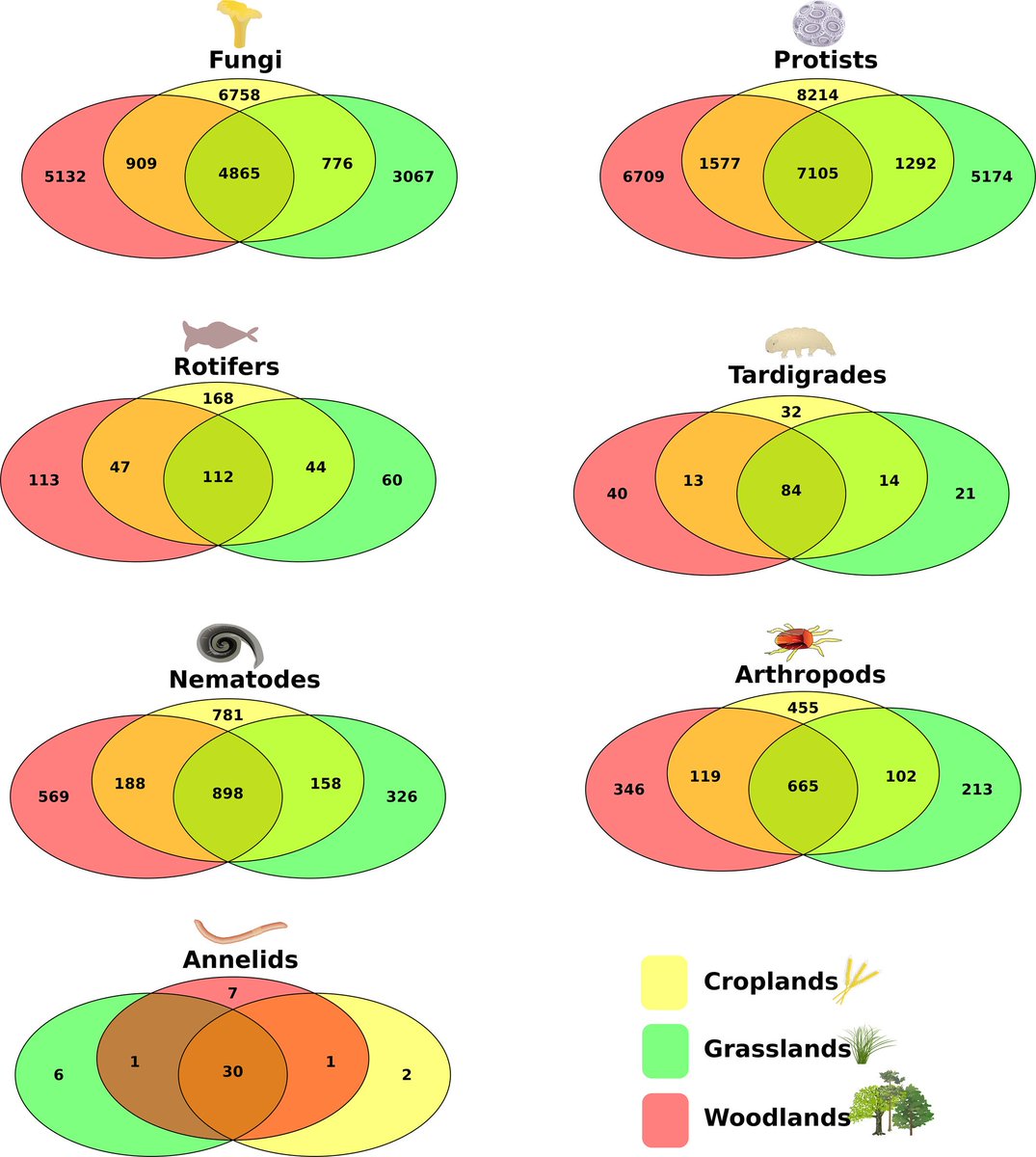
Research finds across Europe: "HIGHER diversity of fungi, protists, nematodes, arthropods, and annelids was observed in croplands than in less intensively managed systems"
https://t.co/g9mQ9SiVFU
Good thread against the view that 1) leaving nature alone maximises biodiversity (as opposed to managing/engineering nature), and 2) that more biodiversity is generally more valuable/useful than less biodiversity (as opposed to particular species configurations).
These results go against the "higher biodiversity is better because that's what nature has" theory.
"We found the LOWEST bacterial and fungal diversity in less-disturbed environments (woodlands) compared to grasslands and highly-disturbed environments (croplands)." 🤔
Interesting study: Cover cropping is often seen as a climate solution for agriculture, but if it reduces crop productivity (as some research suggests it might), that could negate much of the climate benefit by increasing farmland expansion elsewhere: https://t.co/rLK9wdejlo
Das zentrale Kapitel 6 des Buches über die (zahlreichen und erfolglosen) Versuche, Wert in Biodiversität zu finden, ist frei zugänglich: https://t.co/IuxkfOZn7i
Maiers Kernaussage ist, dass die gemeinhin vorgebrachten und weit verbreiteten Theorien und Argumente über den Wert der (Erhaltung der) biologischen Vielfalt zutiefst fehlerhaft sind.
Was ist eigentlich so gut an der biologischen Vielfalt? Nicht viel, wie ein hervorragendes, aber wenig beachtetes Buch von Donald S. Maier aus dem Jahr 2012 zeigt. https://t.co/lVenRJr7dw
Nachdem ich Maiers hervorragendes Buch gelesen habe, werde ich mich vorsehen, über Biodiversität so zu denken und zu sprechen, als wäre sie von besonderem Wert (was sie nicht ist).
Was ist eigentlich so gut an der biologischen Vielfalt? Nicht viel, wie ein hervorragendes, aber wenig beachtetes Buch von Donald S. Maier aus dem Jahr 2012 zeigt. https://t.co/lVenRJr7dw
9/ Not only are they going back to the future, but they also claim doing so is carbon neutral (spoiler alert: it isn’t, not even close). Nearly 40% of Europe’s so-called renewable energy is currently obtained by combusting wood, much of it coming from forests in the US.