A 1976 postcard featuring the Southern/Confederate-themed Bicentennial livery on Overseas National Airways DC-8-21 N1976P
The now-defunct U.S. supplemental charter carrier flew this as the companion to its Northern/Yankee-themed livery on its sister ship.
𝐶𝑈𝑅𝑅𝐴𝐻𝐸𝐸!
Camp Toccoa, Georgia
Training ground of the 506th Parachute Infantry Regiment, attached to the 101st Airborne Division—and many others—in the buildup to the Normandy Invasion, June 6, 1944.
#America250
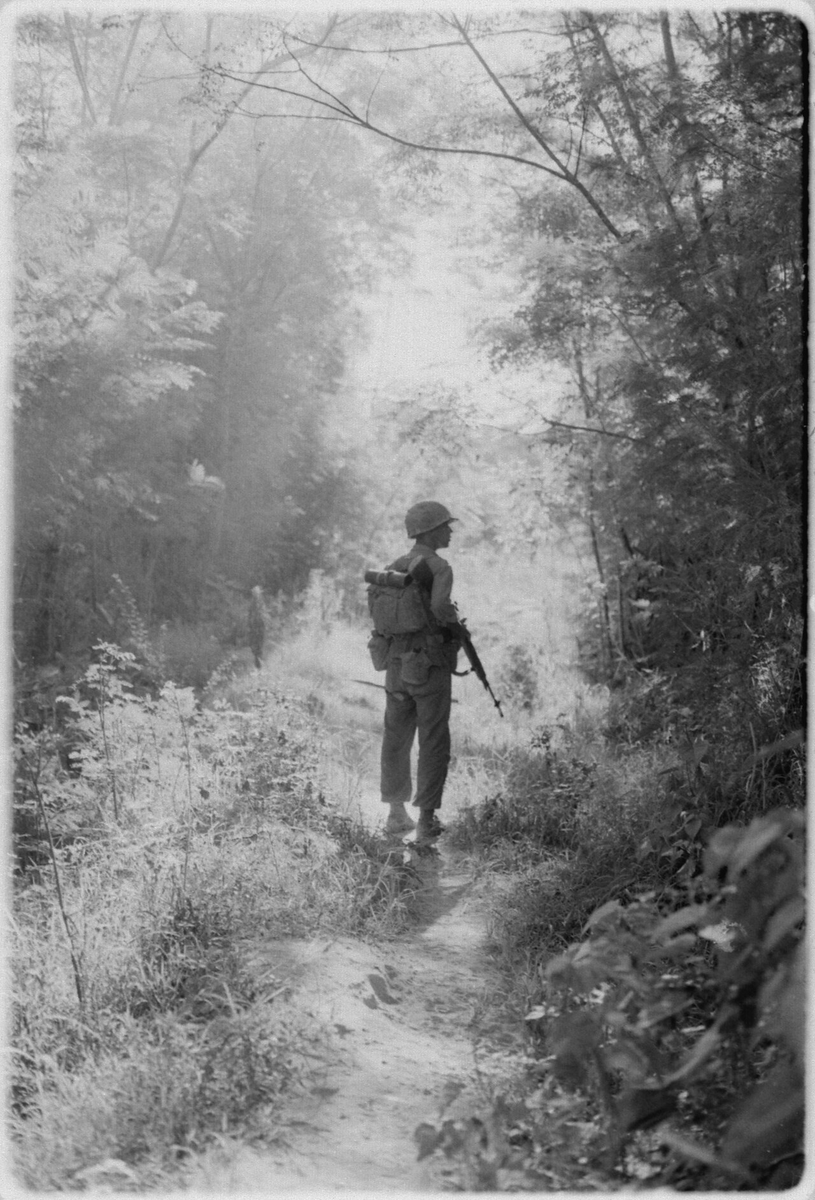
US Marine of Company H, 2nd Battalion, 4th Regiment walks through a punji-staked gully. January 28, 1966.
Punji stake booby traps were made out of wood or bamboo, and placed in the ground to injure soldiers on patrol.
The American right should be making a much bigger deal about America 250. Our ancestors did it and we are their living heirs. It is our time and the left subconsciously knows it. We should claim it and make it ours.
The strain of battle for Dong Xoai is shown on the face of U.S. Army Sgt. Philip Rush Fink, an advisor to the 52nd Vietnamese Ranger battalion, shown June 12, 1965.
The unit bore the brunt of recapturing the jungle outpost from the Viet Cong.
On the cold morning of January 17, 1781, at a South Carolina cattle pasture called the Cowpens, Brigadier General Daniel Morgan delivered one of the most brilliant tactical victories of the American Revolution.
Pursued by the aggressive British Lt. Col. Banastre Tarleton and his 1,100 man force of Redcoats, Loyalists, and dragoons, Morgan with roughly 1,000 Continentals and militia chose his ground. He deployed his men in three deliberate lines: sharpshooting militia up front to fire and fall back, a second line to absorb the British charge and veteran Continentals in reserve. Cavalry under Lt. Col. William Washington waited hidden on the flanks.
As Tarleton launched his signature headlong assault the American militia executed a textbook feigned retreat. The British, believing victory was in their hands rushed forward only to be met by devastating fire from the Continentals at close range. Then Washington’s cavalry slammed into their flank while fresh militia reformed and struck the other side. The British line collapsed in confusion. In less than an hour Tarleton’s command was shattered with over 800 men killed, wounded, or captured, along with two cannons and precious supplies lost. Tarleton himself barely escaped with a small remnant.
The result of the Battle of Cowpens crippled Cornwallis’s southern campaign, boosted Patriot morale after years of setbacks and helped set the stage for ultimate victory at Yorktown.
More about California Confederates
The Biderman Flag
Do we have anyone in California willing to retrieve this flag?
On July 4, 1861, at Sacramento, California, Major George Phineas Gillis decided to celebrate not only America’s independence from Britain, but also that of the South from the North.
At about 10 p.m., after an exhibition of fireworks, he unfurled a Confederate flag that had been wrapped around his walking stick, and marched up the boardwalk before the St. George Hotel at the corner of 4th and J Streets; most of those present appeared to be Southern sympathizers, pleased with the display of the flag.
Not all those viewing this scene approved of it, however: J. W. Biderman and Curtis Clark watched with anger. After Major Gillis had demonstrated his feelings, Biderman and Clark followed him; Biderman approached Gillis, caught him by the throat with his left hand, and, with his right, tore the flag from the stick, and put it in his pocket.
The account of the incident in the Sacramento Daily Union did not reveal the relative sizes or ages of the two antagonists; the Major was apparently a fighter, and called out to the crowd for a knife, but, no one proffering a weapon, Biderman’s assault was successful. He cried out that “no such flag as that could be carried in this town” in his presence, and left the scene, taking the flag with him.
Biderman subsequently brought a large number of friends to the St. George; they waved the flag and invited any “secessionists” to come and take it. No one tried. Major Gillis later “earnestly pled for the flag’s return,” but to no avail.
There seems to be no record of how or when, but the flag became the property of the California State Capitol Museum. The flag is made of silk, and is a variant of the first national flag, the Stars and Bars, of the Confederacy. The difference is, in place of the original seven stars in the canton, there are 17 white 5-pointed stars. Inscribed on the white bar in the middle is “Rebel Flag. Captured 4 July 1861. By Jack Biderman.”
The display at the museum states that this is “the only known Confederate flag captured in California during the Civil War.” It is truly a Californian flag, of unique design. Designated the “Biderman Flag,” it might better be named for Major George Phineas Gills, its owner.
The incident that occurred on the streets of California’s capitol city on July 4, 1861, and the flag that brought it about, are prophetic and symbolic of the secessionist movement in the state: open advocation and defence of the cause, defeat by a more powerful adversary, and all of this forgotten by history with only a battered memento remaining.
-- Laurence Talbott, California in the War for Southern Independence, xi-xii,
𝗧𝗛𝗘 𝗖𝗦𝗦 𝗔𝗟𝗔𝗕𝗔𝗠𝗔'𝗦 𝗛𝗨𝗡𝗧 𝗙𝗢𝗥 𝗨𝗡𝗜𝗢𝗡 𝗦𝗛𝗜𝗣𝗣𝗜𝗡𝗚
On 4 June 1863, the Confederate commerce raider CSS Alabama captured the American merchant vessel Talisman in the Mid-Atlantic.
Under the legendary Captain Raphael Semmes, Alabama roamed the world’s oceans for nearly two years, preying on Union merchant ships and disturbing Northern commerce far from the battlefields of the Civil War.
Alabama’s remarkable cruise included the capture of Talisman and many other credits.
By the time she sank in 1864, the Confederate raider had captured or destroyed over 60 Union vessels, making her one of the most successful commerce raiders in naval history.