1.We were broadly interested in what causes some children with atopic dermatitis (AD) to develop allergic and asthmatic disease (the atopic march) and are exploring potential mechanisms of this progression in a prospective early life cohort of children with AD (MPAACH).
Omitting race from lung function equations increases detection of asthma in Black children
https://t.co/yeo0iX4h2b
https://t.co/SNfuqFMB7i
https://t.co/yuV5xjqS4G
@CincyResearch@GKhuranaHershey@JMBiagini
Our latest research shown that dropping an outdated lung function equation helps detect more Black children with #asthma. Congrats to my co-authors @GKhuranaHershey Daisy Chang
Read our blog post: https://t.co/ZNnEYoD9v6…Read the study
@JAMANetworkOpen https://t.co/iPqNEpDwKe
Open Access: Temporal relationships between Staphylococcus aureus colonization, filaggrin expression, and pediatric atopic dermatitis
First author: Arya Dahal; corresponding author: Gurjit K. Khurana Hershey
Free to read: https://t.co/sA6J7cfGgj
The authors assessed S. aureus skin colonization and atopic #dermatitis (AD) outcomes across two annual visits in the MPAACH cohort. Persistent S. aureus colonization is characterized by increased severity, allergic sensitization, and decreasing never-lesional filaggrin expression. Low never-lesional filaggrin expression positively contributes to future S.aureus colonization. Maintaining filaggrin expression may be therapeutically important to prevent colonization and worse AD outcomes.
Read more articles published in #Allergy on #atopicdermatitis here:
https://t.co/x3WR17mp1M...
#allergy_journal
https://t.co/ujUFSa6yZx
The #Pediatric Asthma Risk Score (PARS), which was developed largely in Caucasian affluent cohorts, was tested in populations more representative of those afflicted with asthma. PARS functioned well when tested with data from a broad range of backgrounds. https://t.co/aehIBne9rr
Congratulations to my colleagues @LJM2344@LizaBMurrison@ButschKovacic on their publication highlighting the Greater Cincinnati Childhood Cohort!https://t.co/DcNfAm00zP
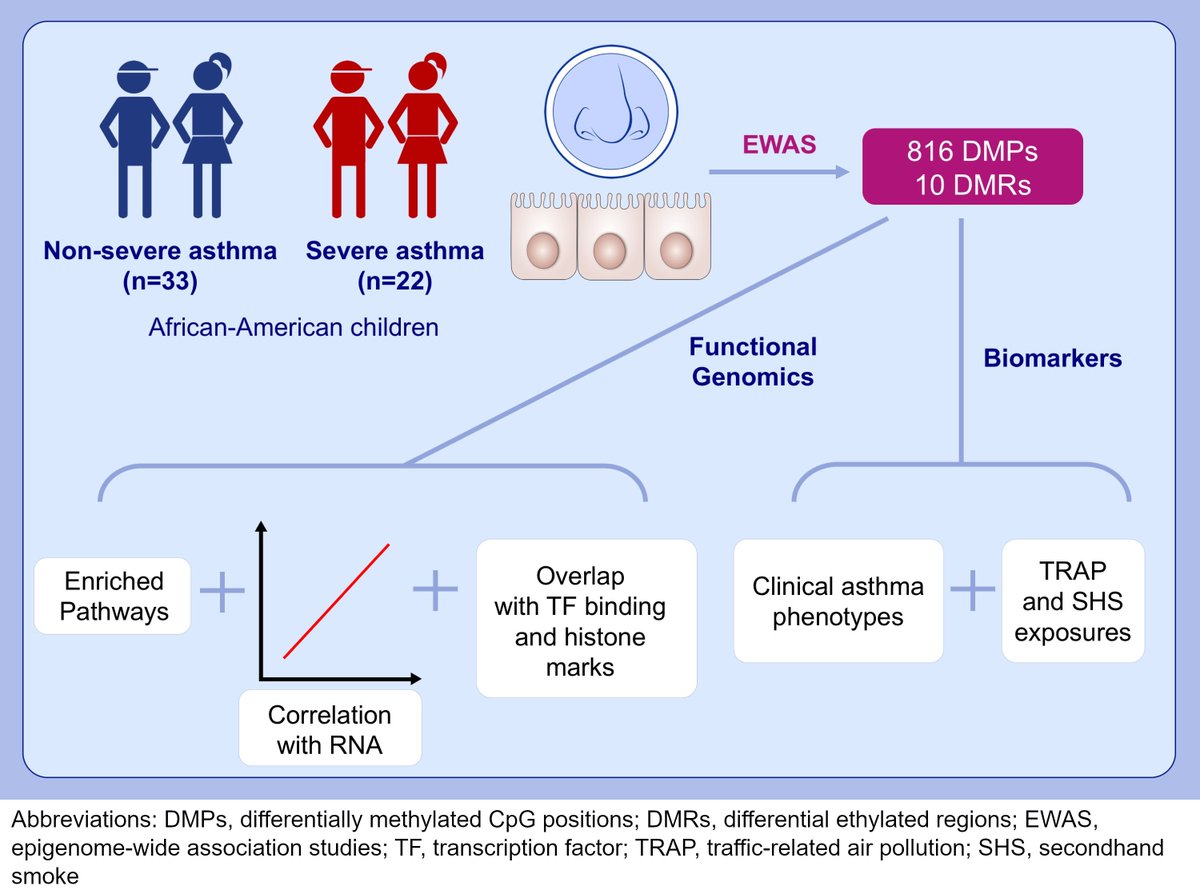
Nasal DNA methylation differentiates severe from nonsevere asthma in African American children https://t.co/DvbiB3BoLg. A continued collaboration with @AsthmaResCincy@JMBiagini@GKhuranaHershey and others to understand the epigenetic regulation of pediatric asthma.
Nasal DNA methylation differentiates severe from nonsevere asthma in African American children; First author: Tao Zhu; Corresponding author: Hong Ji; Download the article here: https://t.co/fI9ydhRRwU
https://t.co/b9CsnEx6pJ
#asthma#epigeneticmodifications
Gene Variants Help Explain Connection Between Skin Disorder and Food Allergy Risk https://t.co/AlmxX8a92P @NatureComms Congrats Drs. Stevens, Khurana Hershey and team @CincyChildrens! #atopicdermatitis#eczema#KIF3A https://t.co/a3dm2VLLoT
Researchers from @CincyChildrens discovered that a variation in the NAT1 gene modifies asthma risk in children exposure to #secondhandsmoke. This genetic variation interacts with SHS exposure to increase the risk of asthma in children. #CincyKidsScience
https://t.co/gd4GB5MuYf
Do aeroallergens sensitize through the skin? Children in MPAACH, the first US-based study of children with eczema, have 4x the rate of positive food and aeroallergen skin tests compared to children without eczema.
Click here to read more⬇️
https://t.co/NQcBs8JUoh
A glowing review! "The #PARS should be considered by all practitioners who treat children to help provide parents with the most accurate risk of #asthma development in their children." #CincyKidsScience
Congratulations @GKhuranaHershey on receiving the highest honor awarded by the University of Cincinnati College of Medicine, the Daniel Drake Medal! We are extremely proud of you.
Pediatric Asthma Risk Score (PARS), a new tool to predict asthma development in young children, shows an 11 percent increase in sensitivity over that of the Asthma Predictive Index. https://t.co/L8MzARXbOc
Our awesome research staff just enrolled the 500th participant into the Mechanisms of Progression of Atopic Dermatitis to Asthma in Children #MPAACH cohort, the first prospective pediatric AD cohort in the United States @CincyChildrens!!