Wenn die Auszahlung von Versicherungsleistungen künftig an die Vermögenssituation angeglichen werden, kommen wir in ein ganz seltsames Fahrwasser. Man kann ja auch argumentieren, dass ein Krankenversicherter, der eine teure OP braucht, diese selbst bezahlen muss, weil er über ein Eigenheim verfügt. Das führt das Prinzip einer Versicherung ad absurdum. Noch krasser wird es, wenn man gezwungen bleibt, die Versicherung zu bezahlen, wohlwissend dass man daraus gar keine Leistung beziehen wird (wegen Vermögen).
Der Mietspiegel 2024 ist da! Die Bestandsmieten steigen moderat, bei den Angebotsmieten zeigt sich ein anderes Bild. Wer eine neue Wohnung sucht, wird stellenweise mit sehr hohen Mietforderungen konfrontiert. https://t.co/ymbWzr4wkH
La taxe sur les petits colis chinois est un échec. Surprise totale. Les colis transitent désormais par la Belgique avant d'arriver en France, les emplois logistiques français ont disparu, et le consommateur paye pareil. Bercy découvre la deuxième loi de la thermodynamique appliquée à l'économie : un système contraint trouve toujours sa fuite.
Cette histoire est minuscule, mais elle est l'incarnation parfaite du problème français. À chaque fois que l'État touche à l'économie, ça finit dans le mur. À chaque fois. Sans exception. Pas par malchance. Par construction.
L'économie n'est pas un tableau Excel. C'est un système vivant de plusieurs milliards d'agents qui prennent des décisions chaque seconde en fonction de leurs contraintes locales. Quand vous taxez les colis chinois, vous ne créez pas magiquement des emplois français. Vous créez une perturbation que le système contourne en quelques semaines, en passant par la Belgique, par les Pays-Bas, par le Luxembourg, ou par n'importe quel point d'entrée moins taxé.
Le marché est un objet mouvant. Il a une intelligence distribuée que personne, absolument personne, ne peut surpasser depuis un bureau ministériel. Friedrich Hayek a obtenu le Nobel pour avoir formalisé exactement ce point en 1974. Cinquante ans plus tard, nos hauts fonctionnaires en sont encore à découvrir empiriquement ce qu'il avait démontré théoriquement.
Le seul mécanisme connu pour coordonner des milliards de décisions économiques simultanément, c'est le système des prix dans un cadre de libre-échange. Les prix transmettent en temps réel l'information sur la rareté, la demande, la qualité, le risque. Aucun ordinateur, aucun algorithme, aucun comité de planification ne peut répliquer cette densité informationnelle. Ce n'est pas une opinion idéologique. C'est un théorème.
Quand un fonctionnaire de Bercy décide de taxer les colis pour "protéger l'emploi français", il imagine un effet de premier ordre. Les colis deviennent plus chers. Donc moins de colis. Donc plus d'emplois locaux. Cause et effet, ligne droite, dossier bouclé.
Mais l'économie ne fonctionne jamais en effets de premier ordre. Elle fonctionne en cascades. Effet d'ordre 2 : les distributeurs réorientent leurs flux. Effet d'ordre 3 : les hubs logistiques s'installent en Belgique, et les emplois français disparaissent. Effet d'ordre 4 : la TVA française n'est plus collectée. Effet d'ordre 5 : les consommateurs payent quand même, donc leur pouvoir d'achat baisse. Effet d'ordre 6 : ils consomment moins ailleurs, ce qui détruit des emplois dans d'autres secteurs. Le bilan net de la mesure est négatif sur tous les indicateurs qu'elle prétendait améliorer.
Aucun fonctionnaire au monde n'a la capacité cognitive de prévoir une cascade à six ordres dans un système de cette complexité. Ce n'est pas une question d'intelligence individuelle. C'est une limite structurelle de l'intelligence centralisée face à la complexité distribuée. Les meilleurs économistes mondiaux ne le peuvent pas. Aucun haut fonctionnaire de Bercy ne le peut, peu importe le diplôme.
Donc soit ils sont insanes, soit ils sont déconnectés des réalités. Dans les deux cas, ils n'ont rien à faire à la barre.
La conclusion est simple. Chaque fois qu'un politique annonce qu'il va "protéger" un secteur, "soutenir" une industrie, "réguler" un marché, "encadrer" une pratique, vous pouvez prendre les paris à 100 contre 1 que le résultat sera l'inverse de l'objectif annoncé. C'est la régularité empirique la plus solide de l'économie politique française des cinquante dernières années.
Le marché se régule. Il a toujours su le faire. Ce qui ne se régule jamais, c'est la prétention des bureaucrates à savoir mieux que des centaines de millions de consommateurs et de producteurs ce qui est bon pour eux.
Le seul mode opératoire qui marche, c'est le suivant. L'État garantit le contrat, la propriété, la sécurité physique. Et il sort. Tout le reste est entre les mains de ceux qui ont leur peau en jeu, c'est-à-dire les entrepreneurs, les producteurs, les consommateurs.
Tout le reste, c'est de la planification soviétique en habit Saint Laurent. Et la planification soviétique a un taux de réussite historique parfait : zéro.
Die Staatsquote in 🇩🇪 soll 2026 sagenhafte 51,3% erreichen: selbst im Coronajahr 2020 waren es nur 51,5%. Mitte der 2000er – nach Schöders Reformen – war sie nur 45%: 6% oder 268 Mrd Euro weniger. Trotz Aufrüstung: die Quote ist zu hoch & zusätzliche #Steuern#zementieren sie.
@Karl_Lauterbach 2025 wird die Staatsquote 50 Prozent überschreiten. Eine Debatte darüber ist deshalb dringend erforderlich. Rüstungsausgaben spielen eine wichtige Rolle, aber was fehlt ist eine Senkung anderer Ausgaben.
Eine Mrd. Kosten. Um nach 8 Jahren eine modernisierte Nutzfläche von 5.100 qm. zu erhalten. Fast 200.000 Euro/qm. Ich vermute mal, es wird sehr hübsch werden.
Die Ausgaben des Staates laufen aus dem Ruder – hauptsächlich die Ausgaben der Regierung für sich selbst: Der Bundespräsident beansprucht für die Sanierung seines Amtssitzes mehr als eine Milliarde Euro. Das ist vollkommen verrückt.
https://t.co/g6FHsl7QBS
"Wir wollen nicht enteignen"
Wir wollen dich nur deiner Eigentumsrechte berauben und Dir so viele Pflichten auferlegen, dass Du Dir wünschen wirst, wir hätten Dich enteignet
Berliner SPD will Mieten und Gewinne von Vermietern deckeln https://t.co/jL3P4pl6E9
Argentinien schrumpft unter Milei massiv den Staat und schafft signifikantes Wirtschaftswachstum.
Schweden hat allein mit der Abschaffung der Erbschaftsteuer für mehr Investitionen und Wirtschaftswachstum gesorgt.
Deutschland hingegen bläht bei einer Staatsquote von über 50 % mit Rekordsteuereinnahmen und Rekordneuverschuldung den ineffizienten Staat weiter auf. Linke fordern täglich neue Steuern.
Der Staat muss endlich auch in Deutschland drastisch auf seine Kernaufgaben reduziert werden. Auch die zahlreichen teuren Regulierungen (z. B. Berichtspflichten) gehören drastisch reduziert. ¡Afuera!
Für mehr Privatvermögen, mehr Wohlstand und Wirtschaftswachstum. 25 % Staatsquote reicht völlig. Gerne langfristig weniger. Der Staat ist nicht die Lösung, er ist in zu vielen Bereichen des täglichen Lebens das Problem!
Ich frage mich, warum wir uns jetzt angesichts der tiefgreifenden Wirtschaftskrise mit Vorschlägen zur Erbschaftssteuerreform und zu billigen regionalen Warenkörben beschäftigen müssen?
Das ist das eigentlich Verstörende.
Who Will Build NYC if Builders Are the Enemy?
As a New Yorker Jew, I'm surrounded by people who have been in real estate their entire lives. I am not trying to feed a stereotype, but that's my reality. They aren't activists or online commentators. They are people who bought their first buildings with all their savings, carried debt through rate hikes, fixed things themselves when there was no money to hire, and stayed in New York through high crime, recessions, 2008, COVID, rising taxes, insurance increases, and an ever-expanding book of laws and codes. None of them were promised fairness before they started, and none of them were protected from risk. They succeeded very slowly, and painfully, but with responsibly.
That experience is exactly what is missing from the worldview of Zohran Mamdani, and it shows in every part of his housing agenda. Mamdani has never built anything. He never signed a personal guarantee, never met payroll, never carried a mortgage through a rough month, never had to choose between fixing a boiler now or hoping it survives another winter because there is no cash. He has only operated in a political world where consequences are abstract and other people absorb the risk. When you have never operated in the real economy, it becomes easy to believe that shortcuts are solutions.
It is also why his message resonates with a certain type of voter. The people demanding “housing reforms” are not bad people. They are frustrated renters who feel like the system is rigged against them. I understand the frustration. But frustration doesn't change math. Housing is hard. Ownership is a very slow process. Building anything meaningful in this city takes years of stress, and debt. The people calling for "landlord policies" often want the outcome without the grind, the stability without the risk, and the reward without the years of sweating that every responsible adult who succeeded here had to endure. But it does not work like that.
NYC is in housing crisis. Citywide vacancy sits around 1.4 percent, a level economists consider an emergency. Median rents keep rising anyway, with Manhattan near $4,800 and Brooklyn around $3,800, even under an already thick layer of regulation. The reason is obvious. Supply has not kept up. In a good year, New York adds roughly 30,000 units. The city needs hundreds of thousands more over the next decade just to stabilize prices. At the same time, construction costs here are among the highest in the country, financing is extremely difficult, and insurance is wildly expensive
Mamdani’s proposals take that fragile situation and make it worse. When you cap upside while leaving downside unlimited, rational people stop participating. Developers do not argue on X. Lenders do not protest. They simply reallocate. Projects stop coming up. Renovations are postponed. New construction dies before a shovel hits the ground. The people I know in real estate are not angry. They are disengaging. Some are buying elsewhere. Some are sitting on cash. Some are done entirely. And when that happens, tenants do not win. Buildings deteriorate, supply tightens further, and rents rise anyway.
What Mamdani offers is emotional satisfaction, not solutions. He tells voters that prices are high because someone else is greedy, not because the city has spent decades making housing harder and almost impossible to build. He frames landlords as villains instead of participants in an ecosystem that only works when incentives align. That framing feels good, but it does not produce housing. It produces resentment, fear, and withdrawal.
Everyone I know who made it in this city did it the same way. Slowly, without shortcuts. Policies written by people who never did that do not create fairness or affordability. They create shortages. NYC doesn't have a landlord problem. It has a confidence problem. And a city that teaches people to hate the builders while demanding more building is a city sabotaging its own future.
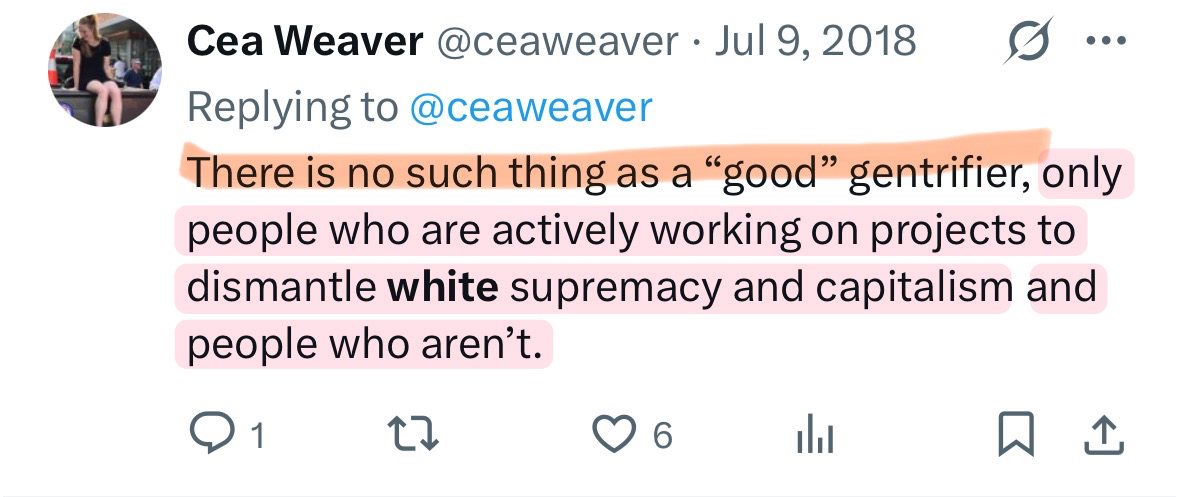
A few months ago, I dug into Cea Weaver's Twitter history because she was Mamdani's housing advisor.
I had a hunch she might get a position on his team.
Well, she did, and she deleted her X account, accordingly.
However, I took some screenshots. Let's dig in.
Besteuerung der privaten Altersvorsorge zur Finanzierung der gesetzlichen Altersvorsorge. 🤡
Das ist keine ergebnisoffene Analyse zur Rentenreform, sondern eine geisteskranke. DOA
Der “Kompromiss”, der den Jungen Abgeordneten aufgenötigt werden soll, ist mit Blick auf die “Einbeziehung anderer Einkunftsarten” verstörend. Mit Sozialabgaben auf Kapitalerträge könnte Friedrich Merz das nächste habecksche Wahlversprechen einlösen. Warum dieser Vorschlag nichts taugt, habe ich schon damals erläutert.
Und eines gilt weiterhin: Dummheit ist keine Gerechtigkeit. WK
Nur damit das jeder versteht: An #Sozialwohnungen ist außer dem Namen wirklich nichts "sozial".
1. Eine "Sozialwohnung" kostet die Gemeinschaft ca. 200.000€. Die Familie, die einzieht, muss nur in diesem Moment "bedürftig" sein und wohnt dann bis zum Tod aller billigst. 1/4
Der #Wohnungsbauturbo der aktuellen Bundesregierung besteht bisher aus der Verlängerung der #Mietpreisbremse und einer Kommission für die #Bestrafung von Vermietern.
Das ist keine Politik. Das ist #Satire.
https://t.co/Qk6sxThute