It’s with a heavy heart I’ve finally decided to write this post.
A few days have passed since the horrific crash of the UPS MD11, and I’ve been following the news around this tragedy closely, ever since the first text messages appeared on my phone from fellow cargo pilots, minutes after it happened.
Aviation, and the cargo pilot world in particular, is a very small world where social structures are closely bound.
It echoes like a ripple through the community of fellow freight dogs... all of us individuals who share not only the same routes, hotels and occasional bar, but also know the same solitary lifestyle of being on the road for days or weeks on end, continents away from home and family.
Flying through violent storms or the darkest nights, knowing you’re the only two or three conscious beings for thousands of miles around.
A lifestyle that suits few, but is deeply rewarding in its own right for those who manage to appreciate it.
I was glad to see my own friends flying for UPS are OK, but I feel deeply for the tragedy that befalls the relatives of the people on the ground and the crew who perished.
Hearing the news, the shock, the uncertainty about their loved ones who might not be able to answer their phone inflight... an absolute nightmare for all of those involved.
Without going into deep speculation, it seems obvious the aircraft experienced a catastrophic engine separation just after V1 speed. No possibility to stop the aircraft anymore: they had to continue.
And engine number 2 failed just during rotation, quite possibly due to ingestion of debris from the fiercely burning wing, sealing their fate.
I can’t help thinking what I would or could have done in such a scenario. My only conclusion is: nothing at all.
A typical black swan event; an extremely rare, unpredictable occurrence with massive impact.
This is a part of aviation all pilots know, but would rather not post about.
Then again, besides sharing the beauty of flight, this is also a darker part of being a professional pilot.
Out of respect for the crew and their families, I hesitated to post this, but I feel it's important to acknowledge the difficult realities of our profession too.
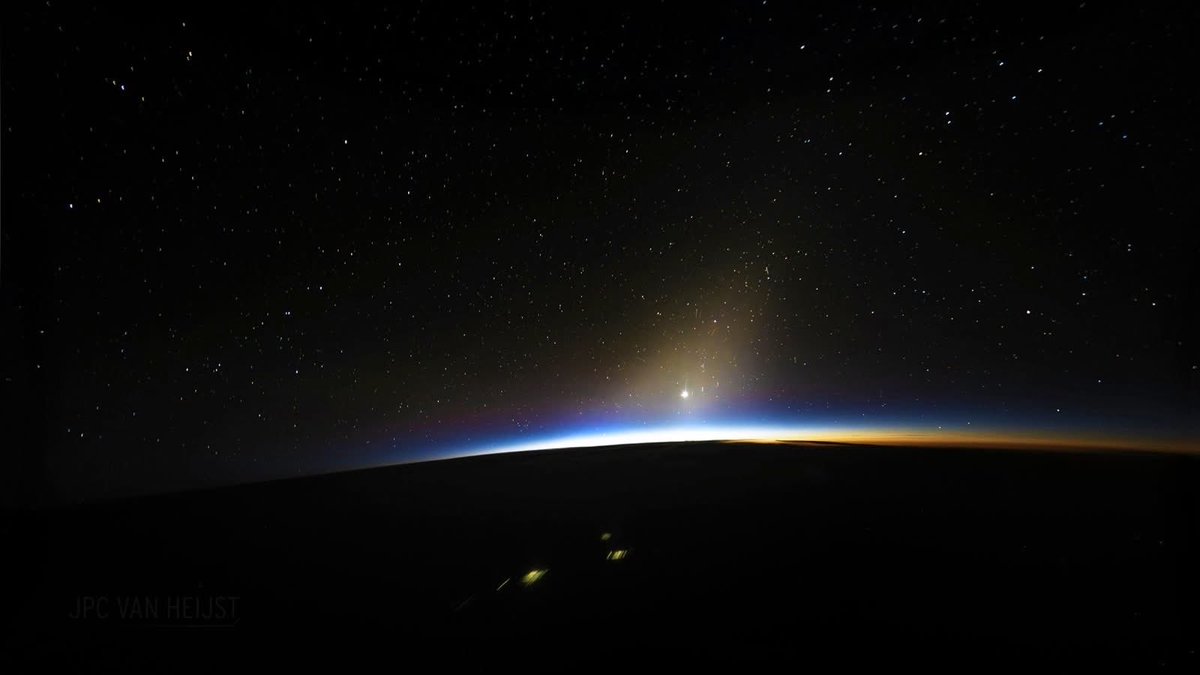
First Light.
It started with a faint glow: the Zodiacal Light: sunlight reflected off a trillion tiny dust particles in the solar system, likely originating from the dusty sandstorms of Mars that left it's atmosphere in the timespan of many millions of years.
To complement the vision of our celestial neighbourhood, planet Venus shines brightly ahead, reflecting solar rays from her cloudy atmosphere, over a thirty millions of miles away.
Far beyond our own planetary system, literally of stars glow in a wide variety of colours and intensities, as the first signs of a new dawn slowly appear on the eastern horizon.
And with clear skies and enough contrast ahead, one can even make out the distinct curvature of the horizon at 37,000 feet, visible as long as the windows offer a wide enough perspective.
Even though my Boeing 747 travels around one-third of the planet tonight, it’s next to nothing compared to the distances across space and time that unfold beyond my cockpit.
No navigation screen or weather radar onboard reaches far enough to show me what’s really out there, except my own imagination and sense of wonder.
Who knows what lies beyond.
The stars are waiting.
Per aspera ad astra.
Approximately 10,000 kg (22,000 lbs) of kerosene jet fuel are consumed per hour by the Boeing 747-400 during cruise flight, with variations depending on weight and altitude.
While that’s a significant amount of fuel, when you consider the massive payload we transport across the globe, nearly at the speed of sound, air freight remains one of the most efficient and cost-effective methods of transportation.
And besides, those contrails aren’t going to make themselves.
🎉 Exciting News! 🎉
I’m thrilled to announce the launch of my new book, “Skybound – A 747 Pilot’s Journey”! ✈️
Dive into the skies with over 67 short stories that capture the essence of aviation and my personal journey as a 747 pilot. This hardcover treasure includes never-before-published captions and stunning images that bring each story to life.
Choose from two editions: the normal edition or the Exclusive Limited Edition, with only 747 hand-signed copies available. Each Limited Edition features 16 additional pages of breathtaking photos, a luxurious silver-lined cover, and a personally signed Certificate of Authenticity—making it a perfect collector’s item for aviation enthusiasts.
Join me on this unforgettable journey and elevate your bookshelf!
#Skybound #Aviation #747Pilot #BookLaunch #LimitedEdition #AviationPhotography #Bookstagram #PilotLife #book
@arkhipov_calm Yeah I eventually found out its a fleet of Chinese fishing vessels fishing for saury / mackerel. Typically seen in the north Pacific between August and November 🚢
@rgault20033 @disclosureteam_ @ChrisUKSharp Yes my question as well. And has he been in contact with Garry Nolan as he’s clearly encountered mental changes.
Skimming the upper reaches of the atmosphere above the ancient oases of northern Saudi Arabia, the view is unparalleled. Thousands of massive dried-up riverbeds and streams stretch across the landscape as far as the eye can see.
Being one of the driest regions of the world, this stark contrast is truly fascinating, and I find myself pondering the history of this place. How long ago did these rivers form, flow, and shape the landscape? I was instantly interested.
Once home, a deep dive into history revealed that this region was once a fertile, thriving paradise. However, a rapid climate change event roughly at the end of the Neolithic Stone Age (estimated 6,000 years ago), forced a flourishing civilisation to migrate across the Middle East. I guess that'll teach them for using plastic straws and not paying enough green-deal taxes.
Regardless, this lost civilisation left behind a wealth of intriguing artefacts, such as the Rajajil Columns—often referred to as the 'Stonehenge of Saudi Arabia,' dating to around 4000 BCE. Additionally, stone axes and other tools, dating between 300,000 and 1.3 million years old, have been found on the Arabian Peninsula, indicating that early human migrations from Africa passed through this region since ancient times.
Looking over this arid and inhospitable landscape today from 40,000 feet, I once again come to the conclusion that the world must have been unimaginably and totally different a few thousand years ago and we have barely scratched the surface of our own history.
Feeling privileged once again, to be sitting in an air travel time machine with a camera at hand.
-
#saudi #saudiarabia #arabia #landscape #landscapephotography #landscapelovers #wadi #desert #desertlandscape #atmosphere #earth #planet #planetearth #flying #aerial #aerialview #space #sky #skyporn @nikoneurope@nikonnl
I’ve been asked by some about the possible cause of the recent ATR 72 crash near Campinas, Brazil. Videos show the aircraft in a nearly flat spin, descending vertically before hitting the ground.
While we must wait for the final investigation report, preliminary data suggests that the airplane encountered significant icing during its descent, which could have led to a loss of control. The ATR 72 is known to be very susceptible to icing conditions, which might be a clue to what happened here.
So, what is 'icing'? It is a phenomenon where undercooled or freezing water droplets in clouds turn into ice when they come into contact with an object, such as an airplane. Depending on temperature, ice accumulation on the airframe—primarily the wings, engine inlets, propellers, nose, and cockpit windows—can become severe enough to pose a danger. In this case, the weather forecast warned of severe icing conditions between 12,000 ft and 21,000 ft, exactly where the ATR was flying.
Turboprops like the ATR (and the F50 that I used to fly) are more exposed to icing compared to jets since they fly slower and lower, often spending prolonged periods 'in the weather'. Fortunately, airplanes are equipped with anti- or de-icing equipment to remove ice before it becomes too much. This includes heated propellers, engine inlets, and cockpit windows, as well as inflatable 'boots' on the leading edges of the wings to shed ice layers. These systems are effective against moderate icing, but if ice accumulates too quickly or becomes too thick, even these measures can be overwhelmed. In such cases, the added weight of the ice and the altered shape of the wings can lead to a loss of lift and control.
We will have to wait for the final report to determine what actually happened, but it appears that icing played a significant role in this tragic event.
-
Photo 1 & 3: Icing on cockpit window after flying through a cloud.
Photo 2: Light rime ice on the leading edge of an F50 wing.
Nice to see the @DailyMailUK posted a new article about my photography!
-
The Earth as you've never seen it before - from a jumbo jet cockpit
https://t.co/zimL2wbGQG
UAP history being made in @EUParl_EN by @FGuerreiroMEP. Great and necessary questions regarding UAP & the @EU_commission Space Law Initiative. Thank you Francisco & team. More to come in the near future. #uaptwitter#uapX#ufox#ufotwitter
Today is the 45th Anniv of the Soesterberg Airbase incident. Dutch National TV made an item about it and also another sighting in the town of Gorredijk. Our Ambassador @JPCvanHeijst weighs in on flight safety. Thanks Bram Roza & @tasmedes for keeping history alive. #ufoX#uapX
And just like that, the flying year of 2023 came to an end again. Time seems to pass by faster and faster, the older I get.
A turbulent year for me personally, but also for the world at large it seems... a year with so much hardship and senseless suffering. At times it feels like we're fighting a spiritual uphill battle with little reason for optimism.
However, I refuse to succumb to nihilism. I am categorically convinced of the absolute beauty of existence and life itself, serving as a source of creativity and a driving force to share the beauty I encounter on each and every flight.
Another highlight of this year was the ECHO event in Paris this past November. During the event, I presented my own UAP (Unidentified Anomalous Phenomena) sightings as a commercial pilot and expressed my concerns about flight safety regarding this topic. Meeting some of the most influential people in the field and forged friendships with great people.
Anyway, it's time for the yearly statistics again, so let's go.
Total flying hours: 330:30 (not counting the hundreds of hours as a passenger on duty)
B747-400: 329:25 hours
SEP (Single Engine Piston): 1:05
Landings: 61
Autolands (landings done by autopilot): 0
Go-arounds: 0
Diversions: 0
Bird Strikes: 0
Lightning strikes: 0
Books read: 22,5
UFOs / UAP: not sure, honestly. I've witnessed some very strange and weirdly behaving lights on multiple occasions that I have not been able to explain yet, but reluctant to state them as genuinely anomalous
Total distance flown: 203,400 miles / 327,400 km (equivalent to 8x around the world)
New destinations: Phnom Penh, Ningbo, Toronto
Longest flight: 12:05 (Liege – Ningbo)
Shortest flight: 0:25 (Cessna 172, Teuge-Teuge)
Line-check exam, landing in the peak of storm Ciarán in November, with heavy wind gusts up to 45 kts / 85 kmh: always fun and of course Murphy's Law to have that happening during the yearly check-ride.
Wishing all of you Happy Holidays, Merry Christmas and a Happy New Year!
Christiaan