To my X followers,
I’ve worked with the media for nearly 25 years. For most of that time, the relationship was professional and balanced. But in recent years, something has shifted.
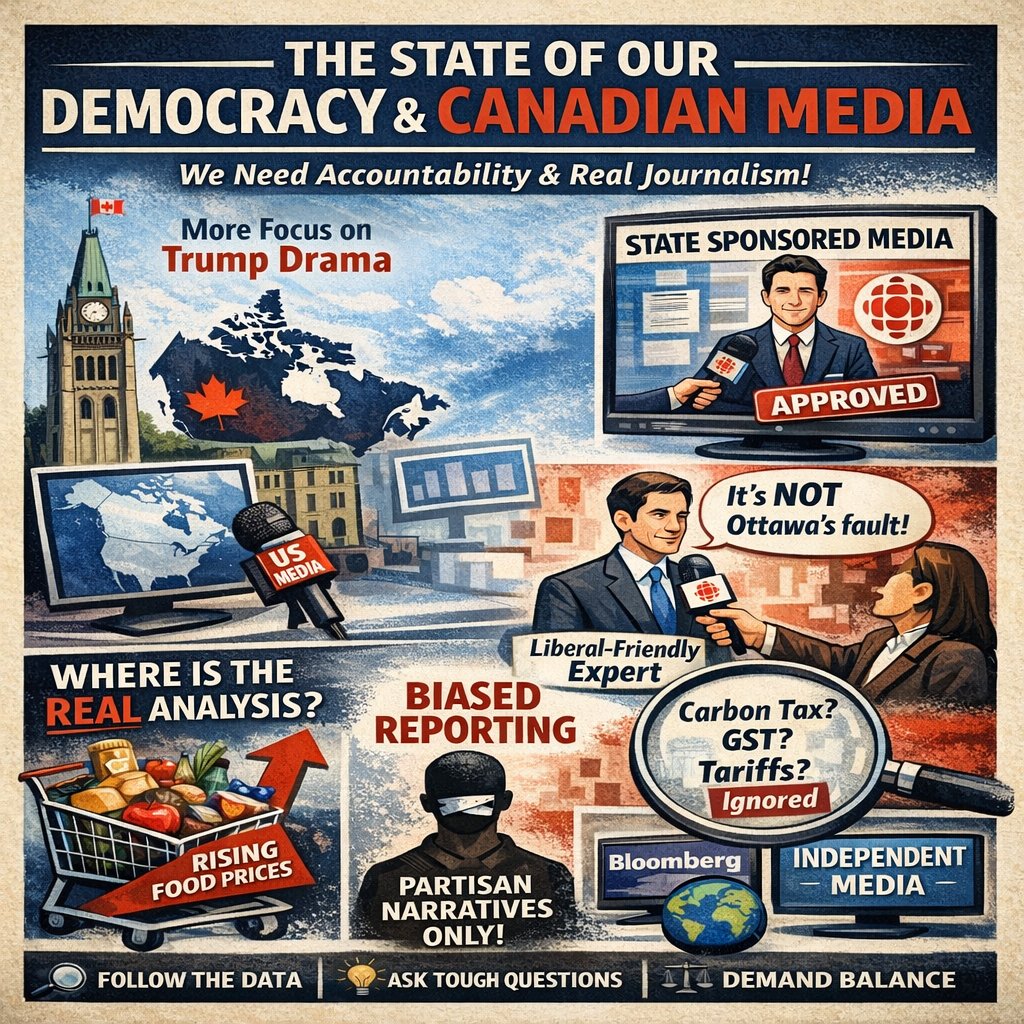
I am increasingly concerned about the state of our democracy — particularly how media, in general, are informing Canadians about food policy, food inflation, and economic policy.
I now find myself learning more about Canada’s economy and policy changes from American outlets than from Canadian ones. Much of our national coverage feels reactive, shallow, or overly fixated on partisan narratives rather than substantive policy analysis.
What troubles me most is the lack of scrutiny applied evenly across governments and institutions.
For example, when the Bank of Canada suggested that Ottawa’s counter-tariffs contributed to food inflation, only one major outlet — Bloomberg — gave it meaningful coverage. The grocery benefit program received very little examination regarding how it would be financed. It took days before anyone pressed for clarity.
During the latest spike in food inflation, several outlets turned to the same small circle of commentators who dismissed any potential role of federal policy — carbon pricing, GST holidays, counter-tariffs — despite mounting evidence that policy decisions can and do affect food prices.
Instead of investigating structural drivers of inflation, much of the coverage focuses on fact-checking opposition rhetoric, even though the opposition has not governed since 2015. Scrutiny should be applied equally — not selectively.
Quebec media, while imperfect, appear to have maintained a broader range of debate. In much of the rest of Canada, I see increasing concentration of voices — often from the same region, Ontario, often reflecting similar policy perspectives — and less diversity of thought grounded in empirical research.
This isn’t about partisan politics. It’s about accountability, transparency, and healthy democratic discourse.
Media are under financial pressure — that’s real. But public trust depends on independence and depth. Subsidy structures, incentives, and newsroom economics all matter.
Canada deserves stronger policy journalism — especially on food affordability, supply chains, and economic resilience.
We need more data-driven analysis, more intellectual diversity, and more courage to ask uncomfortable questions — regardless of which party is in power.
Until that happens, Canadians would be wise to diversify their news sources and think critically about what they’re being told — and what they’re not.
VRB Energy’s Joint Venture in China Completes
Another Successful Battery Storage System
– Hubei Changyang’s Power Station
https://t.co/vFKMOsBi3I
#spartonres#vrb#vrfb
Fascinating paper from Drs. @ChrisPalmerMD and @ZSarnyai about ketogenic therapy being an anti-inflammatory treatment for schizophrenia. It's worth a read!
https://t.co/Bo7fE1QOBp
Second Government Critical Mineral Study Begins at Bell Copper’s Big Sandy Porphyry Copper Project in Arizona
https://t.co/Fk3XREswX5
The Arizona Geological Survey (“AZGS”) research initiative, led by Dr. Carson Richardson, Senior Research Scientist, and Ms. Zoey Plonka, AZGS Research Scientist
Second Government Critical Mineral Study Begins at Bell Copper's Big Sandy Porphyry Copper Project in Arizona, USA - $BCU.V $BCUFF.US | CEOCA Breaking News
https://t.co/mR0Be2avqS
🚨 Jan 2020, the WHO warned about a novel coronavirus from China that led to worldwide mandates & lockdowns.
Here are all the emails from Canada's Cheif Public Health Officer, Teresa Tam, for Jan 2020 obtained under the Access to Information Act:
https://t.co/fzrkCJ5Oll
There are ~2500 pages of emails to go through for that month, so I'm releasing them publicly to crowd source them for information.
I will release more of Tam's emails as I receive them.
Please share this post and any information you find.
PDFs made searchable by @DonaldBestCA
The largest mining companies believe copper is set for a fascinating 12-18 months.
Recently, they shared outlooks at the Deutsche Bank annual copper CEO conference.
Here are your key takeaways:
For four years, my husband, @DavidBaszucki, and I have dedicated resources to advancing metabolic therapies for mental health, like the kind that helped our son, @BaszuckiMatt, recover from a serious illness.
During this time, we worked hard to stay in our lane and remain focused on mental health. I vowed not to dilute our efforts by taking on too much. But sometimes, taking on too much is the only reasonable path. The body and brain are not separate. Americans are facing both a mental and physical health disaster, and we feel compelled to step up to take on this larger challenge.
Today, our family is committing $50M to combat America's broader health crisis. The launch of @metcoalition, the Coalition for Metabolic Health, represents our commitment to reversing the chronic disease burden of America's adults and children. We vow, today, to do our part to make the next generation of Americans the healthiest in history, and we believe this goal is within reach.
We are honored to bring together experts who have been fighting for decades to bring metabolic health to the mainstream. We are in their debt for their tireless efforts, which we are now dedicating ourselves to supporting and amplifying.
Join us in this mission by following CMH on social channels and sharing this announcement. We have nothing if we do not have our health, and we are all in this fight together.
@Metabolic_Mind@BaszuckiGroup@bschermd
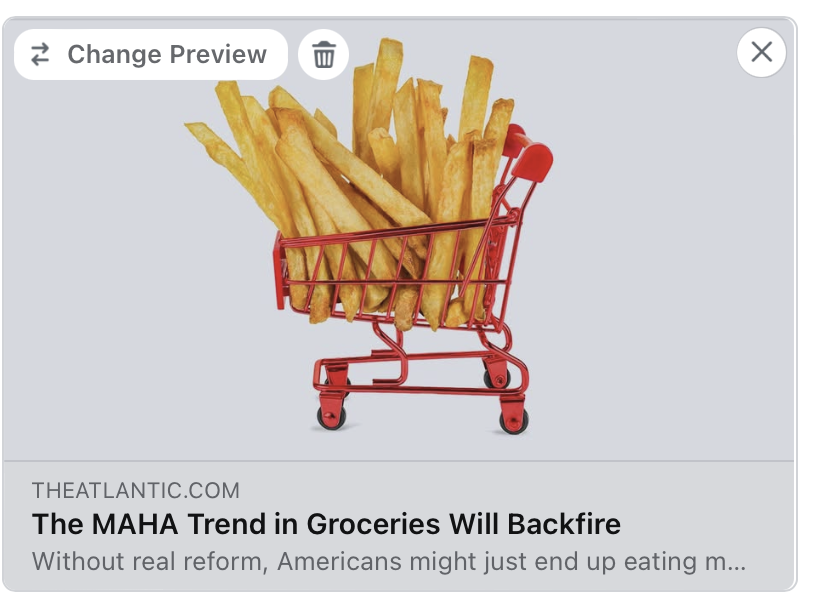
Aren't journalists supposed to do something beyond recite the nutritional status quo? How come they're not more curious about why we are all so sick and fat?
This is from @TheAtlantic: "Seed oils have repeatedly been shown to be not only safe to consume, but healthier than animal-based fats such as butter and beef tallow, which are rich in saturated fat and are linked to higher risk of heart disease."
This line could have been written by any establishment group-- the AHA, USDA, CDC, ADA, ACC, or most other 3-letter agencies. For the past 85 years.
These are the same groups whose advice has led us directly into our epidemics of obesity, diabetes, cancer, fatty liver disease, mental health illnesses, and more. How could it not make sense to wonder about this status quo?
The last decade-plus of science has shown that saturated fats are not the culprit. Some 2 dozen peer-reviewed systematic reviews conclude these fats don't cause heart disease. I've sent the list to many journalists, but they're not curious.
Wake up, journalists. We need you to do more than be echo chambers of the conventional wisdom
I'm grateful to @SecKennedy and this administration for standing up to entrenched interests. He's right that butter and tallow are healthier options than industrial seed oils. He's also right to get sugar/soda out of SNAP.
If journalists dismiss these ideas simply because they're dug into an oppositional stance to this administration, that's not journalism. And if the public then loses trust in the media, that is unfortunately deserved.
We don’t need to find a substitute for meat, be it plant meat or lab meat
Those of you that were suckered into the “it will save the planet” argument have gullibly fallen under the tech bro marketing spell
It’s a solution to a made up problem in order to try and create new markets
Fortunately, plant meat has largely been rejected and the same will happen with any lab “meat” that survives enough to get to the very small niche market of weirdos that think this is a good thing
In 2025 if you still think cow farts are boiling the oceans then you probably are too stupid to understand that you’ve been played
How Over Regulation Destroys Canada: Other Nations Will Surpass Us Through Common Sense
Last week a First Nations announced its unwavering opposition to any mining in Ontario Ring of Fire, a swath of Northern Ontario rich in minerals
Since 2014 Ontario has promised a road
2/
IMPORTANT
My Personal Video Statement
My FIRST personal statement about my 5yr freedom of conscience/speech legal saga with College of Physicians & Surgeons of Ontario (CPSO) re my tweets in 2020 criticizing governments' harmful covid edicts.
Full transcript in link (2) below