Physician by training, a public servant by choice and a democrat by conviction. Founder - @FDR_india, LokSatta movement , @loksatta_party, Surajya movement
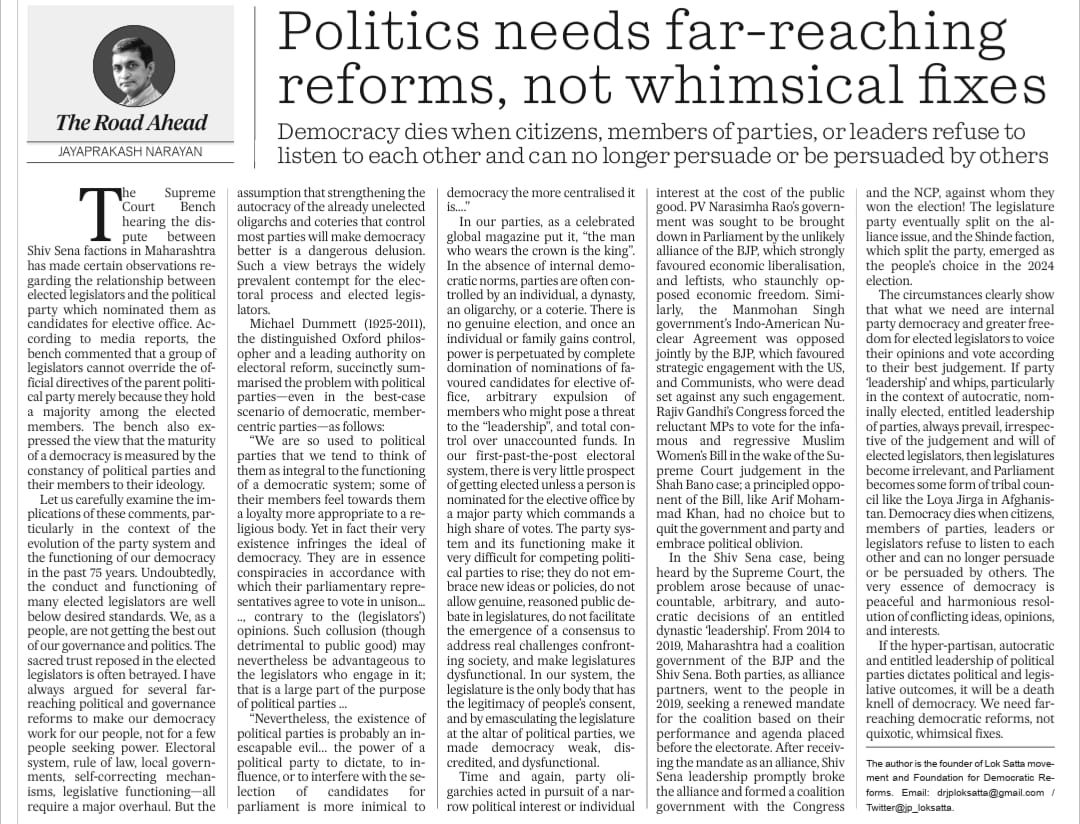
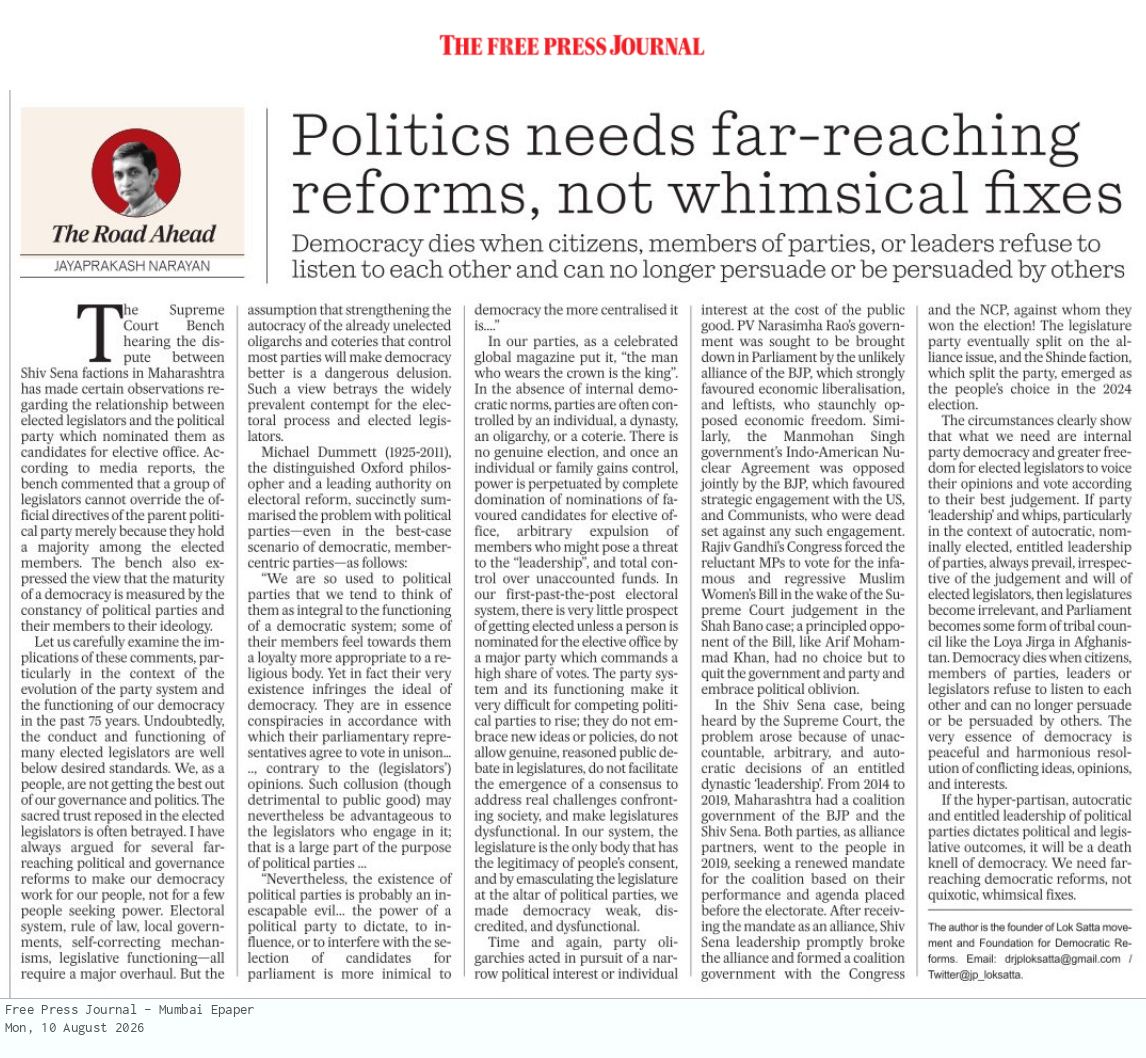
Democratization of political parties is vital for a healthy democracy. If parties become private fiefdoms and family heirlooms, and yet have the power to control the vote and speech of legislators, if party bosses arbitrarily decide who will be candidates for elective office, and members and elected legislaties are mere slaves of party bosses, then democracy becomes perfunctory without substance. If parliamentary debate is irrelevant, and there is no possibility of persuasion by logic and evidence, and members' vote is preordained based on party loyalty irrespective public good, then democracy dies slowly. We need far-reaching political and governance reforms; but preserving the autocracy of party bosses is not the way.
Politics needs far-reaching reforms, not whimsical fixes | 10th August 2026 | The Road Ahead | Free Press Journal
Read the online version here - https://t.co/2eU4KF41QD
Our students and families in all cross sections of society sacrifice a lot in pursuit of good education as a passport to a better future. Governments are spending vast sums; in many states the annual government expenditure on schools is over Rs 100,000 per child! Society values education enormously. And yet educational outcomes and skills levels are appalling! Rote learning without understanding or application of knowledge, and mass copying are the bane of our education stunting our children and marring their future. Poor government monitoring and a terrible examination system are ensuring poor outcomes in all institutions - public or private. Sensible, stress-free, concept-based examinations, regular monitoring of outcomes, skill promotion, and community role in school management are critical. Better buildings, equipment etc are necessary, but the real challenge is focus on outcomes and skills. In most states we have very good teacher-student ratios, and teachers are paid reasonably well, much above the market wages. The real challenge is unrelenting focus on sensible, honest measurement of outcomes. This will empower parents and other stakeholders and incentivize them to push for real learning instead of meaningless certificates, marks and ranks.
Dr @JP_LOKSATTA comments on Examination Reforms Task Force and 2026 Bill after Dharmendra Pradhan Resignation and Youth Protests
#NEETLeak
Full video : https://t.co/hKLVZVClfM
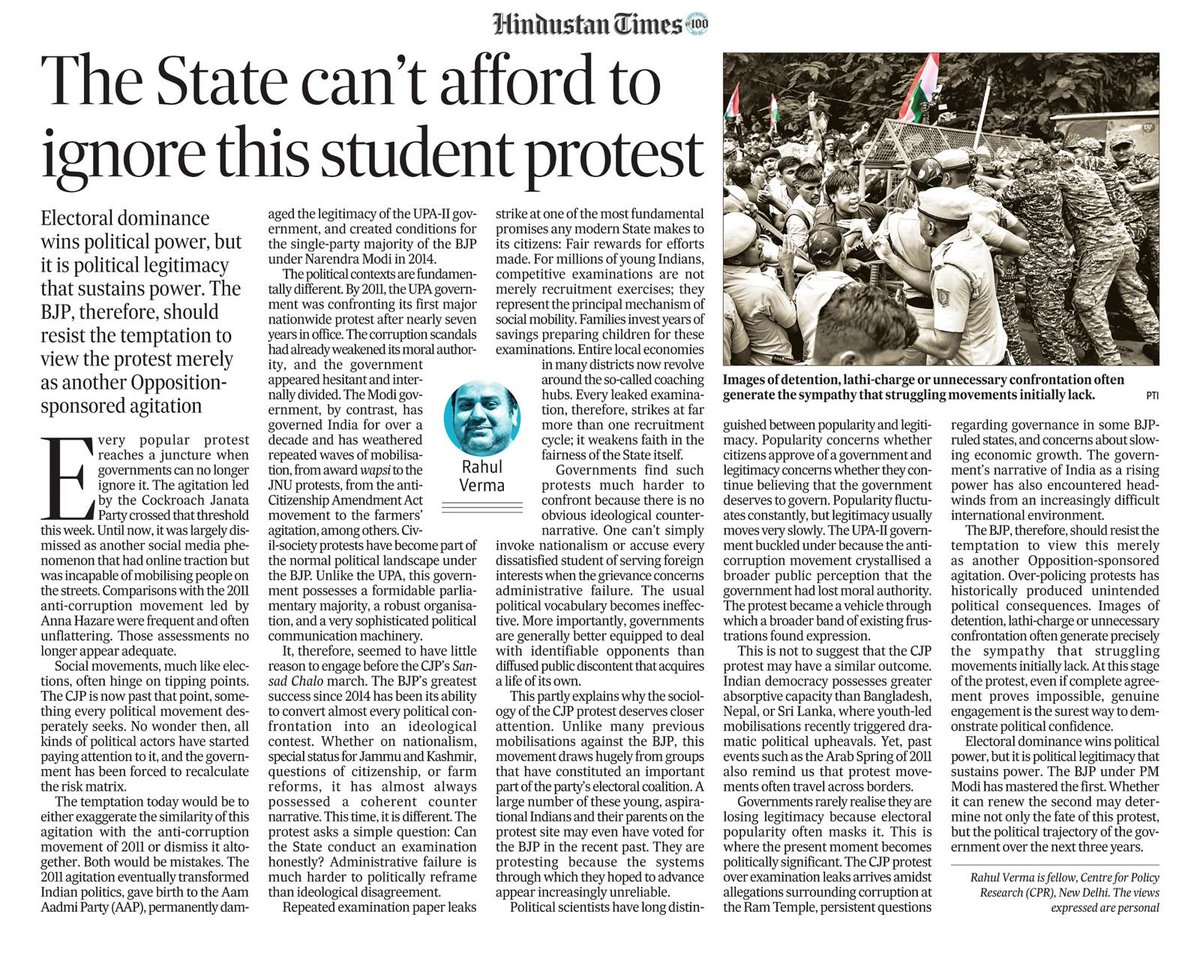
Very sound advice. Political power rests on legitimacy, not merely numbers in legislature. The government must engage the agitating students and take credible steps to ensure integrity in examinations at all levels. The Union must also sit with all States, because most of the examinations are conducted at the state level.
Once the examination and accountability issues are resolved, energetic and determined steps are needed by the Union and States to address the real and deep crisis in education, skills and jobs. And we must introspect on the growth model which is not creating enough formal jobs, and is not inclusive enough. Small town development, serious reforms in land, labour, credit and energy pricing to spur growth of job-creating SMEs and quality of urban life are vital to promote inclusive growth. This is the greatest challenge our polity and economy face.
We are facing global headwinds: energy crisis because of supply disruption, increasing trade barriers. Massive national effort is needed to make us energy-inde pendent in the next decade. Complete electrification of transport, massive addition to solar power generation, super-fast daytime charging stations, battery storage and industrial policy mandating only EV sales over time - all are critical. Energy crops, processing network to convert biomass into fungible energy and massive rural industrialization are all vital. An integrated, all out strategy addressing inclusive growth, job creation, energy security and agricultural transformation is the need of the hour.
The student protest is a wake up call. It is a symptom of the deep-seated structural problem in our education, skills, productivity, growth, employment and urbanisation. The goverments across the country and parties should focus on the real challenge and should not be consumed by political management and power games.
The BJP govt has faced major protest every 2-3 year, but this is the first where clear counter-narrative is not available. And, the CJP protest has arrived amidst multiple headwinds this govt. is facing.
Need an astute political judgment to tide over.
Heartiest congratulations to Pawan, Bharat and the whole Skyroot Aerospace team! It is innovation, entrepreneurship and courage like this that make dreams come true! They are an inspiration to to a whole generation of Indians.
In the burning heat of Madras in 1946, a young man walks the dusty streets carrying a heavy gunny bag filled with colored toy balloons. He sells them directly to street vendors and children, counting out copper coins just to secure his next meal.
K.M. Mammen Mappillai belonged to a prominent family in Kerala. His father, K.C. Mammen Mappillai, was the chief editor of the highly influential Malayala Manorama newspaper & a powerful banker. In the late 1938, his father clashed fiercely with Sir C.P. Ramaswami Iyer, the tyrannical Diwan (Prime Minister) of the princely state of Travancore.
The state govt locked down the newspaper, seized the family’s assets & shut down their bank, throwing his father into jail. Overnight, 1 of the wealthiest families in the region was left completely bankrupt.
By 1946, young Mammen Mappillai had graduated in science from Madras Christian College. He had no money, no ancestral wealth & no place to live, often sleeping on the floors of acquaintances. Refusing to be broken, he pooled a tiny bit of borrowed money & set up a makeshift, completely manual rubber workshop in a small wooden shed in Tiruvottiyur, a suburb of Madras. He called it the Madras Rubber Factory (MRF).
He did not have the machines or the capital to build industrial rubber goods, so he chose the cheapest product possible: toy balloons. The early days were pure manual labor. Mammen Mappillai’s wife, who had a background in chemistry, helped him manually mix the rubber latex, dye & chemicals in their home.
They hand-dipped wooden templates into the latex mix to form balloons. Once the balloons dried, Mammen Mappillai packed them into gunny bags, walked into the heart of Madras & sold them street by street directly to vendors & children to secure daily cash flow.
By 1949, the small shed operation stabilized. They upgraded from just balloons to making latex gloves & cast rubber toys. But Mammen Mappillai knew that selling toys on the street corner would never pull his family out of financial ruin.
The watershed moment came in 1952. He noticed that post-war India was experiencing a huge surge in commercial trucking, but the country lacked a domestic supply of tread rubber (the thick, patterned rubber strip used to retread worn out tires to make them reusable). Transportation companies were spending massive foreign exchange importing tread rubber from global giants like Dunlop.
Mammen Mappillai made a high-stakes gamble. He took every single rupee he had saved from 6 yrs of selling balloons & toys, abandoned the consumer novelty market & pivoted MRF entirely into heavy industrial manufacturing to make tread rubber.
The gamble was a masterstroke. Because his tread rubber was locally manufactured & significantly cheaper than foreign imports, Indian transport operators flocked to MRF. Within just 4 yrs (by 1956), the little balloon shed had captured a staggering 50% market share of all tread rubber sold in India.
Having mastered the tread, the final evolutionary step was inevitable: making the actual tire. In 1961, MRF went public & signed a crucial technical partnership with the Mansfield Tire & Rubber Company of the United States. The company came full circle in 1989. Now a massive tire conglomerate, MRF partnered with Hasbro (the world's largest toy maker) to launch Funskool India, bringing the industrial giant right back to its original roots of making toys for children.
When K.M. Mammen Mappillai was awarded the Padma Shri in 1992, he was no longer the bankrupt student sleeping on the floors of acquaintances. He was the architect of a global empire. Today, MRF is a multi-billion-dollar powerhouse exporting specialized tyres to 65+ countries, its iconic logo stamped on the bats of the world’s greatest cricketers.
It stands as a towering monument to a simple, unyielding truth: you can strip a family of their banks, their buildings & their land, but you can never strip away the relentless, unstoppable drive of a mathematical & entrepreneurial mind determined to rebuild from a single hand-dipped balloon.
Grid management and energy security key to more power | 13th July 2026 | The Road Ahead | Free Press Journal
Read the online version here - https://t.co/EcGI0YwBKT
My new EAC-PM working paper (with Satvik Dev) argues that India’s rising solar penetration is causing grid stress. While solar is meeting more midday demand, it also forces conventional sources, especially thermal plants, to ramp up and down more sharply to meet the net load. This is visible in both the summer “duck” curve and winter “camel” curve, putting grid operations under stress . Three signals show the stress. First, prices: in May 2026, power on the IEX day-ahead market averaged Rs 1.11 per unit at midday but Rs 9.71 at night. Second, curtailment: about 24 GWh of solar was wasted daily in May. Third, shortages: the grid fell short of non-solar-hour peak demand on 36 days in April-May, compared with only 6 days for solar-hour peak demand. The paper supports the direction of the Draft Electricity (Amendment) Bill, 2025, and draft Electricity (Rights of Consumers) Amendment Rules, 2026. But it cautions that without adequate storage and net-load smoothing policies, solar growth will intensify grid stress.
https://t.co/e7ZbWkdPeB
India is the world's largest producer and exporter of rice, yet the Food Corporation of India (FCI) is holding rice stocks that are nearly five times the prescribed buffer norm, at a carrying cost of over Rs. 10,712 crores in FY25.
In their latest article, Ashok Gulati, Ritika Juneja, and Purvi Thangaraj trace this surplus to three interlinked policy distortions: open-ended MSP procurement, with several states offering bonuses above the MSP; free electricity and heavily subsidised urea.
Instead of addressing these underlying distortions, the government's response has been to divert surplus rice to ethanol production, supplying rice to distilleries at Rs. 23/kg despite FCI's economic cost of about Rs. 44/kg on the justification that it is broken and damaged rice.
The authors also highlight the environmental costs of the current policy framework, including the use of ~ 4,000 litres of water to produce one kilogram of rice, high methane emissions from paddy cultivation, and nitrate contamination of groundwater associated with serious health risks.
To address these challenges, the authors recommend capping state procurement at 40% of production, discontinuing state MSP bonuses, limiting free PDS supplies to the most vulnerable households, shifting ethanol production towards maize, and replacing fertiliser subsidies with direct income support.
Read more:
Financial Express: https://t.co/PGado3L3Dg
Indian Express: https://t.co/43KiCohXWn
Sustainable energy needed to prosper and protect nature | 4th july 2026 | The Road Ahead | Free Press Journal
Read the online version here - https://t.co/HHcLGlkQNw
Having me here in Paris and screening my films is itself an honour for me. But a sweet surprise I never saw coming. It is a feeling I cannot fully put into words. To have a permanent place in the halls of one of the world’s most legendary film institutions, named after the great Henri Langlois himself, is something I will carry with me forever.
My deepest gratitude to the legendary Mr. Costa Gavras and the entire Cinémathèque Française family for this honour, and for embracing Indian cinema with such warmth and love. 🙏
It does not matter how many global summits a country hosts/how many billions are committed to infra; if a 10 yr old homegrown brand can be erased overnight by an aggressive interpretation of an import code, "Make in India" becomes a high-risk gamble for honest entrepreneurs.
The founder mentions changing their HS Code (Harmonized System code used for customs tracking) in 2023 based on professional advice. In India, Customs & Tax depts frequently use a tactic: Retrospective Reclassification.
The Trap: A founder openly declares a code for yrs. The dept accepts it, clears the shipments & takes the tax. Then, a local audit officer decides, "Actually, I interpret your product differently. It should not be under Code A (10% duty); it should be under Code B (30% duty)."
The Penalty: They do not just apply the new rule going forward. They hit the company with retrospective bills for the last 3-5 yrs, piled high with 100% penalties & interest charges. For a MSME, this instantly wipes out their entire lifetime liquidity.
If we want to compete with China, we need to realize that Ease of Doing Business is not some rank on a World Bank list but a feeling in a founder's gut.
Right now, that feeling is fear. The system must learn to distinguish b/w a fraudulent tax evader & a genuine corporate classification dispute. Until the process stops feeling like a punishment, our best minds will keep choosing to register their companies outside instead of their own homeland.