ICRIER is India's premier policy think-tank seeking to augment knowledge content for policy-making for India's effective engagement with the global economy.
In an exclusive conversation on DoubleCheck with Sanket Upadhyay, @agulati115, Distinguished Professor, ICRIER, explains why India’s retail inflation has climbed to 6.09%, with food inflation near 9%. He traces it to an El Niño-induced supply shock, with the monsoon 12.6% below normal (which by definition makes it a drought year, though the Centre hasn’t declared one), and argues the government had clear IMD forecasts from April but delayed preventive action, even as onion inflation hit 116% and milk, sugar and edible oils climbed. Since the RBI’s tools can’t tackle a supply shock, Dr. Gulati calls for releasing surplus rice stocks, duty-free imports of pulses and sugar, and scaling up food processing and cold chains to cut the 25-30% wastage in fresh produce and tame price volatility.
Watch here: https://t.co/T55dvDh6RJ
#FoodInflation #Agriculture #FoodPolicy #Inflation #ICRIER
In a recent India Today debate on the Prime Minister’s FICCI speech, Dr. Shekhar Aiyar, Director and Chief Executive, ICRIER, made the case for liberalising India’s import regime to unlock the gains from recent FTAs, and for faster, more even reforms across states to improve the investment climate. The discussion followed the Prime Minister recently urging corporate India to step up, noting that despite corporate tax cuts, industry had not done enough to raise salaries or investment.
Watch here: https://t.co/TqLwV85UqJ
#IndianEconomy #Investment #EconomicReform #Trade #ICRIER
As COP31 closes under the banner of a “COP of Implementation,” the test for climate finance is no longer pledges but delivery. For India, which ranks third globally in disaster-induced displacement (2015-2025), adaptation finance is central to protecting livelihoods and preventing future losses.
ICRIER’s latest blog by Sunaina Saxena, “When Grants Run Short: Rethinking How India Pays for Climate Adaptation”, examines how India can design smarter, less debt-dependent financing pathways.
The blog explores:
𝗚𝗿𝗮𝗻𝘁 𝗰𝗼𝗻𝘀𝘁𝗿𝗮𝗶𝗻𝘁𝘀: The Adaptation Fund has USD 2.39 billion in pending proposals but only USD 553.42 million for new projects, against India’s vast adaptation needs of INR 56.68 trillion (approx. USD 607 billion) until 2030.
𝗧𝗵𝗲 𝗱𝗲𝗯𝘁 𝗽𝗿𝗼𝗯𝗹𝗲𝗺: Loans make up roughly two-thirds of developed-country public climate finance, yet adaptation projects like embankments and shelters generate public goods with no direct revenue, shifting climate risk onto national balance sheets.
𝗜𝗻𝗻𝗼𝘃𝗮𝘁𝗶𝘃𝗲 𝗶𝗻𝘀𝘁𝗿𝘂𝗺𝗲𝗻𝘁𝘀: The “Triple Dividend” framework, a National Adaptation Revolving Fund with grants as first-loss capital, and Climate Resilient Debt Clauses for India.
𝗜𝗻𝗱𝗶𝗮’𝘀 𝗖𝗢𝗣𝟯𝟭 𝗽𝗿𝗶𝗼𝗿𝗶𝘁𝗶𝗲𝘀: Predictable finance, vulnerability-based allocation, stronger Direct Access, and better loan quality through deeper concessionality and longer grace periods.
The goal is not to replace domestic financing but to ensure international support complements it, enabling resilience-building without compromising development priorities.
Read the full blog here: https://t.co/JnlR7bzNQS
#ClimateFinance #ClimateAdaptation #COP31 #India #DevelopmentFinance
𝗕𝗲𝘆𝗼𝗻𝗱 𝗟𝗶𝘃𝗲𝗹𝗶𝗵𝗼𝗼𝗱: 𝗔 𝗦𝘁𝗼𝗿𝘆 𝗼𝗳 𝗕𝘂𝗶𝗹𝗱𝗶𝗻𝗴 𝗪𝗼𝗺𝗲𝗻’𝘀 𝗘𝗰𝗼𝗻𝗼𝗺𝗶𝗰 𝗔𝗴𝗲𝗻𝗰𝘆
Mumtaz’s story began much like that of millions of women across India, shaped by limited access to opportunities. But with the right support, she took a step towards changing that - taking charge of her economic future and, in the process, opening up new possibilities for her child.
Her story is part of ICRIER’s Half the Economy initiative, led by the #EPWD team, which deep dives into the factors shaping women’s economic lives, from education and financial literacy to mobility, access to finance and the burden of unpaid work.
Mumtaz comes from Nuh, Haryana, where female literacy stands at 37 per cent and fewer than half of girls reach higher secondary education; access to education continues to shape the opportunities available to women.
With support from ETASHA Society’s livelihood generation and skilling programme, Mumtaz began her entrepreneurial journey and has scaled it up beyond anyone in her village could have imagined.
For her, starting a business was about more than earning an income. It was about securing a better future for her child; one she knew education could help make possible. Today, her child attends a good school, she has completed her 10+2, and she has recently secured admission to a BA LLB programme.
Her illustrates how access to skills, opportunities and the means to earn can enable women to overcome systemic barriers, exercise greater agency and create an impact that extends across generations.
Watch the full film on YouTube: https://t.co/FEdeI6hlmz
Look up EPWD’s Half the Economy initiative here: https://t.co/G3vqbfvFq6
#WomenLedDevelopment #FinancialInclusion #WomenEntrepreneurs #EconomicEmpowerment #ICRIER #WomenEntrepreneurshipDay
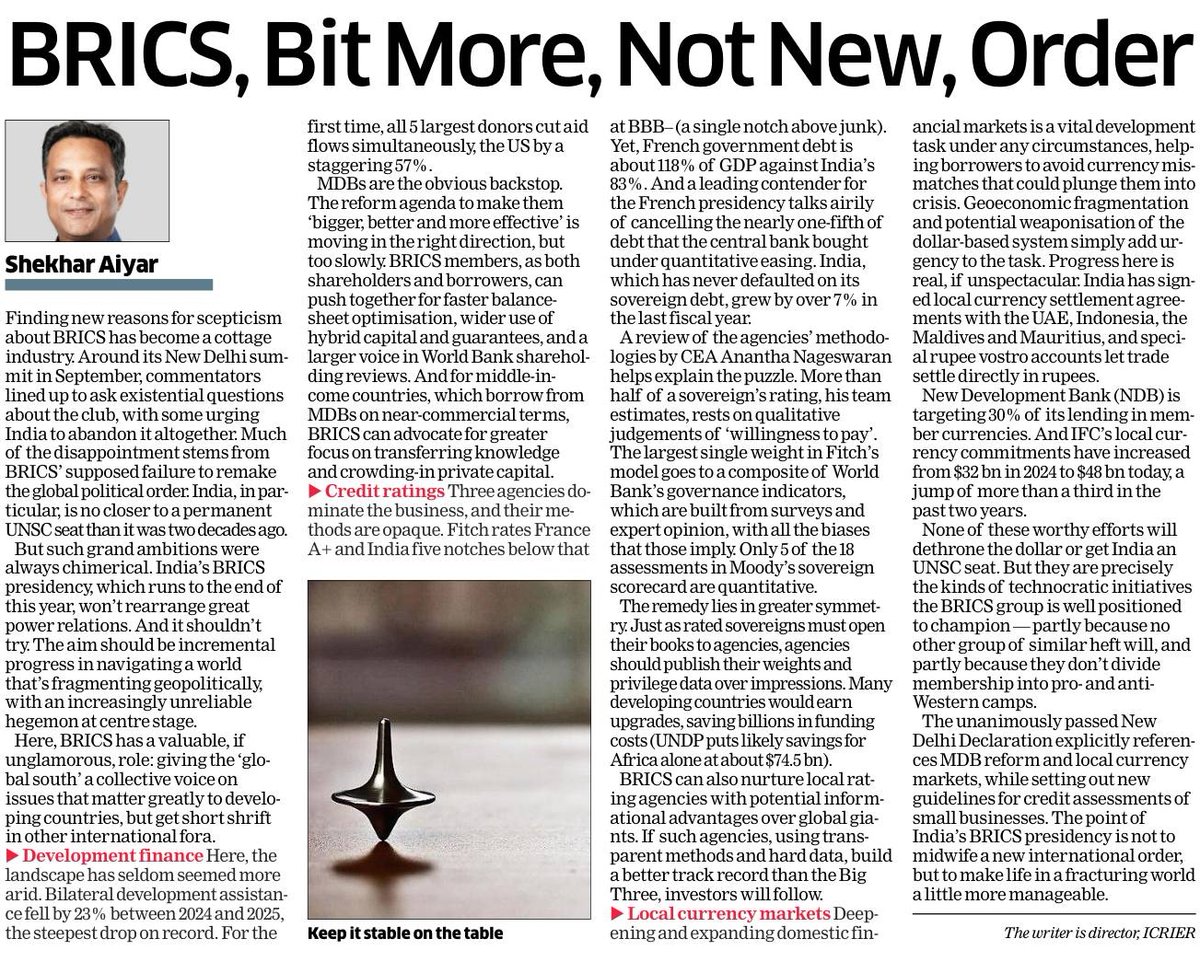
In his recent op-ed in @EconomicTimes, @ShekharAiyar, Director, ICRIER, argues that the point of India’s BRICS Presidency is not some grand reset of the global order, but incremental progress on a set of issues that are important to the global South but get short shrift in other international forums. Examples include development finance reform, the methodologies of credit rating agencies, and the deepening of local currency markets.
Read more: https://t.co/2sddmdZ9hF
#BRICS #DevelopmentFinance #GlobalSouth #MDBs #ICRIER
India's data centre expansion is accelerating, driven by growing demand for cloud computing, artificial intelligence and digital services. But as investments pour into this infrastructure, an important question emerges: how can India scale its digital ambitions while managing the growing demands on energy, water and land?
ICRIER's latest blog by Ritika Verma, “The Infrastructure Behind Intelligence: Rethinking India’s Data Centre Expansion,” examines the environmental, economic and governance challenges associated with India's growing data centre ecosystem.
The blog explores:
𝗘𝗻𝗲𝗿𝗴𝘆 𝗱𝗲𝗺𝗮𝗻𝗱: Implications of rising electricity consumption for India's power infrastructure and decarbonisation goals.
𝗪𝗮𝘁𝗲𝗿 𝘀𝗲𝗰𝘂𝗿𝗶𝘁𝘆: Growing cooling requirements and pressures on freshwater resources.
𝗟𝗮𝗻𝗱 𝗮𝗻𝗱 𝗰𝗼𝗺𝗺𝘂𝗻𝗶𝘁𝗶𝗲𝘀: Land-use implications, local livelihoods and the distribution of economic benefits.
𝗘𝗻𝘃𝗶𝗿𝗼𝗻𝗺𝗲𝗻𝘁𝗮𝗹 𝗴𝗼𝘃𝗲𝗿𝗻𝗮𝗻𝗰𝗲: The need for stronger regulatory oversight, resource-use disclosures and environmental safeguards.
𝗦𝘂𝘀𝘁𝗮𝗶𝗻𝗮𝗯𝗹𝗲 𝗶𝗻𝘃𝗲𝘀𝘁𝗺𝗲𝗻𝘁: Aligning public incentives with domestic value creation, local employment and measurable environmental outcomes.
As India builds the infrastructure underpinning its digital future, ensuring that this expansion is resource-efficient, inclusive and environmentally sustainable will be critical.
Read the full blog here: https://t.co/gFgwcSdGxK
Climate change is already costing India dearly, but how much of that cost shows up in what the country reports? With the second round of Biennial Transparency Reports (BTRs) due at the end of this year, the question is whether India's loss and damage reporting can reflect the true scale of what climate change is costing its economy and communities.
At COP31 in Antalya, the Executive Committee of the Warsaw International Mechanism has finalised voluntary guidelines to help countries collect and manage loss and damage data for their BTRs. India is not starting from zero. Its first BTR carried a dedicated loss and damage section and reported impacts in seven of the nine loss categories the guidelines identify. But where do the reported numbers come from, what do they leave out, and how can the actions India reports be tied to the money behind them?
ICRIER's latest blog by Amrita Goldar examines these questions in light of the new guidelines, India's first BTR and the recommendations of the Sixteenth Finance Commission. It highlights the importance of drawing loss figures from official systems such as the National Disaster Management Information System, in monetary terms as well as physical loss counts; accounting for indirect and private-sector losses that official damage statements miss; organising reported activities and spending along the disaster response and mitigation fund windows; and filling gaps in land and water losses and non-economic losses, drawing on experiences from countries such as Bhutan and Cabo Verde.
Read the full blog here: https://t.co/PkZa9fHpr3
📰 ICRIER in the News
A recent Big News Network report on the EU’s new 9.5% anti-dumping duty on cold-rolled steel from India cites ICRIER’s research on how Europe’s trade measures are squeezing Indian steel. Coming just a month after CBAM, the duty adds to the pressure on a sector for which the EU takes around 45% of India’s finished steel exports. ICRIER’s study estimates that CBAM alone could cut India’s iron and steel exports to the EU by 24%, dragging overall global steel exports down 5.7%.
Read more: https://t.co/7iyFhGnd6k
At the @IndiaToday Group’s Bharat Agriculture Conclave 2026, Dr. Ashok Gulati, Distinguished Professor, joined a fireside chat with Dr. Ashok Lahiri (@NITIAayog), Dr. Bina Agarwal (@IEGResearch) and Shaji Krishnan V (@NABARDOnline), moderated by Business Today’s Siddharth Zarabi, on whether India can raise farmers’ incomes — and how.
Dr Gulati argued that India’s incentive structure traps farmers in a rice-and-wheat cycle. Nearly ₹2.5 lakh crore fertiliser subsidy flows mostly to rice, wheat and sugarcane, while India remains the world’s largest importer of pulses and edible oils. Instead he recommends a crop-neutral incentive of around ₹35,000 per hectare for pulses and oilseed growers, funded by the power and fertiliser subsidies it would save, which he believes could deliver self-reliance within three years.
Watch here: https://t.co/XH0HqNvQFt
#FarmersIncome #Agriculture #CropDiversification #FarmReform #ICRIER
Walking is the most common way women commuters get to work in India. For men, it is the two-wheeler. The National Household Travel Survey 2025–26 found that 51% of women commuters walked for the longest part of their journey, compared with 24% of men.
The gender gap in walking is especially wide in Bihar and Jharkhand. In Bihar, 81% of women commuters primarily walk to work, compared with 34% of men. In Jharkhand, the shares are 75% and 27%, a gap of about 48 percentage points.
14% of women commuters primarily take a bus to work, compared with 5% of men. Bus use among women also varies widely. Nearly half of women commuters in Kerala and more than a third in Tamil Nadu primarily take a bus, compared with 14% nationally. The share is also above the national average in Jammu and Kashmir (22%), Karnataka (22%) and Punjab (19%), and below it in Delhi (12%), West Bengal (12%) and Andhra Pradesh (7%) among the States which provide fare-free bus rides for women.
Getting to work is a huge barrier for women’s labour force participation. When commute is unaffordable, unreliable and unsafe, it limits women’s mobility and workforce participation. Studies across Indian cities have shown that improvements in transport infrastructure are associated with positive gains in labour force participation for women.
For women who walk to work, continuous footpaths, safe crossings and good lighting can make the journey safer. Those same improvements can help women reach bus stops. Affordable fares and reliable services that connect residential areas to workplaces can help put more jobs within reach.
In their recent op-ed in @livemint, @profarpita1 and Angana Parashar Sarma argue that traceability in food exports is no longer a luxury but an imperative, as partners like the US, EU, UK and Australia make farm-to-shelf records a condition of market access. With India’s systems covering only select commodities, they call for a government-led, risk-based traceability platform built into BharatTradeNet — one that connects existing systems, protects Brand India, and supports smaller exporters.
Read more: https://t.co/UsxkzOFoWd
A climate adaptation plan is only as effective as the action it sets in motion. The larger question is whether global adaptation efforts can move beyond producing plans and guidance to helping countries deliver meaningful change on the ground.
Countries are increasingly identifying climate risks and developing adaptation strategies. But how do these priorities translate into projects, who finances them, and how do we know whether they are reducing vulnerability? These questions are central to the adaptation debate at COP31.
ICRIER’s latest blog by Diksha Bali examines these implementation challenges through the Adaptation Committee’s 2026 report, the ongoing review of its performance, its evolving role, and the state of National Adaptation Plans worldwide. It also explores what these developments mean for India’s adaptation planning and implementation. It highlights the importance of learning from other countries' experiences, strengthening project preparation, improving access to adaptation finance and moving towards monitoring systems that capture actual resilience outcomes.
Read the full blog here: https://t.co/2rOmm388Jl
#COP31 #ClimateAdaptation #AdaptationFinance #NationalAdaptationPlan #MonitoringEvaluationAndLearning #GAIAPerspectives #ICRIER
A comprehensive new feature in @IndiaToday explores agrivoltaics and its potential to strengthen farmers’ incomes while advancing India’s clean energy transition.
The feature showcases ICRIER’s Rajasthan Agri-PV pilot, with insights from Dr. @agulati115, Distinguished Professor, and Subhodeep Basu, Fellow, ICRIER, on the opportunities and challenges of scaling Agri-PV in India. Proud to see our research and field experience contributing to this important conversation!
The promise of Agri-PV lies in making the energy transition work for farmers, with agriculture and solar power complementing each other rather than competing.
Read the full article: https://t.co/Xbq2KCRAfR
As discussions unfold at COP31, attention has shifted from the landmark adoption of the 59 Global Goal on Adaptation (GGA) indicators at COP30 to the challenge of putting them into practice. Persistent gaps in methodological clarity, data availability and institutional capacity could undermine efforts to meaningfully measure global adaptation progress.
ICRIER’s latest blog by Diya Dasgupta examines these challenges in the Indian context, highlighting the limitations of existing data frameworks in capturing adaptation-specific outcomes, fragmented data collection and reporting mechanisms, and concerns surrounding the use of externally developed indices. It makes a case for a phased, nationally driven approach that prioritises indicators aligned with India’s adaptation objectives, builds on existing data capabilities, and invests in the systems needed to measure progress over time.
Read the full blog here: https://t.co/NxRzdhhOYo
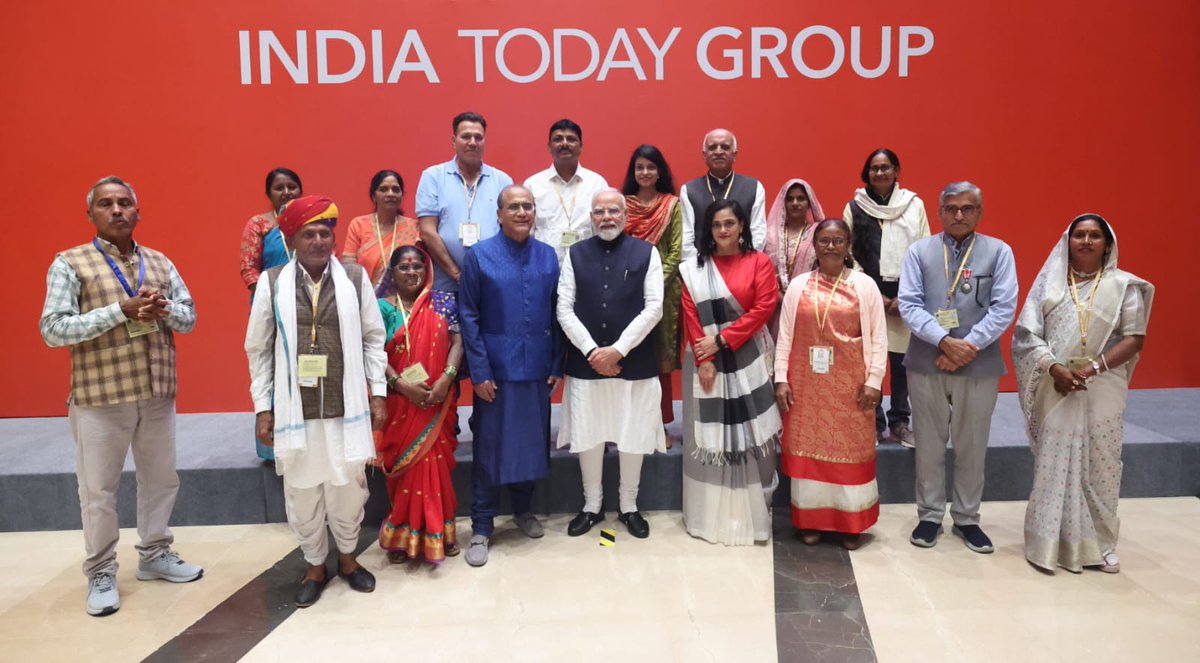
A proud moment for ICRIER: Our Agri-PV initiative and partner farmer Shri Kajod Mal Jat being congratulated by Honourable PM of India Shri Narendra Modi!
At the Bharat Agriculture Conference, Shri Kajod Mal Jat, a farmer from Jaipur, Rajasthan, and ICRIER’s partner under our Agri-PV initiative, was congratulated by the Hon’ble Prime Minister of India, Shri Narendra Modi, along with other distinguished dignitaries.
Kajod Mal shared his firsthand experience of the pilot at the conference and was also interviewed by India Today, carrying the story of farmer-led solar and agriculture integration to audiences across the country.
His story began on his 3-acre farm, where a conventional ground-mounted solar plant had taken the land out of cultivation. With technical support from ICRIER and financial support from Kotak CSR, the panels were raised to 11 feet, and the soil beneath them came back to life.
Today, his farm tells a very different story:
🌾 A 10-fold increase in income from combined agricultural and solar earnings
💰 Over ₹4 lakh per acre in annual earnings
🥬 Three vegetable harvests a year, with drip irrigation and mulching
☀️Crops that stand up better to Rajasthan’s harsh summer heat
This is the promise of Agri-PV: a farmer no longer has to choose between the sun and the soil. He can be both an Urjadata and an Annadata.
Seeing Kajod Mal, and the work we have built together, honoured on such a prominent national platform fills all of us at ICRIER with immense pride. Our heartfelt congratulations to him, and our sincere thanks to Kotak CSR for making this journey possible.
#AgriPV #Agrivoltaics #ICRIER #SustainableAgriculture #RenewableEnergy
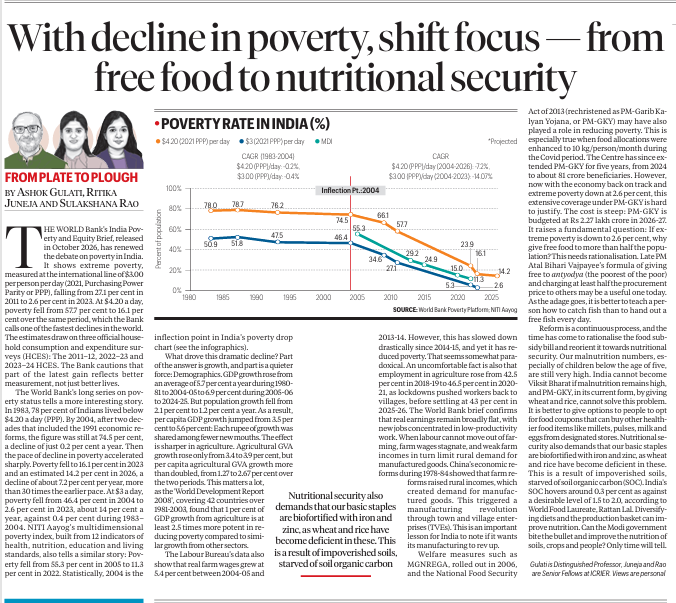
Op-Ed | Poverty dip a pointer to reform
India’s decline in poverty presents an opportunity to rethink its food security and welfare priorities. In an opinion piece published in The Financial Express (India) and The Indian Express, Dr. Ashok Gulati, Ritika Juneja and Sulakshana Rao examine why India needs to move beyond cereal-centric food subsidies towards a more nutrition-focused approach.
The authors argue that while free food-grain distribution has played an important role in reducing poverty and addressing hunger, the next phase of reform must prioritise dietary diversity, access to protein-rich foods and better nutritional outcomes. They make a case for rationalising food subsidies and redirecting public support towards broader nutritional security.
Read the articles: https://t.co/zDI0suhSih
https://t.co/bGwdutHwjB
#ICRIER #PovertyReduction #FoodSecurity #NutritionalSecurity #AgriculturalReforms