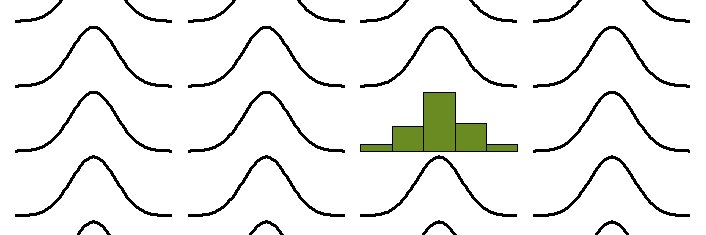
This is Spain. Not by land. By people.
Every block = 0.1% of the national total.
The interior looks massive on every map.
Remapped by population, it almost vanishes.
Madrid barely exists by land. By people, it takes over.
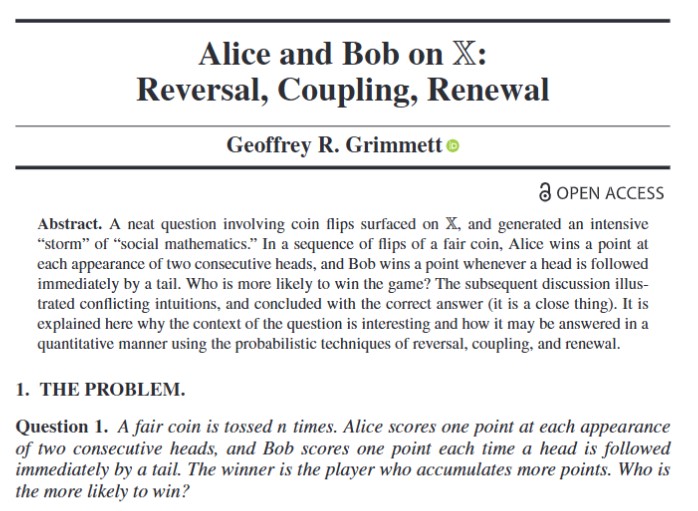
Se lanza una moneda n veces. Alicia gana un punto cada vez que aparecen dos caras consecutivas y Bob cada vez que una cara va seguida inmediatamente de una cruz. Gana el jugador que acumula más puntos. ¿Cuál de los dos tiene mayor probabilidad de ganar?
https://t.co/6HkA7SL42l
Podría argumentarse que máxima verosimilitud es la contribución más influyente de las matemáticas aplicadas del siglo XX. Una forma automática de obtener estimadores casi insesgados de varianza casi mínima.
(En Efron y Hastie, Computer age statistical inference)
See the top ranked papers in AI, ML, Robotics, Quantum Physics, and more on @kurateorg. Hundreds of arXiv preprints ranked daily by scientific impact through pairwise tournaments judged by Claude, GPT, and Gemini.
Producir artículos empieza a ser más fácil que leerlos críticamente. (...) El cuello de botella de la ciencia ya no parece estar en producir información, sino en separar lo relevante de lo irrelevante
https://t.co/w8w7e8w0oN
En matemáticas, el contexto oscurece la estructura. En estadística, el contexto proporciona el sentido. Esta diferencia tiene profundas implicaciones en la docencia.
(Cobb y Moore, "Mathematics, Statistics and Teaching", Amer. Math. Monthly, 1997)
Quantile regression is a valuable tool for analyzing the relationship between variables, especially when data is not evenly distributed or has outliers.
Unlike traditional linear regression, which focuses only on the mean, quantile regression allows us to predict different points across the distribution of the target variable.
Challenges:
❌ Compared to linear regression, quantile regression requires more computational power and can be harder to interpret for non-experts.
❌ Larger sample sizes might be needed to achieve stable and reliable quantile estimates, especially for extreme percentiles.
❌ The model's results might be less intuitive if you are accustomed to traditional regression techniques, which could limit ease of communication.
Advantages:
✔️ Quantile regression helps to explore trends at various quantiles, offering a more detailed picture of your data.
✔️ This method is highly effective for non-normal data, particularly when there are outliers or heavy tails.
✔️ It is ideal for situations where extreme values or various percentiles are as important as the central trend.
How to handle quantile regression in practice:
🔹 R: Use the quantreg package to apply quantile regression. The rq() function allows you to specify the quantiles you're interested in.
🔹 Python: In Python, statsmodels provides quantile regression with the QuantReg() function to analyze different percentiles of your data.
The attached visualization is based on a Wikipedia image (link: https://t.co/AESkeL5pg0) and illustrates quantile regression lines at various percentiles, showing how predicted values differ across the distribution.
To explain this topic in further detail, I collaborated with Micha Gengenbach to create a comprehensive tutorial: https://t.co/oJnspCYzC3
Curious to learn more about statistics and R programming? Join my online course, "Statistical Methods in R." For more information, visit this link: https://t.co/7YQCRDKSPO
#Rpackage #datastructure #database