It is our job as principled conservatives to affectuate positive change in the @GOP and the world at large.
We shouldn't abandon the party simply because we are more conservative than the average Republican. That's the easy way out, and is exactly what has led the @NCGOP to the place we're at now.
We should instead lean in and make the case for principled conservatism. We should be getting involved on the ground floor and helping *actual* conservatives win elections. We should be helping educate the "meh" voters who may or may not show up to the polls during any given election cycle.
That's the roadmap for winning the future for North Carolina and our citizens.
Capitalism didn't turn biological need into bargaining power. Scarcity did that automatically.
The real question is what system you use to convert scarce necessities into allocated necessities.
Under private ownership, the "bargaining power" the owner holds is checked by three things:
1) Competition (other owners bidding for your labor)
2) Substitutability (you can often produce necessities yourself — grow food, build shelter — at some cost)
3) Exit (you can walk across the street to a different owner, a different industry, or start your own operation)
These 3 "checks" are the reason wages in competitive labor markets track productivity really well over time rather than collapsing to bare subsistence, which is what pure bargaining-power-of-the-owner theory results in.
If you take private ownership out of the picture, someone still has to decide who gets the milk. If the free market doesn't make that decision, a planner or a bureaucracy does.
In other words, under a socialist system, the bargaining power simply relocates to whoever controls the plan. That power / decision-making concentration has historically been orders of magnitude worse for the milk-risk problem.
Socialism removes the competition and exit options that discipline private owners, and replaces "many owners bidding for your labor" with "one allocator deciding your ration," with no other allocator to walk to if that one abuses the position.
Soviet and Maoist agricultural allocation are the clearest historical examples of that failure.
Cow-risk and milk-risk aren't the same thing.
Cow-risk is chosen and concentrated (one person puts capital on the line, and if it fails, they lose the capital).
Milk-risk (needing food to live) isn't something capitalism invented. It's the baseline condition of being a biological organism in a world governed by scarcity and thermodynamics.
Capitalism took that pre-existing risk and let people trade it away. In other words, instead of betting your survival on your own harvest or your own herd, you can sell labor for a predictable wage and let someone else absorb the risk / volatility.
Calling that "coercion" stretches the word past the point it means anything. Coercion is when a specific person threatens you to extract compliance. For example, "I need calories to survive" isn't a threat issued by the dairy owner — it's a fact about biology that predates them, and the wage contract is thr best tool humans have found for managing it. This is because it converts an unpredictable, high-stakes problem (will I personally produce enough food this season) into a predictable, low-stakes one (will I get paid Friday).
If that weren't true (if wage labor was worse than the alternative) nobody would ever leave subsistence farming for factory work. Historically, in case after case, they **voluntarily** did.
In your example, you might not have any cows... But you also didn't have to buy, feed, and insure any cows (or lie awake wondering if disease or extreme weather is going to wipe out your herd overnight).
Someone else took that risk with their capital, so that you don't have to take it with yours.
The owner didn't just "own" the cows — they (or someone before them) saved money instead of spending it, then bet those savings on cows, land, and machinery instead of a vacation.
That's what capital is: deferred consumption redirected into production.
You're free to do the same.
Plenty of dairy farmers started as milkers who saved, borrowed, and eventually bought their own herd. My neighbor literally did this in 2015, and has been building his dairy business ever since.
You sell your labor because it's the highest-value thing you have right now, without needing capital upfront. In exchange, you get a paycheck whether the milk sells or spoils, whether prices crash or the cows get sick. The owner doesn't get that guarantee — they eat the loss.
That certainty you're handed is worth something, and it's why wages get paid before profit does, not after.
As for "created value" — value isn't just milking. It's building the shed, maintaining the machine, negotiating the supermarket contract, absorbing the risk that the whole thing fails. Coordination and risk-bearing are real economic contributions, not fictions invented to justify a paycheck.
And nobody's forcing you to buy the milk back at a markup with no alternative — you can buy from a competitor, start a co-op, or, if the margins are as absurd as the meme implies, undercut the owner yourself. That threat is exactly what keeps prices from running away in a functioning market.
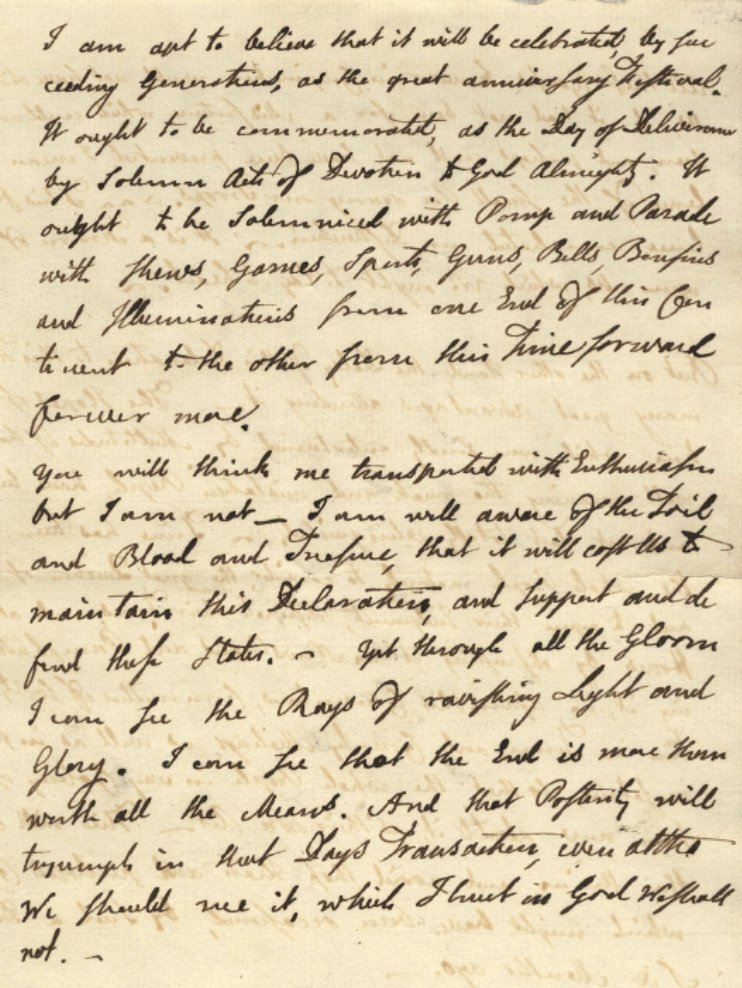
John Adams, writing to Abigail, about the Continental Congress' vote in favor of independence on July 2, 1776:
"The Second Day of July 1776, will be the most memorable Epocha, in the History of America. I am apt to believe that it will be celebrated, by succeeding Generations, as the great anniversary Festival. It ought to be commemorated, as the Day of Deliverance by solemn Acts of Devotion to God Almighty. It ought to be solemnized with Pomp and Parade, with Shews, Games, Sports, Guns, Bells, Bonfires and Illuminations from one End of this Continent to the other from this Time forward forever more. You will think me transported with Enthusiasm but I am not. -- I am well aware of the Toil and Blood and Treasure, that it will cost Us to maintain this Declaration, and support and defend these States. -- Yet through all the Gloom I can see the Rays of ravishing Light and Glory. I can see that the End is more than worth all the Means. And that Posterity will tryumph in that Days Transaction, even altho We should rue it, which I trust in God We shall not."
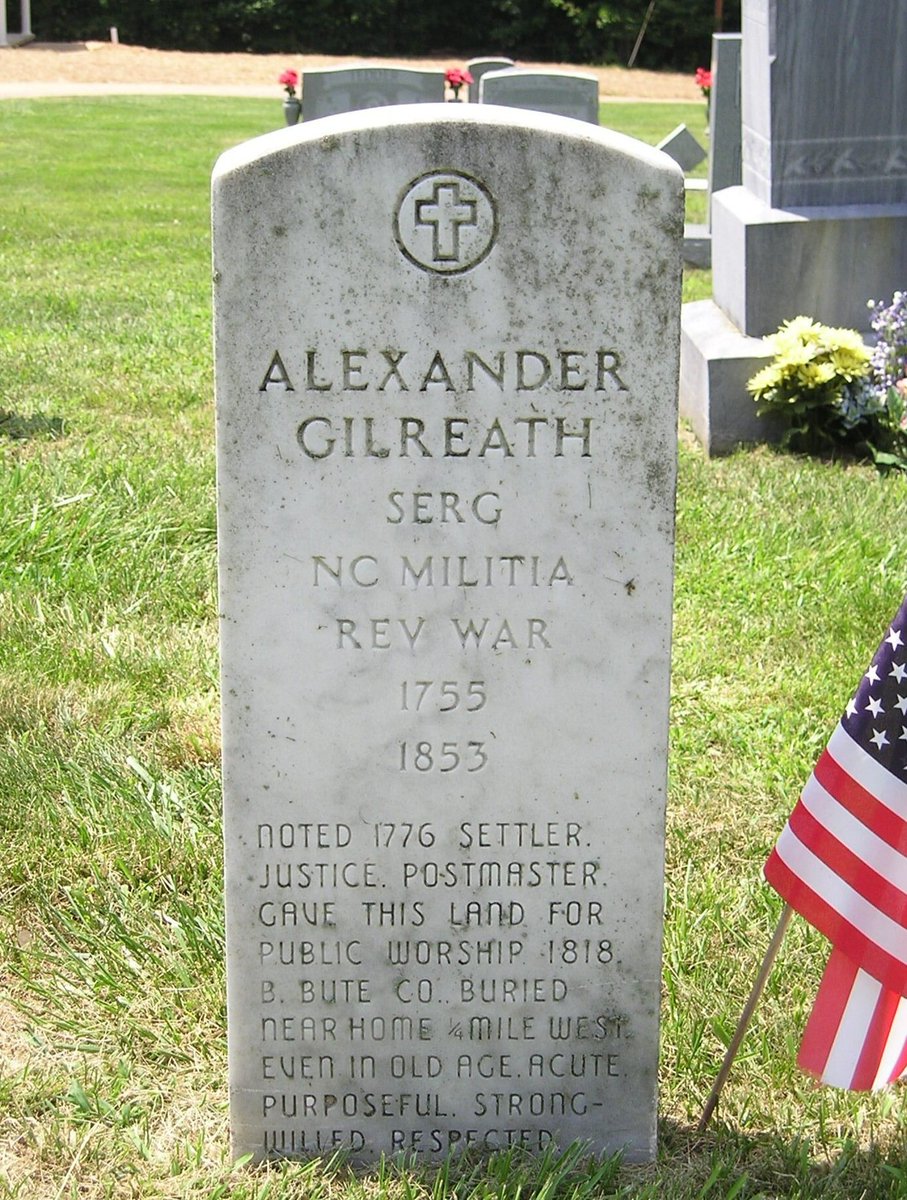
Nearly 250 years ago, a young man in the Brushy Mountains of North Carolina made a choice that helped shape the course of history.
Alexander Gilreath — my 7th-great-grandfather — enlisted as a Private in the Wilkes County militia. He would go on to answer the call repeatedly, whenever his community needed men to stand up.
He walked, on foot, after losing his horses in earlier campaigns, to reach the aftermath of the Battle of Ramsour's Mill (a scene of the dead and wounded he said he could never forget). He fought against the British at the Battle of Kings Mountain and during the Siege of Charleston.
After the war, he spent the rest of his life serving and building his community in the new nation he had helped defend.
He farmed the land, ran a mill and a blacksmith shop, served as Justice of the Peace, postmaster, and constable, and sat on the county school board. In 1818, he gave an acre of his own land so his community would always have a place to worship.
Alexander showed up, year after year, to build and steward the community that American freedom makes possible.
He was still doing that work well into his nineties. He was among the last living Revolutionary War veterans from the state of North Carolina when he died in November 1853 — four days shy of 98.
As we mark 250 years since America's founding, I think about the example men like Alexander Gilreath set for us. They not only achieved freedom... 𝒕𝒉𝒆𝒚 𝒔𝒑𝒆𝒏𝒕 𝒕𝒉𝒆 𝒓𝒆𝒔𝒕 𝒐𝒇 𝒕𝒉𝒆𝒊𝒓 𝒍𝒊𝒗𝒆𝒔 𝒃𝒖𝒊𝒍𝒅𝒊𝒏𝒈 𝒐𝒏 𝒊𝒕.
Good citizenship is something we owe our fellow Americans, every single day!
#America250
H.R. 6267 is an excellent, common-sense bill from @RepKnott.
We need pragmatic, bipartisan bills like this one in order to modernize the federal government's systems and processes.
https://t.co/HPk46damJ9
.@BernieSanders , it is a time to celebrate. @elonmusk has created enormous value for society by building @SpaceX, driving down the cost of rocket launches and creating a global satellite communication network that has brought high speed, low-cost internet and communication access to hundreds of millions and eventually billions of people along with critical advantages for our military and our nation’s defense.
SpaceX and its technologies will cause an acceleration in the growth of wages and wealth creation globally, including in some of the poorest communities in the U.S. and around the world.
Access to low-cost, high speed communications everywhere will allow children around the world to be educated, families to build businesses, and life-saving medical knowledge and care to be available everywhere.
SpaceX will materially bring down the cost of compute, advancing AI and humanity.
Meanwhile, 4,000 SpaceX employees yesterday became millionaires, including hourly wage employees who you claim you are trying to help.
The Elon Musks of the world drive growth, global GDP, and provide access to goods and services at lower cost that would otherwise not exist.
Elon’s nominal trillionaire status is due to his ownership of SpaceX, Tesla, Neuralink, the Boring Company and his other initiatives that have brought new technologies that improve our everyday lives.
Elon is not sitting on a trillion dollar pile of cash, jewelry and gold. He is using his controlling stakes in his companies to advance mankind. Elon’s companies don’t pay dividends. They reinvest all of their capital to accelerate innovation and value creation.
Elon is working 24/7 for all of us. He deserves respect and appreciation, not smears.
Bernie, your socialism would never allow a SpaceX to be built. Socialism has only proven to impoverish mankind and lead to death and destruction.
We need to create the conditions for more SpaceXs to be built, not attack the great entrepreneurs who are helping to advance our country.
Incomes not keeping pace with inflation has been the persistent economic issue for tens of millions of Americans for quite some time.
When Congress borrows trillions and runs massive deficits, it is still an effective tax increase — it just comes in the form of higher prices.
𝟐 𝐃𝐄𝐒𝐊𝐒 𝐖𝐎𝐑𝐓𝐇 𝐒𝐄𝐄𝐈𝐍𝐆
On February 17, 1826, a dying Thomas Jefferson sat at his desk in his Monticello home and penned a letter to his close friend of more than 50 years, James Madison. In that letter, he concluded:
"If ever the earth has beheld a system of administration, conducted with a single and steadfast eye to the general interest and happiness of those committed to it, one which, protected by truth, can never know reproach, it is that to which our lives have been devoted."
Despite decades of being dragged through the mud by his political critics who argued for a more powerful federal government, Jefferson passionately believed the framework the Founders had designed nearly 4 decades prior was guided by the welfare and happiness of America's people, rather than personal ambition or corruption. He 𝐤𝐧𝐞𝐰 the government he helped architect was grounded in reason and truth, making it morally unassailable to legitimate criticism.
From his desk at Montpelier, 74 year-old James Madison penned this in reply:
"The view you have taken of the course we have pursued, and of the principles which have guided us, is a sweet solace to my mind, under the temporary clouds which partisan malice may have thrown over them."
𝑻𝒘𝒐 𝒅𝒆𝒔𝒌𝒔. 𝑻𝒘𝒐 𝒃𝒓𝒊𝒍𝒍𝒊𝒂𝒏𝒕 𝒎𝒊𝒏𝒅𝒔.
Photos of the desks both men wrote these letters from are attached.
I had the privilege of seeing both last week.
Madison's desk was of particular interest to me, as it is the same desk he used while writing the Virginia Plan, which was later presented at the 1787 Constitutional Convention as the architecture for what became our US Constitution!
That same Constitution - OUR Constitution - is the oldest in world history, and has functioned as a cornerstone for the freedom, prosperity, and happiness hundreds of millions of Americans have enjoyed since it went into effect on June 21, 1788.
You are reading this ~1 month before America's official 250th anniversary. Over the course of the last 250 years, neither the partisan malice Madison wrote about, nor civil war, nor major economic depression, nor civil rights struggles, nor the flawed nature of man has managed to defeat the Democratic-Republican system of government thought up by Madison, Jefferson, and the other Founders.
THAT is something worth celebrating!
I thank God for the immeasurable blessings He has poured out upon this nation, and for the special people He gave us that helped shape the strong foundations we still stand on today.
The adjustable desk Thomas Jefferson used for many of his writings later in life. On top of the desk is a polygraph, which Jefferson used to create a copy of all of the nearly ten thousand letters he wrote in the last 20 years of his life.
“The brave die never, though they sleep in dust: their courage nerves a thousand living men.”
Today we thank God for the heroes whose sacrifice continues to fuel this great nation forward. 🇺🇸
~164,250 flights/yr under 350 mi
~76 avg passengers/flight
~$0.45/passenger snack cost
~$10/flight logistics cost
Est. Direct Food & Beverage Cost:
$9,382,000
Est. Logistics & Overhead
$1,643,000
Total Est. Annual Cost for "Free" Snacks:
~$10.5 million
If the CEO of Delta left due to a pay dispute, the resulting dip in stock price due to uncertainty and the high cost of a global executive search would wipe out billions of dollars of shareholder value. A 1% drop in Delta’s market cap would result in a ~$440 million loss in SV. A 50+% CEO salary cut would put Delta at a significant compensation and talent disadvantage with their competitors, further damaging their reputation, stock value, and ability to employ over 100k people.
It is 100% worth it to the company, shareholders, and consumers to drop the snacks for short flights.
BREAKING: Delta Air Lines will no longer offer free snacks or drinks on all flights starting May 19th (under 350 miles).
Meanwhile, Delta CEO Ed Bastian received $27.1 million in 2024.
Consumers lose, every single time.