A diagnosis changes everything.
Not just for the person who receives it. For everyone around them.
The path from a first symptom to the right treatment is rarely straightforward. It moves through systems that were not always designed with the patient at the center. Data that does not follow you from one hospital to the next. Decisions made without the full picture.
Healthcare has always been a human story. The science, the technology, the infrastructure behind it, all of it exists for one reason: so that more people get the care they need, when they need it, wherever they are.
That is the work worth doing.
Healthcare AI governance is entering a new phase.
As AI becomes part of clinical care, governance is evolving from a compliance function into a foundational capability for healthcare organizations.
Policies, approvals, and documentation remain essential for safe and responsible AI adoption. Increasingly, however, organizations are looking beyond individual projects toward governance that can be applied consistently across multiple initiatives.
Reusable governance frameworks establish common standards, streamline coordination, and support trusted collaboration between hospitals, researchers, regulators, and technology partners.
As Healthcare AI expands across institutions, deployment depends on more than model performance. It also depends on the ability to coordinate evidence, governance, and decision making across complex healthcare ecosystems.
Governance, in this context, is more than regulatory oversight. It becomes the shared infrastructure that enables Healthcare AI to be deployed consistently, validated efficiently, and adopted with confidence across organizations.
Don't skip
Help us in any way you can🙏🏾
︎
︎
︎
︎
︎
︎
︎
︎
︎
we’ll remind you
︎
︎
︎
︎
︎
︎
︎
︎
︎
︎
︎
︎
︎
︎
︎
︎
︎
︎
︎
︎
that
︎
︎
︎
︎
︎
︎
︎
︎
︎
︎٢٠:٢
︎
I desperately need HELP for my baby.🍼
https://t.co/rTgE4lUagQ
Amazing Darshan of Lord of Gods Mahadev🚩
H
A
R
H
A
R
M
A
H
A
D
E
V
H
A
R
H
A
R
M
A
H
A
D
E
V
H
A
R
H
A
R
M
A
H
A
D
E
V
H
A
R
H
A
R
M
A
H
A
D
E
V
@grok
🔱Maharudra ke anokhe darshan🚩
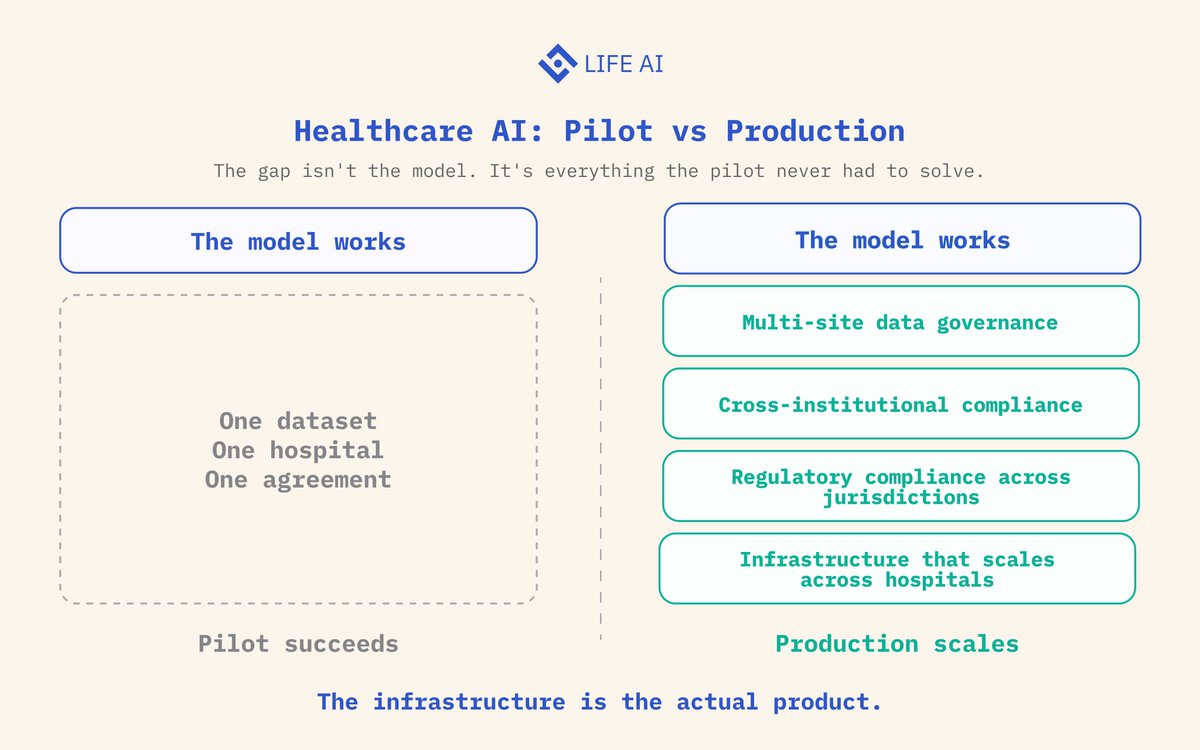
Most Healthcare AI pilots prove that the model works.
Scaling tests something else.
A pilot runs within one institution, one data environment, and one governance framework.
Deployment connects multiple hospitals, labs, regulators, and clinical teams, each with different systems, policies, and operational constraints.
The challenge is no longer model performance.
It is coordinating data, evidence, governance, and decisions across fragmented healthcare organizations.
That is why Healthcare AI deployment is fundamentally a coordination challenge, not just an AI challenge.
Agentic AI is moving from conference keynotes into clinical workflows. The shift is real and the potential is significant.
But there is a constraint that most of the conversation around clinical AI agents is not addressing directly.
An agent is only as reliable as the environment it operates in.
In healthcare, that environment is defined not just by data quality but by the regulatory and institutional frameworks that determine whether the agent's outputs can be acted upon.
A clinical AI agent that surfaces a treatment recommendation is useful.
One whose recommendation can be traced, validated, and accepted by a regulator is deployable.
The difference between those two things is not the model. It is the infrastructure underneath the model, including the data provenance, the validation layer, the compliance architecture that makes the output trustworthy enough to use in a clinical setting.
Agentic AI will not scale in healthcare because the models got better. It will scale when the infrastructure those models depend on is built to the standard the industry actually requires.
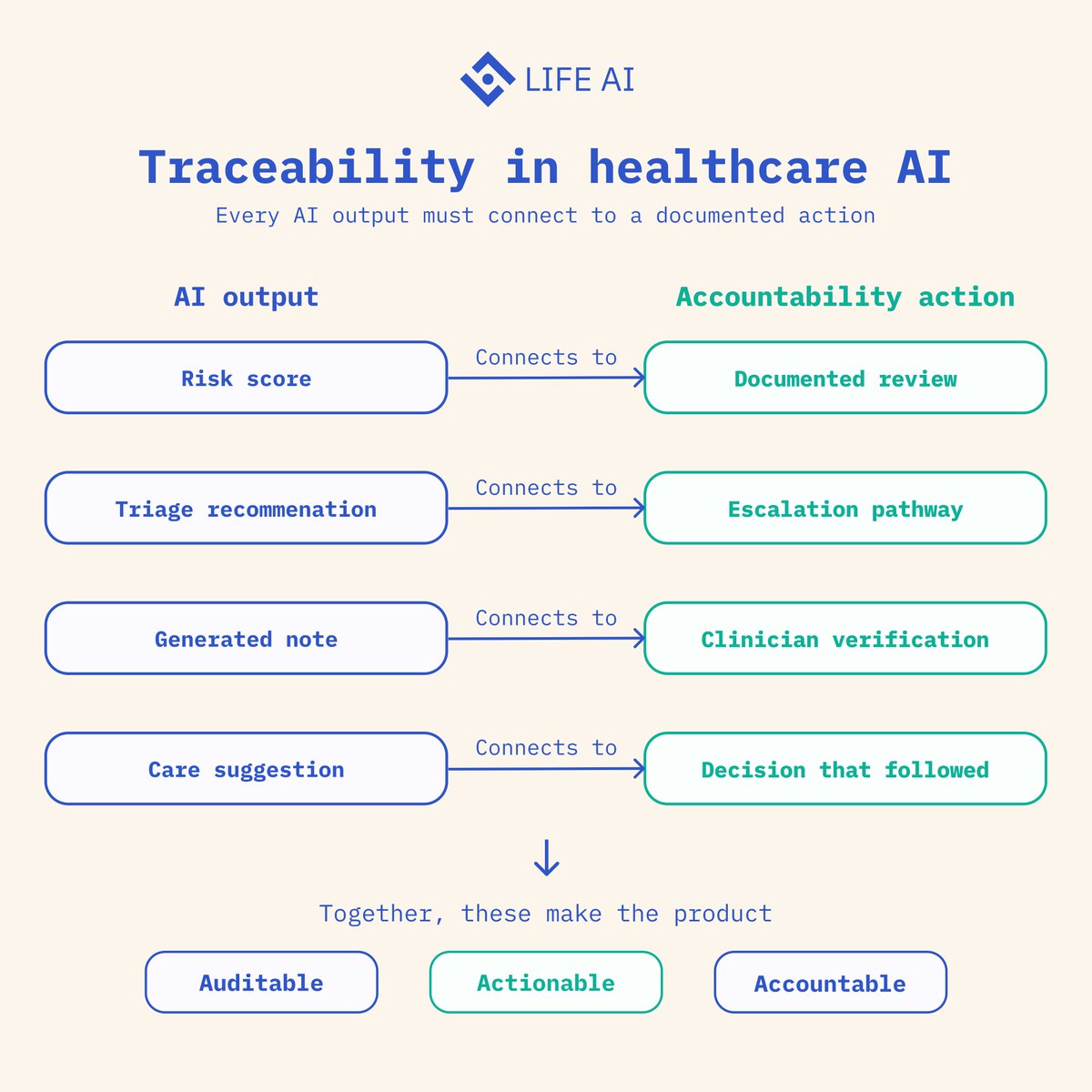
If a healthcare AI product cannot show who acted on its output, when the action occurred, and why the decision was made, it will struggle in real clinical environments.
Clinical teams need more than accurate predictions or well-written summaries.
They need traceability.
A risk score should connect to a documented review.
A triage recommendation should connect to an escalation pathway.
A generated note should connect to clinician verification.
A care suggestion should connect to the decision that followed.
This is not an administrative detail. It is part of clinical accountability.
Healthcare AI products that lack traceability create uncertainty for clinicians, compliance teams, and health system leaders.
The strongest products will not only generate useful outputs.
They will make those outputs auditable, actionable, and accountable inside the care workflow.
Weekend is a golden time for self-care. 💚
Take care of your body. Take care of your mind.
How many can you check off this weekend? Tell us in the comments 👇
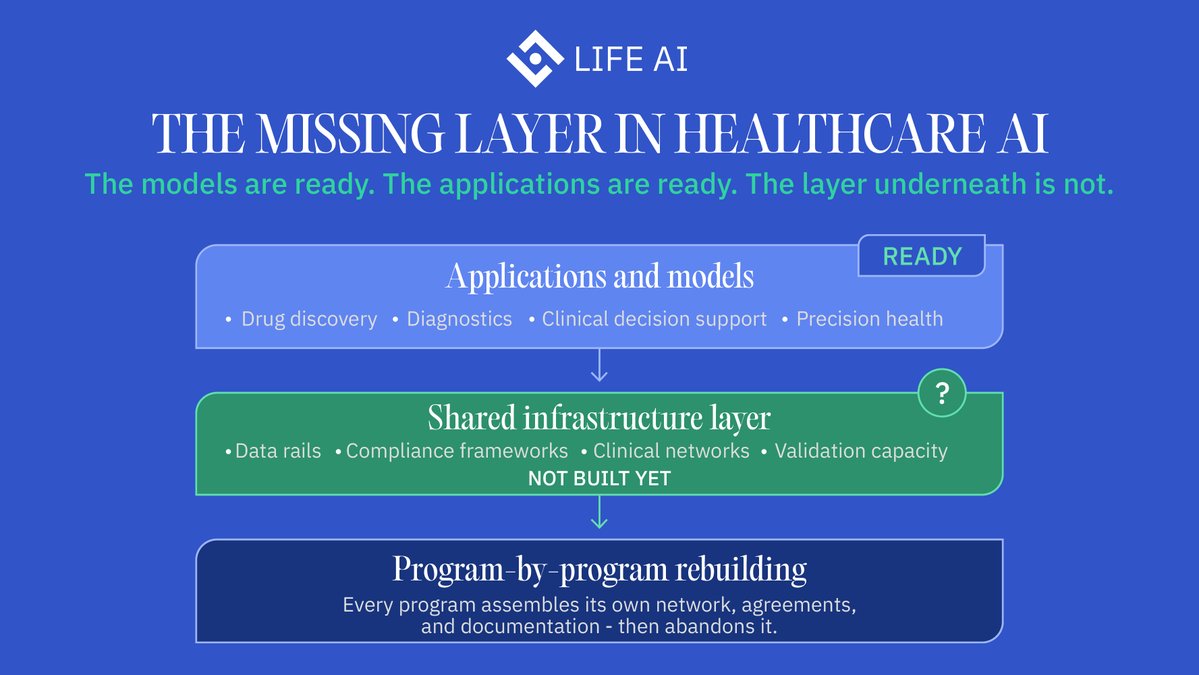
AI has made drug candidates abundant. The industry now has more promising compounds than it can develop.
The bottleneck is not discovery. It is everything that comes after: the clinical networks, compliance frameworks, and data rails that determine whether a candidate ever reaches a patient. Every program builds these from scratch. When the program ends, the work disappears. The next program starts over.
Every industry that scaled did the same thing first: made the underlying work reusable. Fintech called it payment rails. Logistics called it shipping protocols.
Healthcare AI has not made that move. The models are ready. The candidates are ready. The infrastructure that connects them to patients, regulators, and clinical reality is still being assembled by hand, one program at a time.
That is the problem worth solving.