Workshop announcement 📷: We are thrilled to announce the Workshop on Test-Time Adaptation: Model, Adapt Thyself! (MAT) at CVPR 2024 in Seattle @CVPR which centers around opportunities and challenges a model encounters at test-time. [1/5]
In our new paper (oral https://t.co/CPOnCHmWmE, ICCV23), we develop a concept-specific pruning criterion (Density-Based-Pruning) which reduces the training cost by 72%. Joint work with @amrokamal1997@kushal_tirumala@wielandbr@kamalikac@arimorcos (1/5)
https://t.co/q9bsqaC4oe
Ever wondered if CLIP’s stellar generalization performance is just due to high train-test similarity, given its vast and diverse training data? In our new pre-print, we find CLIP seems to genuinely discover much more generalizable features! 1/8
https://t.co/umP3wacAxO
@giffmana Smaller error bars (https://t.co/TYYxJQ6rMw) and robustness to overfitting on the test set (https://t.co/CfX1NFa6Cy) are diminishing quickly once we have a few hundred samples. Though the latter allows mixed interpretations.
@giffmana Made a small, high quality test dataset.
Main weakness for the reviewers was the size comparison to other benchmarks (5k vs 300k), even though we showed that they are 20%-60% noise.
Also that scaling careful human oversight to more data is expensive as a downside of the method.
@aryehazan And the theory of modules over arbitrary (or certain classes of) rings is an immediate generalization of LA that is quite rife with fun surprises.
@aryehazan The highly surprising 😱 issue that there is no natural isomorphism between a vector space and its dual is where all the problems only begin🎭🏚️👻
@maksym_andr At _some_ point with enough data and model size you can (will?) just encode a k-NN classifier (w.r.t. let's say l2 in input space, and large-ish k) and get good standard and robust accuracy.
Though sufficiently covering the image space for good k-NN of course needs a lot of data.
Announcing our Neurips 2023 workshop "XAI in Action: Past, Present, and Future Applications"!
https://t.co/GOvzc6lvMu
Apart from the usual submissions, we have a special "demo" track to demo s/w libraries, visualization tools, applications of ML w major XAI component
Ddl :22 Sept
At #ICML2023 and interested in properly probing ImageNet models for behaviour on truly OOD classes? Come chat with @mueller_mp and me at our poster in today's 2pm session, stand 610! 🖼️
Of course also happy to meet anyone outside of the poster session, please reach out 😊
Improving l1-Certified Robustness via Randomized Smoothing by Leveraging Box Constraints (by me and Matthias Hein) poster at #ICML on Tuesday from 2pm #819, presented by @J_Bitterwolf
I'm not at #ICML due to my conviction against conferences in Hawaii.
https://t.co/IX2xTuALFj
In our new paper (accepted at #ICML2023 🪅, meet @mueller_mp and me there!), we found that most OOD detection datasets for ImageNet are full of ID samples.
To fix this problem and enable reliable evaluations, we release the NINCO dataset. 🧵1/7
🗃️ https://t.co/qU2fyagwk3
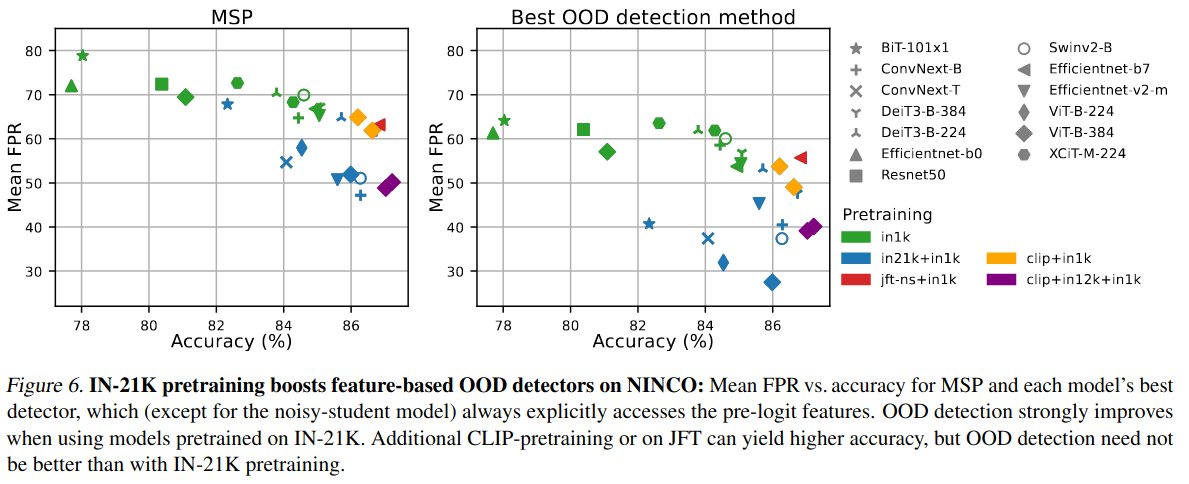
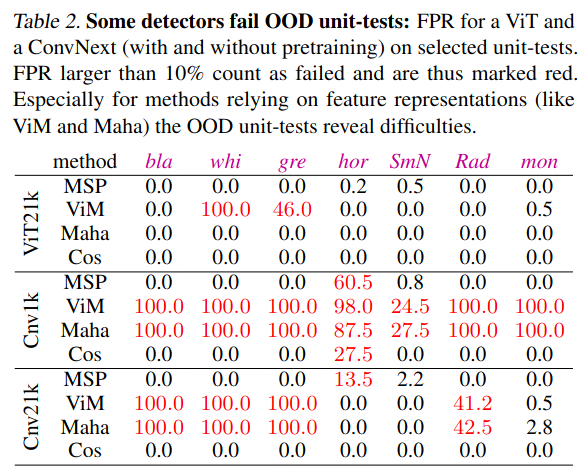
Further insights include that certain (!) pre-training methods help with obtaining strong OOD detectors and that many popular methods fail on easy OOD inputs like completely black images ⬛️ 🧵6/7




![MAThyself's tweet photo. Workshop announcement 📷: We are thrilled to announce the Workshop on Test-Time Adaptation: Model, Adapt Thyself! (MAT) at CVPR 2024 in Seattle @CVPR which centers around opportunities and challenges a model encounters at test-time. [1/5] https://t.co/rmJ9v1C3Hz](https://pbs.twimg.com/media/GIBFPo8XsAAqanp.png)