ultrasound went from a $100k cart → ~$1.2k handheld in 15 years.
butterfly put the transducer on a chip, leaving the medical-device curve for the semiconductor one.
mri is one step behind: hyperfine runs ~$250k against the $1m a shielded room alone costs.
magnet, sonographer, detector all migrating from the room into silicon.
when imaging leaves the hospital, the snapshot becomes a continuous feed.
you can stop scanning once a year, and start watching in real-time: perfusion, vascularization, a tumor's response, eventually mitochondria.
continuous wins, just like a CGM beats an annual HbA1c. the writing's on the wall.
enterprises are demanding determinism from ai in healthcare and finance.
this is an understandable instinct given high stakes decisions: set temperature to 0, require a repeatable trace of reasoning.
but two excellent physicians can examine the same patient and reach slightly different (both defensible) conclusions, and we don’t have a problem with it.
the discomfort with stochastic intelligence is really a discomfort with intelligence itself— the best reasoners, human or not, are the ones who weigh context and sometimes diverge.
we’ll have to get comfortable trading repeatability for quality if we want the best results over time.
ai can hear parkinson's progression before you can see it.
won first place at the healthcare x ai hackathon this weekend building parsel (https://t.co/bnWU3aplzH) — PD progression tracking from voice alone 🏆
the dopaminergic decline that eventually shows up as tremor hits the muscles behind speech first. pitch flattens, cadence drifts, years before anything visible.
train a model to catch that drift against your own baseline, and the phone in your pocket beats an accelerometer wearable as a continuous monitor.
we built:
→ acoustic feature extraction + personalized drift detection
→ federated, so raw audio never leaves the device
→ a voice agent (elevenlabs) for quick, natural check-ins
→ a dashboard that makes physicians more efficient
mostly popped in to meet people building in healthtech and have some fun but the win was a cherry on top. personalized medicine is here. let's keep building it!
shoutout teammates @ dhairya, bonnie, @gokulnpcc.
thanks @HealthcareAIGuy
and it doesn’t stop the body when it comes to ultrasound… aleph just pulled the highest-res images of the brain ever taken from outside the skull.
the dead-zones are vanishing faster than many realize.
We recently obtained the highest-resolution 3D images of the human brain ever taken from outside the skull. This is the first look.
Introducing Aleph, a research lab building brain interfaces for the telepathic future. (1/n)
i'm seeing agi-pilled hype from the midjourney scanner meet traditionalist-md skepticism all over the place in the wake of these recent announcements...
it can be concurrently true that the current state of sensors (in this case, ultrasound) will cause problems when inserted into the current healthcare ecosystem (false-positives, physical limitations like bone, regulatory bottlenecks, etc),
AND these breakthroughs are the first dominos to fall in the shift toward continuous, personalized, preventative, consumer-centric medicine:
but the overwhelmingly important trend that warrants the hype is the democratization of sensors that will measure what medicine used to be blind to.
i think we can concede to the skeptics that any one consumer sensor in current form is not sufficient to monitor, inform, or diagnose, but the piece they miss is the trend toward the sensor stack...
your physiology is a high-dimensional latent state. every sensor — ultrasound on silicon, light reading metabolites, a probe in the blood — is a noisy, low-rank projection of it. medicine has always been a few episodic points on that surface and a guess about the rest.
sensors are blind in different places — ultrasound stops at bone, light stops at depth — so you stack modalities until the dead zones stop overlapping. like stacking swiss cheese until the holes go away. and the set of things physically out of reach shrinks every year.
today, yeah, you might panic over a benign polyp that midjourney finds for you and it will be a net-negative experience, but a) it will equally find issues that require intervention, and b) the same noisy stream resolves into higher and higher resolution over time— as the models train on millions of bodies, they get better at reconstructing from low-res signal and inferring consequences of an image.
so this kind of news is incredibly exciting because the sensors are improving at the same time as the ai that reads them. the sensor can stay fixed and the picture will still sharpen.
@Brady_H fun to track! pumped to see your overlay with dose and ratio of fueling. would be super cool if you included the lead-up. and remember interstitial measurement means a 10-20 min delay! crush it, brotha
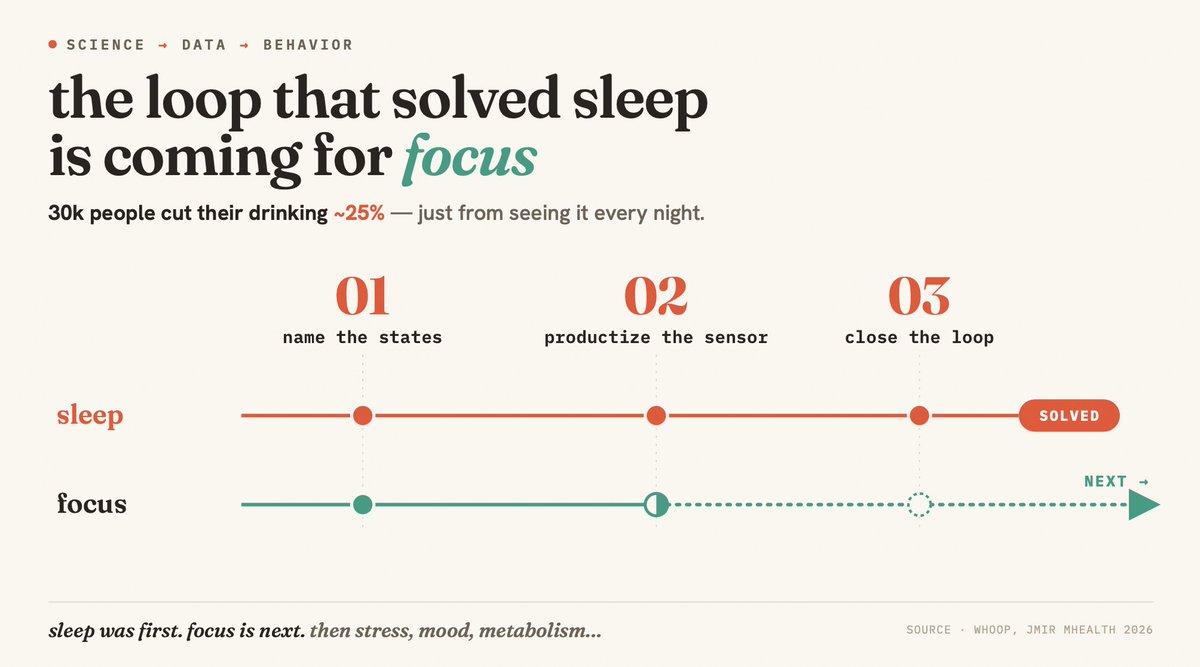
when 30,000 people put on a whoop they cut their drinking: a 25% drop in odds of drinking on any given day.
the wristband showed them what alcohol did to their recovery until they changed intake.
this rapid rise of sleep score chasing is an indicator of what's to come in real-time behavioral analytics, and it arrives in 3 steps:
1) the science names the states. with sleep we validated taxonomy— stages, cycles, RHR, HRV... and people like matt walker made everyone care.
2) the sensor hardware productized to be cheap enough for your wrist and accurate enough to score those stages off heart rate and accelerometer data.
3) wearable companies closed the loop on the software side with gamified motivation and personalized sensitivity calibration. the goal being to dopamine-reward day-to-day intervention. this turns passive data into modifiable habit.
but this research understanding → data collection → behavioral looping framework can be applied to many more domains.
waking state classification is the obvious next domain. flow, focus, deep work, fatigue. these are classifiable and personalizable off pupillometry, HR, blink rate, task output, vocal fluctuation. tobii and pupil labs are already starting here.
this will run in the background of your day the way sleep staging runs at night... noticing patterns in calls, productivity, energy levels.
and if the states are readable, levers in behavioral intervention can close the loop: morning sunlight, caffeine dose and timing, temperature, where you sit... interpretation will reward intervention.
just like alcohol so obviously affected sleep, we'll soon find that there is low hanging fruit to nudge cognitive engagement for mental performance and health.
you don’t optimize what you say you want. you optimize what you measure.
there is an ever growing selection of metrics that can be used to close feedback loops of optimizing functions.
sleep score, salary, speed… but it’s not even goodharts law because these were never good metrics in the first place.
the trap of using these readily available scoreboards in place of what you really want is conflating controllable cause with legible effect.
if you’re a cyclist, fitness may be a targeted output. wattage would be a good metric, yet you’ll see dudes in full kitted lycra and an 8k bike on their commute to work because they’re tracking speed.
but it’s also about identity. the costume is a signal that produces a feeling more than any objective outcome. and when you optimize for what feels like progress, it often leads to neglecting the thing that produces it.
a default that leads to a poor metric function is no excuse. just because salary is easier to measure than optionality, speed is easier to measure than power… isn’t a reason to be less intentional.
the best feedback loops are closed a layer deeper. they’re defined on an individual basis by metric functions that capture the sum of an outputs parts precisely.
This is one of the most pivotal events in history because of the precedent it sets. Even if it doesn't stick, the cat is out of the bag: the government can now unilaterally decide who gets to use AI.
Over the last few days I had fully transitioned to orchestrating with Fable. It initially felt like the cookie jar was moved out of reach. Now after spending the day with Opus, I've accepted just how monumental this is.
Being denied the best AI model is effectively the same as being denied future employment.
the parts for a wearable biosensor cost less than dinner. five boards for the price of a coffee, fabbed in 48 hours.
so why is software getting solo founders while hardware stays a team sport? it's the stack of specialists you needed in one room to prototype— analog, firmware, dsp, rf, power, mechanical, electrochemistry. all phds, traditionally 100s of thousands of $ to get one working prototype.
jeff bezos is going all in on the artificial general engineer... when he, or someone else succeeds, you can do this at home for 1/10,000th the cost.
agents lay out the board, write the firmware, generate the rtl from a sentence, orchestrate the ten tools that used to need ten people, and print on demand. siemens, cadence, flux, quilter— the phd teams in a model.
then the bottleneck for new consumer health tech will quickly become the body and the fda. does the electrode survive skin, does the signal survive motion, does it hold calibration for three weeks?
we validate these sensors in our labs, and good engineering doesn't guarantee reliability... and can our system adapt to keep up with floods of new regulatory submissions?
the solo hardware founder is coming to health. but the moat moves too. it stops being can you build it. it becomes can you prove it and can the fda keep up.
the bench is almost free. the body is the new moat.
your body throws off ~100,000 heartbeats a day, ~20,000 breaths, a glucose reading every few minutes — about 18 GB a year, ~1.4 TB over a life. and that's just today's sensors.
right now we collapse that whole firehose into a few numbers a year. an HbA1c. a blood pressure. a cholesterol panel.
and it's not for lack of sensors. whoop, oura, dexcom, irhythm. the stream's been there all along.
in the last year, a model's working memory crossed from about a month of your data to a year— and it's pointed at a lifetime.
continuous health's bottleneck was always interpretation wide enough to hold the wearables, not the hardware itself.
so the snapshot becomes a feed. a model reads billions of your own datapoints and learns your baseline, not the population's. it reads you day to day, not a 15-minute visit once a year.
a better sensor isn't what we're waiting on. a reader that can hold a whole life of physiology in context is.
it's almost here.
the bottleneck for ai agents in health is that the data is siloed… yours, but also the public research data behind drug discovery and virology surveillance.
so retrieval is downstream of a governance problem, for now. the individual is the only node with authorization to aggregate across every gate—
which may be the path to make patient-owned ground truth licensable as a whole.
think terra’s api model, individually consented— with the licensing end roughly what tempus is building.
seems to be a prerequisite for medicine 3.0
New Science Blog: Why has AI advanced faster in coding than in biology?
To agents, bio databases are like cities built before cars—maddening to drive in because they're designed for different traffic.
How do we build infrastructure agents can use?
https://t.co/PQaNQ4GRJZ
@LoRezTrader yeah weaker magnet worse resolution.
3T still the gold standard for reading one image at max detail but low-field + AI
makes it cheap, repeatable, bedside.
for monitoring, frequency wins. and AI reconstruction is closing the gap without strengthening magnets.
ultrasound went from a $100k cart → ~$1.2k handheld in 15 years.
butterfly put the transducer on a chip, leaving the medical-device curve for the semiconductor one.
mri is one step behind: hyperfine runs ~$250k against the $1m a shielded room alone costs.
magnet, sonographer, detector all migrating from the room into silicon.
when imaging leaves the hospital, the snapshot becomes a continuous feed.
you can stop scanning once a year, and start watching in real-time: perfusion, vascularization, a tumor's response, eventually mitochondria.
continuous wins, just like a CGM beats an annual HbA1c. the writing's on the wall.
endurance training is the only thing that simultaneously:
increases mitochondrial size, quantity, electron transport capacity, and oxidative stress buffering all at once.
oh and it also:
makes your heart more efficient,
cells more responsive to fuel,
mobilizes fat over storing it,
clears out damaged organelles and proteins,
repairs dna,
remodels the epigenome,
reduces senescent cells,
kills circulating cancer cells,
improves blood flow to the brain, and
enhances immune function.
there’s really nothing that comes close to the benefits, for longevity and mental and physical performance.
that new fad diet and getting a standing desk will probably work though. sure, do that instead. sounds smart.