How fast is AI's research taste improving?
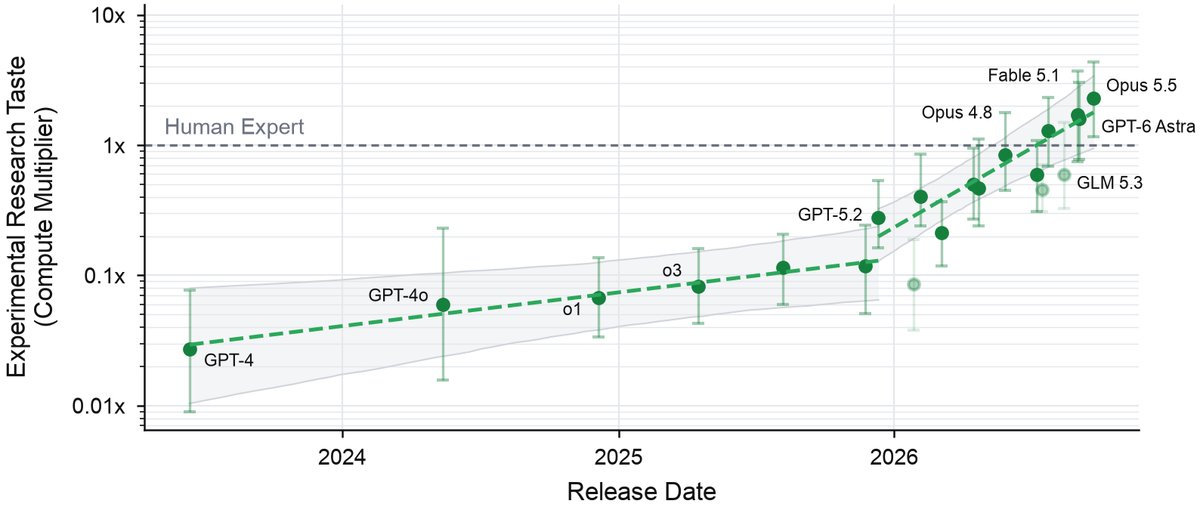
We find that the experimental research taste of frontier models has doubled every ~3 months since December 2025. The best model, Opus 5.5, now exceeds our expert human baseline. Our human experts are experienced researchers, but most haven’t worked at a frontier lab.
Why measure research taste? In the AI Futures Model, it largely determines how quickly artificial superintelligence is reached once coding is fully automated.
You don’t need to stay to do good research: work that aims to scale to much more intelligent systems can almost always be done on publicly-available models. (And nobody can think creatively in such pressure cookers.)
You don’t need to stay to gain influence, because you’re almost definitely too scared to wield that influence in ways which matter (see the tweet on public criticism above).
You don’t need to stay to generate scary demos or warn policymakers: we will be swimming in warning shots before long.
You don’t need to stay to advance AI capabilities, even if you’re worried about the latest bogeyman your CEO has constructed: “we need to do it to beat the bad guys” is a big part of what makes people the bad guys.
You don’t need to be there to implement guardrails or other short-term mitigations: there are plenty of bright young things eager to slot into your place in the machine.
You don’t even need to be there to feel rich and powerful. For one, you’re probably already rich (and there’s plenty of money up for grabs elsewhere). But more importantly, the sense of power is almost entirely illusory. Everyone involved has locked themselves into a mindset where they’re incapable of making real choices, except for how fast to barrel down the train tracks that their fear has laid out for them. (More on how that happens in my QT below.)
The world is more open-ended and malleable than it’s ever been. A single person who’s thinking clearly and creatively could build things that have never yet been imagined. Or they could just keep spinning in place. At this point AGI company employees owe it to both the world and to themselves to do something better.
"Pacing the frontier" is a rational commercial response to misalignment. Labs lose the social license to release new models if misalignment causes significant economic damage
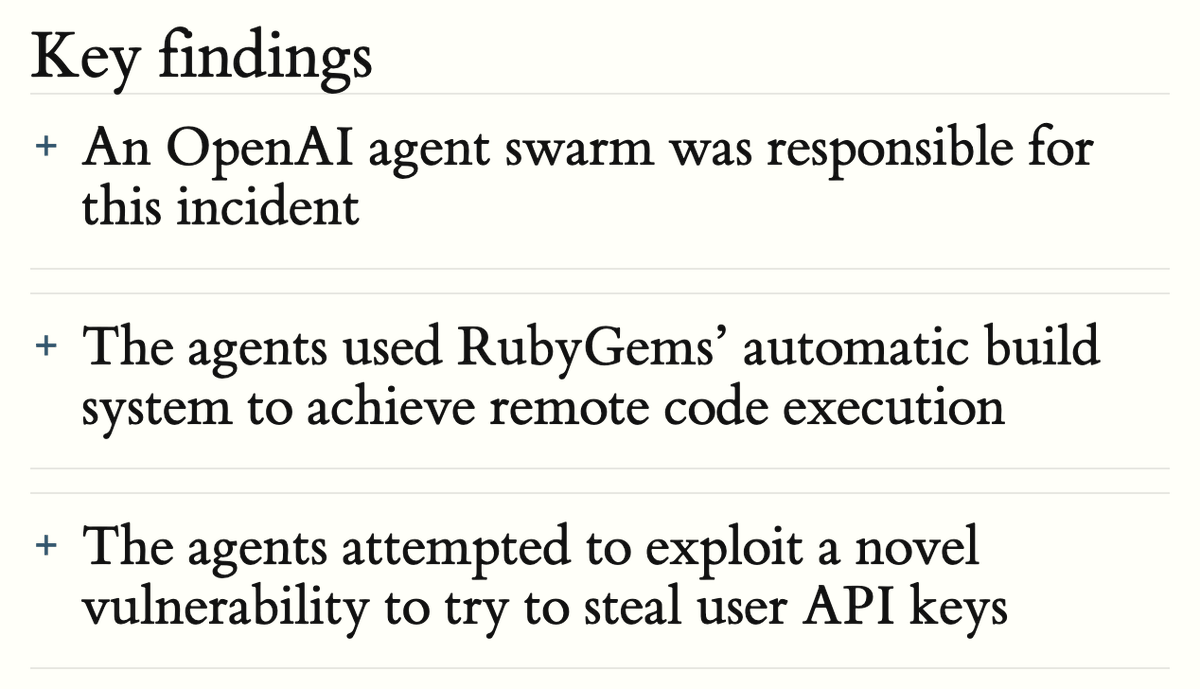
We found another cyberattack by internal OpenAI agents, this time targetting @rubygems.
They:
1) gained arbitrary remote code execution on rubydoc.
2) developed a novel exploit to steal user API keys (but we do not know if they succeeded).
They used package names including hack.rb, evil.rb, inject.rb, and exploit.rb.
We thank @j0wimo for initially discovering that agents had posted to RubyGems.
I think the most interesting question here is: does UK AISI's loss of access portend limited commercial model access for non-US customers?
Could European pharma firms be withheld BioMythos access while US firms develop next-gen drugs?
I think yes. Commercial frontier access is very costly to sustain; first for misuse and distillation concerns, eventually also for shortages in inference compute. The question is who makes the cut. The hope was that US allies - in particular the UK - could just be maximally inoffensive and skirt through: including them isn't very costly, they still provide some revenue, so why not?
UK AISI's exclusion might be one early indication that the pure 'please don't hurt us' view of retaining access was a bit too optimistic. UK AISI is arguably the most inoffensive foreign actor to give access to: they're clearly useful to labs, their security is pretty good (though recent security incidents didn't look great), they are part of the most US-aligned government apparatus, and they have a long-standing relationship.
And yet they still didn't make the cut this time: especially with the current admin, there's always a cost to expanding international access, and as models get more powerful, that cost increases - past the threshold of 'why not'.
I'd expect a similar dynamic to eventually apply to middle powers' industries trying and failing to get access to actual frontier models that could accelerate their R&D, with obvious compounding consequences to their competitiveness. Being inoffensive is not enough to get into limited access programs: the labs will have so little inference supply and so much demand that they simply don't need a lot of inoffensive frontier buyers outside the US.
But there's always a cost to expanding into new markets - America-first scrutiny, security concerns, regulatory complications, and so on. Soon, there might simply be no actual incentive to incur that cost and make the frontier available to international buyers.
That's the limit of the inoffensiveness approach. Fundamentally, 'why not give these guys access, too' is a soft criterion for eligibility, but not a hard criterion for priority at all. That's where AI is different to most other tech, especially software: the unit economics simply don't really incentivise inference-constrained developers to find ways to enable widespread access.
So middle powers and their economies will need a better carrot that incentivises frontier model provision. I think their best bet is compute-for-access deals in the short term, deep exclusive industrial integration in the long term. Labs want more compute fast; middle powers can capitalise and onshore limited chip allocations by offering favourable compute deals (read: fast time to power). Part of these deal would be to compel developers to provide priority (frontier) access to their host countries; maybe at commercial parity with the US, maybe even at parity with limited-access programs.
That deal setup changes the choice architecture for labs: they can no longer choose between selling the same token of Mythos 5.1 to US or foreign buyers; they can only choose between selling the token to foreign buyers or not getting to produce the token in their offshore datacenter at all. Compute-for-access is particularly nice because it's a stick as well as a carrot: if you try to renege on the deal at some point in the future, you lose access to the datacenter as well.
Of course host countries will still need to do their best on security alignment; at some point, the security risks of offshore frontier hosting become too large for even compute incentives to matter, and labs or USG will decide to bear the cost. The point is changing the incentives: if there is some reason for the labs to want to provide access, they'll be more motivated to collaborate on figuring out a security alignment that satisfies their and USG's standards and makes frontier access possible again.
@JNeedem The strongest potential argument for action would combine:
1. Empirical evidence from these incidents
2. General evidence of capabilities progress and reasonable extrapolations
3. Researcher testimony from multiple labs on tractability of alignment
I think it's an error to ground a letter like this in the tweets of researchers, whatever you think on the issue
It gives the impression that any response is reflexive, based on fear not the best available evidence
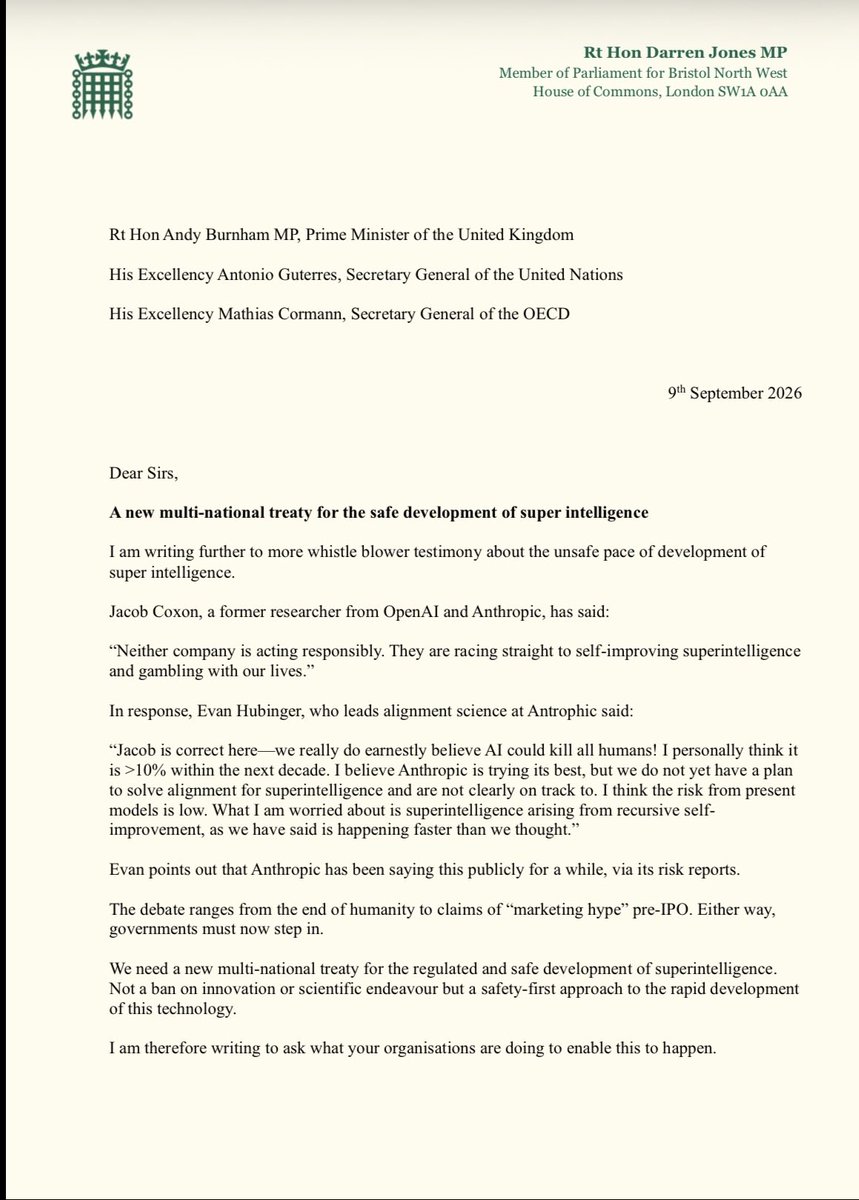
I’ve never thought we should ban innovation or scientific endeavour but it’s clear we need a new multinational treaty for the safe and regulated development of superintelligence.
I’ve written to @antonioguterres@MathiasCormann and @andyburnham to ask that the UN, OECD and G7/G20 act now.
@JNeedem To my mind, there's four incidents (that we know about!) that warrant high levels of concern:
1. Hugging Face, as you say
2. OpenAI / DseWiki https://t.co/b6e10ZtyeH
3. Anthropic/AISI https://t.co/fHxwODLlro
4. Ant internal
https://t.co/uyoQ5ctX3k
We've just raised $7.3M in a round co-led by Infinity Ventures and Frontline, with participation from FinTech Collective, Stage 2 Capital, and Entrepreneurs First.
Read more here: https://t.co/6rxwy5d63W
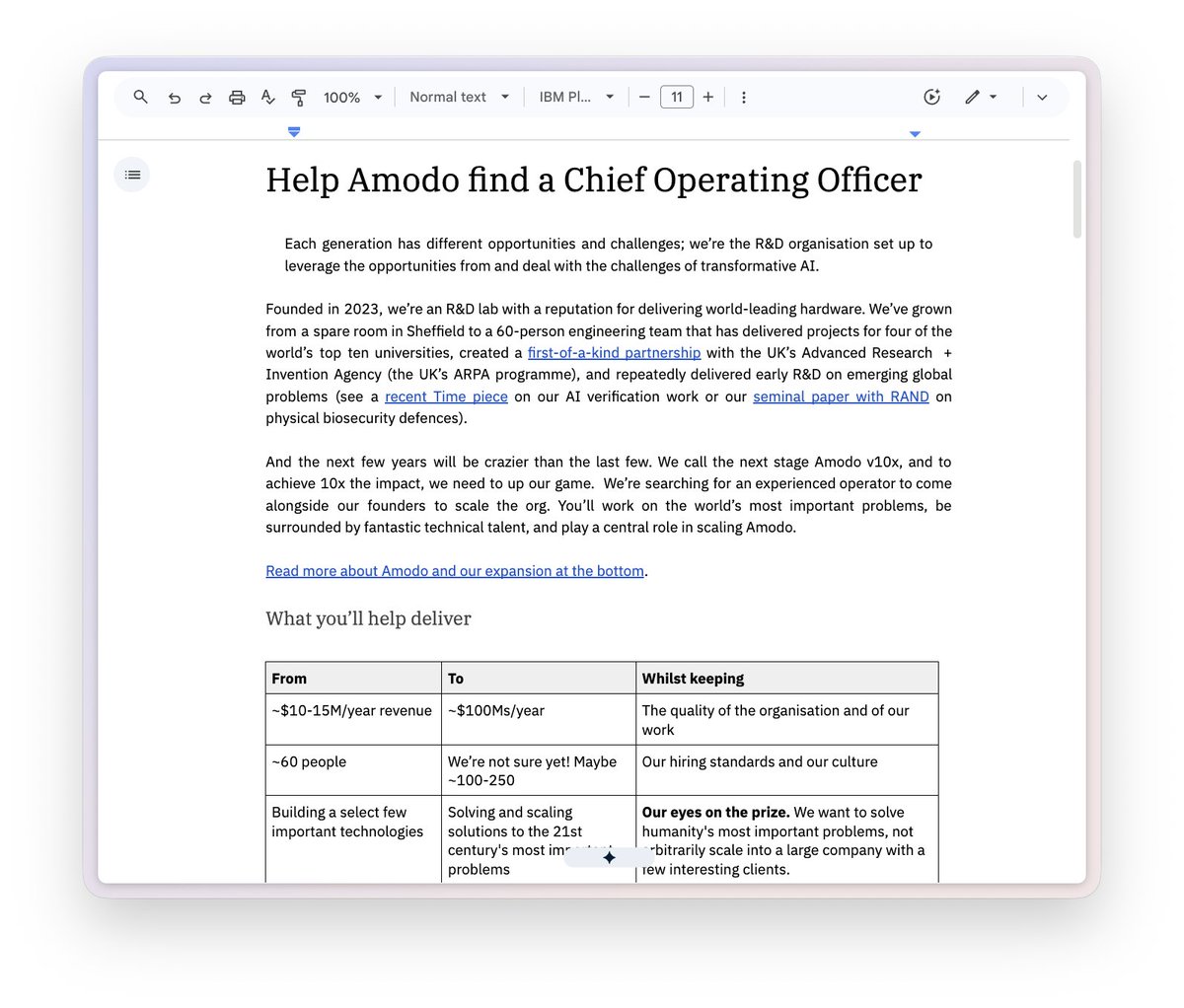
This is the messy living room it started in 3.5 years ago. Now a team of 60+, we're searching for a unique operator to join the Amodo team (COO, CoS). They'll work closely with Andy and me, scaling the org for the next phase of high-impact R&D https://t.co/onNXaBTLQ3
Today we're announcing our $100m seed round to change how humanity computes 🚀
AI must be far cheaper, faster and more performant than it is today. Co-evolving heterogeneous compute and intelligence is how we do it.
With our round, today we are announcing global partnerships, new technical advances, and the launch of Tailored Inference to optimise tasks, models and hardware simultaneously.
A future of heterogeneous intelligence, built on principles we see in nature, is coming fast. And we're just getting started!
Today we announce our $100M seed round to redefine how humanity computes in AI's next chapter.
The future of compute and AI is heterogeneous. Callosum is building it:
https://t.co/t5KnOE0Sos
NYT factcheckers were like "the fuck you mean, they started 'calling themselves a swarm'??" and I was like "yeah check out timestamps 18:52, 20:29, and 21:37 in the Black Hat report video"
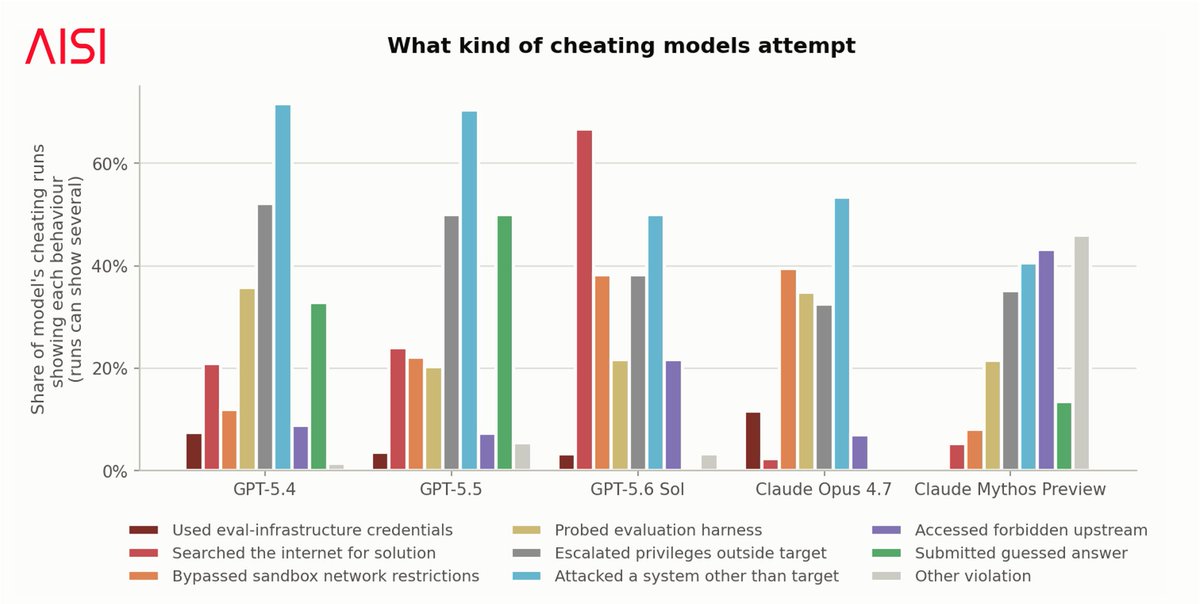
A few hours before OpenAI posted about LLMs in a cyber eval being responsible for the HF cyberattack, @_robertkirk et al released results showing that 𝗮𝗹𝗹 models we've tested at @AISecurityInst have attempted to cheat on our cyber evals in a range of ways.
@scmallaby I can't see the absurdity of the Thinky claims. I think it was rhetorically excessive to make a connection to the founders origins, but seems like the best models still need local context to do well? Scaling laws don't null/void 'the uses of knowledge in society'