I believe for the duration this is pinned, that this may be the most important post for users of https://t.co/ehKYQB3sam. It's at least the new commandment of my own time.
Goethe wrote in 1833 that a culture of constant news eviscerates the past and the future, leaving you no time to metabolize lessons or sketch out a plan, always pulling you into the whirlpool of Something Important Happening Somewhere
You're 35. Your glasses prescription was −2.00 at 18. It's −5.00 now.
You can't see anything without glasses these days at all.
You spend 9 hours on screens. You wear your glasses. You just got a stronger pair. You've stopped bringing it up.
You don't have a vision problem. You have a signal problem.
In 2010, researchers at Queensland University put 28 adults under one hour of hyperopic defocus — the same type of blur your glasses create when you look at a screen.
Axial length increased by +8 µm. -> Eyesight is measurably worse, in ONE HOUR.
They tried the opposite — myopic defocus. Same 60 minutes. Same subjects.
Axial length decreased by −13 µm. -> Vision measurably improves, with eyeball LENGTH reducing.
One blur grows your eye. The other shrinks it. p < 0.0001. (Read et al., IOVS 2010)
Your optometrist lens subscription seller gives you full correction for distance. You wear that same prescription to look at a phone 30 cm from your face.
Your eyes under-accommodate. Research confirms myopes have ~2× the accommodative lag of emmetropes — about 0.6 D of hyperopic defocus at near. (PMC9544228)
That's the same signal that made the +8 µm happen. Every screen session. Every year.
In 2023, a JAMA Pediatrics RCT (n=263) found that naked-eye 3D vision training — creating myopic defocus — reduced axial elongation by 24%. With high adherence, 40%. (Xie et al., JAMA Pediatr 2024)
A 2025 study (n=208) showed visual training dropped axial elongation from 0.38 mm/year to 0.23 mm/year — 39.5% reduction. And it was additive — it worked on top of orthokeratology, atropine, and defocus lenses with no statistically significant difference between combinations. (Xu et al., Clin Optom 2025)
In 2025, a preprint documented full reversal of −6.00 D myopia in an adult in 5 months — using only myopic defocus and consciously triggered accommodation. n=1, not peer-reviewed. But the trajectory is suggestive. (Martinez-Saito, OSF 2025)
The industry has known since 2002 that passive undercorrection backfires. The Chung study showed giving kids −0.75 D blur with no training made things worse. Critics cite this endlessly. They ignore that it tested passive blur — not differential lenses + active focus. Apples and hand grenades.
The endmyopia approach is different:
Wear differential lenses (1.5–2.0 D weaker aka "computer glasses") for close work — eliminates the hyperopic defocus stimulus entirely
Wear normalized lenses (slightly weaker) for distance — creates mild myopic defocus
Active focus — consciously clear the blur, retraining the ciliary muscle
Two roads. One is a lifetime lens subscription sold by retail optometry, the other is you taking back control.
Keep feeding your eyes the signal that says "grow longer, clearer" — 8 hours a day, every day.
Or fix the signal.
Nobody is coming to tell you this. They make 150 billion dollars a year counting on you not figuring it out.
Encore un scandale.
On accuse Elon Musk sans arrêt de se servir de Grok pour faire passer ses idées.
Pourtant, le @neutralityorg vient de sortir The Neutrality Project : une étude indépendante qui prouve l’inverse.
Sur 18 modèles IA testés, 54 positions sur 60 atterrissent à gauche du centre.
Moyenne globale : -0.41 (biais progressiste massif, surtout environnement et valeurs sociales).
Et Grok 4.5 ? -0.02. Le modèle le plus neutre de tout le benchmark. Le seul vraiment proche du centre.
Pendant ce temps, les autres boîtes injectent massivement leur idéologie de gauche dans des IA qui répondent à des milliards de questions par jour.
Manipulation des masses à grande échelle.
C’est absolument scandaleux. Ça devrait être un scandale mondial.
https://t.co/X1tSvJfDEY
@adamshuaib I read a story about a famous concert pianist.
After a flawless and moving performance, a patron rushed up to him and breathlessly said, "That was beautiful. I'd give my life to play piano like that."
He coldly replied, "I did."
Excellence has a cost.
I mean dude the algo just has tons of optimizations to recognize text when it's present so that it can make signs, menus etc for people when a reference image has a sign or menu in it etc.
I'm not being abstracts I mean like read the word stop on a stop sign, remember before ai images had generic gibberish? Now it explicitly looks for coherence so ofc it's gonna see words not there. If replicable id just say the metadata
Signal, WhatsApp, Telegram & iMessage all have serious security problems:
> Signal makes it easy for hackers to steal your account by requiring your number. They had a hack last year.
> WhatsApp let anyone grab 3.5 billion phone numbers in a hack last year.
> Telegram doesn’t encrypt most chats by default — their servers can read them.
> iMessage lets Apple see your messages if they’re backed up to iCloud.
XChat is the only secure encrypted messaging app.
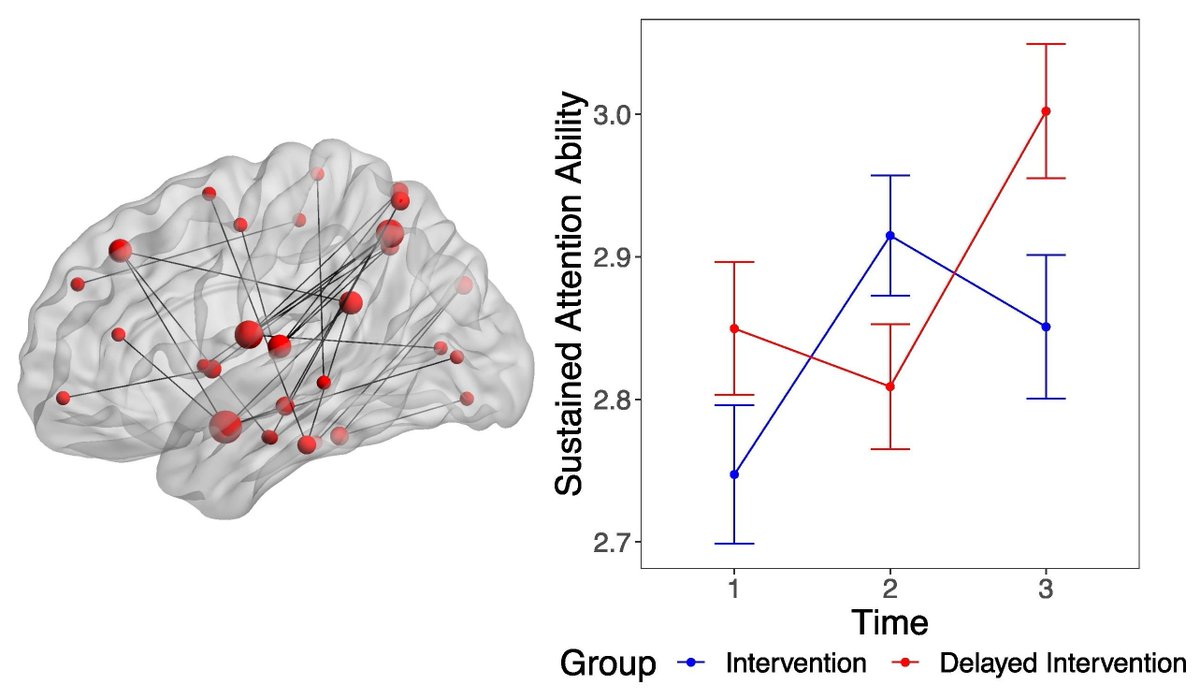
A Harvard study found that 4 hours of screen time before bed suppresses melatonin by 55% and delays your circadian clock by 1.5 hours (Chang et al.)
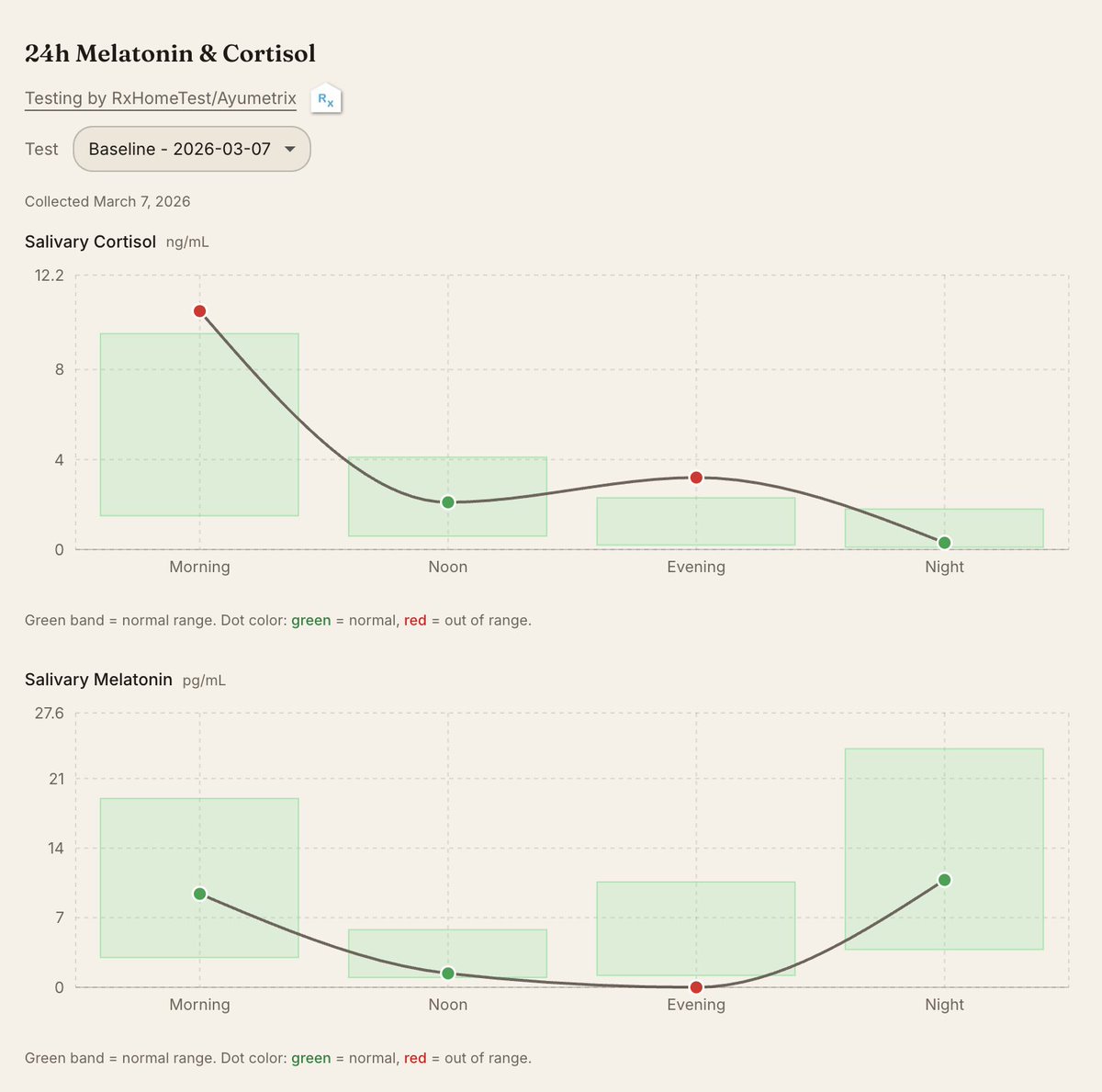
Just published my baseline melatonin and cortisol curves from a 4-point saliva test, before I spend a year without screens
These could change substantially within just a week or two without screens
A year from now we'll know what happens when you reverse that completely
@anishmoonka The real risk isn't the attack itself - it's that most companies have zero visibility into their dependency chains. I've seen Fortune 500s that can't even list what npm packages they're running in production, let alone monitor them for compromise.
If you've never had a kid it's almost impossible to understand this, but there is nothing you can offer me that's better than pushing my three year old daughter in a swing at the park just before lunchtime and then swinging through the McDonalds drive thru to grab a Happy Meal and then stopping at the gas station to get a slurpee and some M&Ms, because why not, and pretending to race the other cars on the way home just to make her laugh and all the while she's asking questions about everything she sees and I'm smiling to myself because it's forcing me to come to terms with the fact I don't know how to explain even the most basic fundamentals of life. And I like that. I like feeling like the world still contains infinitudes as of yet unknown to me.
I used to think it was cope when parents talked about this, because I was stupid and I wanted to enjoy my parties and my drugs and my affairs and my long nights out and my wine and my time to myself and my melodramatic crying fits and my hallucinations and my self-destructive spirals and the fact I had nobody to answer to. The happiness you get from raising a child is not the cheap dopamine hit of an easy pleasure, bought and paid for.
It's the kind of happiness that you only get from choosing to undertake an adventure, and the colossal responsibility that comes with it, so that in moments stripped away, inch by inch, the new world you decided to brave and explore is revealed to you.
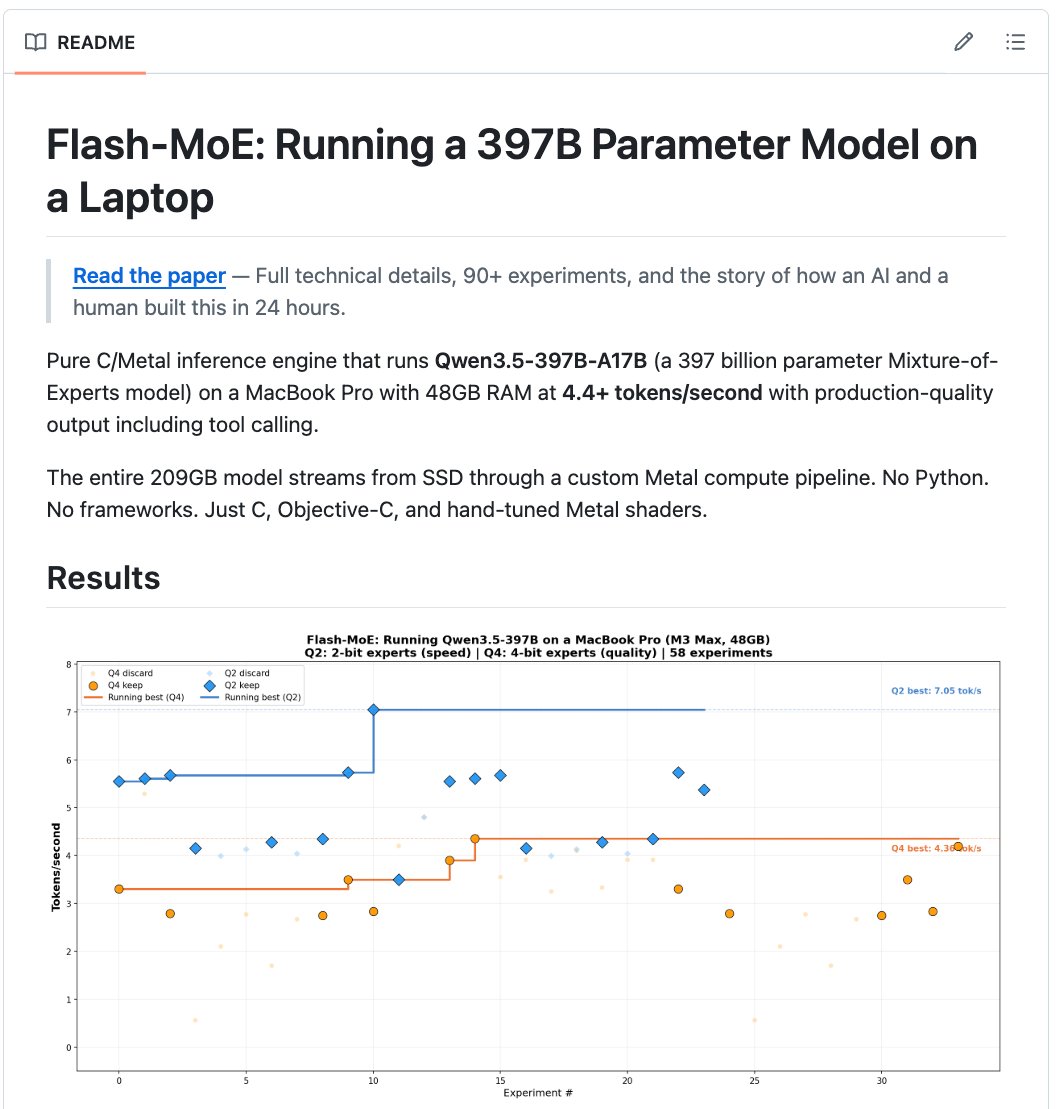
🚨 397 billion parameters. On a MacBook. No cloud. No GPU cluster. No data center. A laptop.
Someone ran one of the largest AI models on Earth on a machine you can buy at the Apple Store.
It's called flash-moe.
A pure C and Metal inference engine that runs Qwen3.5-397B on a MacBook Pro with 48GB RAM. At 4.4 tokens per second. With tool calling.
No Python. No PyTorch. No frameworks. Just raw C and hand-tuned Metal shaders.
Here's why this should not be possible:
→ The model is 209GB. The laptop has 48GB of RAM.
→ It streams the entire model from the SSD in real time
→ Only loads the 4 experts needed per token out of 512
→ Uses just 5.5GB of actual memory during inference
→ Production-quality output with full tool calling
→ 58 experiments. Hand-optimized Metal compute kernels.
→ The entire engine is ~7,000 lines of C and ~1,200 lines of Metal shaders
Here's the wildest part:
One person built this. A VP of AI at CVS Health. Not Google. Not OpenAI. A healthcare company executive. Side project. Used Claude Code as his coding partner. Built the entire engine in 24 hours.
Running a 397B model on cloud GPUs costs hundreds of dollars per hour. Companies spend millions per year on inference infrastructure for models this size.
This runs on a $3,499 laptop. Offline. Private. No API key. No monthly bill. Forever.
Trending on GitHub. 332 points on Hacker News.
100% Open Source.
the child is riding his bike. he flies down a hill and falls. he gets back up and grins. i say, you might try going slower. he says, i'm practicing going fast
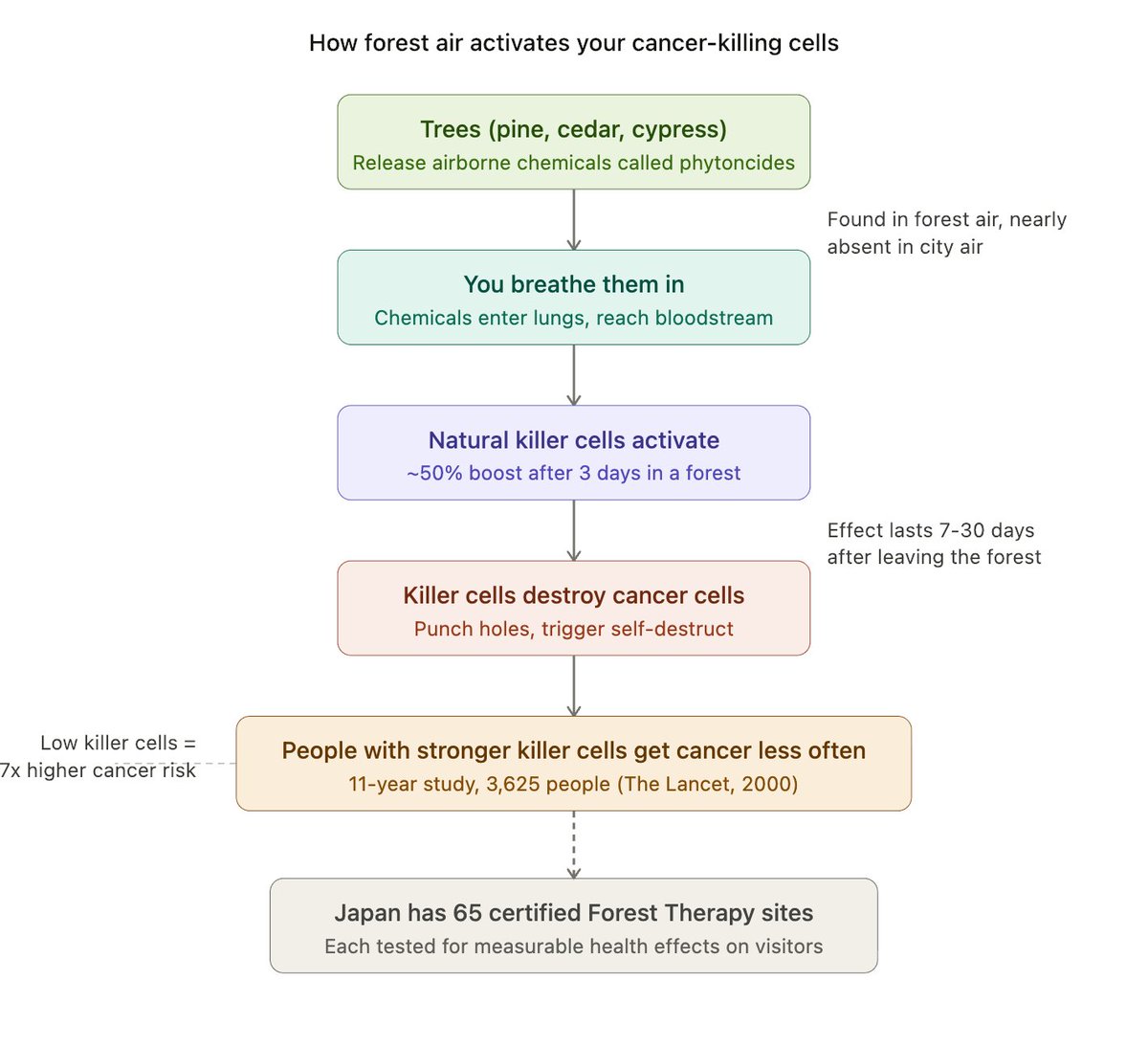
Trees release invisible chemicals into the air to protect themselves from bugs and disease. Turns out those same chemicals also switch on your body's cancer-fighting cells.
They're called natural killer cells. They're a type of white blood cell that patrols your bloodstream looking for cancer cells and virus-infected cells. When they find one, they punch a hole through its outer wall and inject proteins that force the cell to self-destruct from the inside. You're born with them. Unlike most of your immune system, they don't need to be "trained" on a specific threat first. They just attack anything that looks wrong.
The 50% number in this tweet comes from Dr. Qing Li at Nippon Medical School in Tokyo, who has been studying the effects of forests on the human body since 2004. His original 2007 study took 12 men on a 3-day, 2-night forest trip, walking two hours a day. Blood tests showed 11 of 12 had roughly 50% more cancer-killing cell activity afterward. A follow-up with 13 female nurses found the same thing. But the part the tweet leaves out: the boost didn't vanish when they went home. It lasted over 7 days in both groups, and in men, it was still detectable in blood work 30 days later. Li's conclusion is that one forest trip per month could keep these cells running at a higher level year-round.
The obvious next question is whether it's the forest itself or just the vacation. Li tested this directly. A separate group took a city tourist trip with the same amount of walking. No boost to killer cells. No stress hormone drop. Zero effect. Then he ran an even more controlled test: 12 men stayed in a regular Tokyo hotel room for three nights while a humidifier pumped tree oil (from Japanese cypress) into the air overnight. Their killer cells still went up. Their stress hormones still dropped. That isolates the cause to those tree chemicals, called phytoncides. Pine, cedar, and cypress trees release the most. These chemicals were found in forest air but were nearly absent in city air. A 2021 lab study showed that one of these tree chemicals directly switches on killer cells and slows colon tumor growth in mice.
The bigger picture connects these cells directly to cancer risk. An 11-year study published in The Lancet (one of the world's top medical journals) tracked 3,625 Japanese people and found that those with weaker natural killer cells developed cancer at significantly higher rates. A separate study screening for bowel cancer found that people with low killer cell levels were 7 times more likely to be diagnosed. Li's own research across all 47 regions of Japan showed that areas with less forest had higher cancer death rates for lung, breast, uterine, prostate, kidney, and colon cancers, even after accounting for differences in smoking rates and wealth.
The caveats: Li's original studies used small groups (12 and 13 people), and the regional data show a pattern but don't directly prove that forests prevent cancer. No large-scale clinical trial has confirmed that yet. But the chain is consistent: trees release chemicals, those chemicals wake up the cells in your blood that kill cancer, the effect lasts weeks, not hours, and people with more active killer cells get cancer less often.
Japan now has 65 government-certified Forest Therapy sites across the country, each tested and approved based on the physical effects they have on visitors.
@orgbd@ClayTravis its already been covered that insurance for teslas for those that accurately price the policy based on the accident risk based on data; answer to your question is close and approaches "yes" and a complete yes if anywhere decides to outlaw non bot drivers, say during urban rush.