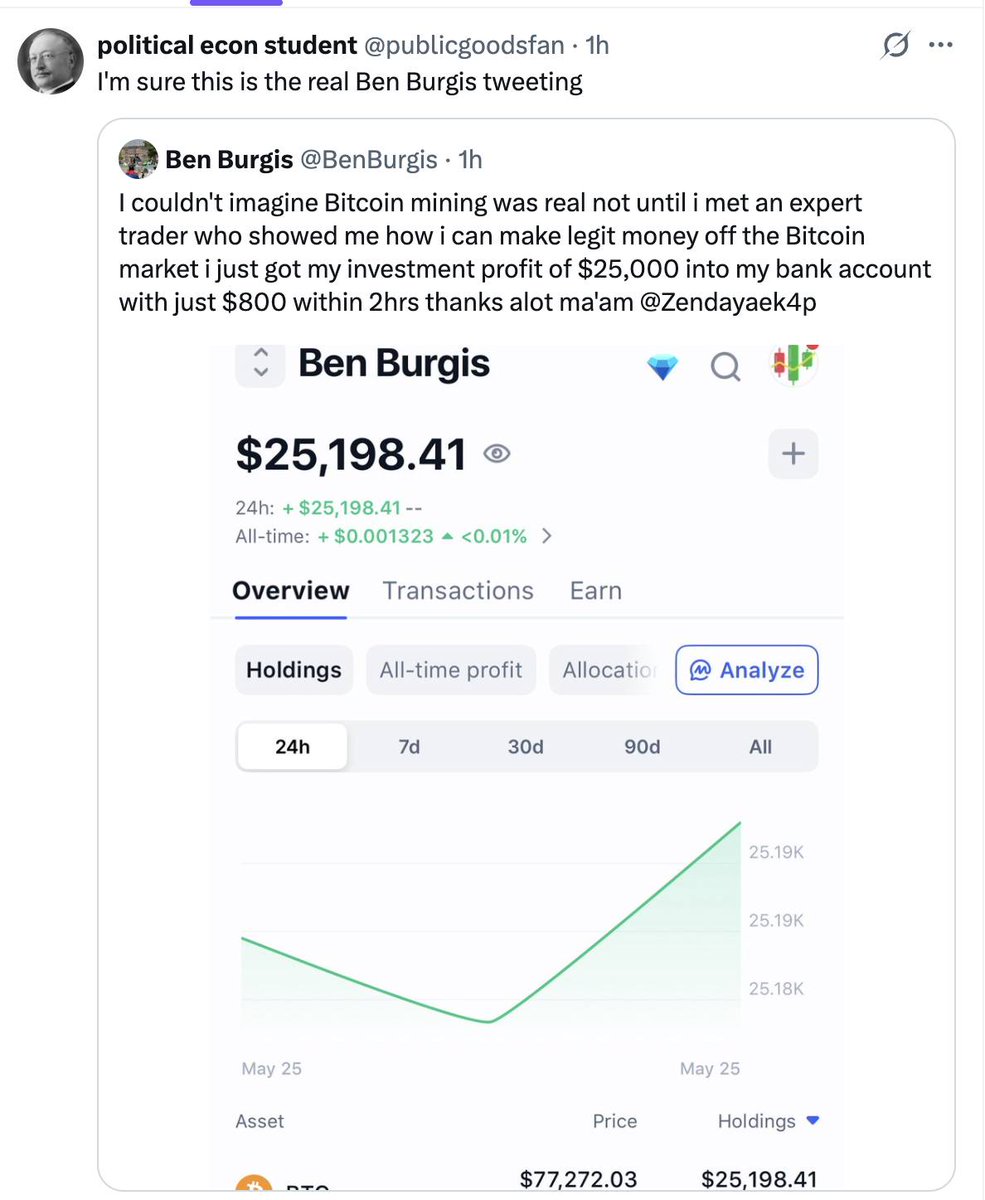
Previous account (@BenBurgis) was hacked, please follow me here!
Columnist @jacobin
Host @gtaa_show
Co-author of "The Blueprint" (Sept. 29th from @VersoBooks!)
The account I've had since 2018 (@BenBurgis) was hacked two days ago. I've repeatedly tried to get X to restore access and I'm not optimistic based on how that's played out so far. If you get a DM from it, please don't click on any links.
Meanwhile, follow me here!
In today's Capital Vol. 1 class, we went over Marx's refutation of Nassau Senior's prediction that all profit would cease to exist if the working day were reduced to a mere 10 hours a day, 6 days a week.
Couldn't resist the opportunity to play this clip to illustrate that:
@j_mal1 Many thanks! Also, seriously, report the account for whatever phishing links it sent you! I'd like to get it back obviously but failing that I'd like to shut it down and either way lots of reports right now can only help.
The account I've had since 2018 (@BenBurgis) was hacked two days ago. I've repeatedly tried to get X to restore access and I'm not optimistic based on how that's played out so far. If you get a DM from it, please don't click on any links.
Meanwhile, follow me here!
This assertion is based on nothing.
Harris is pulling out of thin air because he *needs* it to be true so he can reassure himself that what's being done to Palestinians isn't monstrous.
Talking about it like it was a swastika tattoo is just absurd.
I seriously doubt that more than 1 out of 100 people saying "of course he knew that particular skull-and-crossbones shape was used by the Nazis" would actually be able to pick it out of a skull-and-crossbones lineup.
“When you’re at the level of saying ‘I didn’t know it was a Nazi tattoo,’ give me a break.”
— David Remnick about Graham Planter, on the Brian Lehrer Show
https://t.co/POIyUzVvxn
Weirdest part of Ben's now-hacked account doing this is the spate of decade-plus-old accounts chiming in like pod-people in the replies to remark on how they, too, benefited from this crypto coach it's promoting.
Anyway, follow @JacobinBen .
And that it would be happening even if everyone were scrupulously following the "laws of exchange," trading value for equal value.
That's his point, and once you understand it the idea that it rises or falls on the relationship between value and prices makes absolutely no sense.
Marx argued that this kind of "mute compulsion" of economic circumstances--you submit to capitalists or face destitution--is meaningfully analogous to the direct compulsion to perform surplus labor in feudal and slave societies.
Under that deal, *even if they're paid that much*, workers spend only part of the day producing the goods or services that will sell for the equivalent of their wages ("necessary labor"), and the rest producing goods and services that become capitalist profits ("surplus labor").
The reason why is that, because workers don't own their own means of production, the underlying property relations give them no realistic choice but to submit to capitalist labor contracts.
What does it take to "produce" a day's labor? According to Marx, whatever it takes to produce the package of commodities the worker needs to subsist from one day to the next.
Even if we follow Marx in understanding subsisting not just aas not dropping dead before your next shift but making whatever counts as an adequate living in a given part of the world at a given stage of history, Marx thinks workers can make that much + still be exploited.
Marx's view is that what workers are selling on labor markets is their labor *power* (their *capacity* to do a day's work) and that the value of it is like the value of any other commodity--by the average socially necessary labor time it takes to produce it.
For another, he actually spends a lot of the second and third sections of Capital arguing explicitly that it's a mistake to attribute capitalist profits to unequal exchange--to, in other words, workers not getting the full value of what they're selling on labor markets.
You need to set aside some for repairing/expanding the means of production, for common needs like schools and hospitals, for consumption for those too young or old or disabled to work, etc.
For one thing, he says explicitly (in Capital, and again several years later in the Critique of the Gotha Program) that under *any* system, workers wouldn't get back everything they create in individual consumption.