Una reflexión: si yo puedo hacer esto con R, un café y datos de registros anonimizados y agregados de telefonía celular. .
¿Se imaginan lo que hará el gobierno con nuestros datos personales y biométricos cuando cierre el registro de telefonía en unos días? 🤯📵
@Vee88_e@dona_pily2 Por favor me puede explicar cómo un residente colombiano que viajó a México esta semana se puede inscribir entre hoy y el domingo para votar en ese país. Es para un amigo
🎯 Cuídate sin miedo. Disfruta el Mundial como te lo mereces.
El análisis completo está en mi Substack (El Radar).
🔗 https://t.co/cY0XRytefd
#Ciberseguridad#Mundial2026#WorldCup2026
El Mundial 2026 será una fiesta para ti y también para los cibercriminales.
Mientras tú celebras un gol, ellos celebran que te conectaste a su red WiFi falsa.
Te dejo un hilo con 5 amenazas que pueden usar y cómo defenderte🧵
5️⃣ SIM swapping
Los atacantes engañan a tu operadora para transferir tu número a su SIM. Así saltan tu 2FA por SMS.
✅ Solución: cambia a una app de autenticación o una llave física YubiKey. Guarda los números de emergencia de tu banco y tu embajada fuera del teléfono.
I audited Loupe’s source code after seeing its App Store privacy label: “Data Not Collected.”
My goal was simple: check whether the public privacy claims match what the app actually does.
First, credit where it’s due: Loupe is a thoughtful privacy education app. It shows people, in a very direct way, how much fingerprinting surface iOS exposes through normal public APIs. That kind of transparency is valuable, especially because most users never get to see these signals laid out plainly.
Good news: I did NOT find accounts, analytics SDKs, ad SDKs, tracking code, or obvious developer-controlled data exfiltration. The app appears to be mostly local, and export appears to be user-triggered.
But I did find an important caveat.
Loupe’s App Store copy says nothing is uploaded, synced, or shared unless you export it yourself. In the Photos feature, the app uses Apple’s CLGeocoder to turn photo GPS coordinates into place names. Apple describes CLGeocoder as a network-based geocoding service.
That means photo coordinates may leave the device to Apple for geocoding. I did not find evidence that this data goes to Mysk.
I also found some disclosure gaps: a few permission prompts say the app reads “counts only,” while the app can display more specific values, including reminder list titles, Bluetooth device names, Bonjour service names, music artists/genres, and photo-derived places.
The App Store “Data Not Collected” label may still be technically different from “nothing ever leaves the device,” because Apple’s privacy label focuses on what the developer and its partners collect. But for users, wording matters. If photo coordinates can be sent to Apple, that should be disclosed clearly.
Introducing Loupe, our latest privacy app for iOS. Discover what apps can learn about you just by reading data your iPhone already exposes, such as your languages, installed apps, device sensors, and much much more
Loupe is free, private, and open source. Give it a try 👇
Mientras se prepara para viajar a la Copa Mundial de la FIFA 2026™, recuerde que las emergencias médicas pueden ocurrir inesperadamente. En México, el costo de la atención médica puede ser más alto de lo esperado. La mayoría de los planes de seguro médico estadounidenses no cubren atención médica fuera de Estados Unidos, y muchos hospitales mexicanos no darán de alta a los pacientes hasta que se pague su cuenta. Para más información, visite la página web https://t.co/VxTWQ0sKnS
---------
As you prepare to travel for the FIFA World Cup 2026™, remember that medical emergencies can happen unexpectedly. In Mexico, the cost of medical care may be higher than you expect. Most U.S. health insurance plans do not cover medical care outside the United States, and many Mexican hospitals will not release patients until their bill is paid. For more information, visit https://t.co/VxTWQ0sKnS
4 firmas encuestadoras publicaron sus resultados y contribuyeron a disminuir la incertidumbre:
Sus datos señalaban que:
- Habría segunda vuelta✅
- Iván y Abelardo estarían en ella.✅
- Paloma sería 3.✅
- Fajardo y Claudia tendrían el umbral.✅
Es un buen balance.
The most expensive teams to see at the World Cup by average ticket price:
🇲🇽 Mexico ($1,848)
🇵🇹 Portugal ($1,391)
🇨🇴 Colombia ($1.298)
🇧🇷 Brazil ($1,250)
🏴 Scotland ($958)
🇦🇷 Argentina ($953)
🇿🇦 South Africa ($934)
🇰🇷 South Korea ($921)
🇪🇸 Spain ($884)
🇺🇸 USA ($857)
via ticketdata
The AI Stack Pyramid: Where the Real Value Is Being Created
Everyone is talking about AI.
But very few people understand where value is actually accumulating.
This AI Stack Pyramid is one of the clearest ways to visualize the entire AI ecosystem in 2026.
From the bottom to the top:
🔹 Foundation Layer
ASML, Applied Materials, Lam Research, Micron, Samsung, SK Hynix.
Without semiconductor equipment and memory, there is no AI.
🔹 Foundries
TSMC and Samsung manufacture the advanced chips powering the AI revolution.
🔹 AI Accelerators
NVIDIA has become the defining company of this era, while AMD, Broadcom and Intel compete for a share of the world’s growing compute demand.
🔹 Foundation Models
OpenAI, Anthropic, xAI, Google, Meta, Microsoft and Alibaba are racing to build increasingly capable frontier models.
🔹 Cloud Infrastructure
Microsoft, Amazon, Google, Meta and Oracle provide the compute, networking and storage that make large-scale AI possible.
🔹 Data & Software Layer
Palantir, Snowflake, MongoDB, Datadog and CrowdStrike help organizations operationalize AI with data, security and observability.
🔹 Applications
This is where AI finally touches users and creates business value through productivity, automation and decision-making.
Here’s the insight most people miss:
The AI race isn’t a single race.
It’s seven races happening simultaneously.
Some companies are building the chips.
Some are building the models.
Some are building the infrastructure.
Others are building the applications that millions will use every day.
And just like previous technology revolutions, the biggest winners may not always be the companies closest to consumers.
Often, the largest value accrues to the companies supplying the “picks and shovels” that everyone else depends on.
The real question isn’t:
“Who will build the best AI?”
It’s:
“Who owns the critical bottlenecks of the AI economy?”
Because history shows that controlling the bottleneck often matters more than controlling the product.
We’re witnessing the construction of a new technological infrastructure layer for humanity, one that could be as consequential as electricity, the internet, or the smartphone.
And we’re still in the early innings.
If you’re a leader, founder, or professional, now is the time to understand where you fit in this stack.
AI is no longer a future trend.
It’s becoming the operating system of the global economy.
At @10xme_biz, we’re helping professionals and organizations assess their AI readiness, identify opportunities, and build an AI adoption roadmap.
🚀 Take our Free AI Diagnostic and subscribe to the newsletter at https://t.co/I4zR8aXXi5 to stay ahead of the biggest technology shift of our generation.
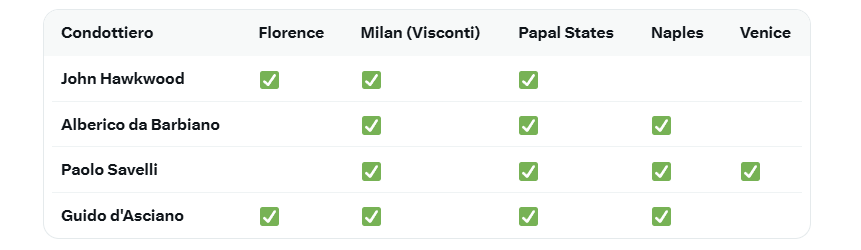
Italian top coaches switching jobs between the same few top Italian teams is hilariously similar to 14th century mercenary commanders in Italy switching allegiances between the same small pool of powerful states in the peninsula.
The 14th Century condottieri carousel: