A ver cómo lo explico:
- Si pones un límite al alquiler, desaparecen los alquileres.
- Si impides los desahucios a personas vulnerables, las personas vulnerables no pueden alquilar.
- Si subvencionas el alquiler joven, sube el alquiler joven.
- Si alargas las hipotecas para que las cuotas sean asumibles, el precio medio de la vivienda sube.
- Si echar a un okupa cuesta dos años, se reduce el mercado del alquiler, y en consecuencia el precio de lo que queda sube.
- Si estableces zonas tensionadas con limitaciones en las ciudades, se tensiona esa zona y la de al lado.
- Si prohibes el alquiler vacacional, se alquila en negro.
- Si persigues el alquiler en negro, el piso se cierra o se vende, y caro.
- Si le haces imposible al banco ejecutar las hipotecas impagadas, se acaban las hipotecas.
- Si una mayoría social generacional es propietaria, esa mayoría no quiere que la vivienda baje.
Lo que hay que entender es que un mercado no es una máquina con un botoncito que yo enciendo y apago con una norma que ponga en el BOE, no es un problema lineal, es un sistema complejo de millones de agentes que reaccionan a las reglas del sistema y se adaptan. Lo que llamamos "mercado de la vivienda" es en realidad la suma de todas esas reacciones interactuando con las circunstancias y las normas.
Berlín, por ejemplo, congeló los alquileres en 2020 y las viviendas ofertadas cayeron en torno a la mitad en un año. Estocolmo lleva décadas con precios regulados y el tiempo que se tarda en acceder a un piso de alquiler es de 9 años. Cataluña estableció zonas tensionadas y el primer año se firmaron un 17% menos de contratos de alquiler, y desde 2021 la caída es de más de un tercio. La oferta de larga duración se fue al alquiler de temporada, y los que sí consiguen alquilar, lo hacen en pisos tan pequeños y caros que no pueden competir como alquiler vacacional.
Pero, ¿qué ocurre? que arreglarlo es lento, difícil y caro, y la demagogia es baratísima e inmediata. Ponerle un límite a los precios le cuesta cero al político de turno; es un textillo estupendo en un Boletín Oficial un día, le da un montón de titulares en la prensa, se pone el pin de político que se preocupa por la gente, dice que está tratando de ayudar a los jóvenes. Y cuando la medida empeora las cosas, que siempre lo hace, le echa las culpas a la avaricia de los caseros, a los especuladores, o a los fondos buitres; ya tiene un nuevo enemigo al que combatir, y él se convierte en el héroe defensor. Redondo. Perfecto. Divino.
Vamos a arreglar ahora mismo, juntos, por ejemplo, el mercado de la vivienda en Baleares, por poner la lupa en algún sitio difícil. En Ibiza, que me encanta. Hay que hacer dos cosas, y las dos a la vez:
La primera: construir muchísimo con dinero público, como animales, a lo bruto, 20.000 viviendas en diez años, y en dos paquetes. Un paquete para la venta de primera vivienda, para la gente de Baleares que no tiene casa: no para el turista alemán, ni para el que acaba de llegar o quiere una segunda residencia. No. Se venden sólo entre residentes con, por ejemplo, diez años mínimo en la isla, y a precio razonable. Es dinero nuestro, público, y se gasta en nosotros, no en fabricar otro mercado al alza que sólo pueda pagar la pensión de un guiri. Y el otro paquetito es el del alquiler, muchísima vivienda pública en alquiler, para todo el que trabaje en la isla, sólo la puede alquilar el que tenga o venga con un contrato de trabajo, porque la isla vive de servicios y sin camareros, médicos, enfermeros, policías y albañiles el modelo se hunde, y obligas al camarero a dormir en una furgoneta en verano y luego marcharse, que es lo que ya pasa. El que llega alquila a precio razonable, trabaja y contribuye, el que se queda diez años, compra a precio razonable. El que es rico que se compre un ático en Talamanca. Lo público se gasta en quien vive aquí y en quien hace que esto funcione, y en nadie más.
Y la segunda: dejar que lo privado funcione, que es regular bien, no regular más. Bien significa: licencias en meses, no en años, y si el ayuntamiento no contesta, silencio positivo. Alturas, densidad y suelo decididos a nivel de isla, con un cupo de viviendas por municipio máximo, consensuado, para no destruir el entorno, pero también mínimo, que se cumple sí o sí y el alcalde que no lo cumple pierde la competencia: así te cepillas al demagogo local que vive del "aquí no" poniendo el interés de los cuatro que le votan por encima del interés de todos. Luego, reglas estables: la ley del alquiler no se toca cada dos años, porque nadie pone un piso en el mercado ni levanta un bloque sin saber qué norma tendrá cuando termine. Y al propietario que ya tiene una vivienda, la certeza de que si no le pagan o se la ocupan la recupera en una semana, no en años, porque es la única forma de que el pequeño propietario no deje su casa cerrada con un cartel de Securitas y la alquile larga temporada en vez de vacacional. Ni un tope, ni una moratoria, ni una ayuda a la demanda. Lo público garantiza el techo de quien tiene que tener techo, y además, saca a 20.000 familias de pujar en el mercado, bajando el alquiler sin tocar la ley del alquiler. Lo privado es el mercado de verdad, donde va a seguir viviendo la mayoría de la gente, y donde también compran el turista, el alemán y el jipi que viene a abrazar árboles. Si lo privado funciona, la mayoría de los de aquí no pisará lo público en su vida; lo público está para que, mientras tanto, nadie duerma en una furgoneta porque no puede pagar 1200€ de alquiler.
Nada de esto es nuevo ni es mío. Está en los manuales, lo hizo Tokio y lo lleva haciendo Auckland diez años con la densificación. No hay debate técnico sobre cómo se arregla el probelma de la vivienda, se sabe perfectamente, como no hay debate médico sobre cómo se trata una gripe; lo que hay es un debate político sobre si compensa arreglarla, y la respuesta de la política española, hasta ahora, ha sido que no compensa. Porque arreglarla es un arquitecto, una grúa, un plano y diez años de callarse, emplear bien el dinero público y ponerse a currar, y eso no da votos, amigo. Cuestión de incentivos en democracia, pero ese es otro tema.
She dared to remove her chador before Ayatollah Khomeini. In October 1979, Italian journalist Oriana Fallaci traveled to Qom, Iran, to interview the Islamic Revolution's supreme leader.
To get inside the room, Fallaci was forced to cover herself from head to toe in a heavy black chador, leaving only her face visible.
The conversation inside the room was tense from the very start. Fallaci did not hold back her questions.
She pushed the Ayatollah on political executions, the sudden shutdown of independent newspapers, and the sharp loss of rights for Iranian women under the new regime.
When she asked about the forced wearing of the veil, Khomeini dismissed her concerns and claimed the garment was meant to protect young and respectable women. He then added,
"If you do not like the Islamic dress, you are not obliged to wear it."
Fallaci took his words literally and replied, "Thank you, Mr. Imam. Since you tell me so, I am taking it off right now."
With a quick move, she pulled the chador off her head, leaving her hair completely exposed right in front of the Supreme Leader.
Khomeini was furious.
He stood up without saying another word and walked out of the room. The room fell silent, and the interview was abruptly stopped. However, Fallaci refused to leave Iran until he returned a day later to finish the conversation.
This confrontation became legendary in the history of journalism.
It showed a reporter refusing to bow down to authority, even in one of the most dangerous settings imaginable.
Fallaci proved that real journalism requires standing up to power, asking hard questions, and refusing to be silenced by fear or tradition.
When journalists trade raw courage for easy access and comfortable silence, we lose one of our strongest shields against tyranny.
In an era where true courage in reporting feels rare, her brave stand reminds us that honest journalism still has the power to light up the dark, giving a voice to the voiceless and inspiring future generations to speak truth without fear.
Melilla es española desde 1497 y Ceuta desde 1668, cuando pasó de Portugal a la Corona. Melilla, cuando la tomó Castilla, estaba en ruinas y sin control efectivo de nadie: los wattasíes de Fez y los zayyaníes de Tlemecén se la disputaban sin ocuparla. No se arrebató a ningún Estado, se ocupó un vacío. La dinastía alauí, la que reina hoy, no llega al poder hasta los años 1660: casi dos siglos después.
Pero el título español no depende de esa fecha, y ahí está su fuerza. Depende de cinco siglos de posesión continua, pacífica y efectiva, con una población que tiene ciudadanía española, vota en elecciones españolas y está representada en el Congreso. Eso es prescripción adquisitiva, la forma más sólida de soberanía que reconoce el derecho internacional.
Marruecos no reclama por herencia dinástica, no puede, sino por contigüidad geográfica y marco descolonizador. Y ahí el argumento se le complica: Ceuta y Melilla nunca fueron colonias, son territorio metropolitano con las mismas instituciones que Cádiz o Málaga, y sus habitantes no han pedido nunca cambiar de bandera. La descolonización se decide por autodeterminación, no por proximidad en el mapa.
Cinco siglos y una ciudadanía que se afirma cada vez que hay urnas. Eso no lo mueve un argumento de contigüidad.
¿Tiene Tadej Pogacar el mayor VO2max de la historia? ¿Puede superar la barrera de los 100 ml/kg/min?
En este estudio, recién aceptado en @IJSPPjournal, estimamos qué VO2max debería tener según su rendimiento en competición.
Gran idea de @SitkoSebastian y @OleKBerg
1/4
No seamos injustos, no nos equivoquemos. Con su zafio comportamiento, sucias maneras y mal perder, la selección que jugó contra España no representó a Argentina, que es mejor que eso. Representó sólo a la parte más violenta e irracional de cierta detestable sociedad argentina.
Cucurella le estaba preguntando si todo bien y Messi fue a pedir que le expulsasen.
Es la acción más deshonrosa que he visto en un campo de fútbol y va a perseguir a Messi de por vida.
What is my stance on climate change?
Well, I'll lay it out for all of you newcomers. Grab some popcorn! 🍿
First, I do not deny the fact that the Earth has warmed up by ~1.2°C since 1850. However, nobody knows precisely how much because of data quality issues (e.g., uneven surface station distribution; fragmented records, especially outside of the United States; station siting changes; and urban heat island contamination) that have not been (and likely cannot be) removed from the record.
But, I have no doubt that the Earth is [slightly] warmer than it was 175 years ago or that 𝑠𝑜𝑚𝑒 of that warming might be due to carbon dioxide (CO₂) emissions.
Second, contrary to what the online army of alarmist foot soldiers have 𝑚𝑖𝑠𝑙𝑒𝑑 people to believe, there are not really any so-called “fingerprints” that distinguish human-caused global warming from warming caused by other forcings / variability.
Numerous scientific papers claim to have found such a “fingerprint,” but the only evidence that they have presented is that the anomaly of interest is 𝑐𝑜𝑛𝑠𝑖𝑠𝑡𝑒𝑛𝑡 𝑤𝑖𝑡ℎ anthropogenic warming. But these authors fail to mention that said anomaly would also be consistent with natural warming.
Case in point, a reduction in low- and mid-altitude stratiform cloud cover, for instance, would allow more sunlight into the climate system, which would warm the oceans. A warmer ocean—all else being equal—increases the rate of evaporation, which raises the vapor pressure (humidity) contributing to polar amplification and faster land warming than the ocean (e.g., Compo & Sardeshmukh, 2008).
🔗https://t.co/sQurHsN80P / open-access: https://t.co/WVKvLrSV7k
All warming, natural or man-made, results in:
1⃣ Higher latitudes warming faster than both the mid-latitudes and tropics.
2⃣ Land heating up faster than the oceans.
This is just basic physics; look up heat capacity.
Also, an increase in, say, solar forcing would have the same material effect, though we can admittedly likely rule that out as the cause of modern trends because sunspot activity has been declining in recent decades. But the sun does affect our climate in ways that have not really been thoroughly researched because little, if any funding, is ever allocated for such projects by the funding agencies such as the National Science Foundation (NSF).
In any case, the 𝒃𝒆𝒔𝒕 empirical evidence that I have seen to suggest that there is probably [at least some] anthropogenic “fingerprint” on recent temperature increases is stratospheric cooling.
First, you need to understand that in atmospheric physics, heat flux is measured as power—measured in Watts (that is, Joules per second)—standardized per square meter of surface area. This is written as W/m².
Next, the average radiation flux into the atmosphere is on the order of 239 ± 3.3 W/m² of absorbed solar radiation (ASR) averaged over a year (Stephens et al., 2012). This means that in order for the Earth's surface to maintain a constant temperature, the surface must emit 239.7 ± 3.3 W/m² back to outer space.
🔗https://t.co/5z5iMdazRB / open-access: https://t.co/51Ys5w8BWj
Global warming theory maintains the direct radiative forcing from doubling atmospheric CO₂ levels (often noted as RF 2×CO₂) is 3.7 ± 0.4 W/m² (e.g., IPCC TAR, 2007). That means that the net outgoing longwave radiation (OLR) to outer space is reduced by 3.7 W/m², which creates an Earth energy imbalance (EEI), which leads to a slight warming tendency in the troposphere (surface to ~13 km altitude).
🔗https://t.co/0JkXIQRGDH (p. 357)
In the stratosphere (~13-50 km altitude), this causes a cooling tendency because less infrared radiation (IR) flux is moving upward from below. These relationships were first demonstrated in Manabe & Strickler (1964).
🔗https://t.co/JNaXP7nUC9
NASA satellite measurements indicate that cooling in the stratosphere has been observed since the late 1970s, although there has been very little cooling over the last 25 years, all the while the troposphere has continued to warm.
🔗https://t.co/hT0Oxwm2Io
That means that most of the warming observed since 2000 is likely natural OR perhaps partly caused by a reduction in stratospheric sulfate aerosol concentrations, an artifact of particulate aerosol pollution regulations in recent years.
But, yes, I would agree with most scientists that the cooling observed in the stratosphere, at least that from the 1970s to 2000, is most likely a result of CO₂ forcing.
So what?
What happens down here in the lower atmosphere in response to CO₂ forcing is a lot more nuanced.
Why?
Because here in the troposphere, there are feedbacks (largely cloud-related) and precipitation processes that affect the atmospheric radiation budget far more than CO₂. And how exactly clouds respond to warming in the troposphere, if at all, is not very well understood, and by extension, not well-modeled.
What we do know, theoretically speaking, is that the direct warming effect of RF 2×CO₂ is actually very small. Specifically, it is on the order of ~1°C (e.g., Wijngaarden & Happer, 2020).
🔗https://t.co/y5szlGBmjd
However, amplifying (or dampening) feedbacks that kick in as a response to radiative forcing mean that the real-world value—that is, the equilibrium climate sensitivity (ECS)—will be higher (lower) than the ~1°C figure derived from radiative transfer calculations.
So, three critical pieces information are unknown:
1⃣ Exactly how much warming has been man-made (since, let's say, 1950). We still don't know the answer to this because the coefficients that are used to ascribe anthropogenic versus natural forcings are all estimated from computer modeling, not real physical in-situ measurements.
2⃣ The exact value of ECS.
3⃣ Even if global warming is entirely man-made, is it really a net drawback to civilization? Is it a crisis? Is it a problem in the slightest?
To break it down:
• If ECS is <3°C, the climate is insensitive to GHGs, and impacts are exaggerated.
• If ECS is ≥3°C, the climate is sensitive to GHGs, and warming could be a concern.
The IPCC’s “best estimate” of ECS is 3°C with a range of 2-5°C.
🔗https://t.co/8Ntgszr1dC (pp. 44-45)
In 1994, using NASA's real-world bulk atmospheric temperature data, one of my mentors, Dr. John Christy and his co-worker, Dr. Richard McNider from the University of Alabama in Huntsville (UAH), calculated climate sensitivity by removing the effects of El Niño / La Niña and volcanic stratospheric aerosol injection (e.g., El Chichón, 1982; Mt. Pinatubo, 1991).
Christy and McNider found that the human-induced warming rate is about 0.09°C / decade (lower than observations of actual temperature increase). This, by the way, came with the stipulation that unknown mechanisms of internal variability or external forcing are assumed to be zero. I attended a lecture where he talked about this paper in detail.
🔗https://t.co/S2GEmUftKo
They then validated their 1994 findings in McNider & Christy (2017). Specifically, they found a near-identical anthropogenic warming rate of only 0.096°C / decade and a transient climate response (TCR) of 1.10 ± 0.26°K.
🔗https://t.co/zueJLn8V8w / open-access: https://t.co/eLcqeizbRh
Many other recent studies (e.g., Lewis & Curry, 2018; Scafetta, 2021; Spencer & Christy, 2023; Lewis, 2025) have all estimated ECS to be far lower than the IPCC AR6's “best estimate.”
🔗https://t.co/8G0sF8gy2p
🔗https://t.co/5TgNX7c1JN
🔗https://t.co/BxyO1XIbNP
🔗https://t.co/YNQhNajrrO
The jury on ECS is still out. 🤷♂️
What's more, in order to reliably detect anthropogenic influence on the climate system, EEI must be known to the nearest 0.1 W/m² (Von Schuckmann et al., 2016; Gebbie, 2021).
🔗https://t.co/T7SKxidZ4N / open-access: https://t.co/GD45cbhxIT
🔗https://t.co/L6vZKVVpXg
However, the aforementioned Stephens et al. (2012) estimates the EEI to be 0.6 ± 0.4 W/m², which is eight times larger than the anthropogenic detection limits. And the natural top-of-atmosphere (TOA) flux has a 6.6 W/m² margin of error, which is 66 times larger than the detection limits. This range of uncertainty remains in newer estimates, such as Loeb et al. (2021), which estimates EEI to be 1.12 ± 0.48 W/m².
🔗https://t.co/ynRTFd3LWZ
This means that 𝑚𝑜𝑠𝑡 (but not all!) of the observed global warming since 1950 could be natural and scientists would never know for certain (nor would most be humble enough to admit it because the vast majority of academics have high egos). Alternatively, warming could be mostly man-made like alarmists claim, but, even if that is the case, I'll ask again. . .
SO WHAT?
That doesn't mean it is an existential crisis or urgent problem.
The big unknown are CLOUDS. ☁️
Why?
Because (a) cloud albedo has a far greater impact on the atmospheric radiation budget than does CO₂, and (b) how clouds change in response, if at all, to CO₂ is unknown. What's more, cloud cover can (and does) change naturally without mankind's assistance for any number of reasons (e.g., El Niño / La Niña activity; ocean circulation changes; cosmic ray flux; etc.). Even a small decrease in global cloud area fraction (CAF) can more than offset any temperature rise caused by CO₂. Song et al. (2016), for instance, found that,
🗨️ “[𝐴]𝑙𝑡ℎ𝑜𝑢𝑔ℎ 𝑡ℎ𝑒 𝑔𝑟𝑒𝑒𝑛ℎ𝑜𝑢𝑠𝑒 𝑒𝑓𝑓𝑒𝑐𝑡 𝑐𝑎𝑛 𝑏𝑒 𝑒𝑛ℎ𝑎𝑛𝑐𝑒𝑑 𝑏𝑦 𝑖𝑛𝑐𝑟𝑒𝑎𝑠𝑖𝑛𝑔 𝐺𝐻𝐺𝑠 𝑎𝑛𝑑 𝑤𝑎𝑡𝑒𝑟 𝑣𝑎𝑝𝑜𝑟 𝑖𝑛 𝑡ℎ𝑒 𝑎𝑡𝑚𝑜𝑠𝑝ℎ𝑒𝑟𝑒, 𝑖𝑡 𝑐𝑎𝑛 𝑏𝑒 𝑤𝑒𝑎𝑘𝑒𝑛𝑒𝑑 𝑏𝑦 𝑑𝑒𝑐𝑟𝑒𝑎𝑠𝑖𝑛𝑔 𝑐𝑙𝑜𝑢𝑑𝑠. 𝐼𝑓 𝑡ℎ𝑒𝑠𝑒 𝑡𝑤𝑜 𝑎𝑐𝑡𝑖𝑜𝑛𝑠 𝑜𝑓𝑓𝑠𝑒𝑡 𝑒𝑎𝑐ℎ 𝑜𝑡ℎ𝑒𝑟, 𝑎 ℎ𝑖𝑎𝑡𝑢𝑠 𝑜𝑓 𝑡ℎ𝑒 𝑔𝑙𝑜𝑏𝑎𝑙 𝑔𝑟𝑒𝑒𝑛ℎ𝑜𝑢𝑠𝑒 𝑒𝑓𝑓𝑒𝑐𝑡 𝑤𝑖𝑙𝑙 𝑟𝑒𝑠𝑢𝑙𝑡.”
🔗https://t.co/NHkmfOc08y
I don't deny that global warming is occurring. I never have. I don't even deny an anthropogenic influence on it either. I never have. What I do reject, however, is unchecked alarmism and climate activism, particularly from fellow scientists.
Activism is not science and has no place in science. If you are an activist, you cannot call yourself a scientist because you are not dispassionate and objective. This goes for the vast majority of self-described “climate scientists” who actively use social media and are well-known in the debate. Two notable exceptions on the other side of the spectrum from me, in my opinion, are Drs. Robert Rohde and Paul Williams, both of whom I have always had pleasant interactions with.
I also reject the idea that every weather event needs to be blamed on climate change with a rushed, half-baked attribution study (namely the ones done by the clowns at World Weather Attribution that are often not scientifically rigorous, but get plenty of news media attention by the Associated Press, CNN, The New York Times, and The Washington Post). Attribution “science” is fraudulent anyway because one of the architects behind it admitted to Politico in 2021 that it was designed with the intention of using it in litigation against oil and gas companies.
🔗https://t.co/ETUBune0A8
Conflict of interest much?
It should also be abundantly clear that climate is just a statistical description of the mean and variability of the climate system, including long-term weather. So, a change in climate is just a change in statistics. That is an outcome, not a force or accelerant that causes an extreme weather event to occur.
For what it's worth, I used to be a climate alarmist well before I got my degree in meteorology.
Now that I know a great deal (but not everything and never will) about atmospheric science, my position has evolved to a cooler heads point of view. Perhaps it is not my judgement that's clouded, but rather that of the alarmist arm-wavers who have high trust in both academic institutions and their government officials who spoon-feed them pre-canned talking points on the daily.
Why is it hot in Europe this week?
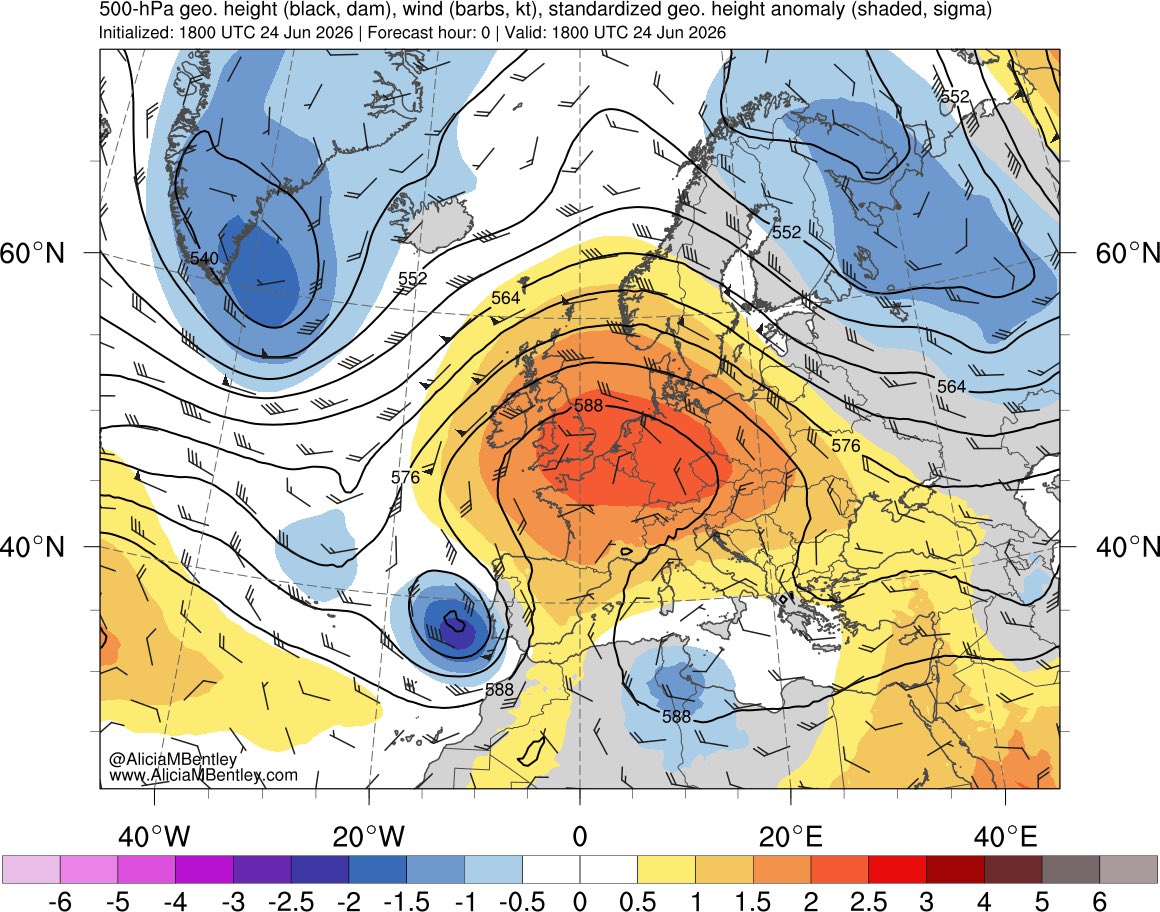
Well, it has to do with the “omega block” in the jet stream. Omega blocks get their name because they resemble the Greek uppercase letter omega, Ω.
You can see that in the synoptic setup. The map below on the left shows the 500 mb geopotential height anomaly at 18z. The contour lines resemble the Ω shape due to an enormous high-pressure ridge in the mid-troposphere that is sandwiched between two low-pressure systems to its east and west.
Hot Saharan air has been advected—that is, horizontally transported—northward into western Europe due to anticyclonic (clockwise) airflow, and as that air mass moves north, it is compressed adiabatically beneath the ridge where air is sinking.
This process is natural and has nothing whatsoever to do with climate change or greenhouse gas emissions. In fact, there are quite a few studies suggesting that reduced latitudinal baroclinicity (north-to-south temperature gradient) caused by Arctic amplification could reduce the frequency of mid- and high-latitude blocking events (e.g., Hassanzadeh et al., 2014; Woollings et al., 2018).
🔗 https://t.co/NGsFsRKpEt
🔗 https://t.co/M7h3vg232H
There is, however, debate about this.
Europe has seen an unusual amount of these extreme heat events since 2019, but most other areas of the globe have not. The notable exception was the June–July 2021 Pacific Northwest heatwave in North America, but even that wasn’t as rare as previously thought.
🔗 https://t.co/rNRFfJohs4
The most likely explanation for this boils down to a combination of two things:
1️⃣ Undiagnosed changes in atmospheric circulation patterns.
2️⃣ Increased absorbed solar radiation at the surface due to reduced stratiform low- and mid-level cloud cover (increased sunniness), some of which is likely due to reduced atmospheric aerosol concentrations from the EU’s strict pollution regulations.
The overall increase in the “global mean temperature” (which mostly affects overnight lows) has very little to do with this event. Even in a “pre-industrialized” climate, a record-breaking heatwave would still be happening. Heck, the “global mean temperature” fell today despite the heat cranking up in Europe.
This is mostly weather systems moving around. When you have a chaotic system with two turbulent fluids interacting with each other (the atmosphere and ocean), wild things can happen.
Get your weather information from real meteorologists, not sensationalistic clickbait news outlets like BBC News or the Daily Mail.
El meteorólogo estadounidense Chris Martz (@ChrisMartzWX) explica por qué hace tanto calor esta semana en Europa y no, no se debe al cambio climático (aunque el cambio climático sea un hecho –pero no una crisis).
Europa es el continente que más ha reducido sus emisiones de CO2 (junto con otros países ricos de la OCDE), con un coste enorme para sus contribuyentes, inmolándose económica e industrialmente frente a la mitad del mundo (especialmente frente a China), sin obtener ningún resultado ni sobre el clima ni sobre el tiempo ni sobre las olas de calor.
De acuerdo con Martz, el bloqueo omega Ω es la verdadera explicación meteorológica detrás de las temperaturas extremas que actualmente se miden en gran parte del continente europeo. Mientras que los grandes medios vinculan el calor al cambio climático y los gases de efecto invernadero, los científicos críticos señalan una explicación mucho más sobria y mejor fundamentada: un patrón meteorológico persistente en la alta atmósfera que ya ha ocurrido en Europa en varias ocasiones.
Un bloqueo omega es un patrón de la corriente en chorro — el potente flujo de viento a gran altura que en gran medida condiciona el tiempo en nuestras latitudes. El nombre proviene de la similitud de la forma que adopta la corriente en chorro con la letra griega omega (Ω): una gran cresta de alta presión en el centro, flanqueada por dos áreas de baja presión a ambos lados. Este patrón hace que las masas de aire cálido apenas puedan fluir y que la situación meteorológica pueda mantenerse durante días e incluso semanas.
En el caso de la actual ola de calor, el aire caliente del Sáhara es transportado hacia el norte en dirección a Europa por el aire anticiclónico (que gira en el sentido de las agujas del reloj). Mientras esa masa de aire sube y baja, se comprime adiabáticamente (sin intercambio de calor) — un proceso puramente físico que hace que la temperatura aumente aún más. Sin ninguna influencia del CO2.
Chris Martz ha compartido su análisis de manera extensa a través de las redes sociales. Su conclusión es clara: este bloqueo omega no tiene nada que ver con el cambio climático o las emisiones de gases de efecto invernadero. Es una dinámica meteorológica conocida, bien documentada, que siempre ha ocurrido y que muy probablemente también habría llevado a alcanzar récords de calor en otras épocas preindustriales.
Martz además señala una paradoja científica notable. Existen diversos estudios que sugieren que el calentamiento del Ártico en realidad conlleva bloqueos omega menos frecuentes, porque la diferencia de temperatura entre el ecuador y las regiones polares se reduce. Eso contradice directamente la afirmación de que el cambio climático causa o intensifica este tipo de olas de calor. Martz reconoce que hay debate sobre este tema, pero el mensaje que los medios transmiten es demasiado simplista.
Luego está el aumento de la radiación solar debido a que hay menos nubosidad en las capas de nubes bajas y medias. Esa disminución de la nubosidad está parcialmente relacionada con las estrictas regulaciones europeas contra la polución del aire, que han llevado a que haya menos partículas y aerosoles en la atmósfera. Menos partículas en el aire, menos polvo y contaminación, significa menos formación de nubes, más luz solar directa y, por lo tanto, temperaturas superficiales más altas. En otras palabras: la propia regulación ambiental europea de cielos más límpidos contribuye en parte al aumento del calor. Esa es una conclusión incómoda que rara vez encontraremos en los medios.
Los medios de comunicación eligen siempre el sensacionalismo por encima de la sutileza científica.
En cuanto hace calor, los medios buscan el clickbait y establecen el vínculo con el cambio climático, casi sin matices, raramente con fundamentos meteorológicos y sin la más mínima referencia a posibles explicaciones alternativas. Eso no es periodismo — eso es activismo político disfrazado de ciencia.
CLINTEL (Climate Intelligence), con más de 2.000 científicos climáticos asociados, representada en Europa por el periodista científico Marcel Crok (@marcelcrok), respalda el análisis de Martz.
An interesting case study on Kristian Blummenfelt:
"The findings question the validity of the 2.5× basal metabolic rate ceiling, suggesting world-class athletes may sustain energy expenditure well beyond previously accepted physiological limits."
https://t.co/lVw9LAXIxJ
@ZPotxolin@crsanchezx Es un pueblo de 200.000 habitantes o más (creo que censados hay 150.000) . Los precios de la vivienda se han disparado pero aquí se pueee ganar bastante más dinero que en otras partes . Mucha de la gente que trabaja aquí no vive en Marbella , conduce si hace falta más de 1h .


![ChrisMartzWX's tweet photo. What is my stance on climate change?
Well, I'll lay it out for all of you newcomers. Grab some popcorn! 🍿
First, I do not deny the fact that the Earth has warmed up by ~1.2°C since 1850. However, nobody knows precisely how much because of data quality issues (e.g., uneven surface station distribution; fragmented records, especially outside of the United States; station siting changes; and urban heat island contamination) that have not been (and likely cannot be) removed from the record.
But, I have no doubt that the Earth is [slightly] warmer than it was 175 years ago or that 𝑠𝑜𝑚𝑒 of that warming might be due to carbon dioxide (CO₂) emissions.
Second, contrary to what the online army of alarmist foot soldiers have 𝑚𝑖𝑠𝑙𝑒𝑑 people to believe, there are not really any so-called “fingerprints” that distinguish human-caused global warming from warming caused by other forcings / variability.
Numerous scientific papers claim to have found such a “fingerprint,” but the only evidence that they have presented is that the anomaly of interest is 𝑐𝑜𝑛𝑠𝑖𝑠𝑡𝑒𝑛𝑡 𝑤𝑖𝑡ℎ anthropogenic warming. But these authors fail to mention that said anomaly would also be consistent with natural warming.
Case in point, a reduction in low- and mid-altitude stratiform cloud cover, for instance, would allow more sunlight into the climate system, which would warm the oceans. A warmer ocean—all else being equal—increases the rate of evaporation, which raises the vapor pressure (humidity) contributing to polar amplification and faster land warming than the ocean (e.g., Compo & Sardeshmukh, 2008).
🔗https://t.co/sQurHsN80P / open-access: https://t.co/WVKvLrSV7k
All warming, natural or man-made, results in:
1⃣ Higher latitudes warming faster than both the mid-latitudes and tropics.
2⃣ Land heating up faster than the oceans.
This is just basic physics; look up heat capacity.
Also, an increase in, say, solar forcing would have the same material effect, though we can admittedly likely rule that out as the cause of modern trends because sunspot activity has been declining in recent decades. But the sun does affect our climate in ways that have not really been thoroughly researched because little, if any funding, is ever allocated for such projects by the funding agencies such as the National Science Foundation (NSF).
In any case, the 𝒃𝒆𝒔𝒕 empirical evidence that I have seen to suggest that there is probably [at least some] anthropogenic “fingerprint” on recent temperature increases is stratospheric cooling.
First, you need to understand that in atmospheric physics, heat flux is measured as power—measured in Watts (that is, Joules per second)—standardized per square meter of surface area. This is written as W/m².
Next, the average radiation flux into the atmosphere is on the order of 239 ± 3.3 W/m² of absorbed solar radiation (ASR) averaged over a year (Stephens et al., 2012). This means that in order for the Earth's surface to maintain a constant temperature, the surface must emit 239.7 ± 3.3 W/m² back to outer space.
🔗https://t.co/5z5iMdazRB / open-access: https://t.co/51Ys5w8BWj
Global warming theory maintains the direct radiative forcing from doubling atmospheric CO₂ levels (often noted as RF 2×CO₂) is 3.7 ± 0.4 W/m² (e.g., IPCC TAR, 2007). That means that the net outgoing longwave radiation (OLR) to outer space is reduced by 3.7 W/m², which creates an Earth energy imbalance (EEI), which leads to a slight warming tendency in the troposphere (surface to ~13 km altitude).
🔗https://t.co/0JkXIQRGDH (p. 357)
In the stratosphere (~13-50 km altitude), this causes a cooling tendency because less infrared radiation (IR) flux is moving upward from below. These relationships were first demonstrated in Manabe & Strickler (1964).
🔗https://t.co/JNaXP7nUC9
NASA satellite measurements indicate that cooling in the stratosphere has been observed since the late 1970s, although there has been very little cooling over the last 25 years, all the while the troposphere has continued to warm.
🔗https://t.co/hT0Oxwm2Io
That means that most of the warming observed since 2000 is likely natural OR perhaps partly caused by a reduction in stratospheric sulfate aerosol concentrations, an artifact of particulate aerosol pollution regulations in recent years.
But, yes, I would agree with most scientists that the cooling observed in the stratosphere, at least that from the 1970s to 2000, is most likely a result of CO₂ forcing.
So what?
What happens down here in the lower atmosphere in response to CO₂ forcing is a lot more nuanced.
Why?
Because here in the troposphere, there are feedbacks (largely cloud-related) and precipitation processes that affect the atmospheric radiation budget far more than CO₂. And how exactly clouds respond to warming in the troposphere, if at all, is not very well understood, and by extension, not well-modeled.
What we do know, theoretically speaking, is that the direct warming effect of RF 2×CO₂ is actually very small. Specifically, it is on the order of ~1°C (e.g., Wijngaarden & Happer, 2020).
🔗https://t.co/y5szlGBmjd
However, amplifying (or dampening) feedbacks that kick in as a response to radiative forcing mean that the real-world value—that is, the equilibrium climate sensitivity (ECS)—will be higher (lower) than the ~1°C figure derived from radiative transfer calculations.
So, three critical pieces information are unknown:
1⃣ Exactly how much warming has been man-made (since, let's say, 1950). We still don't know the answer to this because the coefficients that are used to ascribe anthropogenic versus natural forcings are all estimated from computer modeling, not real physical in-situ measurements.
2⃣ The exact value of ECS.
3⃣ Even if global warming is entirely man-made, is it really a net drawback to civilization? Is it a crisis? Is it a problem in the slightest?
To break it down:
• If ECS is <3°C, the climate is insensitive to GHGs, and impacts are exaggerated.
• If ECS is ≥3°C, the climate is sensitive to GHGs, and warming could be a concern.
The IPCC’s “best estimate” of ECS is 3°C with a range of 2-5°C.
🔗https://t.co/8Ntgszr1dC (pp. 44-45)
In 1994, using NASA's real-world bulk atmospheric temperature data, one of my mentors, Dr. John Christy and his co-worker, Dr. Richard McNider from the University of Alabama in Huntsville (UAH), calculated climate sensitivity by removing the effects of El Niño / La Niña and volcanic stratospheric aerosol injection (e.g., El Chichón, 1982; Mt. Pinatubo, 1991).
Christy and McNider found that the human-induced warming rate is about 0.09°C / decade (lower than observations of actual temperature increase). This, by the way, came with the stipulation that unknown mechanisms of internal variability or external forcing are assumed to be zero. I attended a lecture where he talked about this paper in detail.
🔗https://t.co/S2GEmUftKo
They then validated their 1994 findings in McNider & Christy (2017). Specifically, they found a near-identical anthropogenic warming rate of only 0.096°C / decade and a transient climate response (TCR) of 1.10 ± 0.26°K.
🔗https://t.co/zueJLn8V8w / open-access: https://t.co/eLcqeizbRh
Many other recent studies (e.g., Lewis & Curry, 2018; Scafetta, 2021; Spencer & Christy, 2023; Lewis, 2025) have all estimated ECS to be far lower than the IPCC AR6's “best estimate.”
🔗https://t.co/8G0sF8gy2p
🔗https://t.co/5TgNX7c1JN
🔗https://t.co/BxyO1XIbNP
🔗https://t.co/YNQhNajrrO
The jury on ECS is still out. 🤷♂️
What's more, in order to reliably detect anthropogenic influence on the climate system, EEI must be known to the nearest 0.1 W/m² (Von Schuckmann et al., 2016; Gebbie, 2021).
🔗https://t.co/T7SKxidZ4N / open-access: https://t.co/GD45cbhxIT
🔗https://t.co/L6vZKVVpXg
However, the aforementioned Stephens et al. (2012) estimates the EEI to be 0.6 ± 0.4 W/m², which is eight times larger than the anthropogenic detection limits. And the natural top-of-atmosphere (TOA) flux has a 6.6 W/m² margin of error, which is 66 times larger than the detection limits. This range of uncertainty remains in newer estimates, such as Loeb et al. (2021), which estimates EEI to be 1.12 ± 0.48 W/m².
🔗https://t.co/ynRTFd3LWZ
This means that 𝑚𝑜𝑠𝑡 (but not all!) of the observed global warming since 1950 could be natural and scientists would never know for certain (nor would most be humble enough to admit it because the vast majority of academics have high egos). Alternatively, warming could be mostly man-made like alarmists claim, but, even if that is the case, I'll ask again. . .
SO WHAT?
That doesn't mean it is an existential crisis or urgent problem.
The big unknown are CLOUDS. ☁️
Why?
Because (a) cloud albedo has a far greater impact on the atmospheric radiation budget than does CO₂, and (b) how clouds change in response, if at all, to CO₂ is unknown. What's more, cloud cover can (and does) change naturally without mankind's assistance for any number of reasons (e.g., El Niño / La Niña activity; ocean circulation changes; cosmic ray flux; etc.). Even a small decrease in global cloud area fraction (CAF) can more than offset any temperature rise caused by CO₂. Song et al. (2016), for instance, found that,
🗨️ “[𝐴]𝑙𝑡ℎ𝑜𝑢𝑔ℎ 𝑡ℎ𝑒 𝑔𝑟𝑒𝑒𝑛ℎ𝑜𝑢𝑠𝑒 𝑒𝑓𝑓𝑒𝑐𝑡 𝑐𝑎𝑛 𝑏𝑒 𝑒𝑛ℎ𝑎𝑛𝑐𝑒𝑑 𝑏𝑦 𝑖𝑛𝑐𝑟𝑒𝑎𝑠𝑖𝑛𝑔 𝐺𝐻𝐺𝑠 𝑎𝑛𝑑 𝑤𝑎𝑡𝑒𝑟 𝑣𝑎𝑝𝑜𝑟 𝑖𝑛 𝑡ℎ𝑒 𝑎𝑡𝑚𝑜𝑠𝑝ℎ𝑒𝑟𝑒, 𝑖𝑡 𝑐𝑎𝑛 𝑏𝑒 𝑤𝑒𝑎𝑘𝑒𝑛𝑒𝑑 𝑏𝑦 𝑑𝑒𝑐𝑟𝑒𝑎𝑠𝑖𝑛𝑔 𝑐𝑙𝑜𝑢𝑑𝑠. 𝐼𝑓 𝑡ℎ𝑒𝑠𝑒 𝑡𝑤𝑜 𝑎𝑐𝑡𝑖𝑜𝑛𝑠 𝑜𝑓𝑓𝑠𝑒𝑡 𝑒𝑎𝑐ℎ 𝑜𝑡ℎ𝑒𝑟, 𝑎 ℎ𝑖𝑎𝑡𝑢𝑠 𝑜𝑓 𝑡ℎ𝑒 𝑔𝑙𝑜𝑏𝑎𝑙 𝑔𝑟𝑒𝑒𝑛ℎ𝑜𝑢𝑠𝑒 𝑒𝑓𝑓𝑒𝑐𝑡 𝑤𝑖𝑙𝑙 𝑟𝑒𝑠𝑢𝑙𝑡.”
🔗https://t.co/NHkmfOc08y
I don't deny that global warming is occurring. I never have. I don't even deny an anthropogenic influence on it either. I never have. What I do reject, however, is unchecked alarmism and climate activism, particularly from fellow scientists.
Activism is not science and has no place in science. If you are an activist, you cannot call yourself a scientist because you are not dispassionate and objective. This goes for the vast majority of self-described “climate scientists” who actively use social media and are well-known in the debate. Two notable exceptions on the other side of the spectrum from me, in my opinion, are Drs. Robert Rohde and Paul Williams, both of whom I have always had pleasant interactions with.
I also reject the idea that every weather event needs to be blamed on climate change with a rushed, half-baked attribution study (namely the ones done by the clowns at World Weather Attribution that are often not scientifically rigorous, but get plenty of news media attention by the Associated Press, CNN, The New York Times, and The Washington Post). Attribution “science” is fraudulent anyway because one of the architects behind it admitted to Politico in 2021 that it was designed with the intention of using it in litigation against oil and gas companies.
🔗https://t.co/ETUBune0A8
Conflict of interest much?
It should also be abundantly clear that climate is just a statistical description of the mean and variability of the climate system, including long-term weather. So, a change in climate is just a change in statistics. That is an outcome, not a force or accelerant that causes an extreme weather event to occur.
For what it's worth, I used to be a climate alarmist well before I got my degree in meteorology.
Now that I know a great deal (but not everything and never will) about atmospheric science, my position has evolved to a cooler heads point of view. Perhaps it is not my judgement that's clouded, but rather that of the alarmist arm-wavers who have high trust in both academic institutions and their government officials who spoon-feed them pre-canned talking points on the daily.](https://pbs.twimg.com/media/HL809qjXUAAq_Fa.png)
![ChrisMartzWX's tweet photo. What is my stance on climate change?
Well, I'll lay it out for all of you newcomers. Grab some popcorn! 🍿
First, I do not deny the fact that the Earth has warmed up by ~1.2°C since 1850. However, nobody knows precisely how much because of data quality issues (e.g., uneven surface station distribution; fragmented records, especially outside of the United States; station siting changes; and urban heat island contamination) that have not been (and likely cannot be) removed from the record.
But, I have no doubt that the Earth is [slightly] warmer than it was 175 years ago or that 𝑠𝑜𝑚𝑒 of that warming might be due to carbon dioxide (CO₂) emissions.
Second, contrary to what the online army of alarmist foot soldiers have 𝑚𝑖𝑠𝑙𝑒𝑑 people to believe, there are not really any so-called “fingerprints” that distinguish human-caused global warming from warming caused by other forcings / variability.
Numerous scientific papers claim to have found such a “fingerprint,” but the only evidence that they have presented is that the anomaly of interest is 𝑐𝑜𝑛𝑠𝑖𝑠𝑡𝑒𝑛𝑡 𝑤𝑖𝑡ℎ anthropogenic warming. But these authors fail to mention that said anomaly would also be consistent with natural warming.
Case in point, a reduction in low- and mid-altitude stratiform cloud cover, for instance, would allow more sunlight into the climate system, which would warm the oceans. A warmer ocean—all else being equal—increases the rate of evaporation, which raises the vapor pressure (humidity) contributing to polar amplification and faster land warming than the ocean (e.g., Compo & Sardeshmukh, 2008).
🔗https://t.co/sQurHsN80P / open-access: https://t.co/WVKvLrSV7k
All warming, natural or man-made, results in:
1⃣ Higher latitudes warming faster than both the mid-latitudes and tropics.
2⃣ Land heating up faster than the oceans.
This is just basic physics; look up heat capacity.
Also, an increase in, say, solar forcing would have the same material effect, though we can admittedly likely rule that out as the cause of modern trends because sunspot activity has been declining in recent decades. But the sun does affect our climate in ways that have not really been thoroughly researched because little, if any funding, is ever allocated for such projects by the funding agencies such as the National Science Foundation (NSF).
In any case, the 𝒃𝒆𝒔𝒕 empirical evidence that I have seen to suggest that there is probably [at least some] anthropogenic “fingerprint” on recent temperature increases is stratospheric cooling.
First, you need to understand that in atmospheric physics, heat flux is measured as power—measured in Watts (that is, Joules per second)—standardized per square meter of surface area. This is written as W/m².
Next, the average radiation flux into the atmosphere is on the order of 239 ± 3.3 W/m² of absorbed solar radiation (ASR) averaged over a year (Stephens et al., 2012). This means that in order for the Earth's surface to maintain a constant temperature, the surface must emit 239.7 ± 3.3 W/m² back to outer space.
🔗https://t.co/5z5iMdazRB / open-access: https://t.co/51Ys5w8BWj
Global warming theory maintains the direct radiative forcing from doubling atmospheric CO₂ levels (often noted as RF 2×CO₂) is 3.7 ± 0.4 W/m² (e.g., IPCC TAR, 2007). That means that the net outgoing longwave radiation (OLR) to outer space is reduced by 3.7 W/m², which creates an Earth energy imbalance (EEI), which leads to a slight warming tendency in the troposphere (surface to ~13 km altitude).
🔗https://t.co/0JkXIQRGDH (p. 357)
In the stratosphere (~13-50 km altitude), this causes a cooling tendency because less infrared radiation (IR) flux is moving upward from below. These relationships were first demonstrated in Manabe & Strickler (1964).
🔗https://t.co/JNaXP7nUC9
NASA satellite measurements indicate that cooling in the stratosphere has been observed since the late 1970s, although there has been very little cooling over the last 25 years, all the while the troposphere has continued to warm.
🔗https://t.co/hT0Oxwm2Io
That means that most of the warming observed since 2000 is likely natural OR perhaps partly caused by a reduction in stratospheric sulfate aerosol concentrations, an artifact of particulate aerosol pollution regulations in recent years.
But, yes, I would agree with most scientists that the cooling observed in the stratosphere, at least that from the 1970s to 2000, is most likely a result of CO₂ forcing.
So what?
What happens down here in the lower atmosphere in response to CO₂ forcing is a lot more nuanced.
Why?
Because here in the troposphere, there are feedbacks (largely cloud-related) and precipitation processes that affect the atmospheric radiation budget far more than CO₂. And how exactly clouds respond to warming in the troposphere, if at all, is not very well understood, and by extension, not well-modeled.
What we do know, theoretically speaking, is that the direct warming effect of RF 2×CO₂ is actually very small. Specifically, it is on the order of ~1°C (e.g., Wijngaarden & Happer, 2020).
🔗https://t.co/y5szlGBmjd
However, amplifying (or dampening) feedbacks that kick in as a response to radiative forcing mean that the real-world value—that is, the equilibrium climate sensitivity (ECS)—will be higher (lower) than the ~1°C figure derived from radiative transfer calculations.
So, three critical pieces information are unknown:
1⃣ Exactly how much warming has been man-made (since, let's say, 1950). We still don't know the answer to this because the coefficients that are used to ascribe anthropogenic versus natural forcings are all estimated from computer modeling, not real physical in-situ measurements.
2⃣ The exact value of ECS.
3⃣ Even if global warming is entirely man-made, is it really a net drawback to civilization? Is it a crisis? Is it a problem in the slightest?
To break it down:
• If ECS is <3°C, the climate is insensitive to GHGs, and impacts are exaggerated.
• If ECS is ≥3°C, the climate is sensitive to GHGs, and warming could be a concern.
The IPCC’s “best estimate” of ECS is 3°C with a range of 2-5°C.
🔗https://t.co/8Ntgszr1dC (pp. 44-45)
In 1994, using NASA's real-world bulk atmospheric temperature data, one of my mentors, Dr. John Christy and his co-worker, Dr. Richard McNider from the University of Alabama in Huntsville (UAH), calculated climate sensitivity by removing the effects of El Niño / La Niña and volcanic stratospheric aerosol injection (e.g., El Chichón, 1982; Mt. Pinatubo, 1991).
Christy and McNider found that the human-induced warming rate is about 0.09°C / decade (lower than observations of actual temperature increase). This, by the way, came with the stipulation that unknown mechanisms of internal variability or external forcing are assumed to be zero. I attended a lecture where he talked about this paper in detail.
🔗https://t.co/S2GEmUftKo
They then validated their 1994 findings in McNider & Christy (2017). Specifically, they found a near-identical anthropogenic warming rate of only 0.096°C / decade and a transient climate response (TCR) of 1.10 ± 0.26°K.
🔗https://t.co/zueJLn8V8w / open-access: https://t.co/eLcqeizbRh
Many other recent studies (e.g., Lewis & Curry, 2018; Scafetta, 2021; Spencer & Christy, 2023; Lewis, 2025) have all estimated ECS to be far lower than the IPCC AR6's “best estimate.”
🔗https://t.co/8G0sF8gy2p
🔗https://t.co/5TgNX7c1JN
🔗https://t.co/BxyO1XIbNP
🔗https://t.co/YNQhNajrrO
The jury on ECS is still out. 🤷♂️
What's more, in order to reliably detect anthropogenic influence on the climate system, EEI must be known to the nearest 0.1 W/m² (Von Schuckmann et al., 2016; Gebbie, 2021).
🔗https://t.co/T7SKxidZ4N / open-access: https://t.co/GD45cbhxIT
🔗https://t.co/L6vZKVVpXg
However, the aforementioned Stephens et al. (2012) estimates the EEI to be 0.6 ± 0.4 W/m², which is eight times larger than the anthropogenic detection limits. And the natural top-of-atmosphere (TOA) flux has a 6.6 W/m² margin of error, which is 66 times larger than the detection limits. This range of uncertainty remains in newer estimates, such as Loeb et al. (2021), which estimates EEI to be 1.12 ± 0.48 W/m².
🔗https://t.co/ynRTFd3LWZ
This means that 𝑚𝑜𝑠𝑡 (but not all!) of the observed global warming since 1950 could be natural and scientists would never know for certain (nor would most be humble enough to admit it because the vast majority of academics have high egos). Alternatively, warming could be mostly man-made like alarmists claim, but, even if that is the case, I'll ask again. . .
SO WHAT?
That doesn't mean it is an existential crisis or urgent problem.
The big unknown are CLOUDS. ☁️
Why?
Because (a) cloud albedo has a far greater impact on the atmospheric radiation budget than does CO₂, and (b) how clouds change in response, if at all, to CO₂ is unknown. What's more, cloud cover can (and does) change naturally without mankind's assistance for any number of reasons (e.g., El Niño / La Niña activity; ocean circulation changes; cosmic ray flux; etc.). Even a small decrease in global cloud area fraction (CAF) can more than offset any temperature rise caused by CO₂. Song et al. (2016), for instance, found that,
🗨️ “[𝐴]𝑙𝑡ℎ𝑜𝑢𝑔ℎ 𝑡ℎ𝑒 𝑔𝑟𝑒𝑒𝑛ℎ𝑜𝑢𝑠𝑒 𝑒𝑓𝑓𝑒𝑐𝑡 𝑐𝑎𝑛 𝑏𝑒 𝑒𝑛ℎ𝑎𝑛𝑐𝑒𝑑 𝑏𝑦 𝑖𝑛𝑐𝑟𝑒𝑎𝑠𝑖𝑛𝑔 𝐺𝐻𝐺𝑠 𝑎𝑛𝑑 𝑤𝑎𝑡𝑒𝑟 𝑣𝑎𝑝𝑜𝑟 𝑖𝑛 𝑡ℎ𝑒 𝑎𝑡𝑚𝑜𝑠𝑝ℎ𝑒𝑟𝑒, 𝑖𝑡 𝑐𝑎𝑛 𝑏𝑒 𝑤𝑒𝑎𝑘𝑒𝑛𝑒𝑑 𝑏𝑦 𝑑𝑒𝑐𝑟𝑒𝑎𝑠𝑖𝑛𝑔 𝑐𝑙𝑜𝑢𝑑𝑠. 𝐼𝑓 𝑡ℎ𝑒𝑠𝑒 𝑡𝑤𝑜 𝑎𝑐𝑡𝑖𝑜𝑛𝑠 𝑜𝑓𝑓𝑠𝑒𝑡 𝑒𝑎𝑐ℎ 𝑜𝑡ℎ𝑒𝑟, 𝑎 ℎ𝑖𝑎𝑡𝑢𝑠 𝑜𝑓 𝑡ℎ𝑒 𝑔𝑙𝑜𝑏𝑎𝑙 𝑔𝑟𝑒𝑒𝑛ℎ𝑜𝑢𝑠𝑒 𝑒𝑓𝑓𝑒𝑐𝑡 𝑤𝑖𝑙𝑙 𝑟𝑒𝑠𝑢𝑙𝑡.”
🔗https://t.co/NHkmfOc08y
I don't deny that global warming is occurring. I never have. I don't even deny an anthropogenic influence on it either. I never have. What I do reject, however, is unchecked alarmism and climate activism, particularly from fellow scientists.
Activism is not science and has no place in science. If you are an activist, you cannot call yourself a scientist because you are not dispassionate and objective. This goes for the vast majority of self-described “climate scientists” who actively use social media and are well-known in the debate. Two notable exceptions on the other side of the spectrum from me, in my opinion, are Drs. Robert Rohde and Paul Williams, both of whom I have always had pleasant interactions with.
I also reject the idea that every weather event needs to be blamed on climate change with a rushed, half-baked attribution study (namely the ones done by the clowns at World Weather Attribution that are often not scientifically rigorous, but get plenty of news media attention by the Associated Press, CNN, The New York Times, and The Washington Post). Attribution “science” is fraudulent anyway because one of the architects behind it admitted to Politico in 2021 that it was designed with the intention of using it in litigation against oil and gas companies.
🔗https://t.co/ETUBune0A8
Conflict of interest much?
It should also be abundantly clear that climate is just a statistical description of the mean and variability of the climate system, including long-term weather. So, a change in climate is just a change in statistics. That is an outcome, not a force or accelerant that causes an extreme weather event to occur.
For what it's worth, I used to be a climate alarmist well before I got my degree in meteorology.
Now that I know a great deal (but not everything and never will) about atmospheric science, my position has evolved to a cooler heads point of view. Perhaps it is not my judgement that's clouded, but rather that of the alarmist arm-wavers who have high trust in both academic institutions and their government officials who spoon-feed them pre-canned talking points on the daily.](https://pbs.twimg.com/media/HL806YHWwAA3d1U.jpg)
![ChrisMartzWX's tweet photo. What is my stance on climate change?
Well, I'll lay it out for all of you newcomers. Grab some popcorn! 🍿
First, I do not deny the fact that the Earth has warmed up by ~1.2°C since 1850. However, nobody knows precisely how much because of data quality issues (e.g., uneven surface station distribution; fragmented records, especially outside of the United States; station siting changes; and urban heat island contamination) that have not been (and likely cannot be) removed from the record.
But, I have no doubt that the Earth is [slightly] warmer than it was 175 years ago or that 𝑠𝑜𝑚𝑒 of that warming might be due to carbon dioxide (CO₂) emissions.
Second, contrary to what the online army of alarmist foot soldiers have 𝑚𝑖𝑠𝑙𝑒𝑑 people to believe, there are not really any so-called “fingerprints” that distinguish human-caused global warming from warming caused by other forcings / variability.
Numerous scientific papers claim to have found such a “fingerprint,” but the only evidence that they have presented is that the anomaly of interest is 𝑐𝑜𝑛𝑠𝑖𝑠𝑡𝑒𝑛𝑡 𝑤𝑖𝑡ℎ anthropogenic warming. But these authors fail to mention that said anomaly would also be consistent with natural warming.
Case in point, a reduction in low- and mid-altitude stratiform cloud cover, for instance, would allow more sunlight into the climate system, which would warm the oceans. A warmer ocean—all else being equal—increases the rate of evaporation, which raises the vapor pressure (humidity) contributing to polar amplification and faster land warming than the ocean (e.g., Compo & Sardeshmukh, 2008).
🔗https://t.co/sQurHsN80P / open-access: https://t.co/WVKvLrSV7k
All warming, natural or man-made, results in:
1⃣ Higher latitudes warming faster than both the mid-latitudes and tropics.
2⃣ Land heating up faster than the oceans.
This is just basic physics; look up heat capacity.
Also, an increase in, say, solar forcing would have the same material effect, though we can admittedly likely rule that out as the cause of modern trends because sunspot activity has been declining in recent decades. But the sun does affect our climate in ways that have not really been thoroughly researched because little, if any funding, is ever allocated for such projects by the funding agencies such as the National Science Foundation (NSF).
In any case, the 𝒃𝒆𝒔𝒕 empirical evidence that I have seen to suggest that there is probably [at least some] anthropogenic “fingerprint” on recent temperature increases is stratospheric cooling.
First, you need to understand that in atmospheric physics, heat flux is measured as power—measured in Watts (that is, Joules per second)—standardized per square meter of surface area. This is written as W/m².
Next, the average radiation flux into the atmosphere is on the order of 239 ± 3.3 W/m² of absorbed solar radiation (ASR) averaged over a year (Stephens et al., 2012). This means that in order for the Earth's surface to maintain a constant temperature, the surface must emit 239.7 ± 3.3 W/m² back to outer space.
🔗https://t.co/5z5iMdazRB / open-access: https://t.co/51Ys5w8BWj
Global warming theory maintains the direct radiative forcing from doubling atmospheric CO₂ levels (often noted as RF 2×CO₂) is 3.7 ± 0.4 W/m² (e.g., IPCC TAR, 2007). That means that the net outgoing longwave radiation (OLR) to outer space is reduced by 3.7 W/m², which creates an Earth energy imbalance (EEI), which leads to a slight warming tendency in the troposphere (surface to ~13 km altitude).
🔗https://t.co/0JkXIQRGDH (p. 357)
In the stratosphere (~13-50 km altitude), this causes a cooling tendency because less infrared radiation (IR) flux is moving upward from below. These relationships were first demonstrated in Manabe & Strickler (1964).
🔗https://t.co/JNaXP7nUC9
NASA satellite measurements indicate that cooling in the stratosphere has been observed since the late 1970s, although there has been very little cooling over the last 25 years, all the while the troposphere has continued to warm.
🔗https://t.co/hT0Oxwm2Io
That means that most of the warming observed since 2000 is likely natural OR perhaps partly caused by a reduction in stratospheric sulfate aerosol concentrations, an artifact of particulate aerosol pollution regulations in recent years.
But, yes, I would agree with most scientists that the cooling observed in the stratosphere, at least that from the 1970s to 2000, is most likely a result of CO₂ forcing.
So what?
What happens down here in the lower atmosphere in response to CO₂ forcing is a lot more nuanced.
Why?
Because here in the troposphere, there are feedbacks (largely cloud-related) and precipitation processes that affect the atmospheric radiation budget far more than CO₂. And how exactly clouds respond to warming in the troposphere, if at all, is not very well understood, and by extension, not well-modeled.
What we do know, theoretically speaking, is that the direct warming effect of RF 2×CO₂ is actually very small. Specifically, it is on the order of ~1°C (e.g., Wijngaarden & Happer, 2020).
🔗https://t.co/y5szlGBmjd
However, amplifying (or dampening) feedbacks that kick in as a response to radiative forcing mean that the real-world value—that is, the equilibrium climate sensitivity (ECS)—will be higher (lower) than the ~1°C figure derived from radiative transfer calculations.
So, three critical pieces information are unknown:
1⃣ Exactly how much warming has been man-made (since, let's say, 1950). We still don't know the answer to this because the coefficients that are used to ascribe anthropogenic versus natural forcings are all estimated from computer modeling, not real physical in-situ measurements.
2⃣ The exact value of ECS.
3⃣ Even if global warming is entirely man-made, is it really a net drawback to civilization? Is it a crisis? Is it a problem in the slightest?
To break it down:
• If ECS is <3°C, the climate is insensitive to GHGs, and impacts are exaggerated.
• If ECS is ≥3°C, the climate is sensitive to GHGs, and warming could be a concern.
The IPCC’s “best estimate” of ECS is 3°C with a range of 2-5°C.
🔗https://t.co/8Ntgszr1dC (pp. 44-45)
In 1994, using NASA's real-world bulk atmospheric temperature data, one of my mentors, Dr. John Christy and his co-worker, Dr. Richard McNider from the University of Alabama in Huntsville (UAH), calculated climate sensitivity by removing the effects of El Niño / La Niña and volcanic stratospheric aerosol injection (e.g., El Chichón, 1982; Mt. Pinatubo, 1991).
Christy and McNider found that the human-induced warming rate is about 0.09°C / decade (lower than observations of actual temperature increase). This, by the way, came with the stipulation that unknown mechanisms of internal variability or external forcing are assumed to be zero. I attended a lecture where he talked about this paper in detail.
🔗https://t.co/S2GEmUftKo
They then validated their 1994 findings in McNider & Christy (2017). Specifically, they found a near-identical anthropogenic warming rate of only 0.096°C / decade and a transient climate response (TCR) of 1.10 ± 0.26°K.
🔗https://t.co/zueJLn8V8w / open-access: https://t.co/eLcqeizbRh
Many other recent studies (e.g., Lewis & Curry, 2018; Scafetta, 2021; Spencer & Christy, 2023; Lewis, 2025) have all estimated ECS to be far lower than the IPCC AR6's “best estimate.”
🔗https://t.co/8G0sF8gy2p
🔗https://t.co/5TgNX7c1JN
🔗https://t.co/BxyO1XIbNP
🔗https://t.co/YNQhNajrrO
The jury on ECS is still out. 🤷♂️
What's more, in order to reliably detect anthropogenic influence on the climate system, EEI must be known to the nearest 0.1 W/m² (Von Schuckmann et al., 2016; Gebbie, 2021).
🔗https://t.co/T7SKxidZ4N / open-access: https://t.co/GD45cbhxIT
🔗https://t.co/L6vZKVVpXg
However, the aforementioned Stephens et al. (2012) estimates the EEI to be 0.6 ± 0.4 W/m², which is eight times larger than the anthropogenic detection limits. And the natural top-of-atmosphere (TOA) flux has a 6.6 W/m² margin of error, which is 66 times larger than the detection limits. This range of uncertainty remains in newer estimates, such as Loeb et al. (2021), which estimates EEI to be 1.12 ± 0.48 W/m².
🔗https://t.co/ynRTFd3LWZ
This means that 𝑚𝑜𝑠𝑡 (but not all!) of the observed global warming since 1950 could be natural and scientists would never know for certain (nor would most be humble enough to admit it because the vast majority of academics have high egos). Alternatively, warming could be mostly man-made like alarmists claim, but, even if that is the case, I'll ask again. . .
SO WHAT?
That doesn't mean it is an existential crisis or urgent problem.
The big unknown are CLOUDS. ☁️
Why?
Because (a) cloud albedo has a far greater impact on the atmospheric radiation budget than does CO₂, and (b) how clouds change in response, if at all, to CO₂ is unknown. What's more, cloud cover can (and does) change naturally without mankind's assistance for any number of reasons (e.g., El Niño / La Niña activity; ocean circulation changes; cosmic ray flux; etc.). Even a small decrease in global cloud area fraction (CAF) can more than offset any temperature rise caused by CO₂. Song et al. (2016), for instance, found that,
🗨️ “[𝐴]𝑙𝑡ℎ𝑜𝑢𝑔ℎ 𝑡ℎ𝑒 𝑔𝑟𝑒𝑒𝑛ℎ𝑜𝑢𝑠𝑒 𝑒𝑓𝑓𝑒𝑐𝑡 𝑐𝑎𝑛 𝑏𝑒 𝑒𝑛ℎ𝑎𝑛𝑐𝑒𝑑 𝑏𝑦 𝑖𝑛𝑐𝑟𝑒𝑎𝑠𝑖𝑛𝑔 𝐺𝐻𝐺𝑠 𝑎𝑛𝑑 𝑤𝑎𝑡𝑒𝑟 𝑣𝑎𝑝𝑜𝑟 𝑖𝑛 𝑡ℎ𝑒 𝑎𝑡𝑚𝑜𝑠𝑝ℎ𝑒𝑟𝑒, 𝑖𝑡 𝑐𝑎𝑛 𝑏𝑒 𝑤𝑒𝑎𝑘𝑒𝑛𝑒𝑑 𝑏𝑦 𝑑𝑒𝑐𝑟𝑒𝑎𝑠𝑖𝑛𝑔 𝑐𝑙𝑜𝑢𝑑𝑠. 𝐼𝑓 𝑡ℎ𝑒𝑠𝑒 𝑡𝑤𝑜 𝑎𝑐𝑡𝑖𝑜𝑛𝑠 𝑜𝑓𝑓𝑠𝑒𝑡 𝑒𝑎𝑐ℎ 𝑜𝑡ℎ𝑒𝑟, 𝑎 ℎ𝑖𝑎𝑡𝑢𝑠 𝑜𝑓 𝑡ℎ𝑒 𝑔𝑙𝑜𝑏𝑎𝑙 𝑔𝑟𝑒𝑒𝑛ℎ𝑜𝑢𝑠𝑒 𝑒𝑓𝑓𝑒𝑐𝑡 𝑤𝑖𝑙𝑙 𝑟𝑒𝑠𝑢𝑙𝑡.”
🔗https://t.co/NHkmfOc08y
I don't deny that global warming is occurring. I never have. I don't even deny an anthropogenic influence on it either. I never have. What I do reject, however, is unchecked alarmism and climate activism, particularly from fellow scientists.
Activism is not science and has no place in science. If you are an activist, you cannot call yourself a scientist because you are not dispassionate and objective. This goes for the vast majority of self-described “climate scientists” who actively use social media and are well-known in the debate. Two notable exceptions on the other side of the spectrum from me, in my opinion, are Drs. Robert Rohde and Paul Williams, both of whom I have always had pleasant interactions with.
I also reject the idea that every weather event needs to be blamed on climate change with a rushed, half-baked attribution study (namely the ones done by the clowns at World Weather Attribution that are often not scientifically rigorous, but get plenty of news media attention by the Associated Press, CNN, The New York Times, and The Washington Post). Attribution “science” is fraudulent anyway because one of the architects behind it admitted to Politico in 2021 that it was designed with the intention of using it in litigation against oil and gas companies.
🔗https://t.co/ETUBune0A8
Conflict of interest much?
It should also be abundantly clear that climate is just a statistical description of the mean and variability of the climate system, including long-term weather. So, a change in climate is just a change in statistics. That is an outcome, not a force or accelerant that causes an extreme weather event to occur.
For what it's worth, I used to be a climate alarmist well before I got my degree in meteorology.
Now that I know a great deal (but not everything and never will) about atmospheric science, my position has evolved to a cooler heads point of view. Perhaps it is not my judgement that's clouded, but rather that of the alarmist arm-wavers who have high trust in both academic institutions and their government officials who spoon-feed them pre-canned talking points on the daily.](https://pbs.twimg.com/media/HL80Ld_XQAAI0WK.jpg)









![ChrisMartzWX's tweet photo. What is my stance on climate change?
Well, I'll lay it out for all of you newcomers. Grab some popcorn! 🍿
First, I do not deny the fact that the Earth has warmed up by ~1.2°C since 1850. However, nobody knows precisely how much because of data quality issues (e.g., uneven surface station distribution; fragmented records, especially outside of the United States; station siting changes; and urban heat island contamination) that have not been (and likely cannot be) removed from the record.
But, I have no doubt that the Earth is [slightly] warmer than it was 175 years ago or that 𝑠𝑜𝑚𝑒 of that warming might be due to carbon dioxide (CO₂) emissions.
Second, contrary to what the online army of alarmist foot soldiers have 𝑚𝑖𝑠𝑙𝑒𝑑 people to believe, there are not really any so-called “fingerprints” that distinguish human-caused global warming from warming caused by other forcings / variability.
Numerous scientific papers claim to have found such a “fingerprint,” but the only evidence that they have presented is that the anomaly of interest is 𝑐𝑜𝑛𝑠𝑖𝑠𝑡𝑒𝑛𝑡 𝑤𝑖𝑡ℎ anthropogenic warming. But these authors fail to mention that said anomaly would also be consistent with natural warming.
Case in point, a reduction in low- and mid-altitude stratiform cloud cover, for instance, would allow more sunlight into the climate system, which would warm the oceans. A warmer ocean—all else being equal—increases the rate of evaporation, which raises the vapor pressure (humidity) contributing to polar amplification and faster land warming than the ocean (e.g., Compo & Sardeshmukh, 2008).
🔗https://t.co/sQurHsN80P / open-access: https://t.co/WVKvLrSV7k
All warming, natural or man-made, results in:
1⃣ Higher latitudes warming faster than both the mid-latitudes and tropics.
2⃣ Land heating up faster than the oceans.
This is just basic physics; look up heat capacity.
Also, an increase in, say, solar forcing would have the same material effect, though we can admittedly likely rule that out as the cause of modern trends because sunspot activity has been declining in recent decades. But the sun does affect our climate in ways that have not really been thoroughly researched because little, if any funding, is ever allocated for such projects by the funding agencies such as the National Science Foundation (NSF).
In any case, the 𝒃𝒆𝒔𝒕 empirical evidence that I have seen to suggest that there is probably [at least some] anthropogenic “fingerprint” on recent temperature increases is stratospheric cooling.
First, you need to understand that in atmospheric physics, heat flux is measured as power—measured in Watts (that is, Joules per second)—standardized per square meter of surface area. This is written as W/m².
Next, the average radiation flux into the atmosphere is on the order of 239 ± 3.3 W/m² of absorbed solar radiation (ASR) averaged over a year (Stephens et al., 2012). This means that in order for the Earth's surface to maintain a constant temperature, the surface must emit 239.7 ± 3.3 W/m² back to outer space.
🔗https://t.co/5z5iMdazRB / open-access: https://t.co/51Ys5w8BWj
Global warming theory maintains the direct radiative forcing from doubling atmospheric CO₂ levels (often noted as RF 2×CO₂) is 3.7 ± 0.4 W/m² (e.g., IPCC TAR, 2007). That means that the net outgoing longwave radiation (OLR) to outer space is reduced by 3.7 W/m², which creates an Earth energy imbalance (EEI), which leads to a slight warming tendency in the troposphere (surface to ~13 km altitude).
🔗https://t.co/0JkXIQRGDH (p. 357)
In the stratosphere (~13-50 km altitude), this causes a cooling tendency because less infrared radiation (IR) flux is moving upward from below. These relationships were first demonstrated in Manabe & Strickler (1964).
🔗https://t.co/JNaXP7nUC9
NASA satellite measurements indicate that cooling in the stratosphere has been observed since the late 1970s, although there has been very little cooling over the last 25 years, all the while the troposphere has continued to warm.
🔗https://t.co/hT0Oxwm2Io
That means that most of the warming observed since 2000 is likely natural OR perhaps partly caused by a reduction in stratospheric sulfate aerosol concentrations, an artifact of particulate aerosol pollution regulations in recent years.
But, yes, I would agree with most scientists that the cooling observed in the stratosphere, at least that from the 1970s to 2000, is most likely a result of CO₂ forcing.
So what?
What happens down here in the lower atmosphere in response to CO₂ forcing is a lot more nuanced.
Why?
Because here in the troposphere, there are feedbacks (largely cloud-related) and precipitation processes that affect the atmospheric radiation budget far more than CO₂. And how exactly clouds respond to warming in the troposphere, if at all, is not very well understood, and by extension, not well-modeled.
What we do know, theoretically speaking, is that the direct warming effect of RF 2×CO₂ is actually very small. Specifically, it is on the order of ~1°C (e.g., Wijngaarden & Happer, 2020).
🔗https://t.co/y5szlGBmjd
However, amplifying (or dampening) feedbacks that kick in as a response to radiative forcing mean that the real-world value—that is, the equilibrium climate sensitivity (ECS)—will be higher (lower) than the ~1°C figure derived from radiative transfer calculations.
So, three critical pieces information are unknown:
1⃣ Exactly how much warming has been man-made (since, let's say, 1950). We still don't know the answer to this because the coefficients that are used to ascribe anthropogenic versus natural forcings are all estimated from computer modeling, not real physical in-situ measurements.
2⃣ The exact value of ECS.
3⃣ Even if global warming is entirely man-made, is it really a net drawback to civilization? Is it a crisis? Is it a problem in the slightest?
To break it down:
• If ECS is <3°C, the climate is insensitive to GHGs, and impacts are exaggerated.
• If ECS is ≥3°C, the climate is sensitive to GHGs, and warming could be a concern.
The IPCC’s “best estimate” of ECS is 3°C with a range of 2-5°C.
🔗https://t.co/8Ntgszr1dC (pp. 44-45)
In 1994, using NASA's real-world bulk atmospheric temperature data, one of my mentors, Dr. John Christy and his co-worker, Dr. Richard McNider from the University of Alabama in Huntsville (UAH), calculated climate sensitivity by removing the effects of El Niño / La Niña and volcanic stratospheric aerosol injection (e.g., El Chichón, 1982; Mt. Pinatubo, 1991).
Christy and McNider found that the human-induced warming rate is about 0.09°C / decade (lower than observations of actual temperature increase). This, by the way, came with the stipulation that unknown mechanisms of internal variability or external forcing are assumed to be zero. I attended a lecture where he talked about this paper in detail.
🔗https://t.co/S2GEmUftKo
They then validated their 1994 findings in McNider & Christy (2017). Specifically, they found a near-identical anthropogenic warming rate of only 0.096°C / decade and a transient climate response (TCR) of 1.10 ± 0.26°K.
🔗https://t.co/zueJLn8V8w / open-access: https://t.co/eLcqeizbRh
Many other recent studies (e.g., Lewis & Curry, 2018; Scafetta, 2021; Spencer & Christy, 2023; Lewis, 2025) have all estimated ECS to be far lower than the IPCC AR6's “best estimate.”
🔗https://t.co/8G0sF8gy2p
🔗https://t.co/5TgNX7c1JN
🔗https://t.co/BxyO1XIbNP
🔗https://t.co/YNQhNajrrO
The jury on ECS is still out. 🤷♂️
What's more, in order to reliably detect anthropogenic influence on the climate system, EEI must be known to the nearest 0.1 W/m² (Von Schuckmann et al., 2016; Gebbie, 2021).
🔗https://t.co/T7SKxidZ4N / open-access: https://t.co/GD45cbhxIT
🔗https://t.co/L6vZKVVpXg
However, the aforementioned Stephens et al. (2012) estimates the EEI to be 0.6 ± 0.4 W/m², which is eight times larger than the anthropogenic detection limits. And the natural top-of-atmosphere (TOA) flux has a 6.6 W/m² margin of error, which is 66 times larger than the detection limits. This range of uncertainty remains in newer estimates, such as Loeb et al. (2021), which estimates EEI to be 1.12 ± 0.48 W/m².
🔗https://t.co/ynRTFd3LWZ
This means that 𝑚𝑜𝑠𝑡 (but not all!) of the observed global warming since 1950 could be natural and scientists would never know for certain (nor would most be humble enough to admit it because the vast majority of academics have high egos). Alternatively, warming could be mostly man-made like alarmists claim, but, even if that is the case, I'll ask again. . .
SO WHAT?
That doesn't mean it is an existential crisis or urgent problem.
The big unknown are CLOUDS. ☁️
Why?
Because (a) cloud albedo has a far greater impact on the atmospheric radiation budget than does CO₂, and (b) how clouds change in response, if at all, to CO₂ is unknown. What's more, cloud cover can (and does) change naturally without mankind's assistance for any number of reasons (e.g., El Niño / La Niña activity; ocean circulation changes; cosmic ray flux; etc.). Even a small decrease in global cloud area fraction (CAF) can more than offset any temperature rise caused by CO₂. Song et al. (2016), for instance, found that,
🗨️ “[𝐴]𝑙𝑡ℎ𝑜𝑢𝑔ℎ 𝑡ℎ𝑒 𝑔𝑟𝑒𝑒𝑛ℎ𝑜𝑢𝑠𝑒 𝑒𝑓𝑓𝑒𝑐𝑡 𝑐𝑎𝑛 𝑏𝑒 𝑒𝑛ℎ𝑎𝑛𝑐𝑒𝑑 𝑏𝑦 𝑖𝑛𝑐𝑟𝑒𝑎𝑠𝑖𝑛𝑔 𝐺𝐻𝐺𝑠 𝑎𝑛𝑑 𝑤𝑎𝑡𝑒𝑟 𝑣𝑎𝑝𝑜𝑟 𝑖𝑛 𝑡ℎ𝑒 𝑎𝑡𝑚𝑜𝑠𝑝ℎ𝑒𝑟𝑒, 𝑖𝑡 𝑐𝑎𝑛 𝑏𝑒 𝑤𝑒𝑎𝑘𝑒𝑛𝑒𝑑 𝑏𝑦 𝑑𝑒𝑐𝑟𝑒𝑎𝑠𝑖𝑛𝑔 𝑐𝑙𝑜𝑢𝑑𝑠. 𝐼𝑓 𝑡ℎ𝑒𝑠𝑒 𝑡𝑤𝑜 𝑎𝑐𝑡𝑖𝑜𝑛𝑠 𝑜𝑓𝑓𝑠𝑒𝑡 𝑒𝑎𝑐ℎ 𝑜𝑡ℎ𝑒𝑟, 𝑎 ℎ𝑖𝑎𝑡𝑢𝑠 𝑜𝑓 𝑡ℎ𝑒 𝑔𝑙𝑜𝑏𝑎𝑙 𝑔𝑟𝑒𝑒𝑛ℎ𝑜𝑢𝑠𝑒 𝑒𝑓𝑓𝑒𝑐𝑡 𝑤𝑖𝑙𝑙 𝑟𝑒𝑠𝑢𝑙𝑡.”
🔗https://t.co/NHkmfOc08y
I don't deny that global warming is occurring. I never have. I don't even deny an anthropogenic influence on it either. I never have. What I do reject, however, is unchecked alarmism and climate activism, particularly from fellow scientists.
Activism is not science and has no place in science. If you are an activist, you cannot call yourself a scientist because you are not dispassionate and objective. This goes for the vast majority of self-described “climate scientists” who actively use social media and are well-known in the debate. Two notable exceptions on the other side of the spectrum from me, in my opinion, are Drs. Robert Rohde and Paul Williams, both of whom I have always had pleasant interactions with.
I also reject the idea that every weather event needs to be blamed on climate change with a rushed, half-baked attribution study (namely the ones done by the clowns at World Weather Attribution that are often not scientifically rigorous, but get plenty of news media attention by the Associated Press, CNN, The New York Times, and The Washington Post). Attribution “science” is fraudulent anyway because one of the architects behind it admitted to Politico in 2021 that it was designed with the intention of using it in litigation against oil and gas companies.
🔗https://t.co/ETUBune0A8
Conflict of interest much?
It should also be abundantly clear that climate is just a statistical description of the mean and variability of the climate system, including long-term weather. So, a change in climate is just a change in statistics. That is an outcome, not a force or accelerant that causes an extreme weather event to occur.
For what it's worth, I used to be a climate alarmist well before I got my degree in meteorology.
Now that I know a great deal (but not everything and never will) about atmospheric science, my position has evolved to a cooler heads point of view. Perhaps it is not my judgement that's clouded, but rather that of the alarmist arm-wavers who have high trust in both academic institutions and their government officials who spoon-feed them pre-canned talking points on the daily.](https://pbs.twimg.com/media/HL80_WOWkAAFtJA.png)