Nvidia CEO Jensen Huang's email to Nvidia employees:
To my colleagues at NVIDIA,
I owe my family and all of you an apology.
I was unfaithful to my wife. My actions hurt her and our children. There is no excuse for what I did. I am deeply sorry.
Throughout my life, my family has given me love and support. They deserve my honesty and loyalty. Instead, I let them down and damaged the life we built together. I take full responsibility for what I did and the hurt I caused, and I accept the criticism that comes with it.
To my wife and family: I love you. I know an apology cannot undo what I have done. I hope our family will heal and that, over time, I can earn back your trust.
To my colleagues at NVIDIA, including those I have worked alongside for decades, and to our board, partners, and shareholders around the world: you deserve better from me. Leading NVIDIA is the privilege of my life. My responsibility is to serve you and be worthy of your trust. I have fallen short of that responsibility. I am fully committed to NVIDIA and will work to earn back your confidence.
Regarding the national security concerns raised in news reports, NVIDIA’s Board of Directors has initiated an independent investigation. I support the investigation and will cooperate fully. I love our country and our company. I am committed to protecting NVIDIA and supporting America’s national security. I am proud and grateful to be an American.
My family bears no responsibility for my choices. I do. Please give them privacy.
Jensen
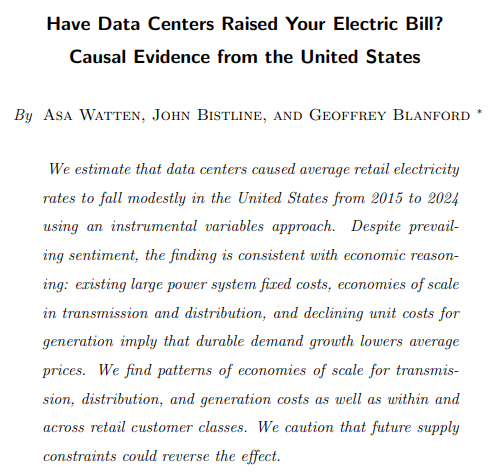
Controls include (by order of what i think is important):
1) Region Fixed Effects: These account for stable, time-invariant characteristics unique to each region - such as specific regulatory frameworks, geography, or historical business policies - that could otherwise bias the results
2) Year Fixed Effects: These control for nationwide shocks that affect all states simultaneously during a given year, such as federal policy changes or macroeconomic cycles.
3) Population: Used to control for regional demographic growth, which can influence both electricity demand and infrastructure investment
4) GDP: Included to account for broader regional economic expansion, which often correlates with changes in energy pricing
Data centers didn’t raise electric bills nationally from 2015–24. Surprise! Actually, they modestly lowered them. That's because big fixed grid costs get spread over more kilowatt-hours, and new demand can unlock economies of scale.
@arxiv
I’ve been crunching whether a $1.5T valuation for SpaceX is actually crazy. At ~100x sales on last year’s ~$16B revenue, it looks charged. But zoom out, it might be cheap.
SpaceX is uniquely positioned right now to help civilization step toward Kardashev Type II (harnessing a star’s full output) — starting with orbital compute that unlocks effectively unconstrained AI at scale. It’s also stacked with exceptional talent: xAI built Colossus (100k+ GPUs) and scaled MACROHARD in record time, roughly 10-12x faster than typical industry builds.
Let’s run a conservative scenario: Say SpaceX hits just 20% of the orbital compute ambitions they’ve outlined (Terafab targeting 1 TW/year production, FCC filing for up to 1M AI/data-center satellites, Musk’s “2-3 year” ramp talk). That’s ~200 GW of compute in orbit within 3 years - ~200,000 satellites, which is already a mind-bending number.
Assume they generate zero revenue from anything else (Starlink, launches, etc.) and price compute conservatively at $5B per GW/year. That yields ~$1T in annual revenue from compute alone.
At $1.5T valuation, that’s just 1.5x sales — after unlocking the biggest bottleneck to an age of energy/compute abundance. Now say they actually triple in valuation to $4.5T during that window (entirely plausible) and deliver 59% IRR over 3 years (top-quartile VC/PE/hedge fund returns average ~20%). They’d still only trade at ~6x sales. Airbnb sits at ~6x sales today. And this is compute revenue only — before Starlink growth, Starship cadence unlocks, Terafab synergies, or anything else.
Assuming Starship hits reusable cadence and regulators don’t fully block the constellation, the upside math gets absurd fast.
I’m convinced. At current rumors, it’s cheap. 🚀
@austinlyons@_Daudinho Which is basically the next gen Nvidia chip - GPUxLPU
It'll be interesting when both MAIA and GPUxLPU fully deployed, where they flock. My guess is GPUxLPU for the flexibility.
(4/4) xAI
Incredible engineering capability + X data moat + SpaceX as customers (more than that soon) + Tesla as customers = incredible engine to accelerate physical frontier flywheel.
(1/4) The Elon Musk mini-complex (SpaceX, Tesla, xAI(?!)) has a stronghold on the physical frontier tech landscape.
Rapidly Reusable Rockets, Electric Autonomous Vehicles, Humanoids, AI Compute.
Each market has its fierce rivals, depending on your lens, but hunt for a single entity dominating across all these frontiers and creating that virtuous cycle for itself, and you'll land on N=1. Bump it to N=2 if you include the state of China.
(3/4) Tesla
I wanted to make this portion about electric vehicles, but with their repurposing of their Fremont plant to humanoid robots, I thought it might be more relevant to focus on that. But here's a quick snip of EV sales FYI. (pic 3)
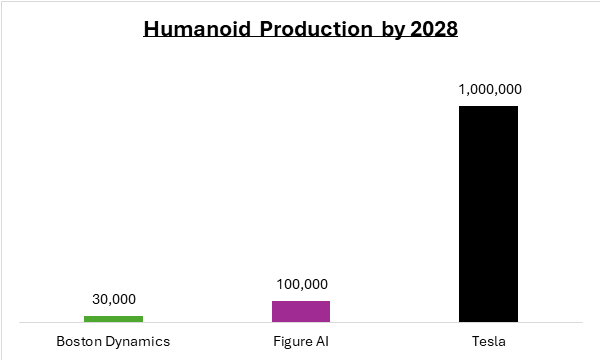
The US humanoid landscape is made of IMO three competitors, Tesla, Figure AI, and Boston Dynamics. Figure AI and Boston Dynamics have a role in this space, and that's to continue to advance what safe & capable humanoids look like with their R&D. Today, you could see them as a serious competitors, but again, econs.
What do we need for humanoids to operate: AI training, custom silicon, robotics hardware, manufacturing, and deployment environments. It's an expensive operation that can bring BOM (build of materials) north of $100k.
Tesla is the most vertically integrated in this space. xAI for compute + potentially custom silicon (at cost) and they'll manufacture + test the hardware in-house. Figure and Boston Dynamics are more research labs with excellent engineers - they'll compete on the brain & design of the humanoid - but require contract manufacturing and aren't primed for mass-market econs in large part due to lack of BOM discipline.
All three are primed to benefit from the required feedback loop of learning -> improvement -> deployment -> learning again, but one will accelerate beyond the others. Here's the latest projections on production by 2028 (2 years from now): (pic 4)