300 agents sounds powerful until you realize they can create 44,850 possible agent-to-agent relationships.
that’s the real scaling problem.
1 agent searches 10 pages.
10 agents can search 100.
300 agents can search thousands in parallel.
but more agents also means more:
• duplicate findings
• shared sources
• hidden relationships
and if every agent returns its own isolated report, you’re left with 300 piles to reconcile manually.
that’s why the graph matters.
instead of: 300 agents �� 300 reports
you get: 300 agents → shared entities → edges → clusters → one connected research map
100 nodes already create up to 4,950 pairwise relationships.
more agents give you more information.
the graph is what stops that information from becoming noise.
full breakdown in the article below ↓
Okay, This is a big Hermes Desktop update 👀
Hermes can now actually use the Preview pane.
Not just open a page.
Not just read a page.
Use it.
Click. Type. Scroll. Navigate. Annotate.
Inside the same visible browser pane you are watching.
That is a big deal.
It means Hermes Desktop is starting to feel a lot less like a chat window attached to tools and a lot more like an agent that can work through web tasks in front of you.
Think about the use cases:
→ Open documentation and show you exactly where a setting lives
→ Walk through a setup flow and point out what to click
→ Search a site, open the right result, and keep moving
→ Work through a dashboard while you supervise
→ Annotate important controls on a crowded page
→ Reproduce a web issue step by step
→ Fill out multi-step web workflows with you watching
→ Find the right tutorial or guide and take you straight to it
That changes the feel of Hermes Desktop.
Because now Hermes is not just telling you what to do.
It can show you, point to it, and act on it in the same workspace.
This one opens up a lot!!!
Your Claude hits the session limit.
You switch to Codex.
And you paste three hours of context into a blank window like none of it happened.
You didn't lose the chat. You lost the decisions.
I've paid that tax all month. So I wrote down the architecture that ends it.
whoever leaked this has bigger balls than sense
someone at Anthropic hired 80 AI helpers onto one project, gave them twelve hours, and counted what came back usable: the two older models handed in 980 and 876 finished pieces of work, and almost none of it could be kept
turns out the newest helpers did better for a reason nobody wants to hear: they went off into their own corners and stopped opening each other's work
i ran two helpers at one document last week and got two confident versions of it, and i kept the one i wrote myself
Grok Bot is the version of this you can actually hire: a helper with a name, one job it owns, and nobody else allowed inside that job
you already pay about $20 a month for one chat window, and the setup that won in that report is one helper with one job it owns
run it tonight in a normal chat, 3 moves:
1. write the one job each helper owns in a single sentence before you open a second chat
2. keep every helper in its own chat with one document, so two of them can never rewrite the same thing
3. add a third only when you can say what it owns without repeating a job that is already taken
save this, then open the piece below:
what one hired helper is really worth, and the point where the next one starts taking it back ↓
call me crazy but the first AI agent most companies should build is an autonomous analyst.
you can build one using Kimi K3.
it watches your competitors while you sleep, remembers every move, and wakes your team with the launches, pricing changes, and positioning shifts they need to act on.
don't bookmark this if it crosses your timeline.
paste the full article into Kimi and tell it to build the first version for your market.
Grok Bot puts five AI workers on one computer sharing one browser session, credentials and files. The security agencies of five countries published the opposite recommendation 103 days ago.
Grok Bot on GOD-MODE - killer of the AI race.
Here's the layer nobody's talking about, the wiring that decides whether a crew is worth 80% more or 70% less, and it installs into the bots you already pay for:
- test one solo agent on the real task first. past roughly a 45% success rate, the study says a crew around it returns zero to negative
- under that line, put a single supervisor over the fan-out. crews with no correction step multiplied their own errors up to 17x the solo rate, supervised ones held it near 4x
- give each worker one job and one output, and never let them read each other's drafts, so a wrong step hits the supervisor instead of infecting four other bots
- re-run the solo-vs-crew test after every model upgrade, because a smarter base model quietly makes your crew stop paying
- keep one lone agent running as the control, the only number that tells you the crew is earning its calls
Sit with that, the model never moved, the tools never moved - only the diagram between the agents moved, and it decided the entire outcome.
Grok Bot just turned spinning up a crew of agents into a single message. which means half the internet is about to build crews that quietly make them worse and never once check.
Google Research and MIT team ran the same agent jobs hundreds of different ways: identical prompts, identical tools, identical compute budget, the only thing they touched was how the agents were wired to each other. the same exact work swung from 70% worse than a single agent to 80% better, and averaged out to basically zero.
Setup for running a Grok Bot swarm that adds instead of subtracts is in the article below ↓
Kimi K3 shipped and a competitor's stock lost 30% the same week. It wasn't an American one.
Z ai fell as much as 30%. MiniMax 16%. Alibaba 4%. The US labs it was supposedly aimed at aren't even listed.
K3 is 2.8 trillion parameters, the largest open-weight model ever released. Roughly 75% bigger than DeepSeek's V4 Pro.
One million tokens of context, native vision, thinking mode always on. #1 in Frontend Code Arena, top three on every major index.
Then Moonshot gave the weights away on July 27. Free to download, free to self-host, yours forever.
That reads like generosity until you check who it actually hurt.
To a frontier lab, an open model is competition. To the second-best open model, it's an extinction event.
Nobody pays for mid-tier open weights when better ones cost nothing.
The license is where the business hides. Past $20M in revenue you negotiate a contract. Past 100M users you display their name.
Free for you. A contract for anyone big enough to matter. Daily revenue is up at least 6x since launch, and they're raising at $50 billion.
Open weights stopped being a gift. They're a pricing weapon now. Go look at what your stack runs on and ask what the giver gets back.
someone just published the clearest introduction to graph engineering i’ve seen.
one page. the whole idea explained.
the key insight is in the top right corner.
model the world as a graph, not a list.
many AI systems still work with linear lists and isolated records. a graph captures entities, relationships, and context together. when AI can see the full structure, it can make better decisions.
graphs mirror how real systems actually work. everything is connected.
two elements form the basic vocabulary.
node: an entity or concept. edge: a relationship or connection.
that is it. everything else is built from those two things.
why it matters in practice.
context: connect the dots across systems, data, and people. reasoning: enable multi-hop inference and deeper understanding. adaptability: evolve the graph as new information emerges. observability: see what’s happening, why it matters, and what to do next.
the workflow is five steps.
model: define entities and relationships. build: create and connect the graph. enrich: add context, metadata, and constraints. query: ask complex questions across connections. act: turn insights into actions and outcomes.
the principle at the bottom is worth keeping.
“good systems are built through clear structure, not more data. connection turns structure into intelligence.”
and the conclusion:
“complexity into capability. systems that evolve, not break.”
graph engineering is not about adding more agents. it is about giving AI the structure to reason the way we do.
a prompter asks a question. an architect draws a graph.
I stopped trying to remember how to manage Hermes.
Instead, I gave one agent a second job: manage Hermes itself.
Updates. Models. Profiles. Settings. Troubleshooting.
Havoc handles the Hermes side so my other agents stay focused.
Meet Havoc 👇 https://t.co/k70O2cJ8y1
The founder of Obsidian dropped his own Claude skills it going viral on github (45k stars).
For Claude becomes part of your second brain.
Built for real Markdown, wikilinks, Bases & Canvas everything
- https://t.co/Wl5gcL8asu
OBSIDIAN IS NOT A SECOND BRAIN, IT IS A FOLDER FULL OF DIGITAL GUILT UNTIL YOU BUILD THIS 4-STEP AI MEMORY LAYER.
i spent three years clipping hundreds of articles into obsidian and building a massive graph view i never opened again.
every new chat session started from total amnesia. i was treating AI like a very expensive intern re-reading my drive.
then an engineer showed me the real unlock: stop treating obsidian as a note museum and turn it into a live memory layer.
here is the exact 4-step recovery system that lets AI agents read, update, and navigate your brain automatically:
1. daily state update log
› log brief daily state updates inside 07_daily so your AI memory gets consistent updates without manual maintenance. › eliminates the heavy librarian workload after a full day of work while preserving long-term project memory.
2. decision & workflow vault
› store past decisions, writing style rules, and project briefs in machine-readable Markdown files inside 03_decisions. › gives coding agents explicit operational context so you never have to re-explain your preferred workflows.
3. _index navigation map
› keep one-line map descriptions inside _index files so agents locate relevant concept notes in a single lookup. › prevents the model from searching thousands of raw files and degrading your vault into prompt slop.
4. automated synthesis pipelines
› deploy AI prompt scripts to extract tasks, connect related ideas, and summarize meeting notes automatically. › automates the maintenance burden so your personal knowledge compounding runs silently in the background.
80% of builders will quit Obsidian because of maintenance fatigue. the 1% who automate context will build a second brain.
save this post before you close your current note-taking app and lose your context harness.
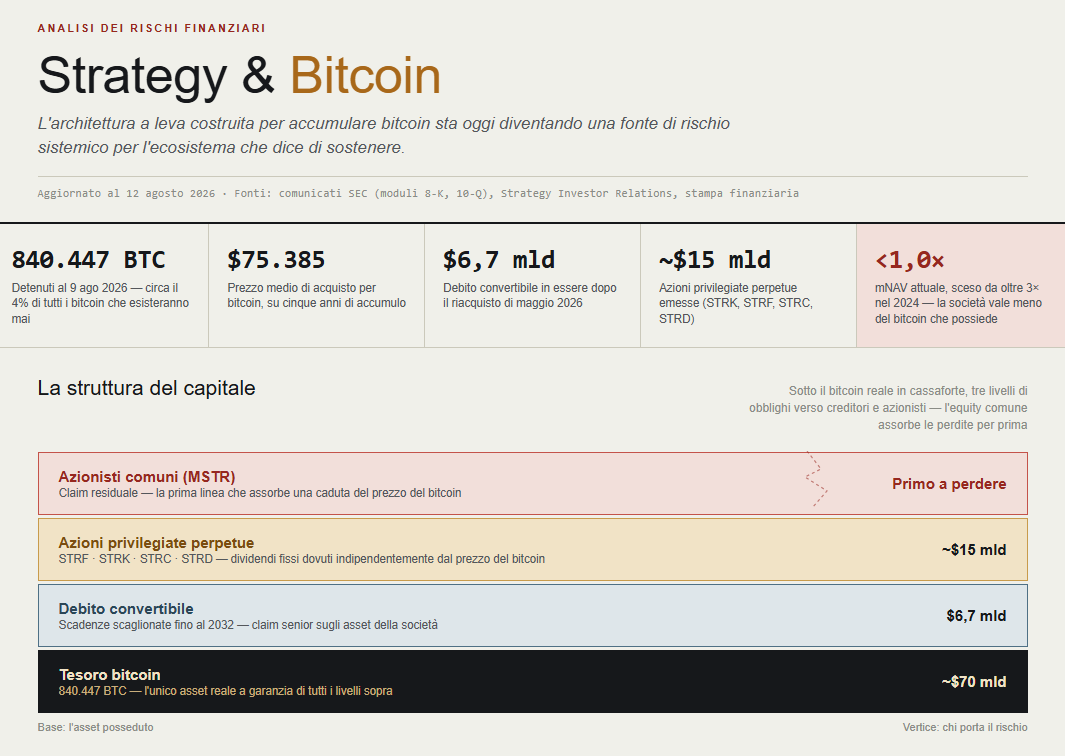
Diversi analisti e gestori paragonano il meccanismo delle azioni privilegiate a uno schema piramidale: i dividendi vengono sostenuti raccogliendo nuovo capitale sul mercato, non con flussi di cassa generati dal business operativo.
Sai quali sono i tipici segnali di uno Schema Ponzi ?
1.
Rendimenti costanti e "garantiti"
2.
Dipendenza dal flusso di nuovi capitali per pagare i vecchi investitori
3.
Costante pressing che incita ad acquistare
4.
Atteggiarsi a nuovo Re Mida della finanza mondiale
5.
Strategia opaca nella gestione del denaro altrui
300 agents just finished your research in 40 minutes. congrats, now go read 300 documents.
that's what a swarm gives you. a pile.
the useful part isn't in any single one of them. it's in how they link up. 100 assets have 4,950 possible connections between them.
nobody holds that in their head.
kimi agent swarm keeps the links. 300 agents in one launch, up to 4,000 steps. every asset and every wallet an agent touches becomes a node. two agents hit the same counterparty, it draws an edge between them.
you don't get 300 answers. you get one map.
point it at your own trading portfolio and the picture gets uncomfortable. positions you thought were unrelated land in the same cluster, because the same market maker quotes all of them.
one bridge lights up as the hub half your holdings route through. that's your single point of failure, and nobody asked for it in the prompt.
Renaissance hedge fund keeps around a hundred PhDs on staff to catch things like that.
it also doesn't die when you close the tab. next launch adds to the same graph.
that's the gap opening right now. one guy re-reads 300 docs every week. the other one has a base that gets smarter every run.
my friend broke down the full framework and wrote the guide in the article below. read it, then go look at what your last agent run left you with.
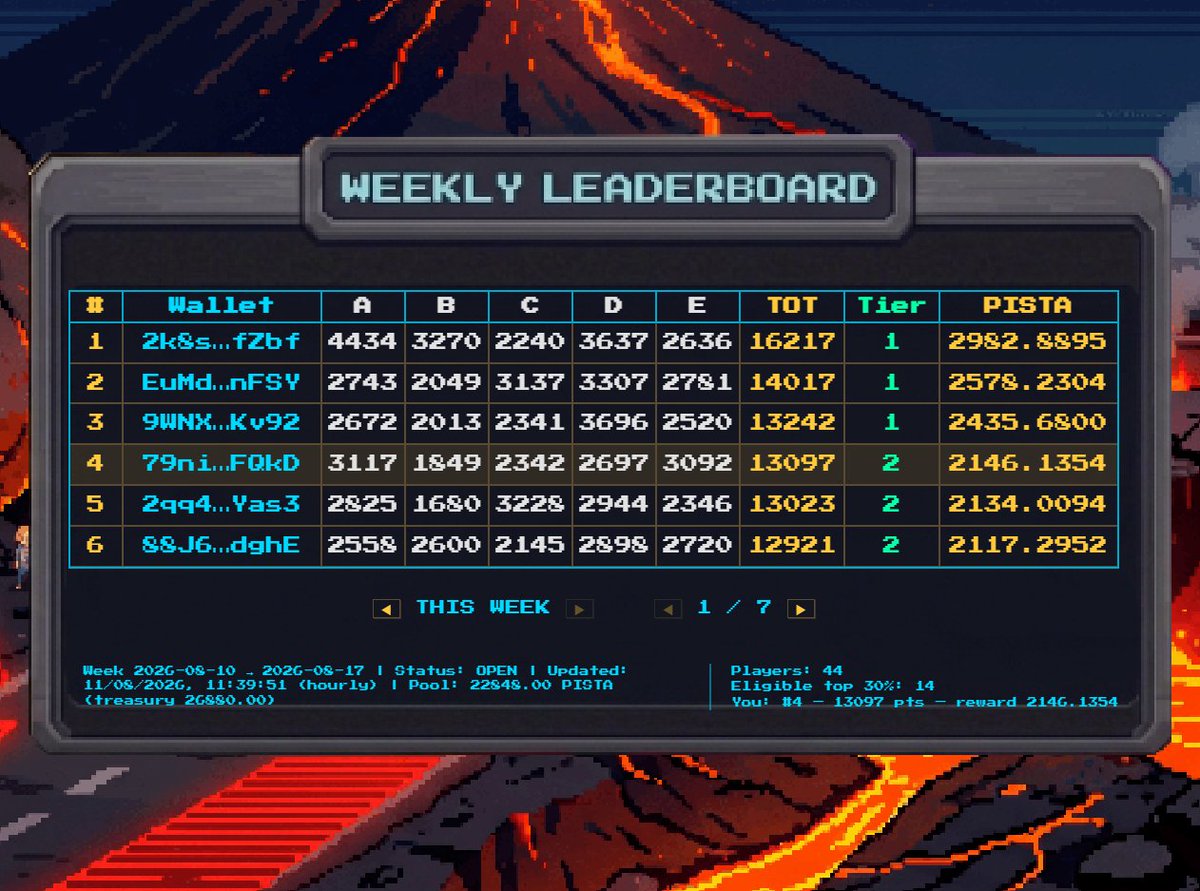
Ogni ora la race leaderboard si aggiorna, questo scatena la competizione tra i gamers che possono pertanto cercare di migliorare il loro total score rifacendo solo alcune specifiche gare in cui hanno ottenuto un punteggio basso o mediocre. A fine settimana il tabellone si azzera, si distribuiscono le rewards tra il 30% dei giocatori con il punteggio più alto e si riparte la settimana seguente con una nuova classifica. Ogni mese è previsto un torneo riservato solo ai giocatori con il punteggio più elevato.
Adding $25m $META here.
I’ve always believed big tech wins AI in the end. They have the users, distribution, data and, most importantly, the profits to pay for it.
Intelligence is going to get very cheap. Frontier and near-frontier models are going open weight, smaller models will run on consumer hardware and the cost per task will collapse. AI usage will explode, but basic access to a model won’t be worth what people think it is.
China will distil whatever the closed labs build and now serious open-weight models are coming from the US too.
Meta has billions of users and an advertising machine that can fund the whole race.
Competing with China is bad enough. Competing with Zuck is bad enough.
If you have both, God help you.