New Content Alert:
Linear regression says one subgroup's "Very Satisfied" share fell by 8pp.
The actual data show it rose by 7pp.
Sign flipped — and the model was properly specified.
This is how linear routinely breaks on Likert outcomes. 🧵(+ two posts & a shiny app!)
@ian_t_adams The UNC system is requiring syllabi be posted, and faculty are being encouraged to provide only the "minimum" to comply. I think we faculty are making a professional and political mistake by actively thwarting scrutiny. https://t.co/d61VMAdNFI
@ian_t_adams Looks like Criminology and Law and Human Behavior were included in the Sociology sample of journals. Check out the "Extended data tables and figures" section of the Miske et al. article for criminology-specific findings.
New preprint with @Jake_Day4 & @MarijanaKotlaja
When stressed, you might get depressed—but will you also commit crime?
Short answer: Yes for depression. No (or not typically) for crime. 🧵[1/11]
https://t.co/yVIoEduNmy
@ashleytrubin@fourbeerspod From the interview, it sounded like the main issue with current AI models and infrastructure is it may be cost prohibitive at scale. Anyways, it was a really interestiing conversation about potential uses of AI in science/meta-science: https://t.co/pypxIRTRo4
@ashleytrubin@fourbeerspod Probably not a huge leap to train AI to answer these perhaps more interesting questions about the less formal characteristics of the published literature.
@rlmcelreath@RealJonBrauer Ironically, my (non-criminological) dissertation, and the work that came out of it, is likely similarly biased (selected on survivors/successful coaches) because I ignored some critical early feedback from one of my committee members! For example: https://t.co/cSvtziKR3T
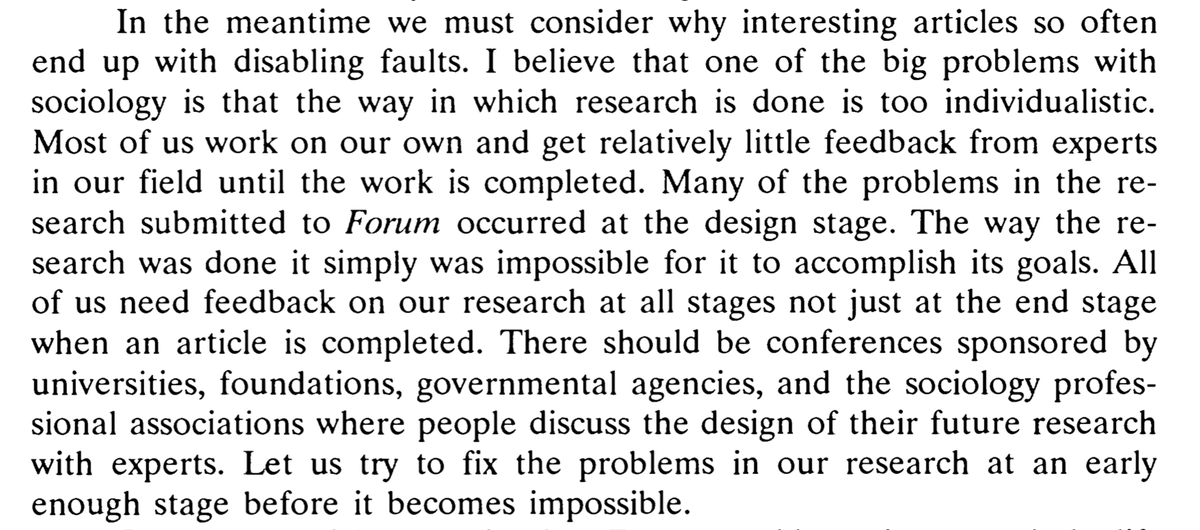
I like the causal story and its implications re more collaboration early in the research process. But the specific issue Cole discusses here (interesting articles are less robust) might be explained by selection (in this case submission to Sociological Forum). >
We've had the same problems with publishing for a long time (ex. vet your research before you undertake it). Why are they still problems? This from Cole, editor of Sociological Forum, in 1993.
Briefly want to draw some implications for you from the observation that:
-Scientists write, review, and share empirical results constantly as their primary job function
-But scientists do not actually read and engage empirical results with the bare minimum to understand them
🧵New Preprint: Is "self-control" a real psychological entity, an emergent property, or a statistical fiction? Our new paper challenges criminology's hidden assumptions about measurement.
w/ @Jake_Day4@agrahamphd
Landmark new article in @Theory_Society from @RealJonBrauer and Jacob Day.
Criminology requires an important shift in priority and perspective to prevent further deterioration of the field's legitimacy and capacity to be truth-seeking.
"By confronting the crisis directly and reimagining the very forms of knowledge we produce, criminology can move closer to fulfilling its potential as a cumulative scientific enterprise."
Check out the article here (open access!): https://t.co/e1KBdKqWXC
The goal: Transforming criminological knowledge products so they constitute the accumulation of real "money in the bank" for precise, falsifiable theories & thus contribute to cumulative theoretical development. (12/12)
Full paper w/@Jake_Day4:
https://t.co/QcyRMMjM7V
@JohnHolbein1 We reanalyzed a published null, showing data lack signal to trust oft-cited null interpretation (large effects also plausible given same data; measurement decisions matter). Based on citation patterns though, I'd say we failed to "overturn" anything. 🤔🤷
https://t.co/2bWBJLnxrN