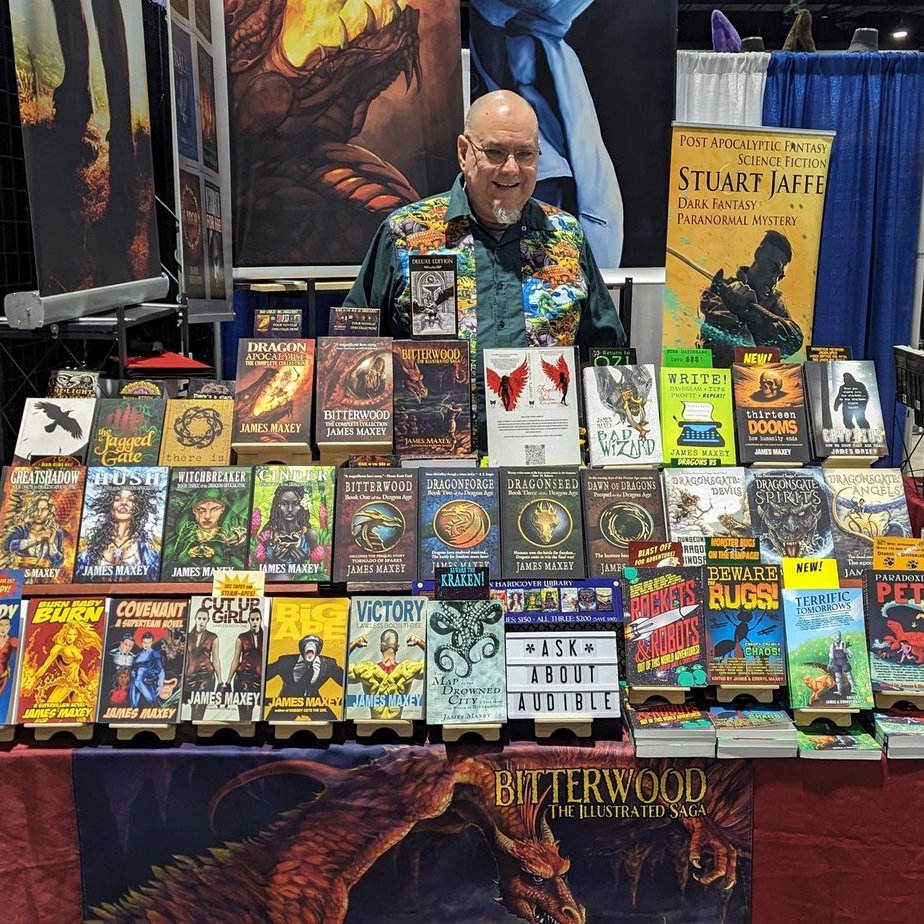
My catalog: A 🧵. I've written a lot of books. I'm not prolific, just old. Crank out a book or two every year or two and eventually you have a wall of books. I mainly use X to talk about writing and books, so I thought I'd use this thread to explain all the crazy stuff I write:
@RBrownAuthor Nothing is necessary. But, you can get a pop up banner for under $100 and it will last for years. 100+ events for some of my older banners. An insanely cheap and effective sales multiplier.
@VioletLave5799 These go for $120. I also have a $300 box collecting all 11 dragon novels, but I sold out in March and haven't had time to make a new one. It's one reason that next week I'll be adding a second laser cutter.
May 2026
Units sold: 267
Total revenue: $6364.92
Lanterns were $1500 of my revenue, and I did $700 in my custom wooden boxed sets. Subtract out the lanterns and Cheryl's crochet and I'm just under $4k for books alone, not stellar, but I can live with it.
The lanterns basically covered my table costs for the two shows. As much as I'd love to have books be my only revenue, having a second product available at live events is a good strategy for getting to profitability.
May 2026
Units sold: 267
Total revenue: $6364.92
Lanterns were $1500 of my revenue, and I did $700 in my custom wooden boxed sets. Subtract out the lanterns and Cheryl's crochet and I'm just under $4k for books alone, not stellar, but I can live with it.
Did I write my newsletter? No.
Did I get much written? No.
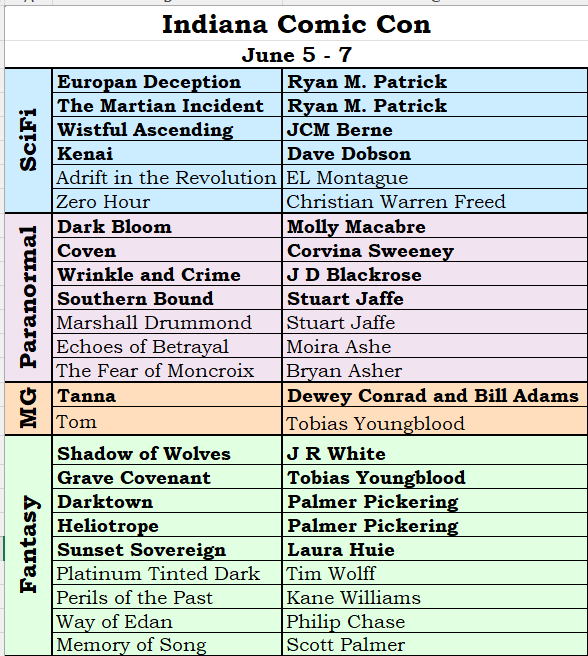
Did I pick the indie books for the Indiana Comic Con? Of course!
The emboldened titles are always-bring-books.
The show still has an hour to go but the aisles are empty. Only sold 43 books unless there's some wildcard last second purchase. My worst showing ever for a Galaxycon.
I need roughly $600 in sales today to hit $6k revenue for May. At most Galaxycons this would be easy, but based on trends from the last two days I'm going to be working hard for every dime.
Hmm. I was actually talking about this today describing stories in one of my collections as being about people in doomed situations. There's no last second rescue, no clever solution. Death or worse is imminent and beyond their power to alter. So, the stories are about how the characters react in that moment when all is lost. Do they find peace, courage, or grace? Do they go down fighting? They might not have agency to alter the story, but they retain the agency to alter themselves, even if it's too late for it to matter at all.
I appreciate that. I learned my craft in the trad pub era, when books had to clear certain quality hurdles to be published. I don't want to be a snob, but in recent years both mainstream and indie books seemed to shift into just another form of content, churned out as fast as possible, and disappearing from the mind as fast as the average tweet.
Part of the problem is that a lot of great novels were framing and making sense of events from the previous 10-25 years. Think of the great books about WW2 published in the 50s and 60s. But the pace of change is now so extreme there's little time to contemplate big events before the next big event arrives and devours it. The decades long struggle to understand the world gets compressed into a matter of hours on social media, only to have the new understanding be instantly forgotten.
It's more like sales equals existence. An unsold book is usually an unread book, and an unread book is more or less the same as an unwritten book. It might have value as a creative experience for the author, but it has no impact on the readers of the world.
I was feeling a little down about slow sales yesterday, but this morning I got an email from someone who saw me at last weekend's show, bought an ebook, and now wants to order a signed copy, plus three lanterns as gifts. Woohoo!
Honestly—and this is where I am gonna get in dutch with a lot of modern indie authors—there are lessons you learn in the slush that can't be easily learned other places. I fear too many indie writers never get their skills pushed to the next level because there is no "No" happening. Nothing to shove back on their product and make them work at it some more. Everything is merely quantity, marketing, placement buys, etc. All of which have nothing to do with telling better stories.
And a lot of literature of recent decades just feels shallow. Very little of the depth of books like Grapes of Wrath or Slaughterhouse Five. It might be that we just need time to Iet the wind carry off the chaff, but I worry that, with the rise of big box book stores and Amazon algorithms, maybe it's all chaff, because that's where the profit is
Part of the problem is that a lot of great novels were framing and making sense of events from the previous 10-25 years. Think of the great books about WW2 published in the 50s and 60s. But the pace of change is now so extreme there's little time to contemplate big events before the next big event arrives and devours it. The decades long struggle to understand the world gets compressed into a matter of hours on social media, only to have the new understanding be instantly forgotten.