N300/Litre Price: Nigeria Pays More for Crude Oil Security Than for Production — Duke
Nigeria reportedly produces about 1.8 million barrels per day of crude oil, with domestic consumption hovering around 500,000 bpd.
However, a barrel of crude in Nigeria costs between $25 and $45 to produce. The actual production cost is about $12 to $15. What drives it up to $45 is the cost of security and dilapidated infrastructure. The oil-producing companies have inflated the security cost per barrel. Selling petrol at N300 per litre, which reflects the true production cost, would improve productivity. The government cannot punish Nigerians for its inability to secure its borders.
Donald Duke, Presidential Candidate of The People's Redemption Party
Free market is where you destroy investment worth over hundreds millions of $ to kill competition for your own private real estate.
Free market means pushing all your middle class into poverty while politicians cruise on Rolls Royce and private jet??.
Smh.
Sad to see you disavow everything you once stood for concerning the Nigerian economy. You have so easily replaced your free market orientation with a strange form of populist economic prescriptions . Its seems economic reforms are different in theory from in practice to you.
All these because you support a Peter Obi who doesn't even know what he's talking about. The attached video was you some 10 years ago strongly advocating everything Tinubu is doing now. Try to be a bit more kind to yourself sir.https://t.co/8I688uPRmK
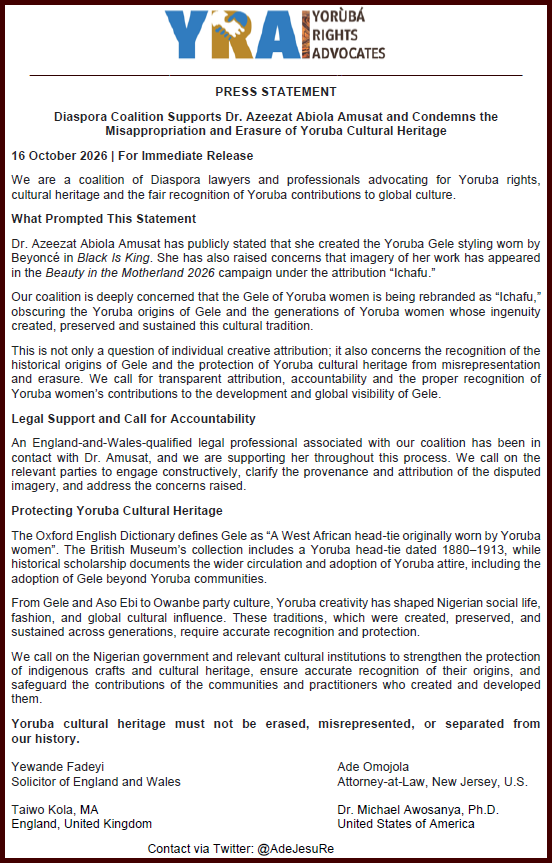
Yoruba Rights Advocates issue this Statement in support of Dr. Azeezat Abiola Amusat, calling for accountability over the misrepresentation and misappropriation of Gele. We also call for an end to the erasure of Yoruba from our cultural heritage.
See Image Below.
History and Etymology of Ichafu in just 2 minutes🔥🔥Ezigbo Nwa Ada. This is how you do it. No unnecessary argument.
Biko share widely and follow her massively, whatever her handle is.
Make Ichafu Great Again #MIGA
Cultural Vampirism and Gele
If you have not listened to the attached interview, please do. The discussion is not about Gele, but the speaker offers a spot-on analysis of “living space” that bears directly to the current debate.
The idea of Lebensraum, or “living space,” was taken by the Nazis to its most extreme and murderous conclusion. But what makes the concept historically significant is not territorial expansion alone. It is the mentality that can accompany expansion: the assumption that another people’s space, symbols, history, and cultural markers may be absorbed, renamed, or displaced with little regard for their ownership, continuity, or meaning.
Nazi cultural policy expressed that logic with ruthless clarity. It did not simply encounter other cultures and borrow from them in admiration. It appropriated selectively while simultaneously subordinating, suppressing, or attempting to erase the peoples from whom it borrowed. Its relationship with other cultures was not one of exchange and appreciation, but of coercion and predation. And examples abound. The swastika, an ancient symbol found in Hindu, Buddhist, Jain, and other traditions, was appropriated and transformed into a racial-political emblem. “Aryan,” derived from Sanskrit ārya, was wrenched from its historical context and converted into a racial category.
That distinction matters in the current debate over Gele and Ichafu.
While it is seductive to dismiss the argument as a quarrel over trivialities, the underlying issue is more consequential. Gele is merely the latest in a longer pattern of contesting ownership of Yoruba cultural elements. Before it, there was Agbada. Then Owanbe. Foods have been disputed. Even the origin histories of Yoruba towns have been challenged, sometimes through elaborate historical narratives constructed to sustain those claims.
And this is not random. The claims have appeared in newspapers, been amplified through coordinated social-media campaigns, chronicled in books, repeated by the same network of voices, and, in some cases, pursued far enough to produce legal disputes. Different subjects, same method. Different cultural markers, same direction of travel.
Silly arguments have been advanced, and sillier positions defended.
One of the most cowardly is the claim that because Yoruba and Igbo people now share a political space called Nigeria, Gele and Ichafu must somehow be treated as culturally interchangeable. That argument is anachronistic, historically weak, and an attempt to dress intellectual spinelessness in the language of sophistication. Modern Nigeria did not create these cultures, and contemporary political coexistence does not retrospectively erase their separate historical development. Yoruba and Igbo sartorial traditions emerged within different social and cultural worlds. Historical descriptions of Yoruba dress identify Gele and related forms as part of Yoruba female attire. To pretend that two peoples with distinct dress traditions, conventions of bodily covering, and ceremonial forms therefore possess interchangeable sartorial histories is not intellectualism. It is erasure.
Perhaps the most egregious argument, however, is that Gele is merely a Sahelian invention fashioned from European materials. Another demented mental gymnastics traces it instead to the Vietnamese Khăn vấn. Let us even assume, purely for the sake of argument, that these claims (which are obviously false) are true. They still would not erase the fact that gele became a distinct Yoruba cultural form. It bears a Yoruba name. It has recognizable styles and conventions of tying and presentation. It carries social meanings embedded in weddings, chieftaincy, funerals, celebrations, and ceremonial status. Earlier influence does not cancel later cultural ownership.
Cultures do not emerge from a vacuum. They borrow, adapt, transform, localize, and create new meanings. If remote ancestry or material provenance were sufficient to invalidate cultural ownership, almost no people on earth could claim anything as their own. Nearly every cultural form has antecedents.
That is why the relevant question is not merely whether something may have older influences. The more important question is what a people subsequently made of it: how they transformed it, named it, embedded it in their social world, and transmitted it across generations.
Cultural exchange is normal. Borrowing is normal. Adaptation is normal. Every culture does it. What becomes problematic is appropriation accompanied by denial: taking a cultural form, stripping it of its acknowledged provenance, renaming it, and then insisting that the people who developed and transmitted it have no particular claim to its history.
Provenance does not mean monopoly. It means honesty. Acknowledging the Yoruba provenance of gele does not forbid anyone else from wearing it, adapting it, or incorporating it into their own cultural practice. It simply refuses the fiction that Yoruba people are incidental to something they named, developed, socialized, and transmitted across generations.
So when gele is adopted while its Yoruba provenance is denied, and Ichafu is presented as though the two terms and traditions are historically interchangeable, the objection is not to cultural participation. It is to cultural erasure. There is a profound difference between sharing in another people’s culture and consuming its symbols while denying recognition to the people who produced, developed, or preserved them. The first is cultural exchange while the second is cultural vampirism.
And that is what makes the metaphor useful. The vampire does not merely coexist with its victim. It feeds on what gives the victim life. Language, names, histories, symbols, dress, and collective memory are among the things that give a culture continuity. To appropriate them while simultaneously denying their provenance is not cosmopolitanism. It is consumption disguised as openness. And no amount of fashionable talk about sophistication should delude a people into cooperating in their own cultural erasure.
Actually, during the first Civil War, my people—the Ibibios and other minority tribes—sided with the Nigerian Federal troops because Biafran troops murdered some of our people under the accusation that they were “saboteurs” or collaborating with federal Nigerian forces.
If that second war you are talking about starts, be rest assured that my people and I will take the side of the Federal Government once again, with our full chest.
It is not today that non-Igbo communities in the former Eastern Region have feared domination by the region’s Igbo political majority and demanded their own states. What do you think led to General Yakubu Gowon creating three states out of the old Eastern Region on May 27, 1967?
Give me a choice between an Igbo presidency and a Fulani presidency in 2027 and beyond, and I will gladly take a Fulani man's presidency. I said what I said.
@JamesIamizugod My question still stand OG!!!! If that same project was posted by any govt I trust Nigerians to not apply any diplomacy as everybody is doing!!!! I’m not even in support of any govt it’s just Nigerians are dogmatic minded set of people.. just slave to whatever they like.
@SirJarus That’s a general question sir!! I knw u are an experienced developer nd I alwys commend ur work nd I can’t throw away ur claim!! I’m jst adding frm my own perspective as an estate surveyor also nd valuing each block of the building. If this is posted by govt d reactn will be dfrt
A lot to unpack here.
The FG did grow revenue by more than 100% to ₦6.2trn (from ₦3.6trn). The increase came from higher oil receipts and stronger tax collections.
But interest payments on debt stood at ₦7.7trn, therefore, gulping the entire revenue generated.
The FG spent ₦16.1trn. This means that, aside from interest payments on debt, the FG spent ₦8.4trn on other activities (i.e., recurring and capex).
Of the ₦8.4trn allocated to other activities, ₦700bn went to capital expenditure, while the rest went to recurrent expenditure (including payrolls and overheads).
In effect, fresh borrowings of ₦7.7trn were spent on recurrent expenditure.
If I wanted to be “mischievous”, I’d have said ₦7.7trn was borrowed to pay salaries (which is not false, by the way). But I won’t do that. That’s not my objective.
So in summary, the government is fetching water into a “basket”. The harder they work to “make things happen”, the more the ghost of the past haunts.
And from the looks of things, this may be the best the FG can do. But the jury is out.
Celebrating Macroeconomic stability Amidst Increasing Poverty!
The recent World Bank report which noted improvements in few macroeconomic indicators such as economic growth and revenue generation should not be misinterpreted and mispresented by the incompetent President Bola Tinubu led APC Government as evidence that the standard of living of Nigerians is improving. Nigerians and even the World Bank know that the criteria for economic development is whether poverty is declining, whether jobs are created for our youths, and whether we are reducing acute inequality. In the case of Nigeria under President Tinubu the answer is no. So-called ‘economic stability’ has not resulted in higher living standards, improved employment opportunities, and reduction of poverty and inequality across Nigeria.
An economy is not truly stabilized simply because government revenue increases, foreign reserves strengthen, or GDP grows. Stability exists when citizens can afford food, obtain healthcare, provide education for their children, and live with dignity.
What comfort does higher revenue offer a mother who cannot provide her children with a nutritious meal? What does higher government revenue mean to a family forced to choose between purchasing food and paying for medicine? What benefit do celebrated reforms provide when ordinary Nigerians continue to bear intolerable costs and hardship?
In the report titled, ‘Beyond the Federal Purse: How Higher Revenues Reshaped State Priorities’, The World Bank noted that the Federal Government spent a whooping N7.7 trillion on debt interest payments alone in the first six months of 2026 from January to June. This represents about 124.2% of our total revenue of N6.2 trillion within the same period with debt interest payment exceeding revenue by about N1.5 trillion. How do you explain the unsustainable debt crisis even with exponential increase in revenue that we have had since 2023?
. Imagine a situation where borrowing and revenue have exponentially increased but expenditure on capital projects reduced by about N700billion in the first half of this year. In comparison, the APC led Federal Government spends about 11 times more on interest payment than on capital projects. The explanation is clearly attributed to reckless borrowing, corruption and incompetence of the President Bola Tinubu led APC Government.
President Bola Tinubu and his incompetent team must recognize that intentionally presenting and projecting incomplete economic statistics cannot replace the critical measure of how reform impacts on the welfare of the people. A government cannot expect citizens to applaud statistics while they struggle to survive the effects of its policies. How do you celebrate when about 140 million Nigerians are classified as multi- dimensionally poor with a recent UNDP report listing Nigeria as one of the countries where gains made in reducing poverty have been reversed.
One thing to note- "We SOUGHT the approval of the President to integrate the East West Rooad.'
Those of u saying we should leave Umahi alone can hear him. Btw, we never said its been abandoned; We are asking for the same route promised to be intact. Do not divert from the Coast of Ondo & Itsekiri to favor the East West road lobbied by ur kinsmen.
This isnt clear enough. Hes been clever by half. If the original route will be more expensive, pause it! Don't cut out Ilaje & Itsekiri coastline. Connecting them to Ogun waterside & Eti Osa is supposed to be the beauty of this for us as Yorubas.
Do not play on our intelligence cuz a Fellow of COREN with 30 years of experience knew that terrain very well b4 commencement of project.
@Freeman2gud
I first went on Channel's YouTube page to confirm this video is legit. It's crazy that there are "lovers of Nigeria" who actually want this project to not happen and desperately seek after bad news to demoralize people. At what point do you start to reflect?
🚨 UPDATE:
Minister David Umahi speaks on the Lagos-Calabar coastal highway:
— Ondo and delta state will get their own coastline highway.
— The East West 400km road alignment, is an ADDITIONAL construction that got the approval of President Tinubu.
— The East West additional alignment WILL NOT STOP the Lagos-Calabar Highway previous construction plan.
Me: I don they boil since yesterday, everything’s was just irritating me since. Atleast I can be happy once more.
You guys can keep crying in political nonsense. Those using the road in real life and living across its corridors will wake up tomorrow morning and thank God the road is getting built. 20yrs from now, it'll be a major landmark project of reference. Politics doesn't mean we should be blind to facts.
I am not one to back out on my position because of political bandwagon or dogmatism. The coastal road project remains the most audacious singular road project embarked upon by any FG since IBB built 3rd mainland.
The massive nature of it, the linkage to many communities and states; and the multiple bridges that connects and throws open countless development corridors is one that will expand many economic opportunities for generations to come. The effect on the Lagos leg alone is mind blowing. And they haven't even finished. The speed of the work is also insane.
You can criticize the government or the budget or whatever you like as a citizen, but that project is audacious and commendable. And to downplay it cos of politics is hypocritical.