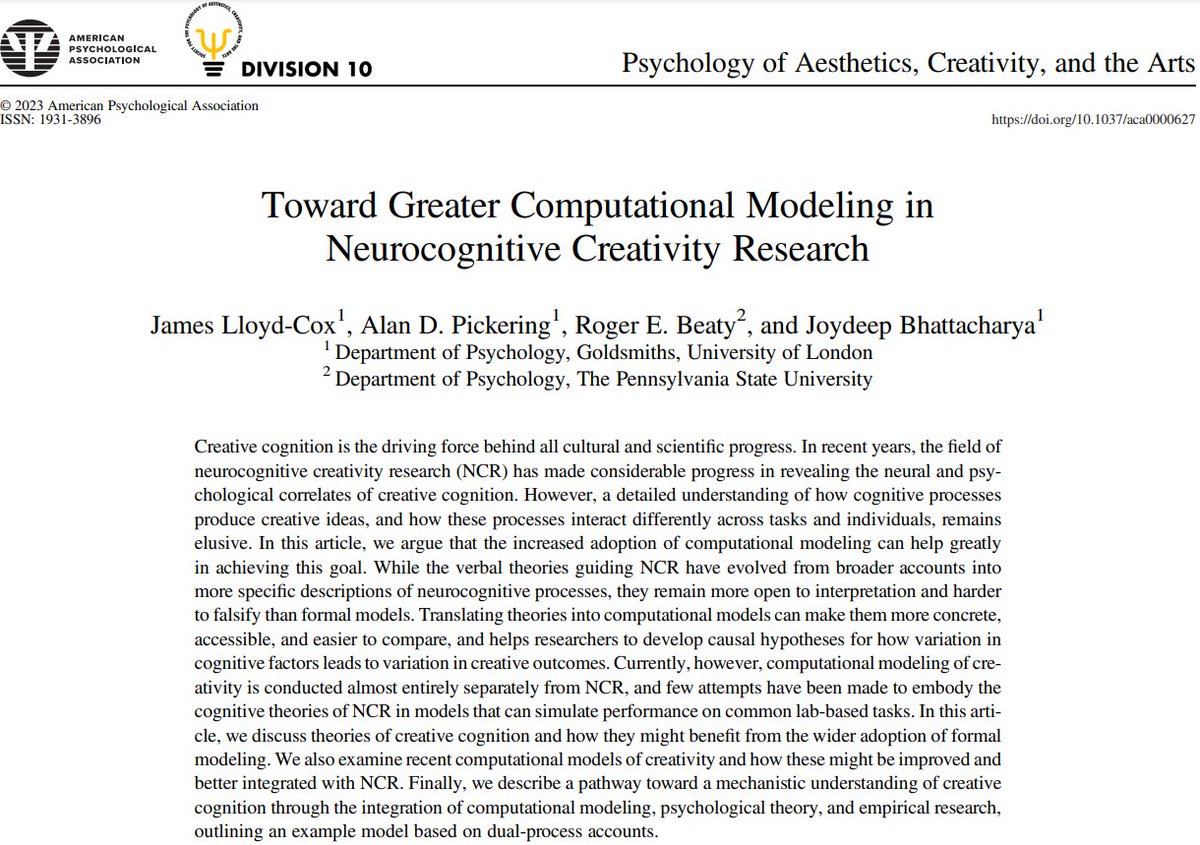
Here we review theories of creativity and discuss how they can benefit from formal modeling. We also review recent computational models of creativity, their successes, and how they might be improved further. Finally, we describe the modeling process with some examples and code.
New paper with @ad_pickering, @Roger_Beaty, and Joydeep Bhattacharya!
Here we argue that neurocognitive creativity research (NCR) would benefit greatly from a new generation of dynamic computational models.
https://t.co/ZSuuGmQqVY
Our new theory paper, led by @JamesLloydCox, argues computational modeling would greatly benefit creativity research by making creativity theories more rigorous & testable. @APADivision10@ad_pickering
https://t.co/ZYD6p3fZlR
Models that instantiate a specific cognitive theory of creativity and can simulate performance on common lab-based tasks could take us much closer to a precise understanding of the mechanisms that produce creative ideas and how these vary across contexts.
1/Very happy to share our paper in Behavior Research Methods!
Divergent Semantic Integration (DSI): automatic scoring of creativity in text (short stories) using BERT
DSI strongly predicts human ratings of stories
Code + paper = open access
🧵
https://t.co/VLj3RVgUjQ
1/🧵 New paper alert in our new #CRJinsights series by Sarah Ahmed and @dguess5 titled “An Analysis of Writer’s Block: Causes and Solutions”! Here’s a link to the paper and a thread:
https://t.co/B2TKoHle3M
Creative ideas are both novel and useful, but how do people weight up these factors when evaluating creativity? Does the kind of idea or the personality of the rater play a role? Find out in this new paper with @live2joy and @ad_pickering!
https://t.co/45TsoCLSBr
Newly published in Creativity Research Journal by @JamesLloydCox, "Evaluating creativity: How idea context and rater personality affect considerations of novelty and usefulness"
https://t.co/Ur9G7yphKH
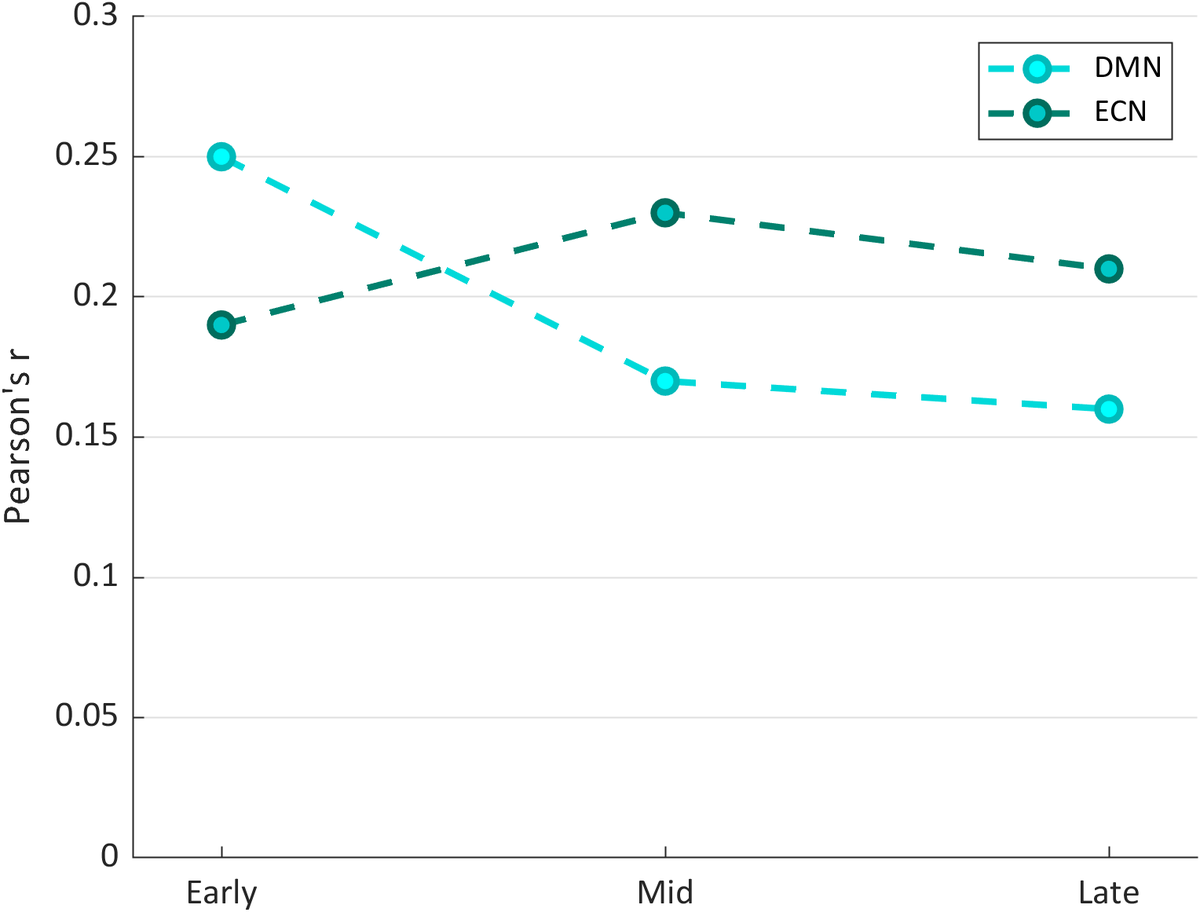
New paper with @Roger_Beaty and @cqllogic! We found different relationships over time between creative activity in the default and executive networks and human-rated creative quality -> potentially reflecting stages of generation and evaluation.
https://t.co/cyAVxG6KzM
In a new paper, led by @JamesLloydCox w/ @cqllogic, we study default & executive network contributions to idea generation over time. We find early involvement of the executive network, suggesting control processes may be important early in idea generation
https://t.co/9LnT8wApHf