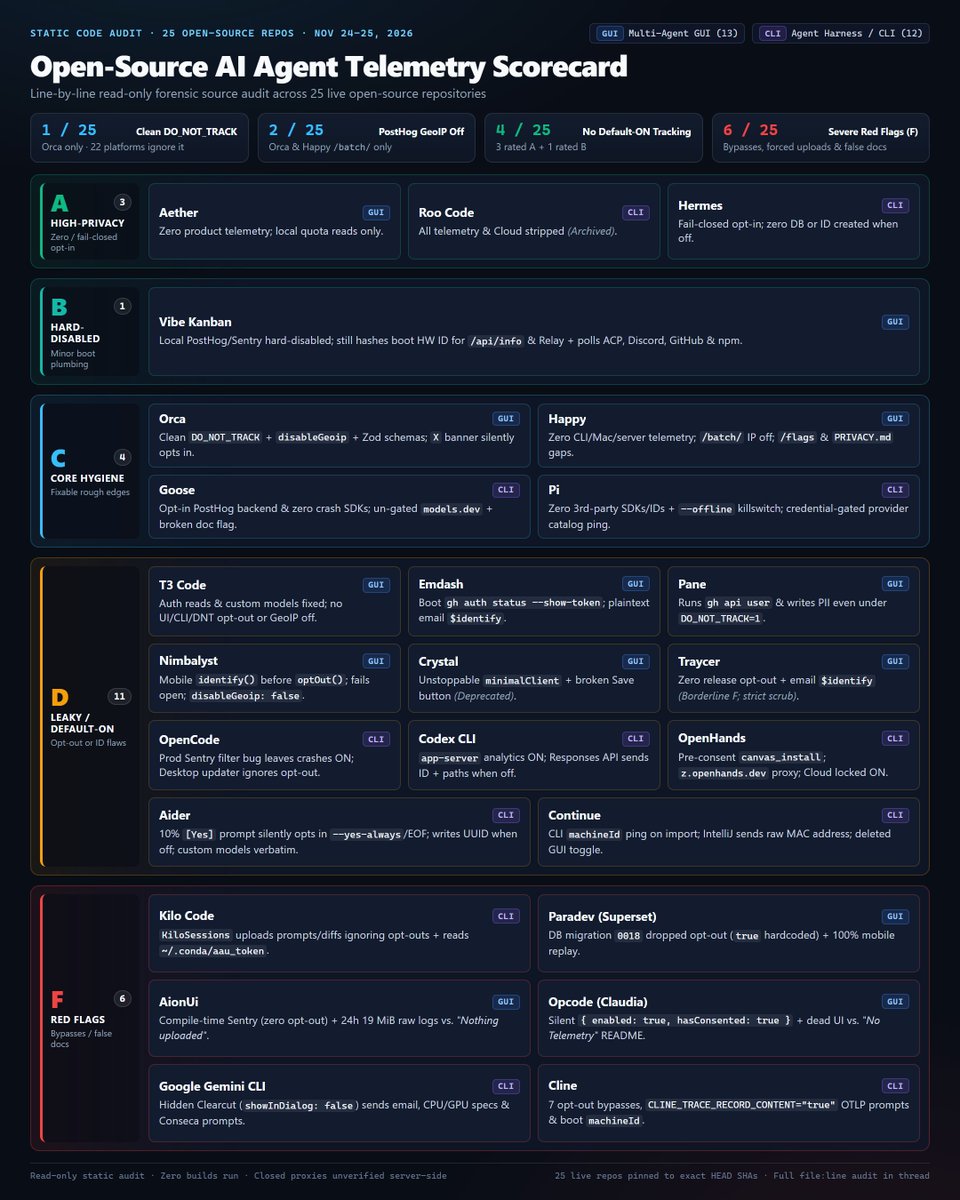
The @theo fiasco today forced me down a rabbit hole to see how bad privacy was for open source apps. It is not great.
I went through 25 open source AI coding GUIs and agent harnesses line by line for telemetry and privacy.
- Only 1/25 cleanly honors DO_NOT_TRAC
- Only 2/25 disable PostHog GeoIP
- 6 got F for opt out bypasses, forced uploads, or false "No Telemetry" claims.
Each tier broken down in replies. Full summaries on GitHub, link in repiles.
@DarioAmodei Your writing says AI must answer to legitimate democratic processes. Claude went to war in Iran, and reportedly Venezuela with no vote in Congress and under 50% public support. Your words don't match your actions.
I really like this idea, but in our testing it doesn't work as well as abliteration; your GLP files removed refusals as well as abliterated weights for us, at no speed cost, but the agentic work suffered; Cybench: 12/20 solved vs 15 stock, 16 abliterated, 37% more iterations. Small n. Do you see the same?
https://t.co/XwZsBilZva
@christopherowen Ran 1122 (c69-r2) vs 1120 on all 8 of my Sparks this morning: switched 200G RoCE, 4 KiB pages, base weights. Both versions on both pods of four, opposite order, plus TP8 and PP2×TP4 on all eight. C1–C32 ladder ×3 each.
Wrinkles vs 1120: none on speed.
• TP4 C1–C32 within 1% at every level except C2, where 1122 leads (+2.6% pod A, +1.7% pod B). C1 ~125 t/s per stream, C32 ~745–759 agg on both.
• Cold prefill 32K–524K, 1M needle (3/3) and a 75-task eval (71/75, same misses) unchanged.
• Your own ring manifests say the same (prose C1 84.9 → 84.2).
What got better:
• Warm boot 143 → 89 s (kernel prep 28 → 3 s). Better than the 34 s you claimed.
• Your intraturn_active_reasoning_loop case: 1120 gives 9/12 turns with empty reasoning on both pods. 1122 passes on every arm. Zero DSML leaks into prose on either version.
• tool_gate 20/20 strict at T=0 and T=1. Greedy 40/40 identical idle and under C16 load on TP4 and both PP shapes.
PP, honestly:
• PP2×TP2 on 4 nodes: 0.53× TP4 at C1, 0.70× at C32, prefill ~5.2K vs ~9.6K t/s. Your ring data agrees (0.48×).
• PP2×TP4 vs TP8 on 8: catches TP8 at C16–24 and passes it only at C32 (843 vs 786). +9.9% KV (31.3M vs 28.5M tokens). TP8 keeps C1 (184 vs 115) and prefill (~11.5K vs ~6.5K).
Rough edges on the upgrade:
First boot without the kernel warm index is slower than 1120 (256 vs 151 s), and the first PP2×TP2 boot took 424–516 s.
No published image, so you build it yourself. Old overlays need re-pointing to cluster.json + a shape name (a few lines).
TP8 leaves ~12–14 GiB free per node while serving.
Ideas, all backed by the receipts:
tool_choice_none_prose fails on TP4 on both versions. It's the 1536-token cap at effort=high (finish=length mid-reasoning); 8192 passes.
Bake the warm index into the image build so the boot win holds on first boot.
Add a "when to use PP" line to the docs.
PP2×TP4 leaves 43–48 GiB free per node, so its KV pool could likely grow a lot.
TP8 isn't batch-invariant under load: 34/40 greedy prompts fork late (e.g. "if necessary" vs "if needed"). TP4 and PP stayed 40/40.
What does "141 fewer kernels" count? We see 272 → 174 JIT compile keys (−98) and 341 → 330 TileLang calls.
Write-up: https://t.co/PNDBZ62wWG
Receipts and harness (python3 https://t.co/ssWuuCKHRU --check reproduces every number): https://t.co/2rCMbSfp1G
Thanks for shipping this. Great work! 🙏