Update: 21 Chicago Office Building Sales
401 S. State St. ↓94% $4.2M vs $68.1M in 2016
300 W. Adams St. ↓92% $4M vs $51M in 2012
Building split from land after 2012.
55 W. Monroe St. ↓90% $25M vs $243.25M in 2014
216 W. Jackson Blvd. ↓89% $2.5M vs $22M in 2013
100 N. Riverside Plaza ↓87% $22M vs $165M in 2005
Leasehold Interest
19 South LaSalle St. ↓86% $4.2M vs $29.9M in 2006
175 W. Jackson Blvd. ↓87% $41M vs $306M in 2018
311 S. Wacker Drive ↓85% $45M vs $302M in 2014
600 W. Chicago Ave. ↓83% $89M vs $510M in 2018
550 W. Washington Blvd. ↓83% $18.5M vs $111M in 2013
111 W. Jackson Blvd. ↓81% $25M vs $135M in 2013
70 W. Madison St. ↓77% $85M vs $377M in 2014
500 W. Monroe St. ↓76% $100M vs $412M in 2019
131 S. Dearborn St. ↓76% $137M vs $560M in 2006
250 S. Wacker Drive ↓74% $23.8M vs $90M in 2011
205 West Randolph St. ↓72% $8.0M vs $28.7M in 2016
180 North LaSalle St. ↓72% $56.5M vs $198.5 M in 2016
200 S. Wacker Drive ↓68% $68M vs $215M in 2013
161 N. Clark St. ↓62% $125M vs $331M in 2013
401 N. Michigan Ave. ↓53% $132.5M vs adjusted $281M in 2017
600 W. Fulton St. ↓44% $17.6M vs. $31.7M in 2006.
@julie_kelly2
#commercialrealestate
The Argentina team are emblematic of a world where lying, cheating and bullying your way to success has become the norm. Nice to see them go home in disgrace, with nothing.
🚨Michael Burry just said Elon Musk and Nvidia's deal is built on fake numbers.
Burry published a detailed breakdown calling the entire structure "Fugazi", his word for fake.
He is alleging that billions of dollars in Nvidia chips are being hidden off balance sheets, and that American retirees are unknowingly funding the whole thing.
Nvidia, the world's largest AI chip company sold $5.4 billion worth of its most advanced GPUs, the GB200, to a company called Valor.
Valor is not a real operating business. It is a special purpose vehicle, a shell company created specifically to hold these chips and nothing else. Nvidia also invested $1.9 billion of its own money directly into Valor on top of the sale.
Those 100,000+ chips are now physically inside xAI's data center. xAI is Elon Musk's artificial intelligence company, the one that builds Grok. xAI is using every single one of those chips right now to run its AI models.
But here is what Burry is flagging.
Neither Nvidia nor xAI owns those chips on paper. Valor, the shell company holds legal title. That means $5.4 billion in GPU assets do not show up on Nvidia's balance sheet as inventory.
They do not show up on xAI's balance sheet as assets. They are legally invisible to both companies.
Nvidia gets to book the $5.4 billion as a completed sale and record it as revenue. xAI gets full use of the chips without owning them. And the risk disappears into a shell company in the middle.
Now here is where American retirees enter the picture.
Valor needed $3.5 billion in debt to fund this structure. Apollo provided it. Apollo is one of the largest asset managers on earth with $1.03 trillion under management and $834 billion specifically in private credit.
Apollo raised the $3.5 billion, packaged it into debt securities, and sold those securities to Athene.
Athene is Apollo's own insurance company. It sells fixed and indexed annuities, retirement savings products, to ordinary Americans.
When a retiree buys an Athene annuity, they believe their money is sitting in safe, stable investments. That money is now inside a structure funding Elon Musk's AI data center.
The numbers inside Athene are most alarming.
Athene holds $74.2 billion in reserves. It has moved $217 billion in assets into a captive insurer based in Bermuda, meaning those assets sit outside normal US insurance regulation and oversight.
Of the entire portfolio, 34.7%, equal to $103 billion, is classified as Level 3 assets.
Level 3 is an accounting classification that means there is no observable market price for these assets. No outside party can independently verify what they are actually worth.
The leverage sitting on top of those unpriced assets is 16 times.
Burry's says:
Every step of this structure is technically legal and publicly disclosed. But the entire thing was deliberately engineered across 8 to 12 steps to move credit risk off balance sheets and away from any market pricing.
- Nvidia books the revenue.
- Apollo collects the fees.
- xAI gets the computing power.
- And retirees sitting at the bottom of a 16x leveraged Bermuda insurance structure, holding $103 billion in assets with no market price carry the risk without knowing it exists.
205 years ago today, Napoleon Bonaparte died on a tiny British prison island in the middle of the South Atlantic. He was 51. He had ruled most of Europe. And he changed the world so thoroughly that you are still living inside the systems he built.
Start with the obvious one. The Napoleonic Code. He commissioned it in 1800, sat in on the drafting sessions personally, argued with the lawyers, and pushed it through in four years. Equality before the law. Property rights. Religious freedom. The end of feudal privilege. It is still the basis of civil law in France, Belgium, the Netherlands, Italy, Spain, Portugal, most of Latin America, Quebec, Louisiana, and chunks of the Middle East and Africa. About a third of the planet writes contracts using rules a Corsican artillery officer wrote between battles.
He sold Louisiana to Thomas Jefferson in 1803 for 15 million dollars. Roughly four cents an acre. It doubled the size of the United States overnight. Without that deal there is no St. Louis, no New Orleans as an American city, no Lewis and Clark, no Manifest Destiny. The American century starts with Napoleon needing cash for a war.
He invaded Egypt in 1798 with an army and, weirdly, 167 scientists, mathematicians, and artists. They found the Rosetta Stone. That single slab is the reason we can read hieroglyphs at all. Egyptology as a field exists because Napoleon brought scholars to a war.
He built the Bank of France, which still runs French monetary policy. He created the lycée system that still educates French teenagers. He shoved the metric system across Europe at sword-point until it stuck. He emancipated the Jews of every territory he conquered, tearing down ghetto walls in Rome, Venice, Frankfurt. He abolished serfdom in Poland. He standardized road networks, civil registries, and tax codes that European governments still operate from.
And then there's the soldiering. He fought around 60 major battles and won most of them. Austerlitz, in 1805, against the combined Russian and Austrian empires, is still taught at West Point as one of the closest things to a tactically perfect battle ever fought. He was outnumbered, baited the enemy onto ground he had pre-selected, and broke them in a single afternoon. Three emperors took the field that morning. Only one walked off it on his own terms.
He slept four hours a night. He read constantly, dictated letters to four secretaries at the same time, and personally signed off on everything from cavalry boot specs to the seating chart at the Comédie-Française. Wellington, the man who finally beat him at Waterloo, was asked decades later who the greatest general in history was. He answered without hesitating. "In this age, in past ages, in any age, Napoleon."
He lost, in the end, because he could not stop. Russia in 1812 swallowed his army whole. Six hundred thousand men marched in. Maybe a tenth came back. He abdicated in 1814, escaped from Elba, ruled France again for 100 days, and lost it all for good in a wheat field in Belgium in June 1815.
The British shipped him to St. Helena, a volcanic dot 1,200 miles off the African coast, and waited. He spent six years there dictating his memoirs, gardening, complaining about the dampness, and quietly rewriting his own legend so effectively that Europe spent the next century arguing about him.
He died on May 5, 1821, during a storm so violent it ripped up the willow tree he liked to read under. His last words trailed off into fever. France. The army. Joséphine.
Nineteen years later France brought him home. Two million people stood in the snow to watch the coffin go by.
He was a tyrant. He was a reformer. He started wars that killed somewhere between three and six million people. He also wrote the rulebook that a third of humanity still lives under.
Most people who try to conquer the world are forgotten inside a generation. Napoleon has been dead for 205 years and we are still arguing about him because we are still using his furniture.
You cannot go anyhwere in the US anymore without feeling taking advantage of. Every restaurant, every lease agreement, every purchase. Everything is so blatantly predatory. Like they don't even care to be subtle about the fact that they're operating in bad faith.
And we're all just submissive to it
I believe that Iran is playing a game of chicken with the US in the oil market because that's Trump's real political cryptonite and true leverage they can exploit in the negotiations to end the war. ⚠️
The first time, Iran waited 48 hours before officially rejecting the US proposal. That sent $CL May price all the way up to almost ~116$ on by this Tuesday, while the various Tacos along the way were only effective to hold up stocks and hold down the June contract.
🚩As you can see in this chart I made, that was the exact point in time when oil futures started to factor in significant supply stress with the spread between CL1 and CL2 hitting ~16$ on Tuesday.
Here is where things become interesting. As you can see in the chart, the June 26 WTI futures contract (that becomes CL2 after the 18 of March) only briefly traded above ~100$ a few times since the 9th of March. On the other side, the May contract surpassed the ~110$ 9th of March high one month later on the 2nd of April. It is no coincidence, in my opinion, that during the Easter weekend, it was when President Trump lost his temper when he posted the famous "open the f-ing Strait". Why? Because he was surely informed that not too far above the oil futures market was about to break loose, since those who were short that contract were starting to get squeezed hard.
After a brief market relief from that post, the squeeze resumed till Monday, when, as reported by the FT, the US administration was pushing hard on Pakistan to open a direct negotiation channel with Iran.
🚩Here is when Iran seized the opportunity again, this time having more leverage in the negotiations, to the point that they got a public preliminary acceptance of their 10 conditions to end the war (the president even reposted FM Araqchi statement, the post is now deleted).
Those conditions would have never been accepted if the GCC or Israel were actively involved in the negotiations, but Trump was in a rush to announce a ceasefire to trigger an oil futures price crash and avoid a sudden spike that could have crashed stocks. Again, I do not think it is a coincidence that on Monday, several large $QQQ short positions were placed in the market with 13th of April expiry.
⚠️If I am right and Iran continues its game of chicken with the US, which has already figured out how they are in no position to accept all the conditions Iran asked, as early as tomorrow, Iran is going to announce they will pull out from the ceasefire talks in Pakistan. This is going to be a MASSIVE problem for the oil futures market, which at that point will be about one week away from the May to June contract rollover. Why? Because not only will the May 26 contracts resume running higher when shorts are in the process of rolling their positions into June, but traders will be forced to price in the supply tightness in the June contract that can potentially even start trading in contango if the conflict escalates further and its end is then projected later in the future.
Beware that so far I haven't factored in additional supply disruptions caused by more strikes on oil infrastructure in the Middle East and potentially the closure of the Bab-El-Mandeb strait. These additional elements can spark the perfect storm on the June 26 contract, with prices likely surpassing the recent ~120$ high by a big margin till the point the pain will be significant for Trump again (maybe because stocks will be crashing at that point causing a big political problem for him too) and he will be willing to accept Iran's conditions and pull out of the region.
Feel free to bookmark this post
Citadel CEO Ken Griffin on why the AI boom might be the most overhyped tech cycle we have ever seen:
This year alone, data center spending in the United States is projected to exceed $500 billion.
And Griffin wants to know what all of that money is actually buying.
"You're not going to generate this kind of spend unless you're going to make a promise. You're going to profoundly change the world."
In his view, the scale of the capital commitment demands the scale of the promise.
And when the promise has to be that big, hype becomes inevitable.
"Is it hype? Of course."
Griffin isn't arguing that AI is worthless. He sees real impact in certain areas like call centers and software engineering.
But for the broader white collar workforce, he's far less convinced.
He points to a recent Harvard paper that coined the term "AI work slop." It looks impressive on the surface, but falls apart the moment you look closer.
He saw it firsthand inside Citadel. A colleague running their commodities business handed him a report generated by an AI engine.
"The first few sentences like, 'Wow, that's really insightful.' And then you go down below that and it's all garbage."
For Griffin, this is the defining tension of the current AI cycle. The industry needs to promise transformation to justify the investment. But the actual productivity gains, for most jobs, haven't shown up yet.
We have seen this pattern before.
Transformative technology attracting massive capital well ahead of proven results.
When the hype finally settles, will AI have actually changed anything at all?
GOODBYE, FUND MANAGERS. GOODBYE, BLOOMBERG TERMINAL.
The $24,000/year in subscriptions is over.
Claude has just turned my laptop into a private quantitative analyst.
Here are 10 prompts to build your own hedge fund at home ↓
The Tokyo Stock Exchange told 1,800 companies to stop being cheap or get publicly shamed.
KFC franchises at 2.5x EV/EBITDA. Egg producers with net cash. Chemical manufacturers at 0.6x book paying growing dividends.
In the US, <5% of S&P 500 companies trade below book.
In Japan, it was nearly half the market.
The exchange itself is now the activist.
And it’s not going away.
699 companies were trading below 0.5x book when it launched.
The largest wave of buybacks in Japanese corporate history followed.
This is the biggest structural catalyst in global equity markets right now, and almost nobody in the West is talking about it.
50 Foods Every Human Must Eat Before They Die:
1. Fresh pasta in a tiny Roman kitchen, Italy
2. Sushi at Tsukiji market, Tokyo
3. Croissant straight from a Parisian bakery at dawn
4. Pad Thai from a street cart in Bangkok
5. Neapolitan pizza in Naples, Italy
6. Peking Duck in Beijing, China
7. Butter chicken in Old Delhi, India
8. Paella on a beach in Valencia, Spain
9. Tagine slow-cooked in Marrakech, Morocco
10. Fresh ceviche in Lima, Peru
11. Pho in a tiny Hanoi shop at breakfast
12. Jerk chicken straight off the grill in Jamaica
13. Injera with doro wat in Addis Ababa, Ethiopia
14. Baklava warm from an Istanbul bakery
15. Rendang in Padang, West Sumatra
16. Bobotie in Cape Town, South Africa
17. Som Tam papaya salad in Chiang Mai
18. Fresh hummus in Amman, Jordan
19. Lobster roll on the Maine coastline, USA
20. Tacos al pastor from a Mexico City street
21. Feijoada on a Sunday in Rio de Janeiro
22. Grilled whole fish on the Amalfi Coast
23. Borscht in a Ukrainian grandmother's kitchen
24. Ramen in a Sapporo winter, Japan
25. Churros with hot chocolate in Madrid at midnight
26. Biryani slow-cooked in Hyderabad, India
27. Doubles on a Port of Spain street, Trinidad
28. Khachapuri fresh from the oven in Tbilisi, Georgia
29. Smoked salmon on black bread in Copenhagen
30. Mole negro in Oaxaca, Mexico
31. Churrasco straight off the fire in Buenos Aires
32. Laksa in a Penang coffee shop, Malaysia
33. Clam chowder in a sourdough bowl, San Francisco
34. Moules frites in a Brussels brasserie, Belgium
35. Fresh oysters on the Brittany coast, France
36. Braai with locals around a fire, South Africa
37. Ackee and saltfish for breakfast in Kingston, Jamaica
38. Hot pot on a cold night in Chengdu, China
39. Mansaf at a Jordanian family table
40. Wiener Schnitzel in a Vienna tavern, Austria
41. Bún bò Huế in central Vietnam
42. Kushari from a Cairo street cart, Egypt
43. Lamb shoulder slow-roasted in Athens, Greece
44. Gözleme from a roadside stall in rural Turkey
45. Soba noodles hand-pulled in Kyoto
46. Jollof rice cooked over wood fire in Lagos
47. Arepa stuffed fresh in Bogotá, Colombia
48. Samovar tea with sweets in Tehran, Iran
49. Lamington at a bakery in Melbourne, Australia
50. Honey cake with clotted cream in Cornwall, England
What's already been crossed off your list???
Bloomberg: "the energy industry is warning that the crisis is only beginning. In conversations with more than three dozen oil and gas traders, executives, brokers, shippers and advisers over the last week, one message was repeated over and over: The world still hasn’t grasped the severity of the situation.
...If the strait stays closed, the world will have to significantly reduce its oil and gas consumption — but not before prices spike to a level that forces consumers and businesses to fly, drive and spend much less."
https://t.co/q2ZBEfhhAf
@Matt_Pinner Mel Gibson. Played blackjack at Wynn in Las Vegas. Sat right next to him for 3 hours. He was there for UFC. His girlfriend was pregnant upstairs. Bet $25 a hand and always took insurance. Walked away with $5k. Told me slow and steady is way to go. Very nice guy.
🚨 PDS Tornado Warning: A large, dangerous tornado is now heading toward Sumava Resorts, Illinois. This is a serious situation, and residents in its path should take shelter immediately.
Footage from Christian Tello shows the damage this storm has already caused, highlighting how powerful and destructive it is.
#ilwx #Illinois #tornado
https://t.co/4CxSz0KF97
Gamma is losing its grip:
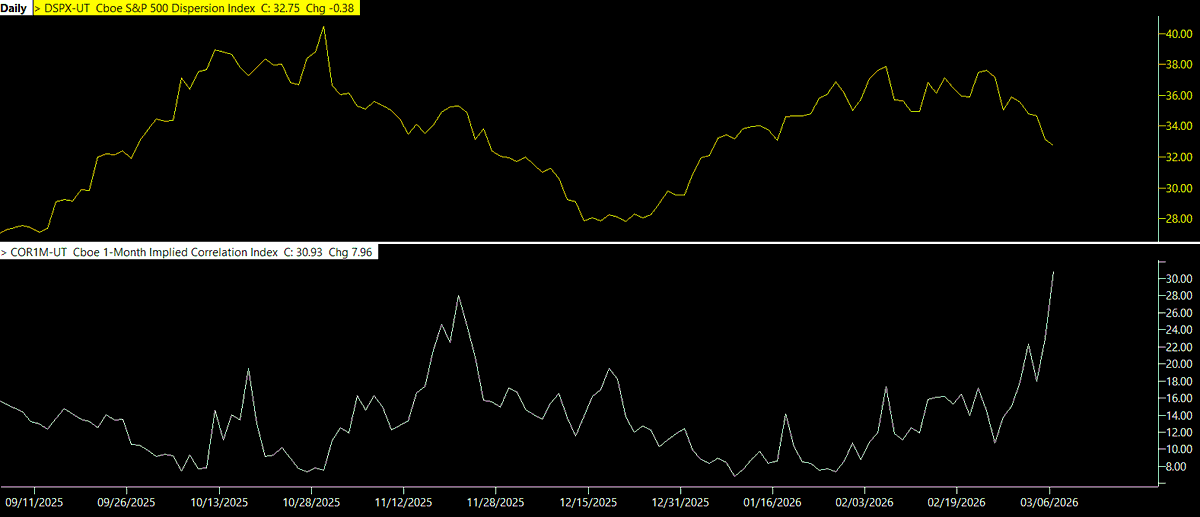
Implied dispersion (DSPX) is falling while implied correlation (COR1M) is rising. That combination is a critical warning signal for the stability of the "gamma grip" regime that has pinned the S&P 500 for months.
When DSPX falls, the options market is signaling that individual stocks are expected to move less independently. Their idiosyncratic variance is compressing. At the same time, rising COR1M means the market expects the components of the index to move more in unison. The stabilizing effects of dealer call‑vanna and gamma hedging are weakening. The “calm index / moving constituents” dynamic that had previously allowed dispersion hedges and single‑name volatility trades to absorb shocks is disappearing. Without that diversification across components, the S&P becomes one large monolithic trade rather than a basket of offsetting moves.
As dispersion collapses and correlation rises, dealers lose the ability to hedge vanna exposure through single‑stock vs. index dispersion trades. Under high dispersion, dealers could be long single‑name volatility and short index volatility, allowing idiosyncratic moves to cushion shocks in the index. But when DSPX contracts, the relative movement in single names dries up, meaning their hedges now concentrate risk instead of diversifying it. The index becomes far more sensitive to systemic flows, and the effectiveness of the “buy dips, sell rips” gamma grip shrinks. Dealer hedging shifts from being spread across many constituents to being overwhelmingly concentrated in index delta, magnifying the impact of small S&P moves.
Instead of dampening intraday volatility, gamma hedging becomes more fragile and more easily overwhelmed by headline shocks and flows. When the index moves, everything moves with it. The hedges that once suppressed movement now move into pro‑cyclical behavior: dealers are forced to chase deltas in the same direction as the move. On selloffs, vanna goes negative and dealers must sell into falling markets, accelerating the decline. The system behaves like a feedback loop.
The surge in VIX/VIXEQ toward the top of its multi‑year range shows that index‑level implied volatility (VIX) is now rising noticeably faster than S&P500 constituent‑level volatility (VIXEQ). That shift tells us the market is assigning more risk to the basket than to the underlying stocks, which is exactly what happens when dispersion collapses and correlations tighten. As this ratio rises, the idiosyncratic cushion dealers previously used to hedge vanna exposure erodes, and hedging becomes increasingly index‑centric. The result is an S&P 500 that behaves like a single correlated instrument: small moves require larger SPX‑delta adjustments, stabilizing gamma flows weaken, and the entire “buy‑dips, sell‑rips” mechanism loses traction. In this state, index vol leads, single‑name vol lags, and the loss of cross‑sectional noise leaves the system vulnerable to nonlinear amplification.
The rise in VIX/VOLI delivers the same message from a different angle: stress is migrating from the ETF hedging layer into the index‑vol complex. VOLI reflects SPY options like 0DTE, weeklies, and other short‑tenor contracts that normally provide cheap, precise intraday gamma. When SPX volatility (VIX) starts outpacing SPY volatility (VOLI), it signals that ETF‑based micro‑hedging is no longer absorbing shocks as effectively and that hedging pressure is shifting into the broader, less elastic SPX book. As this ratio climbs, SPX options begin to carry more of the hedging load, implying that 0DTE/ETF gamma is no longer enough to keep the index in line. The stabilizing local gamma supplied by ETFs wanes, and SPX hedges begin to dominate price formation. That shift makes the tape more sensitive to directional flows and reduces the system’s ability to contain volatility, especially when combined with falling dispersion and rising correlation.
The sharp rise in COR1M/COR3M signals that near‑term implied correlation is breaking higher much faster than medium‑term correlation, a sign that the market expects an imminent correlation snap rather than a slow‑building one.
This all aligns with the correlation‑event setup I described Feb 15. Then, the market exhibited fractured and contradictory internals: HLLI flagged simultaneous new highs and new lows, dispersion reflected extreme disagreement beneath a calm index, and LPPL pointed to late‑cycle extreme moves across sectors. All three measures indicated a market stretched across opposing pressures that almost always resolve through a sharp re‑correlation event. This resolution appears to be underway.
Taken together, the drop in DSPX, the surge in near‑term correlation (COR1M), the widening gap between COR1M and COR3M, and the pressure visible in VIX/VIXEQ and VIX/VOLI all point to a market structure that is on the verge of a correlation snap. The system is now vulnerable to a sudden, non‑linear release of the instability that has been quietly building under the pinned surface for months.
Everyone talks about Iranian oil in barrels. Nobody talks about what is inside them. That difference is why Western refineries have been running shadow networks through Dubai for twenty years to get it despite the sanctions.
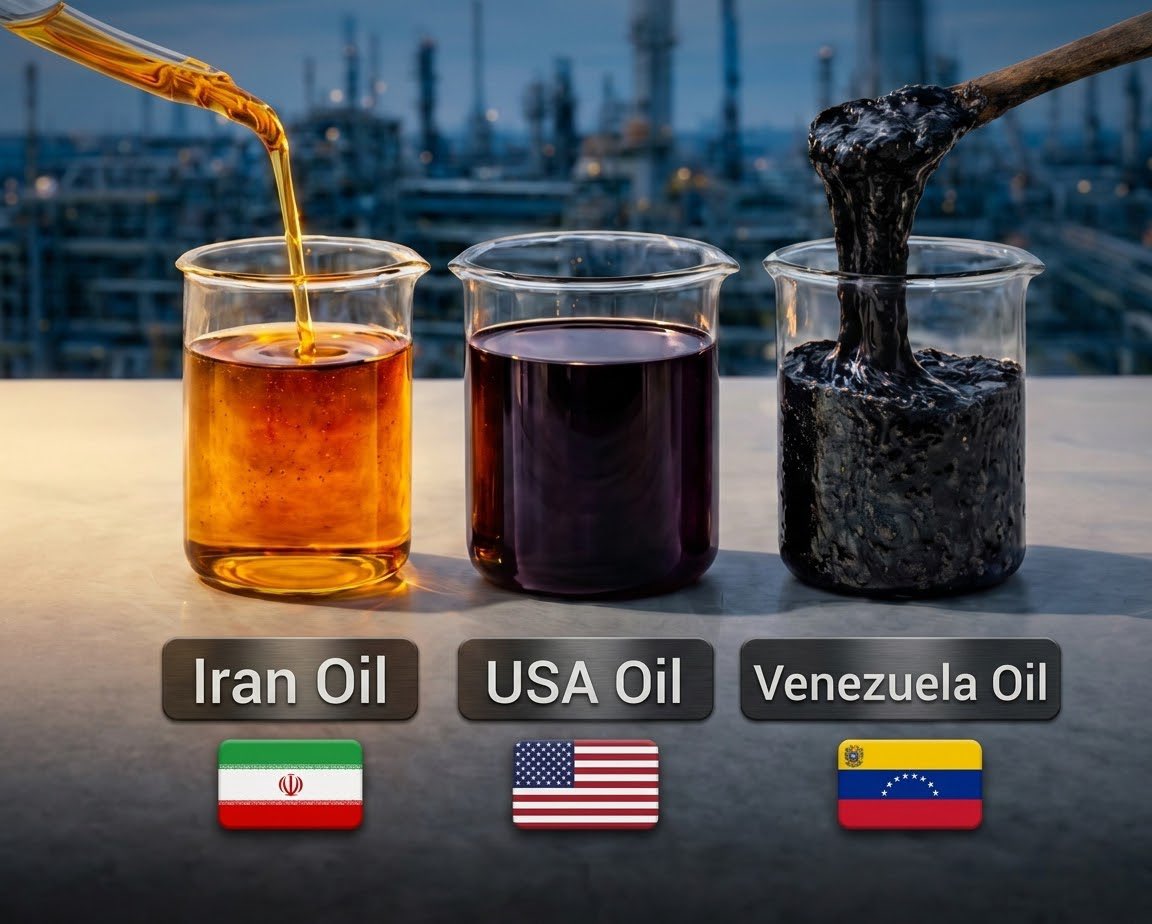
Crude oil is not a uniform commodity. It is a spectrum of hydrocarbons with different molecular weights, and the composition of a given crude determines how easily it converts into the products refineries actually want to sell: gasoline, diesel, jet fuel, heating oil. The measurement that captures this is API gravity. Higher API gravity means lighter crude with shorter carbon chains, which means lower energy cost to crack, lower processing cost to refine, and higher yield of the light distillates that carry premium pricing. Lower API gravity means heavier crude requiring more energy, more processing steps, more capital equipment, and producing a higher share of lower-value residuals.
Iranian Light crude runs at 33 to 36 degrees API gravity with sulfur content between 1.36 and 1.5 percent. That is the refinery sweet spot. It is light enough to yield high fractions of gasoline and middle distillates without excessive processing costs, but heavy enough to produce the full range of products that complex refineries are designed to process. It is what petroleum engineers call an optimal blend crude.
Now compare the alternatives.
Venezuelan Merey heavy crude runs at approximately 16 degrees API gravity with sulfur between 3 and 5 percent. Refining it profitably requires a coking unit, a hydrocracker, and an extensive desulfurization train. The equipment exists. The economics work for refineries purpose-built around Venezuelan feedstock. It is not a substitute for Iranian crude. It is a different product requiring different industrial infrastructure.
US West Texas Intermediate runs at 39 to 40 degrees API with sulfur below 0.25 percent. In theory, the cleanest and easiest crude to process. In practice, it is so light that it does not yield the heavier middle distillates a complex refinery needs to run at full capacity. European and Asian refineries built around medium crudes cannot switch to WTI without blending it with heavier crudes to achieve the molecular weight distribution their process units require. WTI is not a drop-in replacement for Iranian medium.
Iranian oil fits where both US shale and Venezuelan heavy do not. It is the liquid that flows through the middle of the global refining system without requiring either the coking infrastructure for heavy crudes or the blending operations for ultra-light shale. That molecular fit is why it commands a persistent premium above comparable grades. It is why Indian refineries maintained Iranian crude purchases through every round of sanctions and negotiated the logistics to keep that flow moving. It is why the Dubai shadow banking and trading network that the UAE is now considering dismantling existed in the first place.
The Strait of Hormuz does not just carry oil. It carries the specific category of oil that the global refining system was built to process most efficiently. Closing it does not just reduce supply. It removes the grade of crude that the system runs best on and forces every refinery in the world to run less efficiently on whatever it can find as a substitute.
That is the premium embedded in the $82 oil price. Not just volume. Molecular weight.
https://t.co/ULBgEzZ3A8