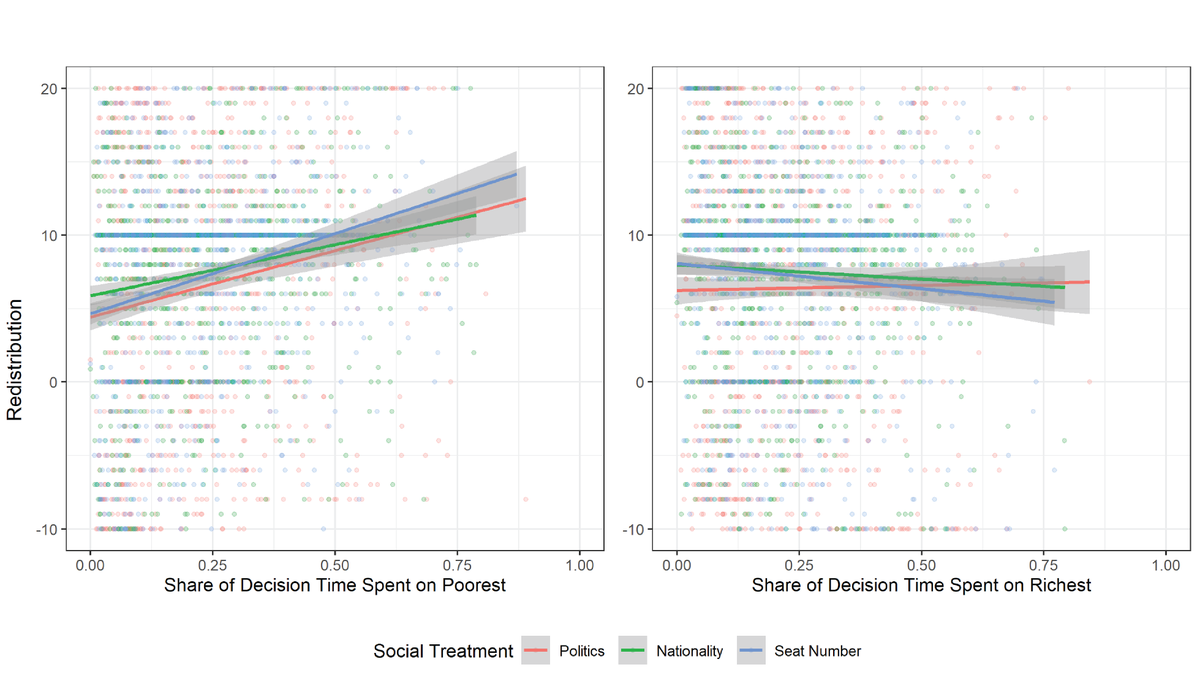
Using eye-tracking, we find that i) attention to group information predicts discrimination, and ii) attention to the poorest group member, but not richest, predicts redistribution, which is in line with a compassion-based redistribution motive or maximin preferences. (6/6)
Very happy to have our paper “Identity breeds inequality: Evidence from a laboratory experiment on redistribution” forthcoming at Journal of Public Economics - by Fischbacher, Grammling, Hausfeld, @vojtech_zika
https://t.co/knjw8c8N85
thread below (1/6)
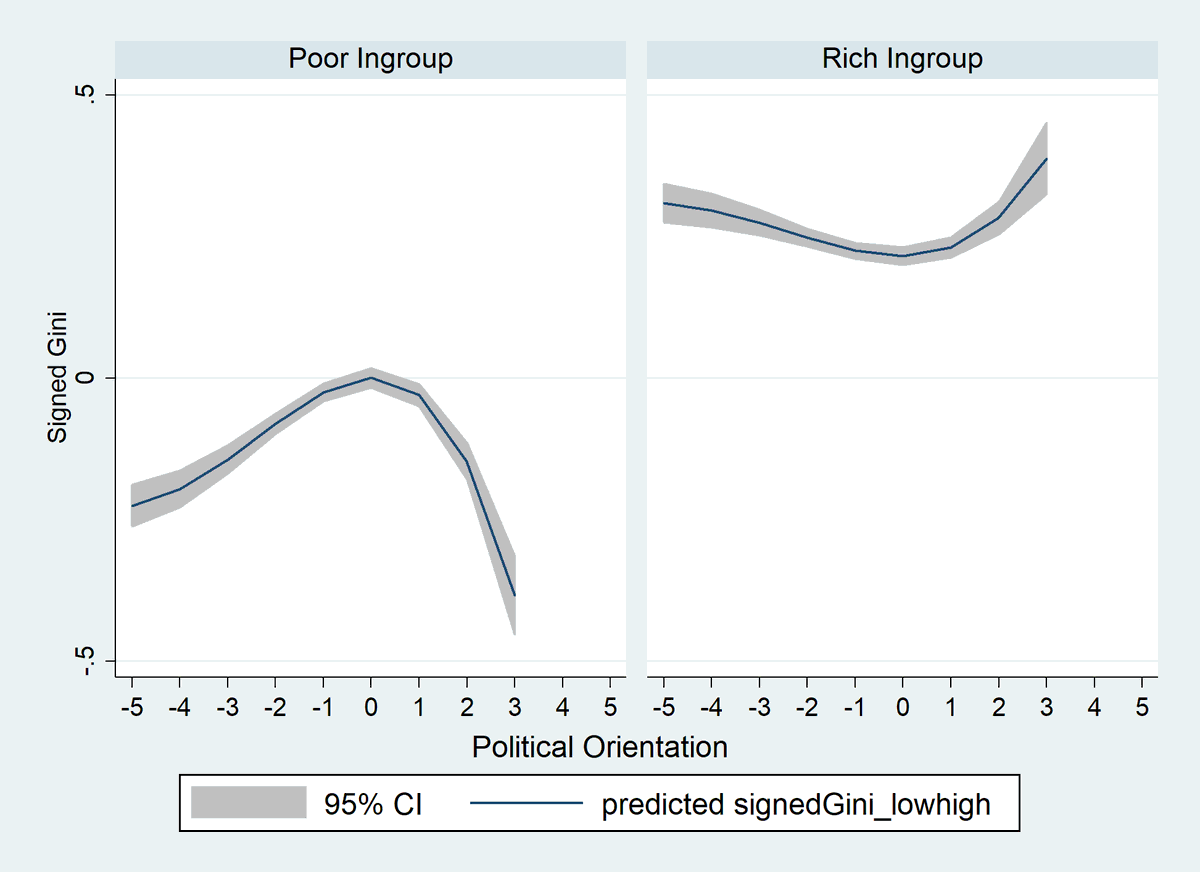
We also explore to what degree political orientation predicts favoritism. We find that the extremes, either left or right, show stronger ingroup favoritism. (5/6)
Seeing a person’s gaze (or choice) enables identifying selfish and prosocial people, but only in the absence of strategic motives.
With incentives, selfish people change their gaze to simulate a “more prosocial gaze”, while prosocial people try to appear even more prosocial.
New paper out with @brenerte & Urs Fischbacher.
Can people identify the nicer person just by seeing their gaze (or choice)?
Are decision-makers able to adapt their gaze to be seen as nicer?
Read it here: https://t.co/yDXEKrYwFt
Also, thx to @KrajbichLab & @SocialNeuroBern