I have been awarded an @ERC_Research Starting Grant! I will look into willingness and ability to perform in competitive environments, to work under time pressure, to speak in public and to multitask. Can these traits help us understand career decisions and labor market outcomes?
"Fairness and willingness to compete" - new publication by Alexander W. Cappelen and Bertil Tungodden (both @NHHEcon, @NHHnor & @TheChoiceLab) and @ThomasBuser in Experimental Economics: https://t.co/L1XMoSIyoE
🚨 REPLICATION REPORT UPDATE: One year ago, a tweet by @JohnHolbein1 alerted me, @OlleFolke, and Joop Adema (@Jopieboy) to a paper with a shocking result about Sweden’s law criminalizing the purchase of sex.🧵
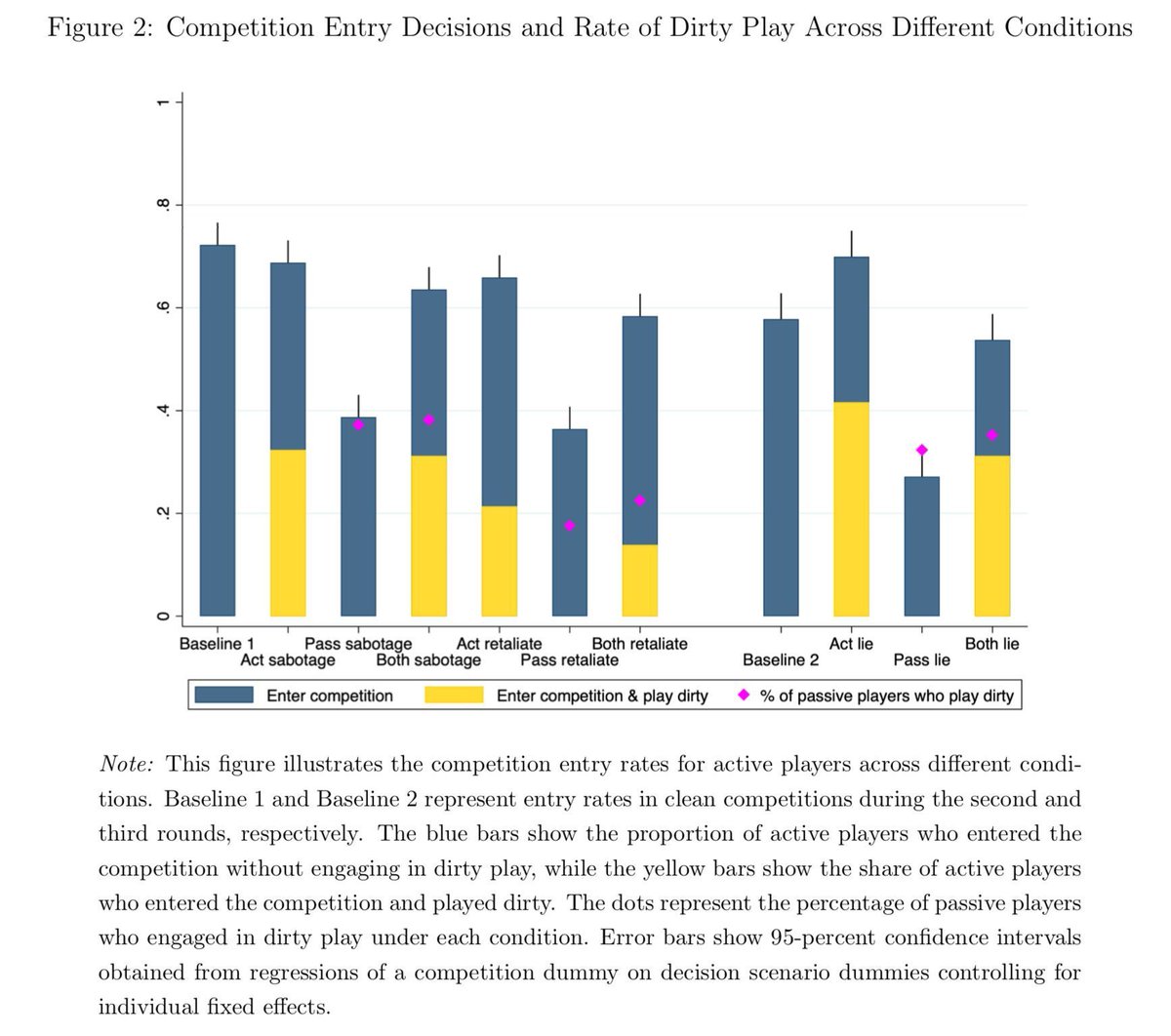
Research by @thomasbuser & Sangi suggests a sizeable minority of people (30-40%)—more likely male, younger, or lower-educated individuals) is willing to engage in ‘dirty competition’ (sabotaging opponents, lying about their performance etc):
https://t.co/CcThlpZuHY
Which occupations carry the highest risk of sexual harassment—and who is doing the harassing?
Our new study finds two distinct patterns depending on whether harassment comes from inside or outside the workplace. Paper link in comments and results summarized below.
🧵 1/
🚨Thrilled that our🆕paper
“Age and Cognitive Skills: Use It or Lose It”
just came out in @ScienceAdvances
💡Longitudinal evidence: age pattern of literacy+numeracy not as bleak as cross-section suggests + strongly differs by skill usage
https://t.co/uMsWPX1FiV
🧵A thread
1/7
📢Call for papers:📢
@CESifoNetwork Area Conference on Economics of Education
(co-organized with @EricHanushek)
5-6 Sept 2025, Munich
Keynote: @raffasadun
👉https://t.co/bXNGMGLMGy
Submission deadline: 18 May 2025
Past programs: https://t.co/JQ2j4JcoWk
📄 New study in JEEA! Norway’s 1936 Folk School Reform boosted education, income & Labour Party support.
✨ Kjell G. Salvanes, Daron Acemoglu, Tuomas Pekkarinen & Matti Sarvimäki show how education shapes mobility & politics.
🔗 https://t.co/DmwlPDm0mR
University peers shape personality development with lasting effects on conscientiousness and competitiveness. Just Accepted new paper by Xiaoyue Shan (@_XiaoyueShan_) and Ulf Zölitz (@uZoelitz) https://t.co/z49lKu9aqN
Our "Discrimination in the Formation of Academic Networks: A Field Experiment on #EconTwitter" with @PedroSant_Anna and @bruno_ferman is now forthcoming in the
😀😀
American Economic Review Insights (@AEAjournals)
😀😀
https://t.co/cgRieG9wiv
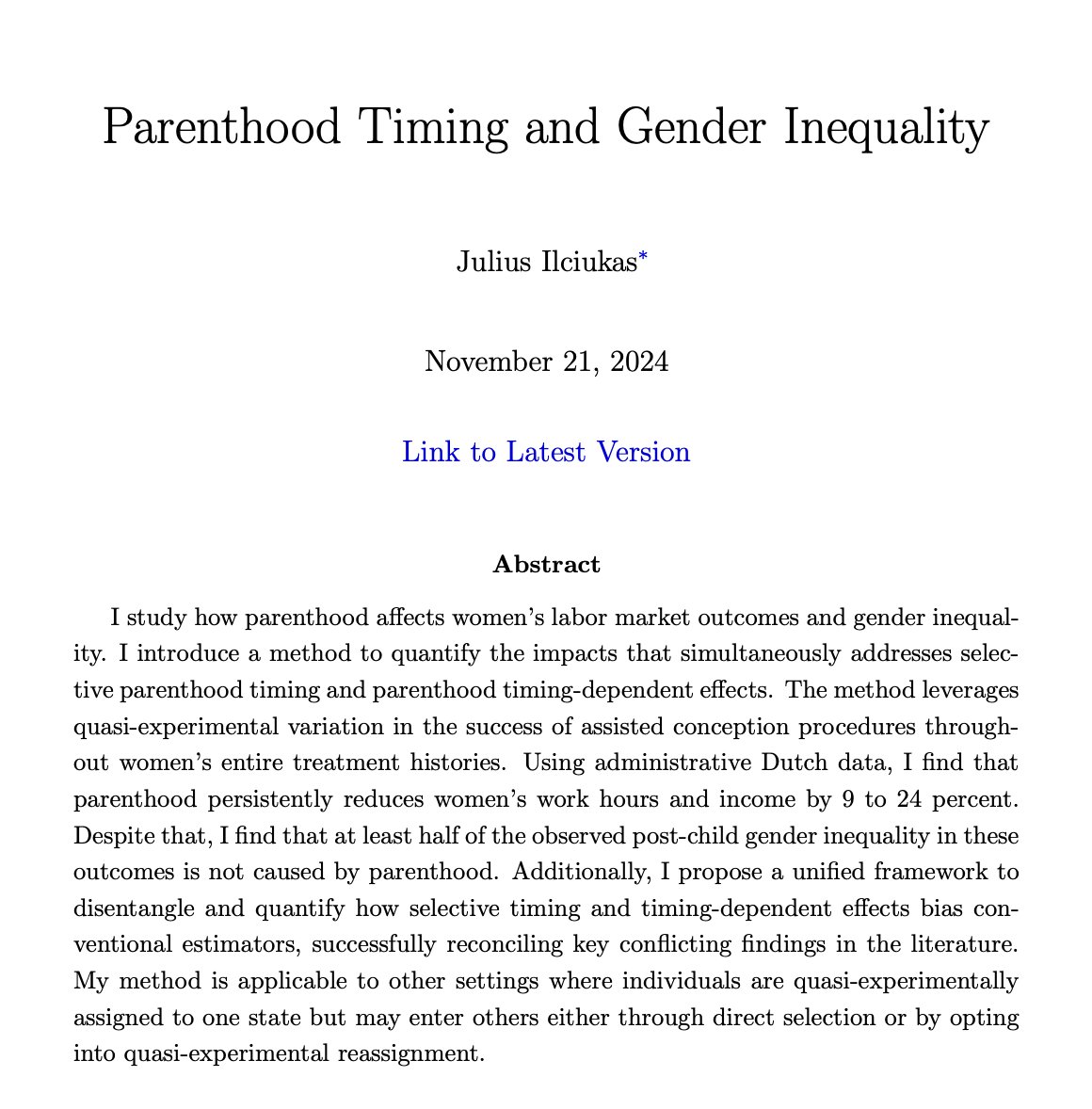
Most gender inequality in the labor market emerges at parenthood. But does parenthood cause it? My JMP introduces a new method to answer this question. I find that at least half of the observed gender gaps in work hours and income would emerge even without children. 🧵
@Lina_loz studies labor market disparities using lab and online experiments. Lina's JMP shows how gender differences in workers' attribution of credit for their team's success/failure contribute to hiring disparities, particularly when gender is unknown. https://t.co/J8CtQVYXxl
🚨💃🏻 PLEASE SHARE💃🏻🚨
Im on the JM 2 move closer 2 family in Lyon- all jobs with direct flight / train to Lyon are interesting. I’m currently working on 3 funded promising projects on AI 🤖
My JMP is under review at QJE has been covered by the Economist etc
more info->
Paper out: Teenagers have improved well-being, conscientiousness, and emotional stability if their mothers had longer paid parental leave, which likely delayed children’s entry into formal care. With @MikkelHoumark @idalykkekr @ceciliemarieloechte 🧵1/6 https://t.co/zoiPnkaFwR
cool study by E Plug @TheChoiceLab questioning the idea that child penalties explain the labor market gender gap by using IVF success as an IV- cool & important work If I hear one more time that we don’t have to study gender gaps cause it’s all children I’m gonna show this! 🥳🤝
🚨Job Market Paper Alert 🚨
A significant part of inequality stems from market forces beyond individual control - what we call *market luck*.
In meritocratic societies, this raises a key question: Do people perceive these inequalities as fair?
Read on to learn more. 👇
[1/14]
🤔How does being around more girls in primary school affect later careers and wages?
Women earn more after going to school with more girls. And, they choose less gender stereotypical jobs
“Early Socialization and the Gender Wage Gap” https://t.co/TaN9Zn7TKQ
w Demid Getik
I've been incredibly lucky to have met inspiring role models throughout my career.
Now, I am excited to share our working paper exploring the impact of role models, co-authored with @pietrobiroli, @ami_digi, and @giu_sorrenti.
Check it out below!









![yusof_jeff's tweet photo. 🚨Job Market Paper Alert 🚨
A significant part of inequality stems from market forces beyond individual control - what we call *market luck*.
In meritocratic societies, this raises a key question: Do people perceive these inequalities as fair?
Read on to learn more. 👇
[1/14] https://t.co/JemrCYyQM2](https://pbs.twimg.com/media/Gb1_hb7WgAA5m8H.png)


